Controversy time: I don’t like ESG investing

ESG (Environment, Social, Governance) is a scoring system some folks have come up with to score which stocks you can “ethically” invest in vs those you shouldn’t. The problem I have is that it seems like a bunch of woo.

The idea is that companies shouldn’t just try to make the most money, they should also protect the environment, advance social justice, and govern themselves responsibly. Yet I’m reminded again of how FTX (you know, the folks who stole investor’s money) got really high scores on ESG despite being a complete criminal enterprise. Other dicey factors seem totally ignored in ESG rankings as well, TotalEnergies SE ($TTE) is a French company directly funding the Russian Genocide of Ukrainians by continuing to ship LNG out of Russia and yet it’s considered a “leader” in the Social category. An otherwise identical company like Exxon-Mobile ($XOM) is considered just “average” in the Social category despite no longer operating in Russia since the war began, so it seems like a little genocide between friends doesn’t affect TotalEnergies’ ESG scores all that much. One wonders just what does affect ESG in that case.

This may seem unfair, after all TotalEnergies is just trying to make money, right? And their LNG is in heavy demand by customers, right? Yet that is exactly what ESG scores are supposed to act against, the tyranny of capitalism to externalize all costs onto the rest of society. Tesla for instance is merely a 9/10 in the Environmental category because despite moving the largest number of cars in history off of fossil fuels, their cars use lithium and the mining of lithium hurts the environment. This is a cost that Tesla externalizes to the rest of us, yet it’s a necessary cost to run their business so they get an ESG ding. But it seems ESG scores are applied randomly and say more about the scorer’s personal biases than anything to do with the companies themselves.

So here’s my advice: forget ESG entirely. If you want to invest ethically, then look at the companies you’re investing in and weigh the costs and benefits yourself. Does Apple adding new privacy features make up for the horrific conditions at the Foxxcon factories? Then go ahead and invest. But that’s a very personal ethics question that no one else can answer for you. If you instead export that question to some ESG-ified ETF, then you’re just letting someone else’s biases run your investment account. And those people might not know the first damn thing about Environmentalism, Social Justice, or Corporate Governance.

Always double guessing my stock choices

I don’t know if other folks do this, but every time I buy a stock I stop to double guess myself. If I see a stock that looks FANTASTIC, good P/E, good dividend, good growth, it may seem like a perfect buy. But I always stop and ask myself “if it’s such a great buy, why isn’t everyone else buying it, why hasn’t the price been pushed up?” Usually this leads me to double checking and realizing the reasons which I had not previously noticed. For instance, it was pointed out to me that Big Box retail stores are very highly valued right now, Walmart is selling at a higher P/E than Microsoft and Apple just for example. It seems that in the current economy, people are looking for the security of retails rather than the growth of Tech. But there’s no way Walmart is worth about 50 P/E, so it doesn’t make sense to buy it at this price point. Macy’s however ($M) is selling at just around 8 P/E. It’s a big box retailer with steady cash flow, doesn’t it look like a perfect buy? But why is it selling so low and Walmart is selling so high? I looked and Macy’s forward P/E isn’t so good, it’s expected to be around 10 or 12. So it looks like right now Macy’s is expected to be a shrinking company, and that’s why it’s being sold on discount. So now I have a better idea of exactly what bet I’m making, do I expect Macy’s P/E to go down that much or might they buck the trend and remain stable or grow? That will tell me whether I actually want to buy their stock or not.

In a market as efficient as the stock market, there are rarely any free 20$ bills on the sidewalk, you always have to wonder “if this move makes sense then why isn’t everyone doing it?” and that will make you realize the downsides of the bet you’re making.

Short post, just want to vent

I encourage anyone to read this tweet thread as it sums up perfectly my anger with how the FTX scandal is being covered. This is a news story about a crypto exchange doing what all crypto exchanges do, steal clients money to fuel their vices. And yet the framing in most stories you find will not be about how SBF stole client’s money, but about a “lack of controls” and “failures of governance” which are corporate-ese ways of downplaying SBF’s crimes and making him seem like just a CEO who couldn’t quite handle it. This cannot possibly be by accident, most journalists understand framing and most journalists on twitter are laser-focused on complaining about other people framing things in ways they don’t like. So why is the framing surrounding the FTX saga downplaying SBF’s crimes and normalizing his actions? Why are so many stories trying to focus attention on SBF allegedly raising new funds, instead of on the fact that he stole funds in the first place? Why is his opinions and personal life being written about with more detail than the lives he destroyed through theft? Go find some of SBF’s villains, it shouldn’t be hard. Write about them struggling to pay the bills because they lost it all in his exchange. Hopefully find some who have finally learned that all crypto is a scam, and write about how they had to lose their house in order to learn that lesson. Most of the journalists currently humanizing SBF and ignoring his victims would have screamed bloody murder if the same had been done to Bernie Madoff, so why the fuck are they doing it now.

You cannot time the market

When you look at the stock market, it’s very human to want to “time” it, that you can buy a stock at it’s lowest point, sell it at its peak, and make oodles of cash. When Apple first IPO’d, it was selling for about 14 cents (when stock splits are taken into account) and it reached an all time high at closing of 180.96$ just within the last year. If you’d bought 1000$ of Apple stock at IPO, and sold them in January, you’d be a millionaire. Even if you weren’t born in 1992, if you’d bought 1000$ of Apple stock in January of 2019, you could have caught it at a price of 37$, giving you a nearly 500% return if you’d sold it in January 2022. This isn’t even taking into account the dividends paid by Apple, which would have increased your return even more especially if you’d reinvested them back into Apple!

But timing the market is impossible, or at least that’s what mainstream economists usually think. It goes back to what I’ve said about The Efficient Market Hypothesis, the stock market is believed to approximate a random walk, therefore it is impossible to know exactly when the bottom is, for the market or for any stock. Therefore the hypothesis says it’s impossible to buy at the bottom and sell at the top except by dumb luck. Even if the hypothesis is wrong (Warren Buffett doesn’t believe it), it is still likely to be functionally impossible to time the market because no one can bring together all the knowledge of the entire economy to accurately declare “yes, this is the bottom”

As a silly example, I follow a lot of stock twits on various social media forums, and the consensus in mid-October was that inflation was still roaring and we had a long way to fall. Since then the S&P 500 has gone up around 15%. Will it pull back down? Maybe, but maybe not. Either way, sitting on the sidelines and losing the opportunity to make a 15% free return a month in a half was probably a dumb move. If people could really, reliably time the market, then investing in mid-October to get a free return through late November would have definitely been the play. And if we’re due for a pullback then you could sell now and keep your winnings. Yet I heard not a peep of this kind of advice through mid-October, so I don’t think any of those stock twits could time the market.

Even more silly of an example is looking back at the recent market crash of 2008. The market bottomed completely in march 2009 and rose from there, but it didn’t stop takemongers from claiming that we were due for an even worse crash any day now.

I know my examples are just anecdotes, but basically I haven’t seen any single person who could reliably time the market over any timecourse whatsoever. Timing the market isn’t value investing it isn’t finding good companies at good prices, it would be going all-cash at the top and going all-in at the bottom, and doing this multiple times a year in order to maximize your returns on each up- and down-swing. You occasionally see hedge funds or take-mongers say they’ve gone all cash, but they then usually miss the bottom of the market by a lot and quietly re-enter it after the big gains have already happened, without ever admitting they were wrong.

In these cases, the old adage is probably the most correct: time in the market beats timing the market.

Yes it’s OK that J Powell killed your puts

I’ve been trawling through old internet posts, and I found something interesting from March 2020. I won’t quote it directly but the gist was this:

I knew the market would crash due to Coronavirus, now that rat bastard J Powell comes in and pumps the market with free money, killing all my puts. What the fuck is this? Are you going to buy my puts from me now since they’re *distressed assets*?

As should be obvious this comes from the time when the Federal Reserve announced they would take every possible measure, including buying “distressed assets” in order to maintain liquidity in the market. Obviously anyone who was hoping a liquidity crisis would create a market crash was SOL, but for the good of the nation as a whole it’s better that our economy keeps chugging than a few disaster capitalists make it rich.

But it does raise a somewhat unfortunate truth: the Federal Reserve mostly buys up the assets of rich institutions that don’t need the help. The Fed buying someone’s underwater mortgage doesn’t actually help them, they’re still underwater and in debt, but it does help the bank that wrote the mortgage and is now facing a loss. The bank gets to offload the “distressed asset” (ie bad loan) and go use that money to make more money, while the mortgage owner just gets a new person they have to pay. It’s genuinely true that the Fed gives the greatest help to those already wealthy, and those of us not wealthy have to live with the consequences. Although all of us are helped in a way by the Fed maintaining liquidity in the economy, we aren’t helped to nearly the same extent as the banks that get to offload their bad decisions onto the government. I think it’s good that the Fed maintains liquidity, but I think there need to be more strings attached, demanding equity in exchange for liquidity would be a very fair trade in my book. And if banks don’t want the Government to own a percentage of them, then they can just refuse the free money.

Why is Sam Bankman-Fried being beatified?

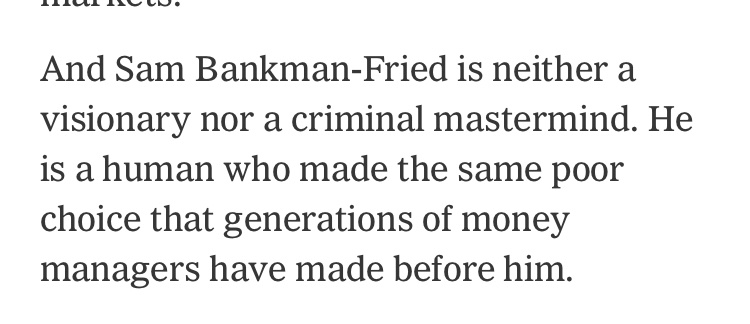
The above paragraph is an utterly insane ending to what should otherwise be an OK NYT opinion piece on Sam Bankman-Fried (SBF). What’s insane to me is that SBF is getting media treatment like this which paints him as shockingly harmless despite the fact that he stole billions of dollars in other people’s money. Would Bernie Madoff have received this treatment? Would Jordan Belfort get this kind of treatment? Hell I don’t remember the NYT even treating legitimate investors like Mitt Romney this way. This SBF coverage is barely one step removed from beatification, covering up his sins and pushing his virtues to the fore in their stead. And the fact that he’s a thief and a crook? Well everyone makes mistakes, right?

Let’s get one thing straight, everyone does not make the kind of mistakes that steal billions of dollars from thousands to millions of people. Generations of money managers have not regularly stolen money from their clients. If you think they did, point to me how much was stolen by traditional money managers this year versus how much was stolen by SBF and pals. The financial institutions of most countries (barring the obvious kleptocracies) are watched closely by their governments to ensure compliance with the rules and regulations, and this means that theft is not the norm, when it happens it is newsworthy.

No, SBF is a once-in-a-generation crook and fraud. Someone who so brazenly stole from every one of his clients that his corporate governance was worse than Enron’s. He is not the kind of person who needs to be painted as a normal guy just like the rest of us who made a few mistakes, he is the kind of guy whose active and willful theft has left many many people much worse off.

What is utterly galling about this coverage is how transparent it is, how obvious it is that this is not the way the NYT usually covers people who profit off of other people’s misery. As someone who has sounded the alarm on crypto for a while now (privately first, and then publicly here on my blog) I’ve long been infuriated by reporters who cover cryptocurrency like it’s “just another tech beat,” as if a Ponzi scheme whose only value is evading taxes should get the same dispassionate tone as the latest smart phone. But now I’m finding a “paper of record” going so far as to whitewash the sins of crypto’s greatest thief (so far) and I have to wonder if they’re doing it on purpose or they’re just stupid?

Because the NYT has to know what this is feeding into, right? Trust in institutions is at an all time low, trust in news media is at an all time low, and carrying water for obvious crooks when you’ve previously maligned people in the exact same situation is exactly the way you get people to believe that you are filled with fake news and hypocrisy! Already I’ve seen conspiracy stories circulate that SBF’s favorable media coverage is because he donated so heavily to Democratic Party causes, or because he said all the right things to get a good ESG score. Coverage like this coming from the New York Times does so much harm to media trust precisely because it’s such a 180 turn from their usual fair, and without a good reason for saying why this Robber Baron needs to be humanized, it really does feed into the conspiracy theories that the only reason he’s getting this is because he said the right things in liberal spaces.

Stock buybacks are very similar to dividends

There’s an old saying in the Tech industry: “Tech companies only give dividends when they have nothing better to do with their money.” It’s been used as an explanation for why so many Tech companies don’t have dividends, and why that’s a good thing: they’re spending their money in better ways which should bring more value to the investors. Yet this is honestly nothing more than a lie: Tech companies don’t give dividends because they found a more tax-efficient way to give money to investors: buybacks.

Amazon is the poster child for buybacks instead of dividends. It has long defended its no dividends policy by saying it spends all its money on capital expansion (ie growing the business). And to be honest it has posted impressive growth numbers for years. But while it has never given a dividend, it has almost always used a buyback.

A buyback of stock, like a dividend, is merely a way for the company to hand value back to its investors. The company floods the market with asks for its stock which raises the stock price, and those investors who wish to cash out can now do so at the higher price. It’s no secret that buybacks increase a stock’s price, pretty much everyone who isn’t economically illiterate understands this, what is less understood is why Amazon uses them instead of dividends.

Dividends are an unavoidable capital gain for investors, unless the stock is held in a preferential account (an IRA or 401k) the investor will have to pay tax on the dividends. A stock buyback though, only creates realized gains for the investors who do want to cash out, and they were going to take a realized gain anyway. For everyone who wants to hold the stock, a buyback raises their stock price without them having the realize the profit, the investors become measurably richer but don’t get taxed. Stock buybacks were illegal until 1982, which is a damn good reason for why most “boomer” companies (Coke, Ford, Boeing) never got into them. Tech companies like Amazon and Google were incorporated in the 90s though, and once they IPO’d management quickly became aware of the tax benefits to buybacks over dividends. For these tax reasons, Tech companies perform buybacks instead of dividends, while giving lip service to the idea that they’re actually fully committed to capital expansion and not shareholder value.

Make no mistake, Amazon, Tesla, and other growth companies are just as committed to shareholder value as Intel and Ford if for no other reason than to enrich Bezos, Musk and the other major investors. They do so with buybacks instead of dividends because it’s more efficient tax-wise, but they are still committed to handing money back to their shareholders. If congress presses ahead with raising taxes on buybacks, we may see a change, or if Amazon and Tesla’s growth begin to slow their shareholders may start to demand a true dividend in addition to buybacks. Either way the shareholders will always be compensated, that’s just how companies work.

Can retail investors make money in real estate?

Maybe not

This is going to be a kind of short post that may prove me to be a dumbass, but I’ve been thinking about real estate and I wanted to talk about it.

For background, I had a friend at work who had to quit her job and move back to her hometown because she could no longer afford rent in the city. She had a steady job at a big research university but it just didn’t pay her rent and so she moved away. I was saddened by both her loss (since she could no longer do the job she loved) and the loss to science, how many other bright minds have been pushed away by low pay and the cost of living crisis?

But it also got me thinking. I’ve talked before about how dividends are supposed to help cure inflation. The housing crisis is caused by a lack of housing supply, and this should mean that housing investors are making bank (much like oil investors). While we think of housing investors as just the individuals who own their own home, the landlords who own most of America’s rental stock are often incorporated and can be invested in. A common investment vehicle for investing in these companies are REITs (real estate investment trusts), which are often publicly traded just like stocks and ETFs. So if landlords are making bank, then REITs should be making bank, so people investing in REITs should also make bank, right? Maaaaaaaybe not.

I did a quick scan of popular REITs and for whatever reason almost all of them seem like strong underperformers. A REIT invests in the real estate market much like an ETF invests in the stock market, and you can grade how well a REIT or ETF is doing by a few metrics, such as alpha, beta, and Sharpe ratio. Note that all REITs and ETFs will be graded relative to a chosen index, $VOO is an ETF that seeks to track the performance of the S&P 500 so it is graded relative to that index. REITs track the performance of the housing market and so will be graded according to a housing market index. Anyway let’s start with alpha, this tells us how much better or worse the fund is doing than it’s chosen index. If $VOO goes up more than the S&P 500, then it has a positive alpha, if it goes down more than the S&P 500 then it has a negative alpha. Beta is a measurement of volatility, $VOO may track the S&P over time, but if it swings wildly up and down (moreso than the S&P) then it will have a higher beta. The Sharpe ratio then is a measurement of reward relative to risk. A higher Sharpe ratio means the ETF or REIT has over-performed on a risk-reward basis, and a lower Sharpe ratio means it has underperformed.

What does this all mean for REITs? They all seem to underperform. The most popular REITs I could find online all had negative alpha (meaning they underperformed their index) and surprisingly low Sharpe ratios of below 0.2 (meaning they weren’t stellar on a risk-reward basis either). Compare that with the most popular ETFs out there, $VOO (mentioned above) has about 0 alpha and a Sharpe ratio of 0.5, meaning it tracks its index almost exactly and is at least OK on a risk/reward basis. $QQQ (another popular ETF, this one tracking the NASDAQ) has a positive alpha (overperforms its index) and a Sharpe ratio of 0.6. Add to this that the stock market has higher expected returns than real estate (meaning you’d expect $VOO and $QQQ to do better than REITs anyway) and it doesn’t look like REITs are a good investment. Past performance does not determine future performance and all that, but the real estate market would have to moon while the stock market tanked for me to expect these REITs to overperform the most popular ETFs.

So it seems that despite skyrocketing housing costs, it’s hard for a retail investor to make money on real estate. I’m not sure who exactly is making money on real estate, if the landlords are making money then it isn’t coming back to the investors, and if the builders/maintainers are making money then it isn’t coming back to their investors either. It seems at this point that the housing market is hurting us all in ways we can’t even make money off of.

I don’t think Twitter is dying

You can stop tweeting #RIPTwitter

Over this past week, Twitter has gotten weird. Reports flying that Musk fired literally everybody, that there’s no engineers managing the servers, that he demanded everyone work 80 hours or quit and most of them quit. Forgive me for not posting sources but most of this is ultimately unsourced info from social media anyway. Regardless, people on Twitter are tweeting up a storm about how this is The End of Twitter and how they’ll all move to Facebook or Instagram or Mastodon when Twitter inevitably goes down for good. I don’t think that’s going to happen, at least not for another year or more.

Twitter may lose some of userbase as its billionaire owner continues to go crazy, but I highly doubt it will be replaced all at once, or even in the next year, or so and for a few reasons:

  • 1.) Lack of alternatives

When MySpace lost the battle to Facebook, it was a true battle between two platforms that did mostly the same thing. Both were neck and neck in terms of usercount and both focused on very similar styles of content and posting. Twitter doesn’t have that problem, Facebook and Instagram are nothing like Twitter in terms of its microblogging content or its ability to spread content to every corner of the userbase by latching onto its trending topics. And Mastodon has a tiny fraction of the total usersbase, if it continues to grow every year and Twitter loses half its userbase every year, then in around 5 years they’ll be neck and neck like Myspace and Facebook were in 2008. Until I see a sustained long-term trend of that nature, I’m not ready to proclaim that This Is The Death Of Twitter.

  • 2.) Institutional Buy-In

Twitter gives institutions something that they really really want, the ability to spread their message easily to all its users at almost no cost. There’s a good reason that Justin Trudeau, his holiness The Pope, and the People’s Daily (most read newspaper in China) all have official active accounts on twitter. Most would never be caught dead on Reddit in an official capacity, and Facebook/Instagram/other sites don’t allow them to reach every user in the way that Twitter does. Even if everyone with a net worth under 1 million dollars left Twitter TODAY, the site would likely continue on the inertia from Institutions for quite some time, as they would find tweeting something and having it get picked up by other institutions (especially newspapers) would still be a great way to get their viewpoint out into the wider world. Institutions don’t change rapidly, and even if Twitter does die it could take years for many institutions to migrate off of it. And the key is that as long as those institutions remain on Twitter, Twitter will still have value to many different users. Users who like to troll politicians’ comments, or bloggers/journalists looking to keep up with what the institutions are putting out, these people will stay on Twitter as long as the institutions stay on Twitter. So even if you start posting your dog pictures solely to Instagram, I doubt the Washington Post newsroom will abandon Twitter any time soon.

  • 3.) The Court of Lord Musk

People like to see billionaires as unaccountable god-kings creating or destroying everything in their path. This is partly because that is the image most billionaires cultivate and partly because they are certainly held less accountable than those of us who work for a living. But Musk isn’t the sole proprietor of Twitter, or even the sole proprietor of Musk Enterprises. There are a legion of accountants, lawyers, and investors who check and double check his every move. It seems strange that a man flaunts both the SEC and slander laws is being checked and double checked, but the very fact that he has never been punished for what he’s done is a testament to the work of his lawyers, accountants, and investors. These intermediaries act as a moderating influence on Musk the auteur CEO and so will likely ensure that no matter what he does the bills will keep getting paid and the lights will stay on at Twitter Enterprises.

  • 4.) Ease of use

Twitter has already been integrated into just about everything imaginable. I only have a Twitter handle (@streamsofconsc) to tweet out my daily blog posts. But WordPress (and basically every other posting software) has made it super easy to link your Twitter handle to your blog and auto-post everything you do with no added work necessary. Mastodon isn’t integrated into this ecosystem and probably won’t be any time soon.

  • 5.) I’ve seen this game before with Musk

This is a bit personal, but I’ve predicted the downfall of Musk before myself. I was part of the Musk hate-culture in r/enoughmuskspam for a fair bit, and fell easily into the echo chamber which pushed a narrative where Musk was constantly on the edge of destruction. I eventually got out, but it made me realize how easily hatred and castigation get amplified in such an echo chamber. Twitter is currently a strong echo chamber declaring the death of the platform and the End of Musk, and since there’s no social benefit to going against the grain, the most hyperbolic and outrageous claims of destruction are shared and amplified. This reminds me all too much of the patterns I saw with the hate-culture surrounding previous Musk ventures, and it makes me skeptical about people’s claims for this one.

I don’t think Twitter will go down because Musk fired too many of the people doing server maintenance. I don’t think Twitter will be replaced by Mastodon within the next few years. I don’t think Musk will be charged with market manipulation or treason for how he’s purchases a major avenue of public speech and trashed it. And I don’t think the people who are declaring the death of Twitter today will ever look back and admit they were wrong (if they are indeed proven wrong) any more than the people who declared the death of Tesla back in 2018 or the peak-oilers of the early 2000s. I think most people will either forget entirely or will claim that they were “early, but not wrong,” eternally pushing back their predicted death-date as they get more and more wrong by the year.

I may be wrong on this, and I’ll try to revisit this post in a year or so to either give my mea culpa or to declare how much smarter I am than everyone, but at this point I’d happily take the gamble that Twitter won’t be dying any time soon.

Flywheel investments, an anatomy of most crypto scams

FTX is in the news for both the enormity of its bankruptcy and the moral bankruptcy of its founder, Sam Bankman-Fried. Before even reading the news I knew in general how FTX went bankrupt, because it’s the same way every crypto ponzi scheme, sorry crypto “exchange” goes bankrupt. Here’s how it always happens.

Someone creates a whole bunch of magic beans, a billion in fact, then sells one of the beans to a sucker for a dollar. Their billion beans are now worth 1 billion dollars, because the most recent sale multiplied by the total number of items must be the fair value of them all, right? With net assets of 1 billion dollars, you can start doing some real financial malfeasance. You can take out big loans (using beans as collateral) or trade your beans for someone else’s beans, since you’re both playing a game where you pretend these beans have value. This gives you cashflow (although most of your “cash” is just other people’s beans) and the ability to pretend you’re running a business.

Once you’re trading beans, you tell suckers (retail investors) that your business is profitable and they should invest. Not by buying stocks in your company on the stock market, that’s a mug’s game. Stocks actually have value and are regulated by the government, no we’re in the business of beans. You tell people that to invest in your beans they just have to hand you over some of their dollars and in exchange you’ll give them beans. You tell them that the beans are interest payments on the dollars they’ve deposited with you, and since you’re still claiming the beans have value these suckers can then trade the beans amongst themselves. You then take those dollars they deposited and gamble them away on over-leveraged stock and crypto bets, all while pretending you’re the Wolf of Wall Street.

As long as people keep giving you dollars in exchange for beans, the scheme is solvent. The beans cost you nothing and you can print as many as you like. If a few people want to exchange their beans for dollars again, well that’s OK too because you’ve still got a big pot of dollars that you haven’t lost yet, so you can give them back their dollars and take back your beans to maintain the illusion of solvency. Your beans are your main asset remember, they’re what you are selling to raise money, they’re what is underwriting all your loans, so people need to believe that the beans have value and the best way to maintain that lie is to always be willing to buy back beans at the current market price.

It seems like the magic of a flywheel, once you spin it up it keeps going and going forever. As more and more people see your company as being profitable, more and more will want to buy your beans to “invest” in you. And when they invest, you give them all the beans they could ever ask for. As long as you keep buying back beans, fear of missing out (FOMO) will drive many investors to throw more and more money at you, driving up the price of your beans and making your company seem like a can’t lose bet. But nothing lasts forever, entropy will eventually slow down a flywheel and risky bets will eventually end a crypto exchange. There’s always some trigger, whether it be too many bad bets, a collapse in the price of bitcoin (which is probably one of your main “assets” after your magic beans) or you or an employee just steals everything and runs. But eventually people will start to catch on that you’re probably insolvent, and they’ll want their money back.

The reason FTX was insolvent is the same reason every crypto “exchange” is insolvent, there is absolutely no profit to be made in doing what they claim to do which is hold people’s money and always be willing to give it back. There is zero profit in doing this, banks write loans using depositor’s funds because that’s the only way to make a profit, and for the same reason exchanges gamble with depositor’s money because that’s the only way they make a profit. But banks are highly regulated to prevent insolvency and stupid bets, whereas crypto exchanges just aren’t. So eventually all exchanges make stupid bets and go insolvent, while most banks don’t.

So insolvency, it’s just a fancy word meaning people want their money back and you don’t have it. You gambled it all away and now all you have are magic beans, magic beans which only have value because you’ve been claiming you’d always buy them back at the market price. So the price of your beans collapse once people learn what’s up and that you no longer have the money to support your beans. Everyone tries to get their money out but you’re broke and can’t give it to them, then the people you took loans from realize you can’t pay them back either. As long as the numbers were going up, people kept buying beans from you and you could use more and more deposits to pay back your loans and keep up the fascade, now you can’t so you’ve got no choice but to default on those loans. And those loans and other obligations were underwritten with beans, which are now worthless as you won’t buy them back from anybody.

This above scenario is more or less how every crypto collapse has operated, plus or minus a few cases of an insider just taking all the money and leaving. They always issue their own coin because it’s an easy way to create the illusion of assets, they always take deposits and gamble them because it’s the only way to make money, and their balance sheet is always nothing but crypto so when the price of crypto goes down, they collapse under the weight of their own coins. Sam Bankman-Fried isn’t the first crypto scammer (although he does have the most appropriate name for one), he’s just the biggest one so far.