-
Why the Labor Theory of Value doesn’t work
In my quest to learn what others think, I was pointed towards the book Unequal Exchange by Torkil Lauensen. This book claims to prove why countries in the Global North are still richer and more developed than the Global South, by using the framework of Marxism and the Labor Theory of Value (LVT). The only problem is, the Labor Theory of Value is bunk.
The LTV posits that the *only* reason good have value is because of the human labor that goes into them. One hour of “socially necessary” labor is identical in America vs Germany vs Bangladesh, so the reason wages in America are so much higher than wages in Bangladesh can *only* be because either Americans work longer hours, or Bangladeshi workers have their value stolen from them through “unequal exchange.”
This is utter nonsense from first principles. It totally makes sense that labor performed with machines can create more *stuff* than labor performed without those machines, the fact that a worker in America can use an earthmover to dig a trench while in Bangladesh that same trench must be built with shovel by definition this means that the American is producing more value (if trenches are what you need). And even if the American worker and the Bangladeshi worker both capture a mere 1% of the value that they create from building trenches, the American’s 1% is bigger because the total value they created is bigger. As Milton Friedman quipped, if you really want to maximize the labor value when building a trench, you should be digging it with spoons.
LTV proponents try to brush this aside. They claim that in some sectors, in some industries, Western workers do the exact same labor with the exact same machines as workers in Bangladesh, and so our “earthmover vs shovel” critique doesn’t apply. Take for instance a garment factory in LA vs Dhaka: identical sewing machines, identical cloth, identical labor. So in the case of garment factories, the LA worker *should* be paid identically to the Dhaka worker, right? And the fact that they *aren’t* once again proves that value is being stolen from the Dhaka workers.
But again, this just isn’t true. An identical garment factory in LA vs Dhaka is still *not identical* simply because of the *location that it is in*. A factory in LA has regular, uninterrupted power, it has strong logistical connections letting goods move quickly and easily to where they are needed, it has highly automated Just-In-Time manufacturing systems ensuring that inputs (cloth) are always available when they are needed, and outputs (garments) are taken away as soon as they are ready. The factory in Dhaka often has none of that. It often has intermittent power supplies which must be supported with expensive diesel generators, poor logistical connections to its local port and roadways, a lack of Just-In-Time systems meaning that the factory can be starved of cloth for days at a time and later be overflowing with garments when the cloth *does* arrive but the trucks to take garments away aren’t ready.
A factory isn’t just a space with machines and people, it’s an entire system of logistics, management, financing, and other things. Management and finance are usually scoffed at by Marxists, seem as “useless parasitism” that will be done away with “when the Revolution comes.” But it is exactly this blind spot for management and finance that make Marxists wrong in many of their critiques, the management systems and financial systems in LA, from JIT to bank loans and equity stakes, those are all the reasons the LA factory can actually produce *more garments* than the Dhaka factory even with identical workers and identical machines.
And even outside of the factory itself, *the city of LA* decides much of the difference in price.
Let us pretend for a second that there was a factory in Dhaka with identical workers, managers, electrical and logistics connections, the same *everything* as a factory in LA. It can produce exactly as many garments in exactly as much time. Shouldn’t it *now* have identical wages to the LA factory? Still no, because the LA factory is still *located in LA*. The LA factory can sell garments directly to all the rich people who live in LA, and those people will (by dint of being rich) be quite happy to pay high prices for the garments that they want, prices far higher than can ever be charged in Dhaka. The LA factory can sell to them with almost zero friction in terms of time or money, and so it captures almost all of these higher prices, which it then gives to the laborers in higher wages.
Why would the factory owners be so “generous” in LA, to pay their workers higher wages than in Dhaka? It isn’t generosity, again it’s *the location of LA*. If the factory doesn’t pay higher wages, the workers can always move to another LA job. Even if they are unskilled laborers, they can be a sanitation worker for any number of movie studios, a driver in any number of limo companies, a gardener in any number of lawncare companies. LA has high wages for all these things, and if the garment factory wants to have *any workers at all* then it must pay a competitive wage, and it can afford to pay that high wage because, again, *it’s selling straight into the city of LA*.
The Dhaka factory can sell to LA as well, so can’t it capture those high prices? No it cannot, because it faces *incredibly high friction* to do so. First of all, it can take 1 to 2 months for a shipment of garments to go from Dhaka to LA, never mind the added *cost* of that journey, plus the import friction (tariffs, inspections) it faces once it reaches LA. The LA garment factories that *still exist today* often specialize in high value fast-fashion, chasing social media trends that come and go in a matter of weeks. An LA factory can get a new style into customer’s hands in just 3 days, by the time a shipment arrives from Dhaka the trend may already be passé.
So for all these reasons and more, the labor done at a Dhaka factory *can never* be identical to the labor done at an LA factory. And so even in the LTV, we would *never expect* the wages of the 2 factories to be identical. Incidentally, the LTV is *not* an accurate picture of the world, there is simply no consistent way to say that the value of a product comes from the “socially necessary” labor needed to make it. Supply and demand do a much better job of explaining value than LTV, with prices being determined by the exact interplay between supply and demand at any point in time and space. That’s why in a shortage of oil, prices go up. There is simply no way to look at the price of oil over this past year and conclude that “the price of oil is determined by the socially necessary labor that went into producing it.”
Incidentally, Marx also used LTV to derive some predictions that have been proven fantastically wrong. Supposedly, as machines replaced workers over the course of the 19th and 20th centuries, the profits obtained by capitalist would consistently go *down*. This is because all value comes from labor and with less workers there is less labor for the capitalists to steal value from. This is patently absurd, and profits have *not* declined over these past 2 centuries. A tech company with billions of dollars’ worth of computers but a mere few hundred employees is today *far more valuable* than a grocery chain with tens of thousands of workers.Indeed, the “Unequal Exchange” book does an even worse job talking about *capital* than it does talking about *labor*. A central part of the book’s thesis is that “capital moves freely, while labor is constricted by the laws of immigration.” This is nonsense, capital *does not* move freely anywhere, and in fact is usually moves *far less freely* in low-wage nations than in high-wage nations, which might go some way towards explaining why their wages are so low.
Take China and India for example, capital *does not* move freely in either of these nations. It’s easy to put money *in* sure, but getting it back *out* is the hard part. An investor does not build a factory in China out of charity, they do so because they expect they can get a profit, and they can bring that profit back to their home country to buy themselves nice things and to pay their shareholders a dividend. China (and India) makes it harder than the US to move your money out of the country, putting up barriers to the remittance of profits that cause investors to pause before putting down their cash.
So when an investor wants to put down money, he eventually wants to get his profits *back out* of the country. He can do that *far* more easily in America than he can in China and India, which is probably why America continues to receive such an outsized share of global investment *even though all those investors have to pay sky-high American wages*.
Capital does not move freely, and labor itself does not create value. Capital is restricted in most underdeveloped nations, which is part of what keeps them underdeveloped in fact. And value is determined by supply and demand, the supply of oil went down, so its price went up, and wages in Texas oilfields have likewise been buoyed by the price hike. Texas oilfield workers didn’t suddenly start working harder, the thing they were producing just got more valuable.
So “Unequal Exchange,” like most of the books I’ve reviewed, is not worth your time.
-
Social sciences need to learn the lessons chemistry learned long ago
I’ve blogged before about my time in cryo-EM studying Alzheimer’s, but I want to bring you a quandry:
Cryo-EM can only study things that are stable and rigid in shape. It relies on bouncing electrons off of something and seeing how they bounce back. You can’t use cryo-EM to check the shape of water or oil, because that’s something that takes lots of different shapes depending on the moment to moment interactions of the many molecules floating around. You might even say water or oil *have no shape*, so finding their shape with cryo-EM is a fool’s errand.
So in cryo-EM, I studied Tau filaments. Tau filaments are long, braided “ropes” made of Tau. They look a little bit like this:

We can study them in cryo-EM because that rope-like structure makes them stable and rigid (compared to water or oil at least). I studied Tau filaments because Tau is implicated as causing Alzheimer’s disease, but there’s a problem: we believe “small Tau oligomers” cause Alzheimer’s not the filaments themselves. The small tau oligomers are like tiny pieces of cotton lint making up a larger rope, they don’t have a strongly defined “shape,” and so you cannot study them with cryo-EM, you can only study the filaments.
So how did I get around the fact that I was studying something *which didn’t actually cause the disease I wanted to study?* I got around it with strong evidence for a pathway that I could latch onto. Let me explain:
The Tau oligomers (the tiny pieces that are like cotton lint) do 2 things: they cause Alzheimer’s, but they also build up into large Tau filaments (the large rope-like structures). The exact shape of the filament “rope” depends strongly on the interactions of the oligomer “lint.” Even though I can’t study the lint itself, studying the rope it created lets me *infer* what the lint originally looked like.
To be fair, there are several weak links in this inference. What if our understanding of how the “lint” of the oligomers creates the “rope” of the filaments is flawed? Then when we try to recover what the structure of the oligomers through looking at the filaments, we get answers that are way off from reality. What if Tau doesn’t actually cause Alzheimer’s? Then all my studying doesn’t actually help us cure the disease.
These weak links must be known and rebutted with other evidence. In this case there is a lot of published literature on how the oligomers create the filaments, so we believe that part is correct. And while the Alzheimer’s field does remain in flux, Tau is widely implicated as a key causative agent in at least some forms of the disease. We don’t know these things for sure, but we have strong evidence, and that lets me build up my inference to say “studying the shape of the filaments will let me study the molecular nature of Alzheimer’s disease,” even if I’m not studying the disease directly.
Chemistry has a very long history, stretching back to quantum mechanics, benzene’s structure, and beyond, of trying to study things we cannot actually measure directly. We use inferences everywhere to study these difficult things until some great new tool comes along and lets us study them directly. These days any undergrad can stick benzene in an x-ray crystallography machine and find its structure, but that structure was discovered over a century ago when all we had to go on was bonding properties discovered by burning it. Inference was key to discovering benzene’s structure, and it’s key to my research today.
But sociology seems like it can’t help itself here. It doesn’t want to do the difficult work of finding small connections which let us study a larger problem indirectly. It seems like sociology wants to study a BIG problem DIRECTLY, and somehow find something that no one else has found over the literal millennia that humans have been studying themselves.
I was convinced to write this post when I saw the below figures passed around on social media:
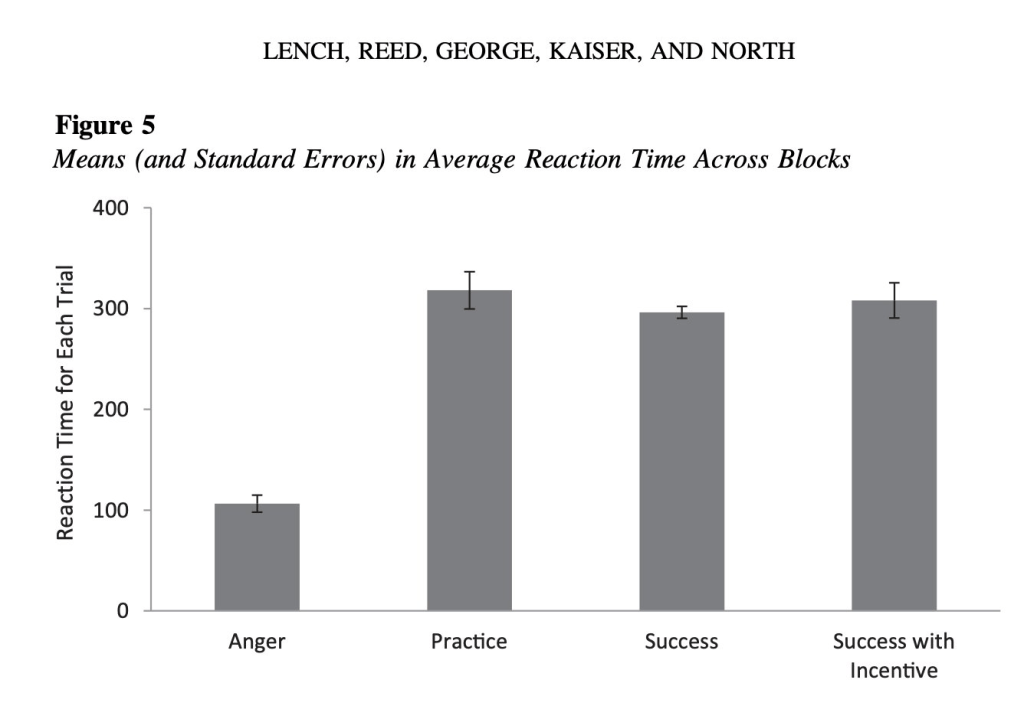
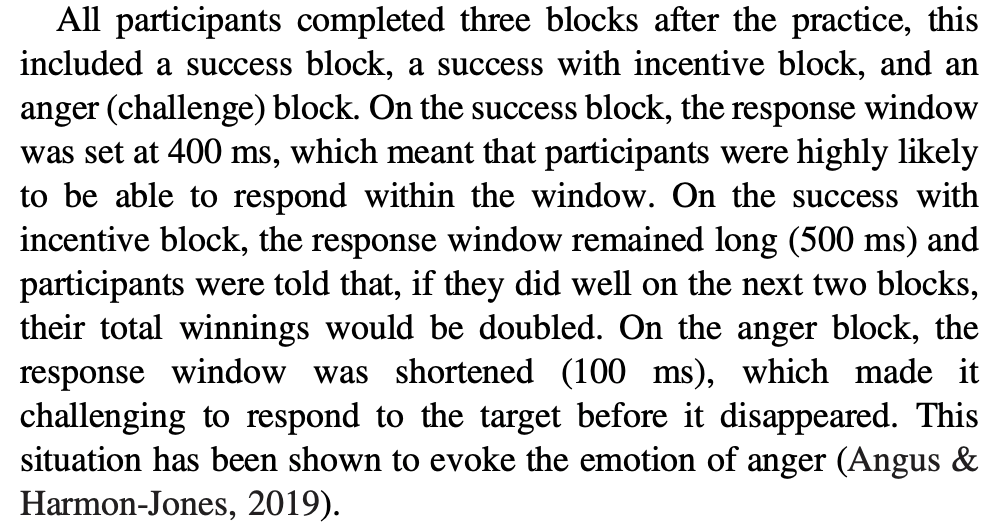
If you don’t like reading science papers don’t worry, I don’t either, so let me explain:
These researchers wanted to study how anger makes people better or worse at performing a task. This in itself is FRAUGHT with problems though: how do you measure if someone is angry or not? How do you do so *objectively*? How do you do so in a controlled research setting, with ethical constraints like “not smacking them in the face over and over”? And even if you can rigidly define anger: how do you measure if anger causes someone to do better or worse at a task, vs if doing worse at a task makes people angry?
These researchers solved this problem by ignoring it. Here’s there method: give people 400-500 milliseconds (which is near the lower limit of average human reaction time) to click on a block on a computer screen. They take between more than 300 seconds on average because that’s about how fast average humans can reasonably react. NEXT: give them only 100 milliseconds to click on the block. This is *faster than humans can actually react*, so any clicks that happen in this timeframe are random guesses, “pre-clicks” (where the participant starts clicking before they see anything, in expectation that something is coming), and importantly: CLICKS MADE SIGNIFICANTLY AFTER THE 100 MILLISECONDS ARE NOT REGISTERED, because the block has disappeared from the screen and the person can’t move to click on it anymore.
What they found is that when people are given only 100 milliseconds to click on a block, the only successful clicks they make happen at around 100 milliseconds: these are usually pre-clicks and random guesses.
What does this have to do with anger? Nothing at all, literally nothing. But here’s the title of the paper:

“Anger has benefits for attaining goals.” Uhbuhwuh?
The researchers make the *completely* unsupported chain of conclusions that:
- Giving people less time to complete the task made them angrier (unsupported, unmeasured by the study)
- Because they were angrier, they completed the clicking task in less time: 100 millisecond vs >300 milliseconds
- They do not at ALL address the issue that since the people were only given 100 milliseconds, they could not by definition take 300 seconds to complete the task
- This lab setting click-on-a-block experiment is generalizable to any action or goal-oriented task where people might be angry (wholly unsupported by the study design)
The real conclusion of this paper is that “when you give people less time, they try to complete something in the less time they have been allotted.” Big whoop. But the authors wanted a sexy conclusion that would get them on the journal’s cover and the BBC, and they got it.
This is bad science, but it’s perpetuated by a cycle of sociologists and reporters who don’t care about bad science. For all that the BBC and British government wrings its hands about online disinformation, their science reporters might be the single biggest source of disinformation in the whole British Isles.
Now to be fair, just because something is bad science doesn’t mean it isn’t *true*. Aristarchus of Samon proposed a heliocentric model of the solar system *millennia* before Copernicus. He did so because Fire is the more noble element compared to Earth, and the center is the nobler position to be in. Therefore the Sun (made of fire) must be in the center with the Earth (made of earth) circling around it. This is bad science, even if it came to the right conclusion.
By the same token, it’s possible that anger really does make people faster at a clicking task, and perhaps better at achieving one’s goals overall. But this paper’s bad science doesn’t support that.
Now back to cryo-EM: we wanted to study how the structure of Tau filaments connect to Alzheimer’s, but we couldn’t do it directly. We had to painstakingly create a chain of inference across decades of empirical research to learn that Tau oligomers probably are part of the Alzheimer’s degeneration, and that the structure of Tau oligomers can be recovered by studying the shape of the filaments. We couldn’t study what we wanted directly in chemistry, but we found a chain of reasoning that let us study it indirectly.
Sociology could do the same thing. It’s hard to objectively measure anger, but could you create an objective measure? Or could you find some fMRI state, some epinephrine cascade state, some blood vessel dilation state, or some other molecular clue which *tracks directly with anger* and can be measured objectively? Yes you could do that in principle. And you could then use objective measurement to run tangible experiments relating anger to task completion. Give people a hard task, let them get angry, and see if as they get angry they get better, or do the people who keep their tempers actually get better? I don’t know, but with objective measurements of anger you might be able to do this.
Instead we have a paper using circular reasoning to construct a conclusion from data which could never have falsified their conclusion to begin with. We have terrible, bad science and we deserve better. Sociologists need to call this out from *within* the discipline, the calls can’t all come from without, or eventually the people who fund sociology will get tired of funding absolute garbage.
-
Reasons for war vs excuses for war
Small post about something that’s been bugging me.
You ever hear about the Schleswig Wars? Probably not unless you play a certain type of video game. But in the mid 19th century Denmark and Prussia had a few wars over the question of Schleswig-Holstein. This little duchy had been technically a part of the Holy Roman Empire way back when, but was long controlled by the Kingdom of Denmark.
About half the people there were German-speakers though, and when Denmark attempted to further centralize and control Schleswig-Holstein, and further enforce the Danish language, law, and customs, the situation grew into a couple of wars where the German speakers eventually got what they wanted, unification with their German-speaking brethren and eventually incorportation into Germany.
The Schleswig Wars are discussed or joked about because the “cause” of these wars seems so obtuse. The exact legalistic status of a duchy with a complicated history involving the now-defunct Holy Roman Empire vis a vis its parent Kingdom. But really that isn’t the cause. The “cause” of the wars was not the legal peculiarities of the duchy, the cause of the war was nationalism, legalism was the excuse.
The war was caused by Danish nationalism trying to impose a centralized state on a German speaking area that used to enjoy some autonomy. The war was caused by German nationalism trying to unite all the German speaking peoples into a single state, or at least ensure no German speaking people lived in a non-German ruled state. The cause was nationalism, the excuse was legalism.
This happens constantly in history. Pop and academic historians alike so often take people’s excuses at face value, or read their preferred excuse in instead. One could certainly say that Denmark’s legal wrangling was a *trigger* for the Schleswig Wars, but they could likewise have been triggered by a simple uprising of the German population for any reason, and uprising that might get support from the German great powers looking to protect their compatriots living in a foreign kingdom.
I think people have a fundamental problem with seeing proximal causes as the most important causes. The spark that ignites the dry kindling may be said to have “started” the fire, but really any spark would do. The more important part is the dried kindling, *that* should be the focus. But most pop history focuses only on the spark.
-
Digger, so bad it’s hard to write about it
I sat in the theatre for Digger with about 4 other people, one of whom was the friend I came in with. This movie is clearly for someone, I heard the guy in the back laugh out loud at some of the slapstick moments, but it isn’t for me and by audience reviews and the empty theatre I watched it in, it isn’t for most people either.
Things started bad when out villain protagonist wakes up with his cat. As a cat lover myself, this should have been a moment to pull me into the movie, to show cute humor and tug on my heartstring. But as a cat owner, or even just someone who’s seen a cat in person, all I could think was that the cat looked incredibly uncanny valley. I guess a real cat would have been too hard to train, or wouldn’t have worked live on set. But whatever puppetry/CGI they used just kicked me out of the movie before the plot even began. My mind went “oh right, this is a movie,” I wasn’t immersed in it at all.
Things stayed pretty boring in the first act as the titular character Digger dealt with the central conflict that would define this movie. I couldn’t help but notice how all the villain protagonists of Digger had southern accents while the slightly more heroic figures (the climate scientists etc) had either northern or western American accents. The movie completely kicked me out of it however after the first act ended though.
Warning, here be spoilers.
Digger meets the president and cabinet to discuss how a massive ice shelf has broken off of Greenland and is headed straight for Europe. The ice shelf is the size of a large city, and with so much volume it won’t just crash into a seaside town, it will bring with it a tsunami when it hits the shore. Noticeably the president and his cabinet are all old white men. It fits the vague Hollywood stereotype that bad things are done by white men and good things are done by women and minorities, but it was an incongruity with reality that actually brought me out of the movie.
If this evil Republican president and his cabinet are some ersatz of the Bush administration, then where are Bush’s black and female advisors, like Colin Powell and Condy Rice. If this is the Trump admin, then where are all the young women advisors that political reporters are implying Trump is sleeping with, as these reporters do their best to turn once respected news orgs into TMZ.
This all white administration isn’t a black mirror pointed at our own world, it’s a bad joke from a 90s SNL sketch, or the Daily Show if it had zero self awareness. The movie wants its audience to be well read enough that they’re worried about climate change, but not well read enough to know anything about modern American politics.
And if this cabinet isn’t an ersatz Bush or Trump, it still makes no sense for a Republican cabinet to not include a few women and minorities. This kind of thing is noticeable to anyone who has watched the news, you could only believe this is an accurate pastiche of reality if you get all your politics from Tumblr.
Digger as a movie was described to me as a modern Dr Strangelove, but Dr Strangelove was clearly holding a mirror up to modern society it was set in, 1960s America. If the good Dr Strangelove had been a southern accented woman instead of a Nazi German scientist, it wouldn’t have landed as a parody of the American missile program and Werner Von Braun in particular.
After Digger’s terribly unfunny cabinet scene, we get to the scene that kicked me completely out of the movie. This movie isn’t even pretending to be real, it’s a play being put on. The main actor playing Digger goes back to his dressing room and his wife and daughter have their own boring subplot. The drama of a massive iceberg and tsunami crashing into Europe is brushed aside because none of this is real.
I think the writer or director of Digger had seen a lot of Mel Brooks movies, because this feels like a Mel Brooks moment. Robinhood reading the script, “why are you moving camera right” in the Producers, that kind of joke. But Robinhood Men in Tights wasn’t trying to moralize about climate change. Again, going back to Dr Strangelove, the themes of MAD being a self destructive policy would have been severely undercut if the movie had broken the fourth wall every now and then to show Peter Sellers practicing his lines.
After a bit more back and forth we come to the scene that made me tap out and leave the theatre to get a meal. Digger and the cabinet set up a conference room to watch the iceberg and tsunami destroy the Netherlands. Again, the director thought they were being extremely clever here; we don’t actually see any of the destruction porn that you’d usually find in a Roland Emmerich film. Instead, we watch the reactions from the cabinet as they watch the destruction.
This is clever, but it’s also boring. The reactions from the cabinet aren’t funny. Roland Emmerich films have a large if niche following because no matter how campy or badly written they are, they’re always a visual treat. This isn’t a visual treat, and it’s campy and badly written.
Let me finish with a thought I’ve had for a while: if I were a comedian, what do I think the easiest gig in the world would be? The Democratic National Convention. Or the Republican National Convention but I probably wouldn’t get invited to that one.
The DNC is the easiest gig in the world because the audience is already primed to clap for the things they agree with. They are also all members of a political party, so they are self-selected to all agree about the same things, and those are things you the comedian already know about, because you know you were booked for the DNC and not the RNC.
The point I’m making is that this would be a very easy gig as an entertainer. Say some biting comments about Trump and the GOP, with the kind of sarcasm and crassness you’d see in a reddit comment or a twitter tweet. Insert plenty of profanity because you’re a comedian, not a politician, and then bask in the applause.
The applause mind you, not the laughter. Applause is easy, just prime the audience to clap and then tell them what they already believe. Plenty of shows have made an industry out of this, finding that preaching is easier to joking, see for example the recent output from Steven Colbert.
This movie feels like it belongs at the DNC, not in a theatre. It feels like something that wants applause, not laughter. It’s telling you what you already believe, but with enough profanity and crassness that it technically qualifies as a comedy, but without any good jokes to make you actually laugh.
But I still want to laugh when I go to a comedy, not applaud. So I didn’t care for Digger.
I walked our soon after the scene where the fat cabinet member talks to the people of Europe, saying that America will stand with them. I walked out because I wasn’t having fun and thought writing a blog post would be more enjoyable. This movie is less fun than writing. Watch at your own risk.
7/10
-
How “Golden” is an Age really? A study of the Ming Dynasty
I’ve seen the Ming Dynasty held up as something of a Golden Age of Chinese technology and culture. Although it had hiccups, and ultimately collapsed to the Manchu invaders when it ran out of silver to pay its soldiers (a classic mistake), it still included some great feats and impressive economic growth. If you’ve heard of the voyage of Zheng He, which took hundreds of ships to India and Africa and brought back giraffes and treasure of all types, that’s from the Ming Dynasty.
But let’s look at Zheng He a bit more closely. His voyage was an incredible feat, to be sure, and the treasure he brought back was real. But it wasn’t really a “trade mission” like we might think. The Emperor at the time, Yongle (famous from Civ VI by the way), was a usurper who had killed his own nephew to take the throne. As any usurper, he had plenty of enemies at court. And as any kin-slayer, he had people undermining his authority by calling him evil. He also had the problem that the body of his nephew was never actually found after Yongle destroyed his nephew’s palace, so there were rumors that the nephew had escaped as a Buddhist monk and would one day return as a righteous Emperor to rid China of Yongle’s evildoing.
So Yongle was “well hated” and he wondered if his nephew was still out there. The voyage of Zheng He was intended to kill both these birds with one trade fleet.
First, Confucious orthodoxy taught that the Emperor’s moral righteousness radiated outward into the whole world. A righteous Chinese Emperor was venerated by foreigners just as he was obeyed in China, and great heavenly beasts only appeared on earth under the rule of a righteous Emperor. Zheng He’s fleet therefore bribed hundreds of foreign dignitaries to come to China and kowtow to Yongle, acknowledging him as the true son of Heaven and silencing any critics who claimed he was illegitimate. Bringing back giraffes (animals unknown in China) was also portrayed as great heavenly beasts showing up on earth. They can only do so if Yongle is righteous, of course.
So Zheng He’s fleet was not an economic nor military expedition, it was a political one. It legitimized the ruling Chinese Emperor, and once his successors took power and no longer needed that legitimizing, Zheng He’s fleet and ship plans were discarded as unnecessary and expensive.
A comparison is worthwhile here, a comparison with the Portuguese and the Golden Age of Sail. When Vasco de Gama went to India in 1498, he traded European goods for so much Indian spices, that his voyage made a 600% profit on the trip. 600% profit in just 10 months, try finding a deal like that *anywhere* today. The profits were so great that future expeditions were obvious, no one was going to pass up a money-making opportunity like that.
So Zheng He’s fleet was a money *losing* operation that was discarded as soon as politics no longer required it. Vasco de Gama’s fleet was a money *making* operation that spurred a huge virtuous cycle of shipbuilding and trading. European nations rushed to build bigger and better ships and find newer and faster ways to reach India, spurring on technological and engineering progress to make it happen. Zheng He’s fleet had no such positive externalities, there was no reason to keep increasing technology or ship engineering because the point of the fleet wasn’t to make money in the first place, it was to bring back foreigners and their goods to kowtow and gift to the Emperor.
So which expedition was actually part of a “Golden Age”? The one-off trip that didn’t, indeed *couldn’t* spur any future voyages because it cost so much, or the extremely profitable one that created a whole industry?
Another part of the early Ming “Golden Age” is their supposedly thrifty defense policy. The first Emperor of the Ming had given families some prime farmland for free, all they had to do was agree that their family and their descendants would always be bound to sending at least one man to fight for the Emperor in times of war. Yes, this is the same system you can see in Disney’s “Mulan.”
But in the reality of the Ming Dynasty, this system almost immediately broke down. First, the soldiers were supposed to *arrive to the Emperor already trained*, they didn’t get a Disney training montage. They were supposed to spend some parts of the year growing and harvesting, but some parts of the year were set aside for training. Most didn’t do this as they’d prefer to spend that time on more lucrative tasks that benefited themselves, like trades and crafts. So instead of a hereditary “army,” the Ming ended up with a hereditary “militia.”
Second, even getting these men to obey the Emperor’s summons turned into a nightmare. Local officials or corrupt officers were systematically steal, take, or buy the soldiers’ hereditary land, leaving them destitute or landless. The families would then migrate to cities or other areas looking for work. So when the Emperor’s men came calling, instead of farmer-soldiers they found lords and serfs. They had to scour the country for these families to drag their men into the army, and again these men were entirely untrained.
So again, was this the army of a “Golden Age?” It doesn’t seem so. Yongle himself is famed for leading 4 expeditions to “punish” the Mongol nomads north of the Great Wall, but all he seems to have done is marched around causing these nomads to migrate away. Then when his armies went south again, the nomads returned to where they’d been. He never managed to inflict any kind of defeat on them which could prevent them from raiding or pillaging nearby Chinese villages.
Not only that, but Yongle’s grandson shows this system at its absolute worst. That Emperor, like Yongle, summoned his hereditary army to fight the Mongols. Only this time, the Mongols fought back instead of fleeing. The Emperor and his entourage were camped without water and surrounded by Mongols blocking access to the only river. After days of thirst, the Mongol leader feigned a ceasefire to allow the Chinese troops some water, but as soon as the desperate soldiers ran to the river to drink, the Mongols attacked, killing the entire army and capturing the Emperor himself.
Not much of a “Golden Age,” is it?
Golden Ages always seem to exist in the past, never the present. We can certainly talk about the economics of the Ming Dynasty, how the population grew rapidly during the mostly-peaceful times. How new land was drained for farms, and how new canals were built or rebuilt. But the idea of a technology advanced and militarily overwhelming state, that doesn’t seem to be the reality. What we see is a large state like any other, with its own nuances, but not really an aberration in the grand scheme of things.
Some Chinese nationalists write alt-history fanfics about how advanced China would have been if the Golden Age of the Ming hadn’t been subjugated by the “barbaric” Manchu people of the Qing Dynasty. But I don’t see much evidence that things would have been that different. The Ming Dynasty was hardly a “Golden Age” in my eyes.
-
Why didn’t Europe run out of jet fuel this summer?
In the spring of 2026, the Iran War started. This immediately shut down the Strait of Hormuz and led to a critical shortage of oil in the world markets.
But crude oil itself isn’t really important to any of our lives, we don’t use it in our cars, planes, or plastics. It’s the refined oil products that really affect us. And this came to a head immediately in Europe.
Europe imports most of its oil from the middle east, and much of that oil is refined into jet fuel for aviation. With the Strait shut down and no more oil coming to Europe, it seemed obvious that a jet fuel crisis was about to ruin the continent’s summer plans.
This isn’t idle chit chat either, social media was ablaze with rumors, warnings and panics about a jet fuel crisis that would shut down Europe’s airports. Dire predictions were made that most of the major European powers would be completely out of jet fuel by now, unless the Iran war ended *immediately* back in the Spring.

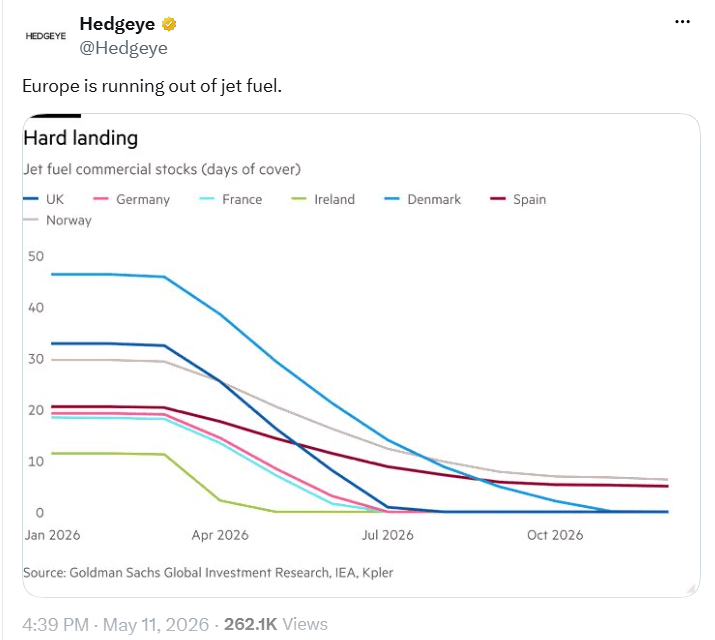
But the Iran War didn’t end. But also, Europe didn’t run out of jet fuel. Planes continue to fly Europe’s skies with the same regularity as they did in 2025. Why did yet *another* dire prediction of imminent fossil fuel doom not come true? In general it’s because those loudest about fossil fuels and economics know the least about them.
First of all, Europe’s jet fuel crisis was a highly localized event. Oil had trouble leaving the Gulf nations due to the war in Hormuz, and much of this oil was destined for Europe. But the rest of the world kept ticking, kept producing and refining oil, and kept making jet fuel. The global price of oil and oil products rose moderately as supply was constricted, but it’s important to remember that most goods are elastic. As the price rose, many people chose not to use oil and switched to other forms of power, like coal plants starting back up in China and Southeast Asia.
And likewise, jet fuel doesn’t have to be made in European refineries from Persian Gulf oil. America is a net oil exporter and a refinery powerhouse. Millions of barrels of oil and oil products were exported from America to Europe as European prices rose in conjunction with the shortage.
So a jet fuel shortage doesn’t at all mean grounded planes, it just meant that Europe had to import fuel instead of making it themselves. But some online argued that imported fuel could never make up the shortfall, as tankers are too slow and supply chains too rigid to allow this fact rerouting of jet fuel. They were wrong about that, but also tankers alone are not needed.
When a plane normally flies a route, it likes to take only as much oil as it needs to get to where it is going (plus some extra in case of an emergency). So if a plane is flying New York → Paris → Berlin, it will take only the oil it needs to get from New York to Paris, then top off in Paris so it has enough to get to Berlin. This way they don’t carry extra fuel, which means extra weight, which means less fuel efficient travel.
But what if jet fuel in Paris is very expensive, as was the case during the jet fuel shortage? Then the airline will decide instead to fill the tanks *completely* in New York, that way they’ll have enough to get to Paris and Berlin without having to fill up in Europe. The added cost of less fuel efficiency is overcome by the added benefit of buying jet fuel for cheaper. This is also a direct and immediate way to “import jet fuel” to Europe, just have planes that fly America to Europe routes top off before they leave America.
And importantly, all these things happened without the hand of the government. The EU did not have to send a missive telling airlines to top off their tanks in America, the airlines did it anyway by following the logic of supply and demand. As prices rose in Europe, they sought cheaper jet fuel in America. That’s how a modern economy works, nothing is stagnant, there’s always market participants trying to mitigate the effects of a supply shock as doing so gives them an edge over their competitors.
The final element of this tale is the most controversial: more oil got pumped than expected.
First, closing off the straight of Hormuz didn’t completely cut off oil from the Persian Gulf. Oil has been rerouted overland, and convoys have continued to pass through the straight. Some won’t like to hear it, but there’s a reason oil isn’t $200 a barrel as many twitterati predicted. There’s a lot more oil getting out than Iran would like you to believe.
Secondly, a shortage of oil has caused other oil producers to ratchet up their production. Again, many twitterati believe the oil industry is nothing but mustache twirling ne’er-do-wells. They believe that the oil companies either can’t pump more oil (because there physically isn’t enough) or won’t pump more (as they love high prices). No one is willing to admit that high prices spur more supply, as greedy companies try to produce more and more oil to take advantage of those prices.
In particular, America and Argentina have had a new oil boom in response to the war in Iran. Both nations use a lot of fracking, which has a much quicker lead time than traditional oil plays, and can be scaled up and down rapidly in response to market forces. America and Argentine won’t replace the Persian Gulf completely any time soon, but a lot more oil has been produced in response to the global oil shortage than the simplistic models assumed. The shortage was thus never as severe as people made it out to be.
Commentators online need to think more in terms of second and third order effects. Cutting off oil from Hormuz doesn’t happen in a static world, you can’t just subtract that oil from the global total and assume the price per barrel will hit $200. Oil companies pumped more oil in response. Gulf nations rerouted their supplies in response. Airline companies retooled their purchasing in response. And Europe never ran out of jet fuel.
-
So what’s up with China’s Economy?
I meant to post this about 6 months ago. I meant to do more research. But I didn’t, and I haven’t, so this will just be stream of consciousness, like always.
When I was a kid, China was the world’s miracle economy. In the 20th century, the world’s developing economies actually tended to grow slower than the developed ones, but when China adopted capitalism (or “socialism with Chinese characteristics”) under Deng Xiaopang, their economy exploded with exactly the sort of dynamic growth that western capitalists dream of.
The rural “villages” of China were themselves already the homes of 10 to 50 thousand people, and giving these people the right to start businesses and open up shops meant China speedran the exact same capitalist development cycle that Europe had in the 18th and 19th centuries, when most European cities were themselves just tens of thousands in population. A successful shoemaker had the right to keep his profits, buy better tools, a factory floor etc, and before you knew it shoe factories and businesses for every other consumer good were popping up everywhere in China. China became a bastion of consumer surplus at exactly the time the USSR was sliding into consumer shortages.
Not only that, unlike “Indian socialism,” “Chinese socialism” had emphasized universal literacy and education. Thus, when foreign firms invested to build factories using cheap Chinese labor, they could do so with the knowledge that every worker hired would be able to read their instructions as well as any reminder safety posters all around the factory floor. Retraining a laborer for a new machine could be as simple as giving them a pamphlet saying “we’re doing this now” rather than the floor manager having to walk each worker through their new job, as happens when retraining illiterate workers.
So not only did China’s domestic capitalists start churning out factories and goods, foreign investment poured into China in unimaginable sums, lured by the exceedingly low wages yet high skill ceilings of its massive, literate workforce.
Even the Great Recession of 2008 couldn’t break China’s stride. The Chinese Communist Party decided on a massive stimulus package to maintain their high rate of growth, which saw China posting near-double digit growth rates at a time when Europe and America languished in stagnation.
But 2008 was almost 20 years ago (feel old yet?). What’s happening today?
I’m just going to throw some factoids at you to get things started. In 2025 China experienced capital flight to the tune of about $500 billion, more than any other nation in the world. That’s more than the capital flight experienced by Russia, India, Mexico and Brazil combined for that year.
Capital flight, if you don’t know, is the large scale exit of money from a country. In a nation like America, capital flight is perfectly legal: if I think the American stock market is going to crash and the American government will go bankrupt, I’m free to sell all my stocks and buy Eurobonds instead. There’s no barrier to moving money around (anti-money-laundering regulations notwithstanding), and America usually records net capital *inflows* rather than outflows. This is because the vast majority of investors don’t think the American stock market will crash or the American government will go bankrupt, rather most investors currently see America as the safest port in the current storm, not perfect mind but better than the other choices.
China on the other hand has massive capital controls. To move large sums of money out of China requires clearance from the federal government of some kind, whether as a business or an individual. The fact that half a trillion dollars of money is still leaving China *despite* these laws (and their onerous penalties) shows just how little faith many investors (especially Chinese investors) have in the overall economy, and how much they’re willing to do to get around those laws and get their money somewhere safe.
This money leaving China is hardly consequence free either. That’s half a trillion dollars of spending and investment that has vanished. If that half a trillion was spent on goods and services inside China, then perhaps more young Chinese people could find jobs in the consumer economy. Instead, China is experiencing a youth unemployment crisis, with outside estimates putting Chinese youth unemployment at greater than 20%, over twice as high as in America or Mexico, and close to the worst nations in the EU like Spain.
This capital flight tells us there’s a problem *right now*: investors, especially Chinese investors, don’t think the Chinese economy is trustworthy. They don’t think their money can grow their and turn a profit, and even if they can eke out a profit, they think the Government could take it from them like what it did to Jack Ma and the school tutoring industry.
This capital flight *also* tells us there’s going to be problems in the future: money is fleeing China and so the next generation of business and jobs aren’t being created. Future growth will be well below where it “should” be if that capital was reinvested into the economy.
But ok, why are Chinese investors so down on the Chinese economy? They’re still the factory of the world, right? They’re still dominant in solar panels and EVs, right?
Remember that investment is forward looking. China built up its dominance throughout the 2000s, but its future might not be so bright. Chinese green tech companies are facing unprofitability now, and the possibility of further unprofitability ahead even if they “win” the price wars. Let me explain.
China is made up of provinces just like America is made up of states. And both provinces and the central government will give funding to companies to build factories and create jobs locally. The original spark to the Chinese solar/EV revolution was these very government subsidies.
But eventually some of those funded companies won’t be able to compete. It happens all the time, see Solyndra in America at roughly the same timeframe. In a normal economy a company that can’t make it, even if it received government funding, will eventually go bankrupt. But bankruptcy would lead to job loses, lose of province prestige, and perhaps social unrest. So the Chinese central and provincial governments have become experts at propping up failing companies.
A government might mandate that local banks give low or zero interest loans to keep bailing out one of these companies. Now there’s zero incentive for the bank to do it, it would rather write profitable loans to good companies instead. But the banks must answer to the government and so the loans get written. These toxic loans remain a drag on the bank’s balance sheet, reducing their profitability and reducing the amount of loans they can write to actually good companies.
Or perhaps a government might coerce a profitable company to merge with its unprofitable competitor. This new company is bigger sure, but the profitable bit is now being dragged down by having to still pay laborers and leases on the unprofitable bit. Sure they could try to restructure the unprofitable bit to make it profitable, without cutting jobs of course as the state doesn’t want them to do that. But trying to fix someone else’s company is like trying to rewrite someone else’s code, at times it’s just so much more efficient to start over and write it yourself. But efficiency isn’t being rewarded here, party loyalty is. So a profitable company gets an albatross hung around their neck, and their growth and efficiency is hamstrung going forward.
So we’ve got zombie companies propped up by toxic loans, plus severe misallocation of capital so that no province’s pet factory goes bust. All this leads to lower profits, and profits have indeed been unusually low in Chinese companies of late.
Low profits aren’t just painful for the fat cat sitting at the top of the ladder, they’re painful for everyone.
First, an unprofitable company can’t afford to grow by enticing the best workers with higher wages. Americas most profitable companies like Google, Facebook and so on also have the highest wages, as they can afford to compete for the best of the best. Unprofitable Chinese companies can’t afford to do that. Wage growth in China was actually lower than in America during the post-pandemic period. With American wages already so much higher than Chinese wages, this should be almost impossible, but the Chinese economy was just that stagnant.
Second, there’s the stock market. Americans by in large invest in the stock market for retirement, the majority of Americans own some sort of stock. The long-term reason for a stock to grow in value is if its profits are or expected to start growing soon. But Chinese companies are unprofitable. This means Chinese stocks don’t grow in value. And this means most Chinese people can’t have a nest egg for retirement like Americans can. The Chinese workers used to use real estate as their nest egg, with 70% of Chinese household wealth tied up in real estate (often second and third homes that are supposed to be sold or rented out in retirement). That real estate has dropped by half in value. Compare this to the numbers for America during the Great Recession, just 35% of American wealth was in real estate, and prices dropped by only a third. Chinese citizens have experienced a destruction of their household wealth on an apocalyptic scale, far in excess of anything experienced in America.
And even if you live in your home, you’re likely now paying back a mortgage on property worth less than the mortgage. You’re now inexorably tied to your current location, unable to move for a better opportunity because you literally can’t afford it, selling your house won’t cover your mortgage and let you get a new one for a new house. Many Chinese people are even paying mortgages for houses that don’t exist, mortgages written and sold to them with the expectation that the house *would* be built, but in the meantime the company building those houses went bankrupt.
So Xi Jinping is sitting there looking at an economy with the following characteristics:
- High youth unemployement
- Low investor confidence, everyone wants to get their money out of China even if they have to break the law
- Low profitability for companies
- This in turn leads to low growth of the stock market, and the inability for the middle class to save and invest for retirement the way Westerners do
- This also leads to low growth of wages
- Low consumer confidence. Chinese consumers just experiences Great Depression levels of wealth destruction, and most are preferring to stick their money in a bank rather than increase their spending or invest in their future.
- These banks meanwhile are being told to take this consumer money and hand it as a loan to zombie companies that will never pay it back
And what does Xi Jinping do about all this? He makes it worse.
It’s clear that the state-backing of companies has created a problem. Low profits, low growth, and any growth to be had is sustained not by Chinese consumers (who are refusing to spend) but instead by selling products to foreign countries (who are increasingly erecting tariffs to “protect” local businesses). But Xi has doubled down on this state-directed, state-funded growth model.
China’s most recent innovations to kickstart the economy have been for the state to increase how much it directs the economy. Xi Jinping wants China to be the builder of the “new productive forces” of the 21st century. Things like AI, quantum computing, autonomous robots, etc.
From a “video game” perspective of economics, this looks like Xi Jinping is making all the right moves. Europeans online so often look back with despair at how their continent missed the boat on the tech industry. Why didn’t Europe build its own Google and Microsoft? Why are all the big tech companies American? So if you believe that these “new productive forces” are the future, then surely Xi is ensuring China won’t make the same mistakes as Europe did, China will be a leader, not a follower, in these new technologies.
But the world isn’t a video game. We don’t know beforehand which techs will succeed, or even which specific companies will succeed. Plenty of people thought that supersonic jets were the “new productive force” of the late 20th century, and I’ve extensively catalogued all of those failures. And some European tech companies *did* exist, they just didn’t grow as fast or were hamstrung by regulation and eventually got bought or outcompeted by American companies. If these European tech companies had instead been funded and propped up by European governments, they wouldn’t have turned into a European Google or Microsoft, they weren’t profitable or efficient enough, *that’s why they lost*. They’d have turned into a zombie company and a drag on government finances or a drag on the balance sheet of whatever bank was ordered to bail them out.
So the last time Xi Jinping unleashed the “new productive forces” of China, he created a green manufacturing economy that has nonetheless led to stagnant wages, low profits (which in turn leads to low consumer wealth since you don’t want to invest in the market), rock bottom investor confidence, and a huge number of zombie firms propped up by government handouts or by leeching off more profitable firms and banks. There’s no reason to believe that this current crop of “new productive forces” will do anything differently.
But Xi Jinping is at his heart a Marxist. At his heart, he clearly believes that the State (with a capital S) can always manage and direct the economy better than the private sector can. He joins the long list of ideologues who believed just that, from the Soviet Union to pre-1990 India to South America and beyond. And every time they were wrong.
China used to post double digit growth. Americans used to believe that China overtaking them was right around the corner. But at the rate they’re going, that’s not going to happen for a long time, if ever.
-
What do you do when things aren’t fun?
Small post, but what do you do when things aren’t fun? I have friends, and hanging out with them is the highlight of my week every week. But then when they’re gone I’m back at home alone. Video games used to be something that could entertain me any time any day, but recently I’ve lost interest in the things I used to play, and I never feel like buying any new games either. My family is fun to be with, but I can’t be with them every day, I have work to do. But how do I fill the empty hours of the day? Running makes me feel better, but I can’t do that all the time either.
I thought having friends, a stable job, a nice place to live, an active hobby like running, and plenty of money for video games would make me happy. I thought all this when I was a kid. If I could have lived like this as a kid, I’d have thought I had the best life in the world. But something is missing, and I don’t know what.
I could go to the movies, but those aren’t fun to me. I could find new video games, but that doesn’t feel fun. I could play old video games, but that doesn’t feel fun. I could read more books, but that doesn’t feel fun. I could write more on my blog, but as my recent output has demonstrated, that doesn’t feel fun either.
It’s not that I don’t have fun, I do. Every day I have something going on that’s really fun, whether it’s a friend to hang out with or family, or some event. But in between these hours of fun are still 23 other hours in the day to fill, and I don’t know what to fill them with that would be fun.
I don’t know, I just don’t know. I don’t know why I feel so happy to run a 5k in the morning with my friend, and then feel so empty later in the day, after we’ve had lunch and said our goodbyes. I was happier in my undergrad days when I had less: less friends, less money, less time, I had less of almost everything. But somehow I was happier then than I am now. And I don’t know why.
-
The EU beclowns itself with tariffs
Josh Barro once said “Trump has only taken the dignity from those who gave it willingly and Jeb Bush.” What he meant is that while Jeb Bush was utterly humiliated by 2016 in general, most of the Republican bigwigs suffered reputational damage not so much from Trump himself, but from their own insistence that he was dangerous, economically illiterate, but also the only logical choice for president. The two-faced insistence that tariffs were stupid and dumb and anti-business, followed by an abrupt about-face on the subject once Trump won the nomination, did huge reputational damage to the GOP in the business community. Just as their two-faced-ness on Trump’s other “novel” policies did damage to them in the immigrant community, the LGBT community, and so on.
Biden later gave his dignity to Trump too, as I have repeatedly dunked on Biden for insisting that tariffs are bad and harmful and must not be done, only to turn about and support them himself once he got into office.
I’ve said before that I think a large part of the literati’s opposition to tariffs is not so much that Trump is *wrong* about them, but that Trump is *right*. The “textbook” definition of tariffs is what Biden and the EU said back in 2019, tariffs only hurt the country which puts them up, they are a tax on your own consumers, they don’t hurt any other country more than they hurt you. Trump disagrees, he thinks that tariffs hurt other countries more than they hurt America.
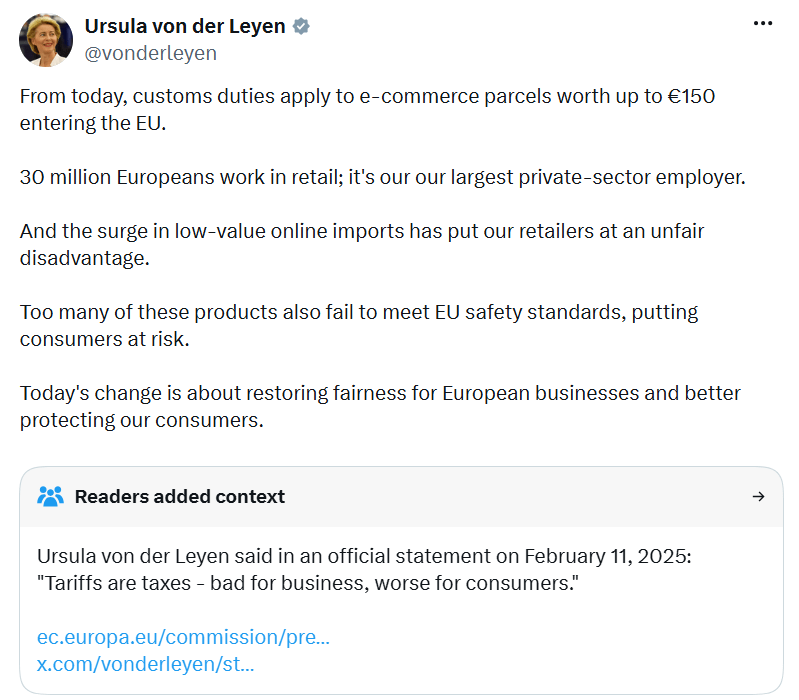
And now it seems Ursula Von Der Leyen has likewise beclowned herself at the altar of Trump. VdL, for those who don’t know, is the top dog of the EU pantheon, and a long-time critic of Trump’s tariffs. But now, in the name of protecting EU business, she too has begun putting up new and bigger tariffs on foreign product. Because she, like Biden, and like Trump, all seem to agree that in reality tariffs hurt the other countries more than they hurt you. And that the damage they do to your own country is “worth it” in order to protect local industry.
I should be aghast. But I’m not even surprised. The free trade consensus of the late 20th century has died entirely because its adherents were always two-faced in their support of it. While the EU preaches free trade, they have always erected huge tariff and non-tariff barriers to protect local industries, especially farming, from foreign commerce. Likewise, the Bidenist democrats may have paid lip service to free trade, but it and economic growth in general always sat at the bottom of their hierarchy of social good. High prices are always worth paying for some other social good, in this framing. And tariffs therefore are not tools of economic self-sabotage but rather can be a means to whatever social end you want, whether it’s protecting rust belt jobs or competing with Chinese solar panels.
Free trade fell apart in the world because it seems its adherents never really believed it. Every politician treated it like a little white lie: we’ll all pretend that tariffs are always bad and wrong so that the hoi polloi don’t demand we start erecting tariffs and eventually drag us into a trade war. But when the chips are down the white lie crumbles, and now tariffs are a part of everyday politics. And more and more politicians beclown themselves by having argued so forcefully against Trump’s tariffs and then arguing even more forcefully in favor of their own.
-
Why did India have so many blackouts in the first half of 2026?
India is no longer a poor country. With a record-setting services industry and a very large production industry, India can afford to have its cake and eat it just like a rich country.
Yet in 2026, I read reports of rolling blackouts across the whole country, especially difficulty to deal with as temps both day and night can remain above 40 degrees Celsius (104 Fahrenheit).
Most reports (like this one) brush past causes. At best they try to blame the blackouts on surging demand. But rising demand can be predicted, and creates an incentive to increase supply. So we should expect that power companies, if they wanted to make money, could have easily built out their production sector to meet the growing demand.
That is exactly what has happened in America, where power demand continues to grow, but blackouts remain uncommon. And unlike America, India still uses cheap coal for the majority of its energy needs, so what gives?
Well it seems India’s power problems came from a toxic mix of rising energy costs and government incompetence. One or the other would be manageable, but the two together dealt a 1-2 punch to India’s power sector that left customers sweating in the heat of summer. Let’s dig in, shall we?
The first thing to realize is that not all coal is created equal. India still maintains the world’s second largest coal mining operations, after China. So in theory their power plants should never run out of coal, right? Except India’s coal is notorious for being made of almost 50% unburnable rocks, what the industry calls “ash content.” This high ash content means boilers that burn Indian coal need to be larger and have more scrubbers in order to deal with all that ash, making them more expensive.
For this reason, coal power plants on India’s coast have actually transitioned to using foreign coal rather than Indian coal. Australian coal in particular is very low ash, as little as 10%, and so a much smaller boiler and many fewer scrubbers can be used to produce the same amount of power. Some plants will also use a specific mix of Indian and foreign coal, to create an intermediate ash content of perhaps 25%-40%. This lets them save some space compared to using only Indian coal, while also not having to import quite so much expensive foreign coal.
But the Iran war threw all of this for a loop. When the war shut down oil and natural gas flow through the Strait of Hormuz, many poorer nations in Southeast Asia switched on their coal power plants to replace their unusable oil and natural gas power plants. It was that or have no power at all, since there was such a shortage of oil and natural gas. This drove the price of coal skyward.
Now, India itself still produces plenty of coal, no problem there. But the cost of high quality *imported* coal was a problem. All these power plants that relied on buying foreign coal suddenly found themselves with skyrocketing import costs. That would usually be no problem, they would raise prices on consumers to compensate. No one likes expensive power, but expensive power is way the hell better than *no power at all*. But this is where the governments of India’s many states stepped in.
No politician wants to lose election, and so no government wants to be responsible for rising prices. But the money must still be paid for that imported coal, so did the government step in to subsidize the power stations? Did they bollocks. No politician wants to be responsible for skyrocketing public debt either, *nor* increasing public taxes. The governments forbade the power plants from raising prices, but also didn’t give them money to compensate.
So could the power companies take out loans? Again no, India’s state-owned power companies have been oceans of bad debt for years as local governments didn’t want to fund them and so have demanded local banks give them roll-over loans for years. Modi finally stepped in and forbade new loans going to any power company that isn’t somewhat solvent. And that rules out any power plant that is selling power for less than the price of imported coal (as demanded by the politicians).
India’s solar buildout has only worsened this problem, as there are no batteries to store the solar power. See, solar power plants are only responsible for providing power during the day, and when it’s sunny. But they get the gain of still being able to demand full price in competition with the *coal* power plants, which are responsible for power both day and night, sunny or cloudy. Solar plants have all the profit, but none of the responsibility that baseload coal plants have.
This means that when solar power cuts off during the evening, or during a cloudy spell, the coal plants must quickly ramp their power supply up to compensate. An expensive process which would be mitigated if those plants just provided all the power during both day and night. India would normally use natural gas “peakers” for ramping power, but remember that natural gas was expensive and the state governments wouldn’t raise prices to compensate.
So what is a power plant to do, when it cannot afford to import more coal because the state governments won’t let it raise prices to compensate AND it cannot take out loans to bridge the gap? It goes down for “maintenance” or declares “load-shedding.” The former is often used an excuse for “we literally cannot supply power at this time,” and the latter is just a euphemism for a blackout.
Loadshedding increased in India severely during 2026, but is falling back down as energy prices now return to normal.
If governments allowed coal companies to raise prices to compensate, this crisis would not have happened. If solar plants were required to compensate coal plants for taking on all the nighttime/cloud-time sectoral risk, this would not have happened. And of course, if the energy crisis had not happened, this would not have happened.
But it did happen, and the Indian state governments cannot control the world, they can only control themselves and their laws. And their obstinance in the face of high prices meant their states suffered greatly due to a complete *lack* of power, when they could instead have had *expensive* power. Economists agree that the GDP hit is vastly greater in the former case than the latter, and I’m sure anyone sweltering or *dying* in a non-air conditioned room would think so too. A shame the politicians couldn’t see it.
-
Subscribe
Subscribed
Have a WordPress.com account? Log in now.

