Seriously, that’s all I’ve worked on this week.
Category Archives: Science
Pointless prognosticating, what is the “Next Big Thing”
If you follow the Tech industry, you know that everyone’s always searching for the Next Big Thing, and if you remember my series on The American Challenge, you might remember that I talked about how that book badly missed on some of its predictions of what The Next Big Thing would actually be. This got me thinking, what do I think the Next Big Thing is? What do I think will be the next trillion-dollar industry, the type of thing countries will want to focus on and people will want to invest in, things like semiconductors and computers in the 80s, mass-built automobiles in the 1910s, or trains in the 1800s. The kind of thing that will change the way we do everything, and if you have a chance to get in at the ground floor you’ll be kicking yourself in 20 years if you don’t take it.
To start with, I’ll talk about others’ predictions.
I’ve heard some people talk about Cloud Computing as the Next Big Thing, but it’s hard to tell if it’s truly Next or if it’s more of a continuation of the Current Big Thing. Like, would it make sense to separate the internet revolution from the computer revolution? Both happened concurrently, the first couldn’t have happened without the second and the second was truly skyrocketted by the first. So how does Cloud Computing fit into all this, it’s already a trillion dollar industry with the largest tech companies in the world all throwing money into it, and even if I can’t explain how it works personally I can definitely see that others are talking about it as a revolution. But again it feels hard to tease it apart from computers and internet as a whole, and it doesn’t seem like we’re on the ground floor anymore. Microsoft, Google, Amazon and Meta have all put so much money into their cloud infrastructure that I don’t see any small fries really taking pieces off of them. I’d say Cloud Computing is the current Big Thing.
But that’s mostly semantics, I’ve also heard people say 3D printing is the Next Big Thing. The University of Nottingham for instance has a department that wants to be able to 3D print a smartphone, circuitry and all, using just metal and plastics as inputs. The ability to mass-produce using 3D printing has long been a holy grail of the field, and the ability to custom manufacture pretty much anything by just fiddling with a computer model would certainly be a game-changer. But 3D printing has so many technological limitations that I still wonder if it will truly take off, most glaringly, 3D printed items tend to not work well out of the printer, and fall apart quickly even if they do, which is a big barrier for mass-production. Ultimately I just wonder if 3D printing will be something more like Supersonic Travel was in the 70s, something that was seen as the mass-market future but was in fact relegated to only specialized roles while more boring “old fashioned” things kept their market share.
The Internet of Things is something I’ve never really gotten the hype for. There are certain applications where having a device always connected to the wifi seems like it could be value added, but most of the hype seems to be marketers trying to see a subscription service for a device that used be be a one-time purchase, or from unrealistic promises that don’t fix the Oracle Problem (ie suppose you give you machine a wifi connection so it can always tell you when certain conditions are met, but will you necessarily trust that your machine is giving you good data or will you have to double check each time anyway, negating the benefits of having the wifi in your machine). Frankly, I don’t want anything in my house to be connected to the wifi unless I expect or need to play Youtube on it.
Another Next Big Thing could be the DNA/protein revolution. The Human Genome Project was a massive success, as was the development of modern Mass spectrometry, and a huge amount of modern biochemistry couldn’t exist without these techniques. Our ability to read the sequence of any protein or piece of DNA we want to, and to alter them in any way we please, have definitely given us a leg up in fighting genetic diseases and engineering proteins for a number of different purposes. In theory, biochemistry can let us create proteins to do just about any job that ordinary chemistry does, only faster and better. This includes highly speculative roles like uranium enrichment and carbon capture to even humdrum every day roles like plastic production. The ability to use genetics and proteomics to both cure our diseases and for industrial purposes is certainly enticing, but I’m still not sure the technology is there or will be there soon. Without getting too jargon-y, proteins can only do their job if they have the correct shape, and our ability to create any shape we want is not fully developed. When you change a single piece of a protein, it can have enormous effects on the protein’s structure and function, and it’s often difficult to even test these effects. Some people have told me that “genes and proteins are the next coding language” but until it’s as easy to test a protein as it is to test a program, I’m not sure that’s true.
Finally, outer space. Will the next trillion dollar company be a space company and not a tech company? I’d love that to be true, but I’m not sure. The best argument I’ve heard for the economic viability of space colonies was actually a really dumb and technical one. If you assume that there is already people living on both the Moon and on Earth, then in theory it is cheaper to ship anything from the Moon to the Earth, versus shipping something from the Earth to the Moon (due to differing gravity and atmospheric drag effects). If we then assume that economies of scale can be harnessed to make producing things on the Moon and producing things on Earth cost almost the same amount, then any company that moves its production from the Earth to the Moon has a comparative advantage that cannot be taken away, and it can service both the population on the Moon and the population on Earth more cheaply. Thus a Moon colony should be (economically) self-sustaining once it reaches a certain size. There are of course a hell of a lot of assumptions with this plan, and some of them are even bad assumptions, but this is genuinely the only compelling argument I’ve heard for colonizing space other than the Tsiolkovsky argument, which isn’t much more of an argument than but I WANT it to happen.
So what is the Next Big Thing? Honestly I don’t know, and I don’t think anyone does at this point. That was one thing I kept thinking about while reading The American Challenge. JJSS and people like him seemed to think that the best way to run a country was to foresee what would be the “Next Big Thing” and then invest in it. But JJSS’s predictions on The Next Big Thing were 1/3 or 1/4 depending on how you wanted to score him, and frankly redirecting national budgets into government projects with all the bureaucratic inertia and election-cycle-thinking that comes with them just seems like a terrible idea. Better to let the free market create a virtuous cycle where the good ideas win and the bad ideas lose, rather than create a government system that can be handcuffed by political or interest-group concerns to throw good money after bad and ignore successes in favor of prestigious failures. I don’t know what the Next Big Thing is, but what do you think? Feel free to comment below.
A conversation with Gail Tverberg
After I wrote my post on theoildrum.com, I found that one of its writers, Gail Tverberg, is still highly active in the blogosphere at here website ourfiniteworld.com. I therefore reached out to her by email to ask some questions regarding her time at theoildrum.com and her time since then. I felt the conversation was enlightening, so I have (hopefully with her permission) copied our email conversation here in hopes others can learn as well
Dear Gail Tverberg,
I’m a biology researcher, a blogger on wordpress, and a sometimes internet historian. I’ve recently found the blog theoildrum.com, which I think is a fascinating window into the time when Peak Oil was more talked about. I personally remember watching An Inconvenient Truth in school and being taught in class about Global Warming and Peak Oil on the same day. I can remember walking out of school being very scared for the future thinking about how we could make earth entirely uninhabitable through oil.
Yet while Global Warming is still talked about, Peak Oil has faded from view, despite the work put in by you and the others at theoildrum.com. I was wondering if I could ask just a few questions about your work there just so I could get to know your feelings about all this. And I was wondering also if I could put my questions and your answers together on my blog, streamsofconsciousness.blog. I’ve already written a tiny bit on what I found on your blog, but I’d like to know more.
1. How big/popular was theoildrum.com when you were part of the team there? I remember Peak Oil being a topic of conversation during my school years, but I wasn’t on the internet as much so I don’t know where it was talked about. Was there a large amount of web traffic coming to theoildrum.com?
2. How popular/common was the viewpoint of theoildrum.com regarding Peak Oil? Did you get a lot of pushback? As I said, I learned about Peak Oil in school but I don’t know how much it was in the public consciousness at the time.
3. Did your views evolve during your time at theoildrum.com? The blog was active from around 2005-2013, though I confess I cannot find exactly when you worked there, did your views on Peak Oil change and shift over time or did you feel that events continued to prove your thesis correct?
4. I have read some of your current blog, ourfiniteworld.com, and I’m interested in your current views. Are they much the same as when you worked at theoildrum.com, or have they changed since then?
I hope your current work is going well, and I thank you very much for any answers you can give me. Have a pleasant day!
And Gail’s response:
Dear Anonymous,
Thanks for writing. I am glad someone is interested in TheOilDrum.com.
As background, you need to understand that there are really three quite different theories of what our problem is.
A. Peak oil (as well as Peak natural gas and Peak Coal). According to this theory, the growth of the economy is limited by fossil fuel use. Oil, coal, and natural gas are all quite separate. The amount available is limited by technology and something called “Energy Return on Energy Invested.” At some point, if EROEI gets too low extraction stops. In any field, extraction naturally peaks and declines. Low EROEI makes it impossibly to add a huge amount of additional energy supply.
Demand is believed to be pretty much unlimited. People will keep “demanding” more fossil fuels. Price will keep rising, to get all resources out that can be technologically extracted. While oil will deplete first, coal and natural gas can continue afterward. In fact, wind, solar, and other energy types can reasonably substitute in the future if their EROEIs are high enough.
The economy will keep going on much as before, after “peak oil,” as the transition is made to other fuels. While running out is sort of a problem, rising prices, substitution, and conservation are likely to “save the day.”
“Preppers” can likely continue in the future, as they live today, if they adequately plan ahead.
B. Global warming / climate change is closely related to Peak Oil theory, but without EROEI limiting what can be extracted.
Global warming morphed into “climate change” when it became clear that the changes that are occurring are not all in the direction of an increase in temperature.
Under Climate Change theory, there is a very large amount of fossil fuels available for possible future extraction. For example, the UK has an enormous amount of coal for possible use, far under the North Sea. With rising prices or improving technology, perhaps someone might get the benefit of buying this coal.
Under this theory, it is imperative that people make every effort to stop fossil fuel extraction, because it will not stop by itself. Instead, it will cause huge temperature changes. Humans and their use of fossil fuels seem to be a big part of what has caused the higher temperature changes that we have been seeing to date.
This has become a major political cause.
C. Gail Tverberg’s Physics and History-Based Theory of Overshoot and Collapse
Our economy is a physics-based system. In fact, it is a “dissipative structure,” just as the human body is a dissipative structure. It requires a mix of energy types, of the right kinds, in the right quantities, or it will collapse, just as a human body requires somewhat the right mixture of foods, in the right quantity, or it will collapse. In fact, even if the economy gets the right mixture of energy types, it will still tend in the direction of overshoot and collapse, just as humans will die at the end of their normal lifetimes.
In the case of economies, one of the usual limiting factors for energy products is diminishing returns, because the easiest to extract energy supples are removed first. In fact, this same kind of problem occurs for fresh water supplies and minerals of all kinds, indulging copper and lithium. Population, however, continues to grow, so that energy per capita starts falling. With less energy per capita, it becomes impossible to grow enough food for the rising population. Other types of goods and services become more scarce as well.
We know that with humans, a small drop in food supply can temporarily be tolerated (but the population will tend to lose weigh), but a bigger long-term drop cannot. People will become more susceptible to disease and may die.
With economies, the financial system is one system that is likely to be particularly stressed by a smaller supply of energy products. With a falling supply of energy products, ever-fewer goods and services can be made. Thus, supply lines are likely to break. Empty shelves in stores are likely to be a problem. Fewer and fewer airline flights will be offered. Fewer and fewer jobs that pay well will be available. It will become increasingly difficult to make repairs to electricity transmission lines after storms, so lack of electricity will become a major problem.
Financial systems will be stressed because these are based on the assumption of ever-lasting growth. People take out loans assuming that they will have a job that will pay well in the future. This is likely not to be the case. Businesses take out loans assuming that they will sell an increasing quantity of goods and services. Debt defaults will become a problem. Share prices are likely to fall.
It is quite possible that inadequate energy supply will never be recognized as the source of collapse, because governments and educational institutions can never tell people what the problem is. Partly, the problem is difficult to understand. (My brief description here misses a whole lot.) The problem of inadequate supply of goods and services is likely to manifest itself as increased fighting among countries. It may manifest itself as over concern about illnesses that, in previous times, would have quickly evolved themselves down to very high frequency, low severity events that mostly removed a few ailing elderly people. (Keeping people inside is a way to artificially reduce the “demand” for goods and services.)
A likely outcome of inadequate energy supply is that financial systems will fail. Governments will fail. People are likely to find that the money in their bank accounts can’t really buy goods and services. The situation could look like a Weimar Germany situation, with a huge amount of money trying to buy goods that really aren’t there, or it could look like many people being cut out of the competition for buying for goods in the first place, by pensions being cancelled and money in bank accounts now longer being available. In this case, it is as if debt defaults wiped out the value of bank accounts. Fields will produce less, because machinery used to plant and harvest crops will fall into dis-repair from lack of spare parts, or lack of fuel.
The expected outcome is that a large share of the human population may die. In fact, most species have historically become extinct. This may occur with humans, as well. On the other hand, humans and pre-humans lived through ice ages, so they may live through a financial collapse, as well as any change in climate. In a finite world, the climate is always changing. It is hubris on our part, to think that we can somehow make the climate do what we want it to. It will continue to change. In some ways of thinking, the timing is getting close to the correct timing for another ice age.
In fact, the economy is set up to expect change and to adapt to change in the climate and in the availability of resources. It is a self-organizing system in which all species of plants and animals have more offspring than they need to replace themselves. The expectation is that “survival of the best adapted” will fix any problem that takes place. While some offspring may die, the survivors will be better adapted to the changing conditions. If humans remain, they will move to habitable places and again flourish and multiply until they again reach a population bottleneck. At that point, population is likely to again collapse.
Now, to try to answer your questions:
On Nov 11, 2022, at 8:00 AM, User Name <theusernamewhichismine@gmail.com> wrote:
Dear Gail Tverberg,
I’m a biology researcher, a blogger on wordpress, and a sometimes internet historian. I’ve recently found the blog theoildrum.com, which I think is a fascinating window into the time when Peak Oil was more talked about. I personally remember watching An Inconvenient Truth in school and being taught in class about Global Warming and Peak Oil on the same day. I can remember walking out of school being very scared for the future thinking about how we could make earth entirely uninhabitable through oil.
I have never been a Peak Oil theorist. Quite a few of the writers at The Oil Drum were very much interested in Peak Oil theory, but a variety of different theories were discussed. I was not well liked at The Oil Drum because the theory I was talking about was very different from theirs. It was much more financial in nature. It didn’t end up with a “happily ever after” stories for survivalists growing their own crops.
Yet while Global Warming is still talked about, Peak Oil has faded from view, despite the work put in by you and the others at theoildrum.com. I was wondering if I could ask just a few questions about your work there just so I could get to know your feelings about all this. And I was wondering also if I could put my questions and your answers together on my blog, streamsofconsciousness.blog. I’ve already written a tiny bit on what I found on your blog,
I would caution you to be careful in the comparisons you make. There is “oil” and there are “liquids.” It is not fair to compare “oil’” to “liquids.” The various organizations try to confuse people as much as possible by adding in more and more, close-to-worthless products into the “liquids” category. They do this, to avoid showing that the “good stuff” is running out. What we are left with is a mix that doesn’t doesn’t meet the needs of society. You seem to have missed this point in the post you link to.
but I’d like to know more.
1. How big/popular was theoildrum.com when you were part of the team there?
The number of subscribers was a little over 20,000. The number of subscribers to Our Finite World is also something over 20,000 now. Articles were copied over on other sites, both OFW now and TOD then. My theories don’t make it into popular discussion, because they are not easily summarized on the back of a napkin. Also, no politician would ever want this story to get widely distributed. Educational institutions want the fiction to be given that “of course,” there will jobs for students in the future that will pay well. While there may be energy problems, they are easily solvable energy problems.
I remember Peak Oil being a topic of conversation during my school years, but I wasn’t on the internet as much so I don’t know where it was talked about. Was there a large amount of web traffic coming to theoildrum.com?
2. How popular/common was the viewpoint of theoildrum.com regarding Peak Oil? Did you get a lot of pushback? As I said, I learned about Peak Oil in school but I don’t know how much it was in the public consciousness at the time.
Both Peak Oil and Climate Change theory depend on a high price of oil (and coal and natural gas) allowing huge amounts of these types of energy to be extracted. I am very doubtful that this is the case. We are now reaching affordability limits on fossil fuels of all kinds. The problem is that the price cannot rise high enough to get the resources that look like they are in the ground, to be extracted, out. This has been Russia’s big problem. It needs a higher price than it was getting from Europe to make the extraction of its natural gas sufficiently profitable. In fact, coal and oil have had much the same problem. People who developed the EROEI theory left out the need for adequate tax revenue for governments, among other things.
Once the price of oil dropped back down in late 2008, and growing oil (or liquids) seemed to be available, the Peak Oil theory disappeared from discussion. Peak oilers had “cried wolf” too often.
I was talking about financial problems associated with energy limits from the beginning. My theory keeps growing and expanding, as I learned more about the real nature of the problem.
3. Did your views evolve during your time at theoildrum.com? The blog was active from around 2005-2013, though I confess I cannot find exactly when you worked there, did your views on Peak Oil change and shift over time or did you feel that events continued to prove your thesis correct?
I started writing my blog OurFiniteWorld.com in March 2007. In fact, I wrote all my articles on that site, until August, 2007. Sometime shortly after I started writing articles on OFW, TOD asked my permission to copy some of them over onto its website. Not long after, they wanted me to be a regular staff member, and somewhat later they wanted me to be an Editor. Other staff members were mostly college professors or graduate students. I was the only person who did not have a full time job doing something else, so I ended up doing a whole lot at TheOilDrum, between September 2007 and October 2010, including a lot of duties as Editor or the site.
I wrote only at TOD (not OFW) between September 2007 and October 2010. There was a lot of conflict at The Oil Drum. The two people who started the site came from pretty much opposite perspectives. “Heading Out” was a professor of coal mining technology at a university in Missouri. He thought perhaps coal could replace declining oil supply. “Prof. Goose” was a political science professor from a university in Colorado, interested particularly in preventing climate change. Leanan (a woman) (who linked to articles every day) also came from a climate change perspective. Several staff members were interested in modeling exactly how oil supply might run out.
TOD staff members coming from one perspective were very protective of their particular perspective. There were commenters who would push back in argument with respect to articles written, but there was also quite a bit of conflict among staff members.
There was a reorganization of TOD in November 2010, which I wrote about in this post. https://ourfiniteworld.com/2010/11/21/changes-planned-to-the-oil-drum/
Basically, some of the other staff members thought that I had too much power. I was deciding what would run, when, to a significant extent. Also, too many of my own posts did not put forth the “correct” peak oil perspective, at least in the view of other staff members. After the reorganization, there would be a staff of six editors, and there would be a vote to see which articles would be accepted. I would go back to writing on OFW, and TOD would copy over only those articles that it agreed with. There would be a paid TOD staff member who would take care of copying over articles from OFW to TOD, as well as performing other duties.
Technically, my titlea didn’t really change at TOD. I was both a Contributor and Editor from whenever I started being an editor (sometime in 2008) until the site ceased operations in 2013. Nate Hagens was an editor as well, but in practice, I ended up doing a whole lot of the day-to-day work, up until the change in November 2010. Nate was more involved with recruiting staff members and keeping peace among the staff. He also was involved with the finances of the site. I was not involved with the finances of the site or with things like potential law suits against the site.
OFW has grown and flourished because I was telling a different story that seems to be right. Neither the Peak Oil theory nor the Climate Change story is really right in my view.
Climate change is a popular story because indirectly, it forces people to figure out what they would do with much less energy supplies. In fact, we are losing energy supplies regardless of what we do because of affordability issues. The climate change story allows people to think that they can voluntarily leave fossil fuels. We are losing access to fossil fuels because of the way the self-organizing system works. The climate change story makes these problems seem modest and solvable. Thus, the climate story is popular with both politicians and educators.
4. I have read some of your current blog, ourfiniteworld.com, and I’m interested in your current views. Are they much the same as when you worked at theoildrum.com, or have they changed since then?
My views are basically the same, with many additions and refinements. I tried to explain a little bit of my current views above. My view of the timing keeps getting moved farther and farther back.
The End of Growth: weekend extra part deux
I spoke more with my friend about The End of Growth by Richard Heinberg. As a reminder, the book posits that (after 2011) economic growth is no longer possible in our world. My friend opined that it would be better for everyone if companies were incentivized to focus on sustainability instead of growth.
I think this focus on sustainability is true and necessary, but here’s my thought: sustainability is an economic externality, and if we want it we must make taxes or laws to encourage it. We already do in some cases, my town has a minimum size of lawns for houses, the reason being that we don’t want to tear up all the trees and pave over all the grass in pursuit of houses. The trees and grass are considered an externality, if the housing market had no rules then for many companies it would be more profitable to build bigger homes and more homes on the same size lot, with no trees or grass at all. The grass especially is important however, as rain soaks into it, and if you pave over the grass then that rain just runs downhill to somewhere else. If all of the city was paved over, the lowest elevations would be flooded with every rainstorm. If that happened then one of two things would have to happen: either the city would have to pay billions upgrading the storm drains (essentially privatize profits and socialize loses for the housing industry) or the lower elevation areas would quickly become the poor slums where people had to abandon their flooded houses in every rainstorm.
So we already in some cases make laws dealing with sustainability and externalities, you can’t build whatever you want in a national park because we’ve decided that those need to be sustained for future generations. Now the problem is that not everyone agrees on what is good sustainability and thus what should be taxes or forbidden by law. A coalition of YIMBYs and housing moguls in my city are trying to change the law to eliminate lawn minimums, saying they prevent the construction of more housing. I’d say I agree with them on the balance, but sustainability advocates have their own point: what about all the trees and all the rain? Shouldn’t we have a city that isn’t baked by the sunlight and not flooded in every storm?
To that same point, sustainability taxes/laws have been proposed in many other ways, but they always come with tradeoffs. A carbon tax encourages us not to increase CO2 levels, but what about the working poor who can no longer afford to drive to work? Access to a car is very closely linked to upward mobility, because if you can only work in jobs you can walk or bus to then your options are severely limited. We can also put taxes on plastic to discourage single-use waste that is trashing our oceans, but is taxes on our plastic use worth the hit that would be taken by modern biology and chem labs, some of which are researching the very medicines we needed during the last pandemic and will need again during the next one? Everything in a modern bio or chem lab is single use in order to meet very strict standards of reproducibility by preventing contamination. The lack of single-use plastics would either require us to use more expensive alternatives (single-use glass) or require us to relax our standards (multi-use glass where we accept that molecules and biologics from a previous experiment won’t always be removed by the cleaning process).
Sustainability requires tradeoffs, it’s something we should strive for but we need to understand and be mindful of those tradeoffs. Companies and people will always be pushed by economic forces, if there was a massive carbon tax I wouldn’t own a car, and if there was a single-use plastic tax then my lab might not be have money to function.
The End of Growth: weekend extra
While talking about The End of Growth by Richard Heinberg with a friend of mine, my friend brought up two important points. One I’d like to discuss today, the other one tomorrow.
For today’s topic, we discussed how it seems a shame that companies have to grow to survive. Everything around a company is always growing, so if a company isn’t itself growing them in relative terms it’s shrinking. Wouldn’t it be better if companies didn’t have to laser-focus on growth? And what does that means for the economy as a whole, that the companies that make it are focused on growth at the expense of all else?
This topic made me remember the “Red Queen Hypothesis” in biology. In Through the Looking Glass, the Red Queen tells Alice “Now, here, you see, it takes all the running you can do, to keep in the same place.” This gave its name to a hypothesis in biology that species must be constantly evolving and proliferating or else they go extinct. In much the same way that companies area always competing, so to are species always competing, and the competitor that cannot go forward will go extinct. I’d idly curious if anyone has adapted the Red Queen hypothesis to economics, is this biological law really part of a broader law on competition?
But more to it than that, I think the constant strive for growth is a very human feeling to have. We are all ruled by emotions of wanting more or at least of not wanting to lose what we already have. That in turn forces us to work every day to make the money we need to keep what we’ve got and get what we want. I know a lot of people my age would love to be able to get a better job to buy a house and start a family, and that requires striving and working towards that goal. And I know a lot of our parents already have a house, maybe even a fully-paid for house in a nice location with a large 401k. Many of our parents could probably sell their house and car, buy a small cottage in the middle of nowhere, and live on baked beans and rice for the rest of their life using only a small fraction of their wealth every year. It wouldn’t be a glamorous life, but commuting once a week into town for beans is surely easier that commuting every day to work? But no one does (or at least very few do) because they’d like to keep their lifestyle and even improve it with a vacation or a cruise every now and then.
Companies are run by people and those people have the same emotions we all do, they want to get what they want and keep what they’ve got. Not just the managers and the C-suite but the investors and the workers as well. The tech workers at Amazon want to move up in the hierarchy or at least get a good recommendation for their work on a stellar project so they can move to some better job. Failing that they’d really hope Amazon stays profitable so they don’t get laid off. The investors in Amazon want their investment to grow or at least not shrink too much, as they’re counting on it to maintain their lifestyle once they retire. Jeff Bezos would probably like to own a Mars colony or at least not have to sell the Washington Post. They all want more and so they all push the company in their own ways to do more.
I think it’s a far fear to have that companies seem focused solely on growth at the expense of all else, because we can all see that many of them will hit an unavoidable wall and stop growing. And it leads to the question of what happens when a company stops growing, when they hit a wall, what happens? I think all companies do eventually find themselves hitting a wall they can’t surpass due to cultural or technological reasons (Amazon and Facebook/Meta may be hitting it now). But it’s important to realize there are always new companies ready to take their place. New companies can always be formed using new technology, and they in turn can use resources more efficiently and effectively, leading to higher and higher growth. Those companies mature, hit a wall, and someone new comes to take their place.
Just look at Tesla or a 2022 Toyota Corolla. 70 years ago it took a massive amount of oil (10 miles to the gallon!) to drive cross-country, and the car you sat in was made required a ton of man-hours to build and wasn’t even all that safe. Today I can get from here to Minneapolis using no oil at all (I can even charge as solar powered charging stations), and the car was made mostly by machines and not men, and it’s got a huge number of safety features making me much more likely to make it to my destination. In real economic terms the car I drive today is worth way more than the cars driven 70 years ago, even the cars driven 10 years ago, and continued advances in technology show no signs of slowing.
Even if exactly the same number of cars were made today as were made 70 years ago, we would say there’s been economic growth as those cars are more efficient, safer, and cheaper to build in terms of man-hours. The supply of cars has not been constant however and has in fact grown, the labor freed up from people who used to work in a Ford factory has been refocused into healthcare and IT, leading to advances there.
That economic growth is good for all of us, and it came about because some new companies were laser focused on growth. Toyota and Tesla have improved the cars we use in both safety and utility, and someday a new company may come to knock them off their perch. That new company will continue to grow by providing us with better products than what came before, and each new company is focused on growth because, again, the people running these companies are all humans with the very human desire of wanting more. I don’t think you can end the desire for growth without ending humans
The End of Growth part 2: growth didn’t begin with oil and coal
I’m continuing to read The End of Growth by Richard Heinberg. His book claims that, from his vantage point in 2011, economic growth is no longer possible and that any future growth is a myth propped up by financial trickery. Part of his thesis rests on the idea that economic growth as we know it only came about through continued advancements in hydrocarbon extraction. Oil, coal, and natural gas, these are all commodities of incredibly high energy density but incredibly low transportation costs: burning them is easy and liberates energy. This energy then powers economic growth. He blithely asserts that prior to the discovery and utilization of these hydrocarbons economic growth basically didn’t exist, and when we have used up the last of these hydrocarbons it will cease once again. It’s that first bit I’d like to take issue with today.
Economic growth didn’t start with coal. Mr Heinberg seems to have a very Eurocentric and modern-centric view of history, ascribing 100% of all economic growth to the time after the industrial revolution. It’s true that in millennia past, a nation’s power lay mostly in its raw population total. That’s because 90%+ of all people were usually subsistence farmers, and mobilizing their labor for war or public buildings was how most nations used their power. But growth still occurred before the industrial revolution, and we see evidence of it through history.
For example: technology is growth. If every single year an average person can do more and more using less and less, isn’t that a case of economic growth? Wouldn’t we measure that as an increase in GDP? And technology has been progressing for every millennium of human history, not just the last few centuries. Take Italy in the 16th century and compare it to Roman Latium from the 1st century, a middle class urban Italian could enjoy luxuries the likes of which a senator or emperor could only dream of. Take books for example, in Latium it would have taken a team of scribes several weeks or months to copy by hand all of Julius Caesar’s Bello Gallico, meaning that copies were limited and had to be fiercely protected. Meanwhile an Italian with a printing press could print off a few hundred copies all by himself, selling them and other books out to middle class folk and letting middle class libraries expand to point that people could spend their entire lives just reading (and some folks did just that). In a very real sense we would say that the printing press led to a growth in the Italian economy, because more books could be made with less labor. This freed up labor to do other things, those former scribes could now go on to be writers themselves, or inventors or even go back to the field as farmhands.
If you took the GDP per capita of Roman Latium and compared it to the GDP per capita of 16th Century Florence, you’d find a hell of a lot more stuff being produced per person per year. The printing press and technological innovations like it had allowed the Italian economy to grow in ways that didn’t require extracting more resources out of the ground, and the same holds true in our economy today.
So even if the very last drop of oil or nugget of coal is extracted from our earth, why would we ever believe that growth would stop right there? Oil, coal and gas are just useful stores of energy, there are other ways to store and transport energy that we could use, and further technology that we can develop to grow our economy. A cheap, fast, and accurate 3D printer using solar power and bioplastic would lead to considerable economic growth, and there’s no reason to think its invention would be impossible in a world without oil. So while it may be true that oil is a finite resource, that truth bears no relation to truths about economic growth. Growth has never required oil, even today solar and wind power are becoming greater and greater proportions of our national electric grid, and when we finally transition away from oil growth will not stop, just as the Italians didn’t need oil to start their growth in the 16th century.
The best way to learn something is to just use it
Short post today, but as I’ve tried to teach things to people I’ve found the best way for them to learn is to just use the knowledge. We work with amino acids in our lab (the 20 building blocks of all proteins), and many new lab members have come up to me asking how I know so much about amino acids and how they can learn. What class did I take, what class should they take, is there a book I studied? The honest question is I learned by doing. When I studied the amino acids I was told to learn their shapes by drawing a protein which would spell out my name, but since half the letters in my name don’t have a corresponding amino acid I dropped that idea pretty quickly. For the rest of the semester I vaguely knew just enough to do well on the test but couldn’t exactly list the amino acids off with any fluency. Once I began working in a biochemistry lab though, it all fell into place. Suddenly, having to remember every day that Lysine and Arginine are positively charged helped me remember their structures, and eventually I could remember the side chains of most amino acids with little difficulty. This never would have happened if I had only studied them in a class, I had to learn by using.
Liquid-liquid phase separation
I don’t have a deep topic to write about today because I’m busy at work, but I thought I’d write on a subject that I’ve been studying myself, partly in order to make sure I understand it.
Phase separation is a common and easily understood way that matter segregates: when water boils the gaseous vapor and the liquid water are separated from each other due to differences in their density. A liquid-liquid phase separation is the same thing, only it’s two liquids separating and not two different states of matter. One example of this is oil and water, as everyone knows oil and water will separate from each other when placed in a glass. This is in part due to their preference to aggregate with each other, water is hydrophilic and so interacts strongly with water and not well with hydrophobic things, while oil is hydrophobic and interacts strongly with itself and not well with hydrophilic things. What’s less understood is how liquid-liquid phase separation is also important in cell biology.
If you remember what a cell looks like from a high school textbook, you can probably remember that it has things like a nucleus, a mitochondria (the powerhouse of the cell!), and some weirder things like an endoplasmic reticulum. These are all examples of membrane-bound organelles. Just like our organs all perform special duties within the body, so too do organelles perform special duties in the cell. The membranes that surround these organelles spatially separate their inside contents from the outside cell, and so allow them to more efficiently perform their functions. But there are also specialized parts of a cell that do not have a surrounding membrane. The nucleolus in particular is a specialized area of the nucleus that has its own special functions, but it is not separated from the nucleus by any membrane whatsoever. So how does the nucleolus prevent all its contents from diffusing into the nucleus and ruining whatever process it is performing? It does so through a liquid-liquid phase separation.
It’s a bit too technical to explain here, but just as oil and water have chemical properties that separate them in a glass, so too does the nucleolus have chemical properties that separate it from the wider nucleus. And it turns out that a large number of cellular functional areas segregate from the cell through liquid-liquid phase separations, all segregated not by a membrane-defined boundary, but by the physical properties of the medium in which their reside. These phase separations allow many different areas of the cell to undergo their own specialized functions without needing to constantly make and remove cell membranes around them, and thus allow for more efficient activity inside the cell.
So that’s an overview of liquid-liquid phase separation, I’m still learning it myself so I hope I got everything correct. But if I miswrote anything, cell biologists out their feel free to correct me.
In science, be willing to say something’s wrong
This is a short one today, it’s been a busy week. I just wanted to share an anecdote from my work:
We’ve been operating under a certain hypothesis for as long as I’ve worked here. We think if we do a certain experiment a certain way we’ll get certain results. We haven’t managed to get those results yet but we are tweeking and revising the experiments in an attempt to do so. Yesterday I randomly ran into a professor who shared with me a paper he had just published, a paper which seemed to indicate that the results we were searching for my not be possible, or at least might not be possible using the experiment we were doing. Now why had we believed our experiment would work? Well we read a different paper that seemed to indicate it would.
So now I have a conundrum, I have this old paper that says what we’re doing will definitely work, and this new paper saying maybe it won’t. What do I do? I start by re-reading both papers to make sure I’m not misunderstanding them, and I come upon something I never realized: the old paper may not have proven what it thought it proved. Maybe the results from the old paper are actually closer to the results from the new paper, but were just interpreted wrong. If that’s the case then the new paper is correct and our experiment won’t work. We read the old paper and believed it’s interpretation, but we didn’t put enough effort into validating that it’s interpretation was correct based on its data, we assumed the paper had done that well enough. But with the benefit of the new paper we can see that maybe its interpretation was wrong.
This is a very heavy conclusion: the paper we have been basing our research on might have a wrong conclusion. It’s a harsh accusation but in science it’s sometimes necessary to speak out and make these accusations. You can’t keep going down the wrong path or you’ll never go anywhere.
Remember when Monkeypox was the next COVID?
Oh the halcyon days of three months ago. I was younger, the air was warmer, and twitter was aflutter with hysterical reports on how Monkeypox was rampaging through the population and would soon run wild through schools as soon as the fall semester began
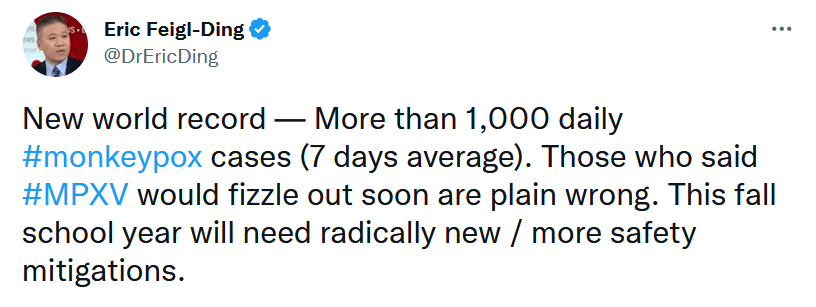
Today Monkeypox is in the rear-view mirror. The vaccine rollout was stymied by some impressively bad government bureaucracy, but the vaccines worked, the virus was only as contagious as the experts said, and spread almost solely through the populations the experts said it would. It was never airborne, and it never ran rampant the way doomers thought (hoped) it would.
Speaking of the distant past, remember Credit Suisse?

A few weeks ago, Credit Suisse was supposed to have a “Lehman Brother’s” moment, their debt was so extraordinary that they were destined to collapse, taking the global banking system down with them. There’s up 20% in the last month and show no signs of default.
Remember Shanna Swan? She’s made headlines claiming that the human race could go extinct due to chemicals in our environment destroying male fertility. Personally I knew this claim was bunk from the moment I read it because biologically speaking, human reproduction is basically identical to all mammalian reproduction. If human fertility really was plummeting due to the chemicals in our environment, then other mammals (the cows we ranch, the dogs and cats we live with, even the rats that infest our subways) should have also seen plummeting male fertility due to their bad luck of sharing the planet with us. Yet somehow no overall drop in mammalian fertility was recorded, this catastrophe only affected humans. No ranchers complained of an inability to fertilize their cows, no reduction in stray dogs and cats was reported due to drop in male fertility, this was somehow the one biological process that humans and no other mammals were subject to. It turns out there was a good reason for that because her whole doom prediction was junk and rested entirely on flawed assumptions.
I’ve grown pretty tired of the endless predictions of collapse doled out by social media. Every week it seems there’s another new thing that will destroy us all but when life carries as normal none of the prediction-mongrels ever admit they were wrong. There’s more than enough actual bad things out there without social media taking misunderstood factoids and extrapolating the complete worst-case scenario out of it all. I’d like to have some more accountability for prediction-mongers but social media makes that impossible as by the time some coming catastrophe can be conclusively proven false, a new one has been conjured up in its stead. Repeat ad nauseam, giving constant predictions of collapse and using any downturn of any kind as evidence for your accuracy. It’s just tiring.
 Streams of Consciousness