Will the market recover in the new year? Or do we still have a ways to go? Bears online have been going on and on about “capitulation” as in “nothing will change until we finally have capitulation.” Capitulation in normal terms means surrender, so in financial terms it means the point where investors finally give up holding and sell their shares at a loss. According to Investopedia capitulation is also the point where the investment hits its bottom. Prima facia this is a circular argument, “we won’t hit the bottom until we’ve reached the bottom” is another way to phrase it. But even dumber, this is a backwards looking argument that cannot be used for predictions. Over the year of 2022, $SPY (a popular ETF that tracks the performance of the S&P 500) hit it’s 52 week low in November at 348$ per share (it currently trades at 382$). Who’s to say that that wasn’t the capitulation, and it won’t go below that? When the S&P500 hit 666 in 2009, that was the bottom of the bear market, yet many people still didn’t believe it, expecting that there was still more pain to endure. It wasn’t until a while later that we realized no, that really was the bottom, there’s no more “capitulation” after that. So I don’t put any stock in people talking about “market capitulation.”
Tag Archives: history
Interpretatio graeca for Chinese myths and legends
I’ve been reading an interesting book from 1931. It discusses the motifs and references used in Chinese art, highlighting the Taoist, Confucian, and Buddhist stories that many of them derive from. However the book has a problem in that the authors were clearly trying to relate every Chinese story back to the stories they were more familiar with, mainly Indian Buddhist stories but also Roman/Greek ones as well. The Romans used to do this all the time, they called it “interpretatio graeca.” The Romans figured that every god or goddess in every culture was merely a manifestation of a god they were already familiar with, so they would “interpret” foreign gods as being the same or similar to their Roman/Greek gods. So Ra, the chief god of the Egyptians, got conflated with Apollo in Roman writings because since they shared a sun motif they must be identical, right? But Ra was not the same as Apollo, and Chinese myths are not the same as Indian myths, yet the authors of this book keep conflating the two and interpreting Chinese myths through a lens of Indian myths.
The book itself is called Outlines of Chinese Symbolism & Art Motives (sic) by C.A.S. Williams. In many respects it works well as an overview of the history and stories that make up a lot of Chinese art, and a primer into Chinese art culture. And yet it falls into this trap again and again of trying to interpret everything unfamiliar through the lens of the familiar. I understand perhaps that for the reader this can make things easier, saying that “This god is the king of the gods, he rules the sky and causes lightning to happen” may be harder to remember than saying “he’s like Zeus,” but saying “he’s like Zeus” brings a bunch of inaccurate assumptions that really aren’t true to what the Chinese sky god is actually like.
I wonder if this is in part because of out-dated theories in comparative religion. There was a vibe for a time of assuming that all myths and legends were just borrowed or stolen from earlier cultures. Jupiter and Zeus weren’t an original idea, they must have been borrowed by the Greeks and Romans from some previous culture that had a sky god wielding thunderbolts and ruling the other gods. The theory went on to say that every single sky-god in history was just a borrowing of a borrowing from an “original” sky god that was dreamed up 10,000 years ago. But the other option is to realize that “sky god causes thunder” is an easy thing for different people to come up with independently. Assuming that every myth in history was borrowed from somewhere else is also how you got inaccurate claims that for example “Jesus was just re-branded Mithra” and other ahistorical nonsense. It’s a very human feeling to want to related everything back to something you already know well, but it doesn’t lead to good history and so it should not be a feeling used in Academic writing.
Still, for a book from 1931 Outlines is surprisingly good, I enjoy being able to read the characters and phrases it writes in original Chinese, and learning the meaning behind some of them with it’s usually accurate descriptions of etymology. The descriptions of myth and stories generally seem accurate and the nonstop conflations with Indian myths can be ignored. I got this for 6$ at a used book store and I think it was worth the money.
Yes it’s OK that J Powell killed your puts
I’ve been trawling through old internet posts, and I found something interesting from March 2020. I won’t quote it directly but the gist was this:
I knew the market would crash due to Coronavirus, now that rat bastard J Powell comes in and pumps the market with free money, killing all my puts. What the fuck is this? Are you going to buy my puts from me now since they’re *distressed assets*?
As should be obvious this comes from the time when the Federal Reserve announced they would take every possible measure, including buying “distressed assets” in order to maintain liquidity in the market. Obviously anyone who was hoping a liquidity crisis would create a market crash was SOL, but for the good of the nation as a whole it’s better that our economy keeps chugging than a few disaster capitalists make it rich.
But it does raise a somewhat unfortunate truth: the Federal Reserve mostly buys up the assets of rich institutions that don’t need the help. The Fed buying someone’s underwater mortgage doesn’t actually help them, they’re still underwater and in debt, but it does help the bank that wrote the mortgage and is now facing a loss. The bank gets to offload the “distressed asset” (ie bad loan) and go use that money to make more money, while the mortgage owner just gets a new person they have to pay. It’s genuinely true that the Fed gives the greatest help to those already wealthy, and those of us not wealthy have to live with the consequences. Although all of us are helped in a way by the Fed maintaining liquidity in the economy, we aren’t helped to nearly the same extent as the banks that get to offload their bad decisions onto the government. I think it’s good that the Fed maintains liquidity, but I think there need to be more strings attached, demanding equity in exchange for liquidity would be a very fair trade in my book. And if banks don’t want the Government to own a percentage of them, then they can just refuse the free money.
The End of Growth part 5: How much more improvement is possible?
As I continue The End of Growth by Richard Heinberg, I’m struck most of all by his lack of creativity. When thinking about the future, most of us should be able to conjure up some ideas of how the world could be a modestly better place to live. Cars will become electric so no more filling up with gas, telework will get more common and we can all work from home, over 400 clinical trials are currently trials are currently studying Alzheimer’s disease, maybe one of them will cure it. These are all things that could change our society for the better and would contribute to economic growth. More efficient cars mean transportation is cheaper and so people can partake in more of it, in a very real way the supply of transportation will be increased, leading to an increase in GDP and a decrease in prices. And this is true of pretty much all technological advancements, technology is supposed to be deflationary, growing our economy while reducing prices. Yet Richard Heinberg doesn’t really see how technology could ever improve our lives from his lofty vantage point of 2011
We may be able to further improve the functionality of the Microsoft Office software package, the speed of transactions on the computer, computer storage capacity, or the number of sites available on the internet. Yet on many of these development trajectories we will face a point when the value of yet another improvement will be lower than its cost to the consumer
Yeah let me stop you right there Rick. If the cost is greater than the utility, then the product is unprofitable and it fails. Like the Nimslo Camera or the Quibi streaming platform, the world of tech is littered with big fails where product designers make something that consumers don’t buy. Yet here’s the secret Rick, if people do buy it then it is adding value to their lives greater than the price they pay for it. Richard Heinberg wants to paint a picture where our ever improving technology isn’t actually bringing any net good to consumers, yet by definition it IS otherwise the consumers just wouldn’t buy it. Consumers aren’t brainwashed automatons (as much as marketers wish they were) you can’t force them to buy something they don’t want. And consumers over the years have proven very willing to turn up their nose at goods and services which bring them less value than what they cost.
He continues:
At this point, further product “improvements” will be driven almost solely by aesthetic considerations […] for many consumer products this stage was reached decades ago.
Damn Rick, you’re right, the only reason people buy iPhones instead of old rotary-dialers is because of the aesthetics, not because you can access the whole world at the touch of a screen. And TVs, who needs a big plasma TV? Hell life was better in black and white anyway! And don’t get me started on ovens, pots, and dishware, sure these modern fancy kitchen appliances are less likely to burn your house down or leach carcinogens into your food, but is that really worth the cost?
If it sounds like I’m mocking Richard Heinberg it’s because I am. I diagnose him with a terminal lack of creativity, and an inability to see the improvements in life happening all around him. Every year consumer products, not just our electronics but our cookware, our houseware, our vehicles, they all continue to improve and become more safe, more efficient, and more useful. But Rick can’t understand why Microsoft Office became a subscription service and so questions whether technological improvement is even possible. Here’s a thought Rick: maybe you aren’t the target market for improving technology? Maybe you’d be happier with a typewriter and a sundial and thus don’t represent the average consumer? I can tell you that as a scientist, modern Microsoft Office is WAY better for me than what we had a decade ago. Since all my programs and files are on the cloud, I can sit down at any computer anywhere in the world and do my work. I don’t need to lug a PC everywhere I go, I can sit down at any PC and get to work. I can also collaborate easily with people anywhere on earth because all our files are in the cloud so we can work on them together instead of editing on our local machines and then sending versions back and forth through email.
My job has become immeasurably easier since Richard Heinberg wrote his book in 2011, the increased utility from technological advances like computer software, computer hardware, and internet communication have made me more productive and a hell of a lot more happy. Technology has worked great for me and I’m glad to pay for the privilege of it. Rick can stick to his sundials if he really thinks technology peaked in the past.
The End of Growth: weekend extra part deux
I spoke more with my friend about The End of Growth by Richard Heinberg. As a reminder, the book posits that (after 2011) economic growth is no longer possible in our world. My friend opined that it would be better for everyone if companies were incentivized to focus on sustainability instead of growth.
I think this focus on sustainability is true and necessary, but here’s my thought: sustainability is an economic externality, and if we want it we must make taxes or laws to encourage it. We already do in some cases, my town has a minimum size of lawns for houses, the reason being that we don’t want to tear up all the trees and pave over all the grass in pursuit of houses. The trees and grass are considered an externality, if the housing market had no rules then for many companies it would be more profitable to build bigger homes and more homes on the same size lot, with no trees or grass at all. The grass especially is important however, as rain soaks into it, and if you pave over the grass then that rain just runs downhill to somewhere else. If all of the city was paved over, the lowest elevations would be flooded with every rainstorm. If that happened then one of two things would have to happen: either the city would have to pay billions upgrading the storm drains (essentially privatize profits and socialize loses for the housing industry) or the lower elevation areas would quickly become the poor slums where people had to abandon their flooded houses in every rainstorm.
So we already in some cases make laws dealing with sustainability and externalities, you can’t build whatever you want in a national park because we’ve decided that those need to be sustained for future generations. Now the problem is that not everyone agrees on what is good sustainability and thus what should be taxes or forbidden by law. A coalition of YIMBYs and housing moguls in my city are trying to change the law to eliminate lawn minimums, saying they prevent the construction of more housing. I’d say I agree with them on the balance, but sustainability advocates have their own point: what about all the trees and all the rain? Shouldn’t we have a city that isn’t baked by the sunlight and not flooded in every storm?
To that same point, sustainability taxes/laws have been proposed in many other ways, but they always come with tradeoffs. A carbon tax encourages us not to increase CO2 levels, but what about the working poor who can no longer afford to drive to work? Access to a car is very closely linked to upward mobility, because if you can only work in jobs you can walk or bus to then your options are severely limited. We can also put taxes on plastic to discourage single-use waste that is trashing our oceans, but is taxes on our plastic use worth the hit that would be taken by modern biology and chem labs, some of which are researching the very medicines we needed during the last pandemic and will need again during the next one? Everything in a modern bio or chem lab is single use in order to meet very strict standards of reproducibility by preventing contamination. The lack of single-use plastics would either require us to use more expensive alternatives (single-use glass) or require us to relax our standards (multi-use glass where we accept that molecules and biologics from a previous experiment won’t always be removed by the cleaning process).
Sustainability requires tradeoffs, it’s something we should strive for but we need to understand and be mindful of those tradeoffs. Companies and people will always be pushed by economic forces, if there was a massive carbon tax I wouldn’t own a car, and if there was a single-use plastic tax then my lab might not be have money to function.
The End of Growth: weekend extra
While talking about The End of Growth by Richard Heinberg with a friend of mine, my friend brought up two important points. One I’d like to discuss today, the other one tomorrow.
For today’s topic, we discussed how it seems a shame that companies have to grow to survive. Everything around a company is always growing, so if a company isn’t itself growing them in relative terms it’s shrinking. Wouldn’t it be better if companies didn’t have to laser-focus on growth? And what does that means for the economy as a whole, that the companies that make it are focused on growth at the expense of all else?
This topic made me remember the “Red Queen Hypothesis” in biology. In Through the Looking Glass, the Red Queen tells Alice “Now, here, you see, it takes all the running you can do, to keep in the same place.” This gave its name to a hypothesis in biology that species must be constantly evolving and proliferating or else they go extinct. In much the same way that companies area always competing, so to are species always competing, and the competitor that cannot go forward will go extinct. I’d idly curious if anyone has adapted the Red Queen hypothesis to economics, is this biological law really part of a broader law on competition?
But more to it than that, I think the constant strive for growth is a very human feeling to have. We are all ruled by emotions of wanting more or at least of not wanting to lose what we already have. That in turn forces us to work every day to make the money we need to keep what we’ve got and get what we want. I know a lot of people my age would love to be able to get a better job to buy a house and start a family, and that requires striving and working towards that goal. And I know a lot of our parents already have a house, maybe even a fully-paid for house in a nice location with a large 401k. Many of our parents could probably sell their house and car, buy a small cottage in the middle of nowhere, and live on baked beans and rice for the rest of their life using only a small fraction of their wealth every year. It wouldn’t be a glamorous life, but commuting once a week into town for beans is surely easier that commuting every day to work? But no one does (or at least very few do) because they’d like to keep their lifestyle and even improve it with a vacation or a cruise every now and then.
Companies are run by people and those people have the same emotions we all do, they want to get what they want and keep what they’ve got. Not just the managers and the C-suite but the investors and the workers as well. The tech workers at Amazon want to move up in the hierarchy or at least get a good recommendation for their work on a stellar project so they can move to some better job. Failing that they’d really hope Amazon stays profitable so they don’t get laid off. The investors in Amazon want their investment to grow or at least not shrink too much, as they’re counting on it to maintain their lifestyle once they retire. Jeff Bezos would probably like to own a Mars colony or at least not have to sell the Washington Post. They all want more and so they all push the company in their own ways to do more.
I think it’s a far fear to have that companies seem focused solely on growth at the expense of all else, because we can all see that many of them will hit an unavoidable wall and stop growing. And it leads to the question of what happens when a company stops growing, when they hit a wall, what happens? I think all companies do eventually find themselves hitting a wall they can’t surpass due to cultural or technological reasons (Amazon and Facebook/Meta may be hitting it now). But it’s important to realize there are always new companies ready to take their place. New companies can always be formed using new technology, and they in turn can use resources more efficiently and effectively, leading to higher and higher growth. Those companies mature, hit a wall, and someone new comes to take their place.
Just look at Tesla or a 2022 Toyota Corolla. 70 years ago it took a massive amount of oil (10 miles to the gallon!) to drive cross-country, and the car you sat in was made required a ton of man-hours to build and wasn’t even all that safe. Today I can get from here to Minneapolis using no oil at all (I can even charge as solar powered charging stations), and the car was made mostly by machines and not men, and it’s got a huge number of safety features making me much more likely to make it to my destination. In real economic terms the car I drive today is worth way more than the cars driven 70 years ago, even the cars driven 10 years ago, and continued advances in technology show no signs of slowing.
Even if exactly the same number of cars were made today as were made 70 years ago, we would say there’s been economic growth as those cars are more efficient, safer, and cheaper to build in terms of man-hours. The supply of cars has not been constant however and has in fact grown, the labor freed up from people who used to work in a Ford factory has been refocused into healthcare and IT, leading to advances there.
That economic growth is good for all of us, and it came about because some new companies were laser focused on growth. Toyota and Tesla have improved the cars we use in both safety and utility, and someday a new company may come to knock them off their perch. That new company will continue to grow by providing us with better products than what came before, and each new company is focused on growth because, again, the people running these companies are all humans with the very human desire of wanting more. I don’t think you can end the desire for growth without ending humans
The End of Growth part 3: Peak Oil
I’m still going through The End of Growth by Richard Heinberg. His central thesis is that in 2011 the world economy completely changed and we can expect no real economic growth happening after that year. He furthermore discusses Peak Oil and how it’s the key to understanding the end of growth. Here’s his first prognostication on oil:
The US had been the world’s primary oil producer, but by 1971 its oil production peaked and began to decline
This was a very defensible position in 2011. Not so today when we’ve seen US oil production skyrocket once again and far outstrip the highs of 1971. Even in the absolute depths of the Coronavirus pandemic, when oil prices briefly dipped below zero dollars and producers had to pay to get excess oil shipped out, oil production was higher than the “peak” of 1971.
An aside: how can oil prices dip below zero but oil wells still afford to pump? Well the coronavirus pandemic was temporary, we all knew it was temporary, and oil wells kept pumping in expectation of the good times just around the corner. Those good times have indeed come to pass, and the price of oil has rocketed back up again along with new production to feed this demand. The price was below zero, but that doesn’t mean you could get oil for “free,” it was only below zero if you showed up to an oil well with the proper equipment and container vehicles to ship oil off the property.
Anyway, Richard Heinberg goes on to sketch out the Peak Oil scenario that he believed in 2011 was an inevitable future. I don’t want to just quote his book verbatim but I’ll summarize it here:
- Around the year 2010 oil production inevitably stagnates, leading to oil prices skyrocketing. This causes an economic crash
- The economic crash leads to economic contraction, meaning oil demand slackens and oil prices fall
- Oil prices falling means demand can pick back up
- …but then oil prices also go up, leading to yet another economic crash
- We repeat theses steps ad infinitum, each boom/bust cycle happening quicker and quicker and causing more and more social chaos
- No force is able to stop this cycle, price volatility precludes oil investment which means supply remains constricted
He goes on further to state that this scenario isn’t actually a prediction of the future, it’s a description of the past
- This Peak Oil cataclysm began in 2008, led in part to the Financial Crisis, and continues to the present time (2011 when Heinberg wrote his book)
This is all very interesting, especially the key feature of his theory that new supply will never be be able to be produced in quantities that will keep up with demand. He claims that rising and falling prices will ensure that there is too much volatility to make the investment sound, and that in part is his theory for why this cycle can’t be escaped with oil. It’s an elegant theory, but it’s a theory that’s been proven false since he wrote it, oil supply did increase and volatility wasn’t an impassible barrier for new production.
Even without the benefit of hindsight it would be unreasonable to believe his theory in the first place as it assumes no one has any sort of agency during this crisis, everyone can only watch helplessly as the price of oil rockets up and down. Let’s discuss the story of Joseph in the bible for a second: The Pharaoh foresaw that 7 years of good harvests would be followed by 7 years of famine and asked Joseph what he could do to prevent calamity. Joseph explained to him the simple principle of storage and rationing: store food during the good times and hand it out during the bad. Instead of a boom/bust cycle leading to massive death and destruction, Egypt under the Pharaoh and Joseph had a smoothed-out supply allowing them to weather the storm and continue living and farming. I bring this up not as a bible lesson but to explain that we have known for thousands of years how to prevent the exact cycle described by Heinberg’s theory from occurring. If we can predict something like this then we can prevent it using even the simplest of economic activities such as storing and rationing.
The United States even has an entire system dedicated storing and rationing oil: the Strategic Petroleum Reserve. When prices are low, the US buys oil and fills the reserve, which keeps the price high and encourages producers to keep producing and investing. When prices are high (such as 2022), we empty the reserve, selling the oil and alleviating the worst effects of the shortage. And the US government isn’t the only one engaged in this, from OPEC to Exxon-Mobile, nearly every oil-producing entity has or pays for a way to store oil during the glut and sell it during the dearth, to mothball unneeded production but then turn it back on when prices spike. The Peak oil cycle never happened, Heinberg theorized that oil supply would stay relatively constant as the volatility precluded investment but instead the volatility was mostly smoothed out by both market and government forces and investment (and production) have continued to rise.
As I said, the cycle sketched out by Heinberg isn’t just theoretically unsound it was disproven by history. He suspected that low oil prices would allow economic growth, leading to high oil prices and another crash. But while oil prices did dip not long after his book came out, they dipped because of sky-high supply from the US and OPEC not contracted demand due to an economic crash. Let me state that again: falling demand did not cause oil prices to crash, rising supply did, which runs completely contrary to Heinberg’s Peak Oil theory. Oil investment has continued and oil production has increased, the US currently produces around 12 million barrels of oil a day, more than any time in the 1970s and more than double as much as was produced when Heinberg’s book was published. I wonder what he would think about that.
The End of Growth part 2: growth didn’t begin with oil and coal
I’m continuing to read The End of Growth by Richard Heinberg. His book claims that, from his vantage point in 2011, economic growth is no longer possible and that any future growth is a myth propped up by financial trickery. Part of his thesis rests on the idea that economic growth as we know it only came about through continued advancements in hydrocarbon extraction. Oil, coal, and natural gas, these are all commodities of incredibly high energy density but incredibly low transportation costs: burning them is easy and liberates energy. This energy then powers economic growth. He blithely asserts that prior to the discovery and utilization of these hydrocarbons economic growth basically didn’t exist, and when we have used up the last of these hydrocarbons it will cease once again. It’s that first bit I’d like to take issue with today.
Economic growth didn’t start with coal. Mr Heinberg seems to have a very Eurocentric and modern-centric view of history, ascribing 100% of all economic growth to the time after the industrial revolution. It’s true that in millennia past, a nation’s power lay mostly in its raw population total. That’s because 90%+ of all people were usually subsistence farmers, and mobilizing their labor for war or public buildings was how most nations used their power. But growth still occurred before the industrial revolution, and we see evidence of it through history.
For example: technology is growth. If every single year an average person can do more and more using less and less, isn’t that a case of economic growth? Wouldn’t we measure that as an increase in GDP? And technology has been progressing for every millennium of human history, not just the last few centuries. Take Italy in the 16th century and compare it to Roman Latium from the 1st century, a middle class urban Italian could enjoy luxuries the likes of which a senator or emperor could only dream of. Take books for example, in Latium it would have taken a team of scribes several weeks or months to copy by hand all of Julius Caesar’s Bello Gallico, meaning that copies were limited and had to be fiercely protected. Meanwhile an Italian with a printing press could print off a few hundred copies all by himself, selling them and other books out to middle class folk and letting middle class libraries expand to point that people could spend their entire lives just reading (and some folks did just that). In a very real sense we would say that the printing press led to a growth in the Italian economy, because more books could be made with less labor. This freed up labor to do other things, those former scribes could now go on to be writers themselves, or inventors or even go back to the field as farmhands.
If you took the GDP per capita of Roman Latium and compared it to the GDP per capita of 16th Century Florence, you’d find a hell of a lot more stuff being produced per person per year. The printing press and technological innovations like it had allowed the Italian economy to grow in ways that didn’t require extracting more resources out of the ground, and the same holds true in our economy today.
So even if the very last drop of oil or nugget of coal is extracted from our earth, why would we ever believe that growth would stop right there? Oil, coal and gas are just useful stores of energy, there are other ways to store and transport energy that we could use, and further technology that we can develop to grow our economy. A cheap, fast, and accurate 3D printer using solar power and bioplastic would lead to considerable economic growth, and there’s no reason to think its invention would be impossible in a world without oil. So while it may be true that oil is a finite resource, that truth bears no relation to truths about economic growth. Growth has never required oil, even today solar and wind power are becoming greater and greater proportions of our national electric grid, and when we finally transition away from oil growth will not stop, just as the Italians didn’t need oil to start their growth in the 16th century.
The end of growth?
I’m doing that thing again where I read old books just to dunk on the authors. This time it’s “The End of Growth” by Richard Heinberg. Written in 2011, here’s how it starts:
The central assertion of this book is both simple and startling: Economic growth as we know it is over and done with
Heinberg goes on to say that although countries may still experience a few quarters or even a whole year of growth,
the general trend-line of the economy (measured in terms of production and consuption of real goods) will be level or downward rather than upward from now on
Not only that, but Heinberg goes further in decreeing that this is true for the entire world, not just any one nation. Any national growth in one nation (which will necessarily be very small, as stated above) will be balanced out by a reduction in the size of the other economies of the world. Heinberg confidently asserts:
the global economy is playing a zero-sum game, with an ever-shrinking pot to be divided among the winners
This is, to put it bluntly, laughable. It was crockery in 2011 and it’s only been proven more ridiculous as time has gone on. It goes back to my post from before about how everyone is always fighting the last war, in 2011 with growth still anemic this seemed like a defensible conclusion but today, not so much. And more broadly, history has proven this thesis to be wrong startlingly quickly: the Federal Reserve has a handy-dandy chart of US GDP in constant dollars (ie dollars accounting for inflation) and we can use it to see that in 2011 the GDP was about 17 trillion dollars, and by 2019 (the most recent year on the chart) it had climbed to 20.5 trillion; a growth of 20% over just 8 years. And it’s not like this is fake growth either, you can see it in the cars we drive and the gadgets we use: lane assist, rear-facing cameras for backing up, electric vehicles, hell even smartphones and tablets. These are all new and useful things that we didn’t have as much of in 2011. Just 31% of Americans owned a smart phone in 2011, today that number is nearly 90%. Just a quick look around us should dispense with this idea that growth has ended, even the consumption of oil, electricity, and natural gas have gone up. Real growth in our economy has occurred.
So the trend-line for America has most decidedly not been flat, but what about the rest of the world? Have we merely stolen growth from everyone else? Hardly. Look at China and India, two countries accounting for around 1/3 of the world’s population, their economic growth has continued to outpace America since even before 2011. They’re growing faster than us, using even more oil, electricity, and natural gas, and buying even more smartphones and electric cars than we are. They are definitely growing in a very real economic sense. And what about the rest of the world? Europe hasn’t grown quickly, but they are by now means trending downward, and neither are Africa, South America, or the rest of Asia and North America. Every part of the world’s economy has seen real growth in the past decade, with real increasing in living standards being the norm not the exception.
And this isn’t an illusion. Mr Heinberg seems strongly intent on portraying any semblance of “growth” as nothing more than an illusion created by debt, yet the fact that I’m typing this out on a laptop that’s computationally stronger than my 2011 desktop seems to put paid to that idea. Heck, I’m in science, 10 years ago Cryo-EM was barely able to do any of the stuff we take for granted today, now we can image and define the structure of thousands of proteins relatively easily. Is this just an illusion? Is our ever-expanding catalogue of verified antibodies for scientific experiments an illusion? What about the fact that just 2 years ago we invented and deployed an entirely new type of vaccine for a disease no one had ever heard of before? That literally happened, and it isn’t an illusion. Technology has continued to rapidly progress since 2011 and shows no signs of stopping, Mr Heinberg’s thesis on growth seems utterly ridiculous. And even our base inputs continue to go up, the amount of oil pumped and burned continues to go up year after year, alongside the amount of electricity the world is using. I’d love to hear Heinberg’s explanation for how world energy consumption keeps increasing year after year despite our growth having ended.
So why did Mr Heinberg think that growth was ending? Well I’ll have to keep reading, but I think that like I said he was simply fighting the last war. The Financial Crisis was a real shock to a lot of people, and the lethargic pace at which the world’s economy recovered from it made people think that it was a new normal. But it wasn’t. Secretly I also wonder if Mr Heinberg is of the heterodox economic school which believes that steady-state or even de-growth is preferable to economic growth. When one looks at all the resources humanity is using one instinctively feels they must eventually all run out. But Malthus predicted we’d outstrip our food supply centuries ago and despite him and many others believing this to be true, year after year people are eating more and living longer than they ever did, along with enjoying more and more of the amenities of modern life. I don’t know what Mr Heinberg was thinking when he wrote this book, but on the first page I can already say lol, lmao even.
Let’s see how he defends his thesis.
Remember when Monkeypox was the next COVID?
Oh the halcyon days of three months ago. I was younger, the air was warmer, and twitter was aflutter with hysterical reports on how Monkeypox was rampaging through the population and would soon run wild through schools as soon as the fall semester began
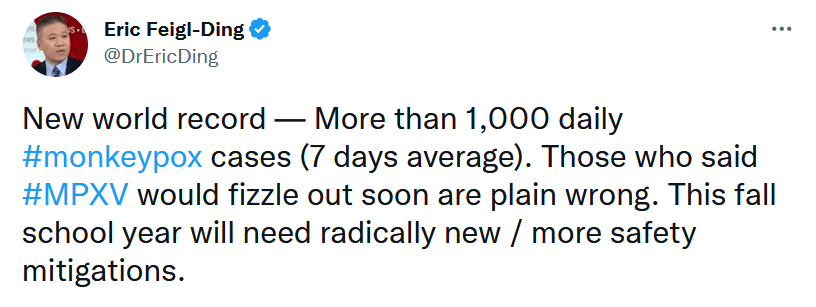
Today Monkeypox is in the rear-view mirror. The vaccine rollout was stymied by some impressively bad government bureaucracy, but the vaccines worked, the virus was only as contagious as the experts said, and spread almost solely through the populations the experts said it would. It was never airborne, and it never ran rampant the way doomers thought (hoped) it would.
Speaking of the distant past, remember Credit Suisse?

A few weeks ago, Credit Suisse was supposed to have a “Lehman Brother’s” moment, their debt was so extraordinary that they were destined to collapse, taking the global banking system down with them. There’s up 20% in the last month and show no signs of default.
Remember Shanna Swan? She’s made headlines claiming that the human race could go extinct due to chemicals in our environment destroying male fertility. Personally I knew this claim was bunk from the moment I read it because biologically speaking, human reproduction is basically identical to all mammalian reproduction. If human fertility really was plummeting due to the chemicals in our environment, then other mammals (the cows we ranch, the dogs and cats we live with, even the rats that infest our subways) should have also seen plummeting male fertility due to their bad luck of sharing the planet with us. Yet somehow no overall drop in mammalian fertility was recorded, this catastrophe only affected humans. No ranchers complained of an inability to fertilize their cows, no reduction in stray dogs and cats was reported due to drop in male fertility, this was somehow the one biological process that humans and no other mammals were subject to. It turns out there was a good reason for that because her whole doom prediction was junk and rested entirely on flawed assumptions.
I’ve grown pretty tired of the endless predictions of collapse doled out by social media. Every week it seems there’s another new thing that will destroy us all but when life carries as normal none of the prediction-mongrels ever admit they were wrong. There’s more than enough actual bad things out there without social media taking misunderstood factoids and extrapolating the complete worst-case scenario out of it all. I’d like to have some more accountability for prediction-mongers but social media makes that impossible as by the time some coming catastrophe can be conclusively proven false, a new one has been conjured up in its stead. Repeat ad nauseam, giving constant predictions of collapse and using any downturn of any kind as evidence for your accuracy. It’s just tiring.
 Streams of Consciousness