College Students and Desire Paths

I blogged before about video games and desire paths, but I wanted to add something from my own work experience as well.

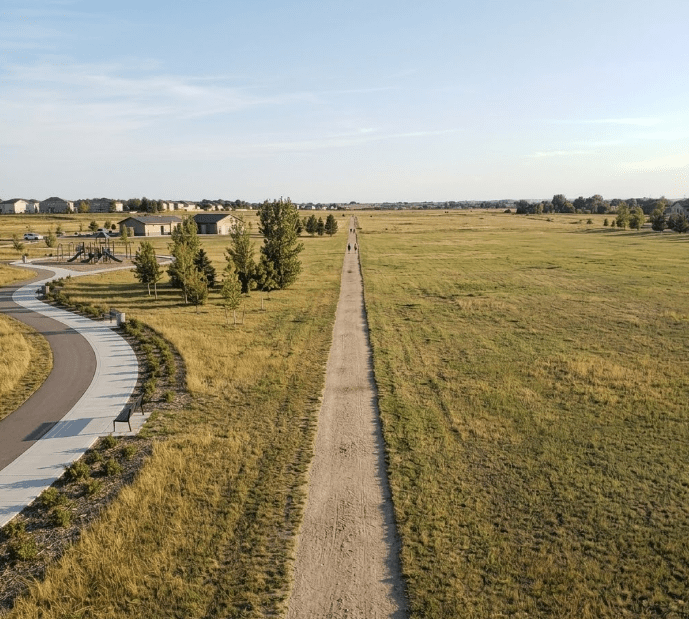
To reiterate, a desire path is a dirt path worn down by people trying to get from A to B in the quickest way possible. There may be a concrete path that gets from A to B, but if it winds around and is inefficient, people will make their own path instead.

I teach science, and I like to say that “students, like molecules, seek the lowest energy state.” A good teacher of wants to set up their class so that the students learn something, and then are asked to demonstrate their knowledge, with the grade being given for how well they do at demonstrating. Students aren’t necessarily there to learn however, they are often grade-focused. So they seek any way to improve their grade at no cost in energy.

When a student writes a lab report, it takes them time and effort to actually study the material, learn the chemistry behind their experiment, and explain what they did and what their results entail. It takes a lot less energy to instead laser-focus on the rubric and attempt to game the system by answering only the questions presented in the rubric without ever understanding the actual experiment.

Here’s an example: the rubric asks the students to “explain the 2-stage design of the experiment, and doing the first stage was necessary to complete the second stage.” A student may try to answer: “the experiment had a two-stage design, and doing the first stage was necessary to complete the second stage.” But they aren’t actually explaining anything, they’re just repeating the question as a statement and hoping a bored grader will let them slide on through.

This is actually made worse by the grading system my department has implemented for labs. In a classical class, lab reports are graded for accuracy and the average of all lab report grades is the grade you get for the lab class. In this new system however, labs are graded on a pass/fail system, with a 70% being all that’s necessary for a “pass.” Then the student’s grade at the end of the semester is based on how many labs they passed, and any labs they don’t pass can be resubmitted at a later date.

This 70% + pass/fail system incentivized many students to try to game the system and answer just enough so they can get a “pass,” without actually trying to do well on the entire lab report. Because what’s the incentive to put effort in when a 70% and a 100% get you the same result? Students will very clearly just give up on doing one of the 5 rubric items, because they know doing the other 4 items well gets them a pass. This often leads to students completely the class with high grades but with gaping holes in their knowledge, as they just ignored parts of the material because it was too hard and focused on acing the easier parts instead.

I’ve spoken to the department that this is a bad incentive system if we want students to learn. Student’s won’t really try to learn all the material if learning just 70% gives them the same grade as learning 100%. The department is right now *only* focused on how many students pass, and this easier system is indeed increasing student scores.

I said before that a desire path should make you rethink how your system is set up, and try to incentivize people to go in the directions they should be going, without just putting road blocks on the desire path. You can pave a newer, quicker path, or you can change where things are located so people are incentivized to walk the paved path.

The same is true for student learning, if your system incentives students to half-ass it, change the incentives. Don’t just clap that more are passing and then wonder why people are having a harder time with upper level courses later.

So just how *do* you get good at teaching?

As a scientist with dreams of becoming a professor, I know teaching is part of the package. Whether it’s a class of undergraduates or a single student in a lab, your knowledge isn’t worth anything if you cannot teach it to others. I always say: no one would have cared about Einstein if he couldn’t accurately explain his theories. It doesn’t matter how right you are, science demands you explain your reasoning, and if you can’t explain in such a way to convince others, you still have a ways to go as a scientist.

Einstein was a teacher. After discovering the Theory of Relativity, he wrote and lectured so as to teach his theory to everyone. Likewise I must be a teacher, whether teaching basic concepts to a class of dozens, or teaching high-level concepts to an individual or a small group, teaching is part of science, and mandatory for a professor.

But how do I get good at it?

The first problem is public speaking. I don’t think I get nervous speaking in public, but I do have a tendency to go too fast, such that my words don’t articulate what I’m actually thinking. It’s hard to realize that the concepts you know in your head will be new and novel to the whole world that lives *outside* your head. When teaching these concepts to someone else, you need to go step by step so that they understand the logical progression, you can’t just make a logical leap because you already know the intervening steps.

So OK, I need to practice speaking more, but beside that, what’s the best method for teaching? And here we get to the heart of why I’m writing this post, *I don’t know and I don’t think anyone does*.

Every decade it seems sociologists find One Weird Trick to make students learn, and every decade it seems that trick is still leaving many students behind. When I went to school, teaching was someone standing at the front of the class, giving a lecture, after which students would go home and do practice problems. This “classic” style of teaching is now seen as passe at best, outright harmful at worst, and while it’s still the norm it’s actively shunned by most newer teachers.

Instead, teachers now have a battery of One Weird Tricks to get students to *really* learn. “ACTIVE learning” is the word of the day, the teacher shouldn’t just lecture but should involve the students in the learning process.

For instance, the students could each hold remote controls (clickers) with the numbers 1 through 4 on them. Then the teacher will put up a multiple-choice question at random points during class, and the students will use their clicker to give the answer they think is correct. There’s no grade for this except participation, and the students’ answers are anonymized, but the teacher will give the correct answer after all the students answer, and a pie chart will show the students how most of their classmates answered. So the theory is that this will massively improve student learning in the following ways:

  • Students will have a low-stakes way to test their knowledge and see if they’re right or wrong, rather than the high-stakes tests and homework that they’re graded on. They may be more willing to approach the problem with an open mind, rather than being stressed about how it will affect their grade.
  • The teacher will know what concepts the students are having trouble on, and can give more time to those prior to the test.
  • Students stay more engaged in class, rather than falling asleep, and likewise teachers feel more validated with an attentive class

The only problem is that the use of clickers has been studied, and has failed to improve student outcomes. Massive studies and meta-analyses with dozens of classes, thousands of students, and clickers don’t improve student’s learning at all over boring old lectures.

Ok, how about this One Weird Trick: “flipped classrooms.” The idea is that normally the teacher lectures in class and the students do practice problems at home. What if instead the students’ homework is to watch the lecture as a video, then in class students work on problems and the teacher goes around giving them immediate and personalized feedback on what they’re doing right or wrong?

In theory this again keeps students far more active, they’re less likely to sleep through class and the immediate feedback they receive while working through the problem sets helps the teachers and students know what they need to work more on. Even better, this One Weird Trick was claimed to narrow the achievement gap in STEM classes.

But another large meta-analysis showed that flipped classrooms *again* don’t improve student learning, and in fact *widen* the achievement gap between minority and white students. Not at all what we wanted!

In theory, science teaches us the way to find the truth. Our methods of storing information have gotten better and better and better as we’ve used science to improve data handling, data acquisition, and data transmission. I read both of those meta-analyses on my phone, whereas even just 30 years ago I would have had to physically go to a University Library and check out one of their (limited) physical journals if I wanted to read the articles and learn if Active Learning is even worth it or not.

But while we’ve gotten so much better at storing information, have we gotten any better at teaching it? We’ve come up with One Weird Trick after One Weird Trick, and yet the most successful (and common) form of teaching is a single person standing in front of 20-30 students, just talking their ears off. A style of teaching not too far removed from Plato and Aristotle, more than 2,000 years ago.

I want to get better at teaching, and I think public speaking is part of that. But beyond just speaking gooder, does anyone even know what good teaching *is*?