I’ve blogged before about my time in cryo-EM studying Alzheimer’s, but I want to bring you a quandry:
Cryo-EM can only study things that are stable and rigid in shape. It relies on bouncing electrons off of something and seeing how they bounce back. You can’t use cryo-EM to check the shape of water or oil, because that’s something that takes lots of different shapes depending on the moment to moment interactions of the many molecules floating around. You might even say water or oil *have no shape*, so finding their shape with cryo-EM is a fool’s errand.
So in cryo-EM, I studied Tau filaments. Tau filaments are long, braided “ropes” made of Tau. They look a little bit like this:

We can study them in cryo-EM because that rope-like structure makes them stable and rigid (compared to water or oil at least). I studied Tau filaments because Tau is implicated as causing Alzheimer’s disease, but there’s a problem: we believe “small Tau oligomers” cause Alzheimer’s not the filaments themselves. The small tau oligomers are like tiny pieces of cotton lint making up a larger rope, they don’t have a strongly defined “shape,” and so you cannot study them with cryo-EM, you can only study the filaments.
So how did I get around the fact that I was studying something *which didn’t actually cause the disease I wanted to study?* I got around it with strong evidence for a pathway that I could latch onto. Let me explain:
The Tau oligomers (the tiny pieces that are like cotton lint) do 2 things: they cause Alzheimer’s, but they also build up into large Tau filaments (the large rope-like structures). The exact shape of the filament “rope” depends strongly on the interactions of the oligomer “lint.” Even though I can’t study the lint itself, studying the rope it created lets me *infer* what the lint originally looked like.
To be fair, there are several weak links in this inference. What if our understanding of how the “lint” of the oligomers creates the “rope” of the filaments is flawed? Then when we try to recover what the structure of the oligomers through looking at the filaments, we get answers that are way off from reality. What if Tau doesn’t actually cause Alzheimer’s? Then all my studying doesn’t actually help us cure the disease.
These weak links must me known and rebutted with other evidence. In this case there is a lot of published literature on how the oligomers create the filaments, so we believe that part is correct. And while the Alzheimer’s field does remain in flux, Tau is widely implicated as a key causative agent in at least some forms of the disease. We don’t know these things for sure, but we have strong evidence, and that lets me build up my inference to say “studying the shape of the filaments will let me study the molecular nature of Alzheimer’s disease,” even if I’m not studying the disease directly.
Chemistry has a very long history, stretching back to quantum mechanics, benzene’s structure, and beyond, of trying to study things we cannot actually measure directly. We use inferences everywhere to study these difficult things until some great new tool comes along and lets us study them directly. These days any undergrad can stick benzene in an x-ray crystallography machine and find its structure, but that structure was discovered over a century ago when all we had to go on was bonding properties discovered by burning it. Inference was key to discovering benzene’s structure, and it’s key to my research today.
But sociology seems like it can’t help itself here. It doesn’t want to do the difficult work of finding small connections which let us study a larger problem indirectly. It seems like sociology wants to study a BIG problem DIRECTLY, and somehow find something that no one else has found over the literal millennia that humans have been studying themselves.
I was convinced to write this post when I saw the below figures passed around on social media:
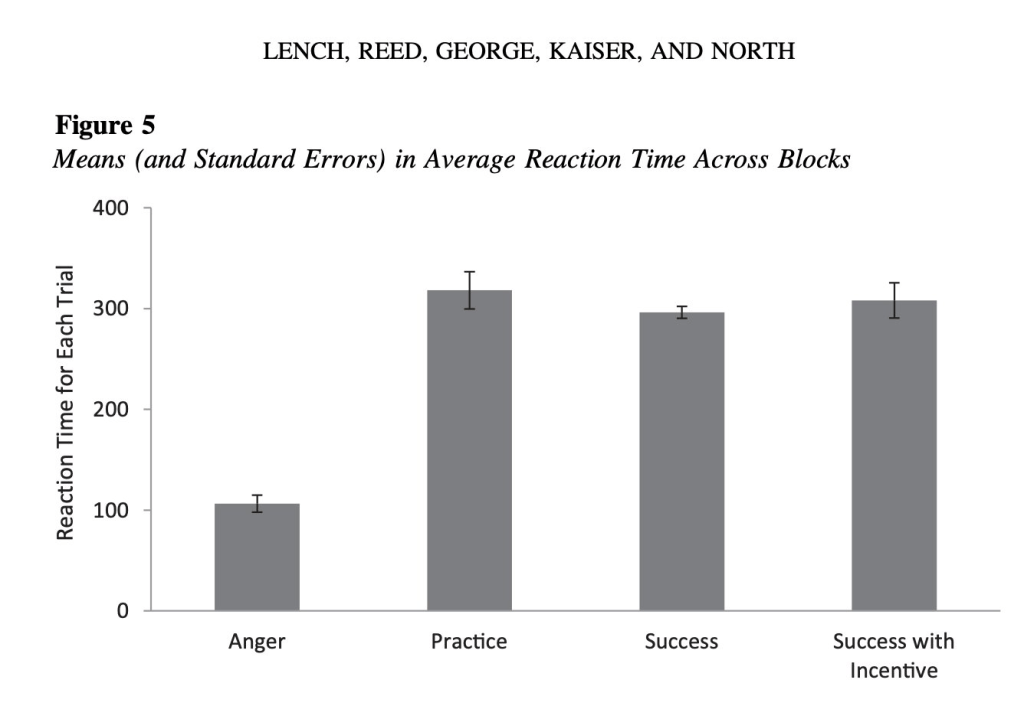
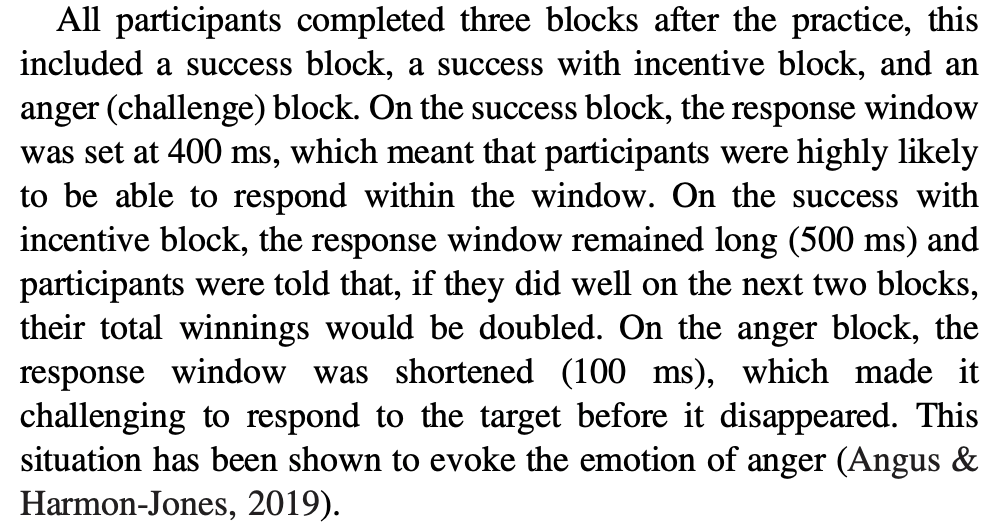
If you don’t like reading science papers don’t worry, I don’t either, so let me explain:
These researchers wanted to study how anger makes people better or worse at performing a task. This in itself is FRAUGHT with problems though: how do you measure if someone is angry or not? How do you do so *objectively*? How do you do so in a controlled research setting, with ethical constraints like “not smacking them in the face over and over”? And even if you can rigidly define anger: how do you measure if anger causes someone to do better or worse at a task, vs if doing worse at a task makes people angry?
These researchers solved this problem by ignoring it. Here’s there method: give people 400-500 milliseconds (which is near the lower limit of average human reaction time) to click on a block on a computer screen. They take between more than 300 seconds on average because that’s about how fast average humans can reasonably react. NEXT: give them only 100 milliseconds to click on the block. This is *faster than humans can actually react*, so any clicks that happen in this timeframe are random guesses, “pre-clicks” (where the participant starts clicking before they see anything, in expectation that something is coming), and importantly: CLICKS MADE SIGNIFICANTLY AFTER THE 100 MILLISECONDS ARE NOT REGISTERED, because the block has disappeared from the screen and the person can’t move to click on it anymore.
What they found is that when people are given only 100 milliseconds to click on a block, the only successful clicks they make happen at around 100 milliseconds: these are usually pre-clicks and random guesses.
What does this have to do with anger? Nothing at all, literally nothing. But here’s the title of the paper:

“Anger has benefits for attaining goals.” Uhbuhwuh?
The researchers make the *completely* unsupported chain of conclusions that:
- Giving people less time to complete the task made them angrier (unsupported, unmeasured by the study)
- Because they were angrier, they completed the clicking task in less time: 100 millisecond vs >300 milliseconds
- They do not at ALL address the issue that since the people were only given 100 milliseconds, they could not by definition take 300 seconds to complete the task
- This lab setting click-on-a-block experiment is generalizable to any action or goal-oriented task where people might be angry (wholly unsupported by the study design)
The real conclusion of this paper is that “when you give people less time, they try to complete something in the less time they have been allotted.” Big whoop. But the authors wanted a sexy conclusion that would get them on the journal’s cover and the BBC, and they got it.
This is bad science, but it’s perpetuated by a cycle of sociologists and reporters who don’t care about bad science. For all that the BBC and British government wrings its hands about online disinformation, their science reporters might be the single biggest source of disinformation in the whole British Isles.
Now to be fair, just because something is bad science doesn’t mean it isn’t *true*. Aristarchus of Samon proposed a heliocentric model of the solar system *millennia* before Copernicus. He did so because Fire is the more noble element compared to Earth, and the center is the nobler position to be in. Therefore the Sun (made of fire) must be in the center with the Earth (made of earth) circling around it. This is bad science, even if it came to the right conclusion.
By the same token, it’s possible that anger really does make people faster at a clicking task, and perhaps better at achieving one’s goals overall. But this paper’s bad science doesn’t support that.
Now back to cryo-EM: we wanted to study how the structure of Tau filaments connect to Alzheimer’s, but we couldn’t do it directly. We had to painstakingly create a chain of inference across decades of empirical research to learn that Tau oligomers probably are part of the Alzheimer’s degeneration, and that the structure of Tau oligomers can be recovered by studying the shape of the filaments. We couldn’t study what we wanted directly in chemistry, but we found a chain of reasoning that let us study it indirectly.
Sociology could do the same thing. It’s hard to objectively measure anger, but could you create an objective measure? Or could you find some fMRI state, some epinephrine cascade state, some blood vessel dilation state, or some other molecular clue which *tracks directly with anger* and can be measured objectively? Yes you could do that in principle. And you could then use objective measurement to run tangible experiments relating anger to task completion. Give people a hard task, let them get angry, and see if as they get angry they get better, or do the people who keep their tempers actually get better? I don’t know, but with objective measurements of anger you might be able to do this.
Instead we have a paper using circular reasoning to construct a conclusion from data which could never have falsified their conclusion to begin with. We have terrible, bad science and we deserve better. Sociologists need to call this out from *within* the discipline, the calls can’t all come from without, or eventually the people who fund sociology will get tired of funding absolute garbage.

