Klein 4: What Ezra Klein’s abundance agenda doesn’t contend with

The answer is trade-offs, Ezra Klein doesn’t contend with trade-offs. But I also wrote the title of this post to reference an old song I heard by a group called “The Klein Four,” check it out, it’s a good song if you like jokes about math and love.

I’ve discussed a lot about Ezra Klein’s abundance agenda before. To remind us, Ezra Klein says the reasons for America’s economic malaise is that we have made it impossible to build the houses, jobs, and infrastructure that we need to bring down costs and bring up wages. Housing costs will go down if we build more houses, so the government should write laws to ensure we can build more houses.

This agenda can seem very “ivory tower,” but has come into sharp focus with the creation of the bipartisan Abundance Caucus, as well as the likely next mayor of New York City coming out in support of the abundance agenda.

But the question that I want to raise is: what political group will be thrown under the bus in pursuit of abundance?

I mean this question honestly. This is not a gotcha, this is not an attack. This is my assertion that abundance *will* require trade-offs, and certain political groups *will oppose* those trade-offs no matter what. In order to enact Abundance then, you will have to choose your trade-offs, and therefore choose who goes under the bus.

Klein is not a politician, and he and his co-author have tried to assert that there really aren’t any trade-offs with abundance. We can keep *all the good things* that he and his co-partisans support without any negative side affects. And likewise the new laws we write to ensure that housing, factories, and infrastructure get built faster and more efficiently will not harm his co-partisan’s priorities whatsoever.

But I think Klein does this because he makes the classic mistake of thinking everyone has the same priorities as he does, they just don’t have the knowledge he does to realize he’s right.

So to start: will Abundance throw unions under the bus, or will it continue to allow them to have veto power over housing projects they don’t like? Josh Barro wrote about this extensively. He points out that unions in blue cities have consistently held up building projects in order to increase their own power. Unions make demands that increase the cost and time-line of a project, and if they don’t get it they use every possible veto point (such as the need to get community approval or the need to do environmental review) to prevent a project from happening.

This creates a trade-off, unions vs abundance. Klein side-steps this and tries to claim that no, there really isn’t a trade-off, and he actually wants to make it radically easier to form a union. But that isn’t important. It’s quite easy to form a union in America, it’s very difficult to exercise union power. Unions are exercising what little power they have when they hold up projects, and they do so in order to ensure the project enriches their members and not non-unionized laborers. Established unions don’t care about forming unions, they’re already established. They care about enriching their members.

So there *is* a trade-off between unions and abundance. Klein tries to handwave that somehow we remove the union veto and give them some other power and that they would accept this as a fair trade. But they simple would not. So if you remove the unions’ ability to veto infrastructure projects, then you throw the unions under the bus. If you don’t remove their veto, you walk back the abundance agenda, because you are failing to make it easier to build housing, infrastructure and jobs.

Or what about environmentalism? Energy is expensive, and it’s a huge barrier to economic growth and the abundance agenda. Right now America pays a lot less for energy than much of Europe because we allow our oil companies to frack oil out of the rocks to release it. But this is an environmental double-whammy, all that fracking harms the environment and burning all that oil accelerates global warming.

Klein’s environmental co-partisans will want to ban fracking and restrict oil, while abundance for consumers may require continued fracking so Americans can use their cars and so America’s economy can continue to use that energy. Germany and the EU have shrinking or stagnating economies in part because the price of energy there is so high.

Again Klein handwaves this by saying that we can make solar panels and solar power so cheap that energy will be cheaper that way. But this ignores present reality. Texas currently is the American leader in energy abundance, with an incredibly permissive permitting regime. It indeed leads America in the installation of solar panels. It also leads America in the fracking of oil.

If solar power were such a sure bet, then Texas energy barons would stop investing in oil and move all their money into solar panels. No company would ever willingly leave money on the table like that. But solar power *is not* a sure bet, and it still has massive difficulties that make oil viable. Battery technology is not sufficient to make solar+batteries cheaper than oil or gas for night-time power. And electric cars still aren’t cheap enough to make American switch over their ICE cars.

You can’t just “abundance” your way into ignoring economics, if you make it easy to permit *any* energy, then you will permit a lot of fossil fuel-based energy solution and piss off environmentalists. If you restrict fossil fuels, you undermine abundance by raising America’s energy prices and making it harder for Americans to drive and making it harder for American companies to operate.

I wanted to write more but I’m a bit tired and this post is very late, it should have been finished two weeks ago. But let me finish with this, every single group that supports abundance has their own group policy that they see as sacrosanct. They will support the removal of *other groups’ policies* but not their own. Abundance will therefore require finding which group is weakest, and removing their policies, or finding some compromise that pleases no one but at least gets things done.

The unions will happily undermine environmentalism and local democracy, but will never support a reduction in union power. Environmentalists will not allow environmental laws to be degraded, but may allow for a reduction in union power and local democracy. And you know what local groups think.

So when you want to build new housing or a new train line through a city, each group will block it until you make the expensive concessions necessary for their support. Abundance is all about removing those expensive concessions so it’s cheaper and easier for America to build. So the question is then clear: which group will be thrown under the bus. Until the Abundance Agenda has an answer, it will largely remain a performative slogan more than a real ideology.
Why is State Farm leaving California?

note: I had intended to publish this months ago. But I never finished it, and now I’m struggling to get a post out in time, so I’ve tried to make this one acceptable.

There was recently news that State Farm insurance is leaving California, and will no longer accept new customers. Perhaps they may even kick old customers off their plans and refuse to do any business in California at all. This caused a wave of reactions, from consternation that a company could be so mean to California, to demands that State Farm “reimburse” customers who have paid for years with no claims, to calls to nationalize the insurance companies because “clearly” they’re just stealing from the little guy.

All these reactions will be addressed in turn, but first, let’s talk about how insurance works. If you recall my post from way back about Ric Flair and his gym, insurance is just a way to reduce your downside risk in exchange for a small lose of your upside gain. You pay a little every month and in exchange if your house or business is destroyed, you get some money back.

What’s important is that insurance is structured like a bet: the insurance company is betting that nothing bad will happen to your property during the period of your insurance, if they win the bet they keep your money and you get nothing in return (except maybe peace of mind). While they only pay out if they lose the bet and your property *is* damaged. Because of this, many people see insurance as a scam. Why would I ever pay if I don’t expect my property to be damaged? Well you’re mitigating risk, maybe there’s only a 1% chance your home is destroyed, but that’s a 1% chance that you lose *everything* and are left utterly homeless unless you have insurance to cover the cost of rebuilding your home. Isn’t it worth it to pay a little to ensure you aren’t homeless from an act of God?

Now first, I want to quickly call out a very dumb line of reasoning I’ve seen floating around regarding insurance. I’m not quoting any one tweet or post, but synthesizing what I’ve seen in many places at many times:

Why isn’t there a refund check for insurance like taxes? I’ve paid so much without using the policy, and even if I make a claim, they find ways to avoid paying. Total scam!

This sentiment belies a complete failure to understand insurance on even the most *basic* level. To start with, if you want a refund because you’ve paid in without using the policy, should the insurance company be able to demand more money if you paid in and then *did* use the policy? Of course not, you’d call them insane and selfish. But realize that it’s the identical situation, in reverse.

An insurance policy is simple: you pay regularly and they pay if certain conditions are met. Of course “certain conditions” can be interpreted differently by different people. And insurance companies are profit-maximizing (like all companies) they’ll try to avoid paying when they can. But this is a necessary evil, better the company try to limit payouts than it go bankrupt overpaying it’s customers. Because then every *other* customer would suddenly lose their insurance.

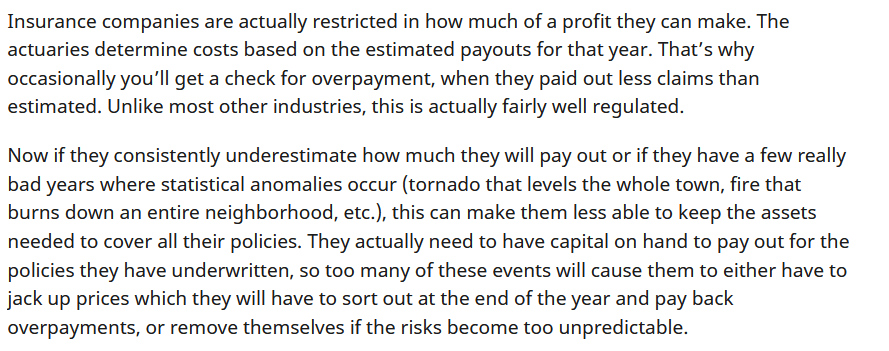
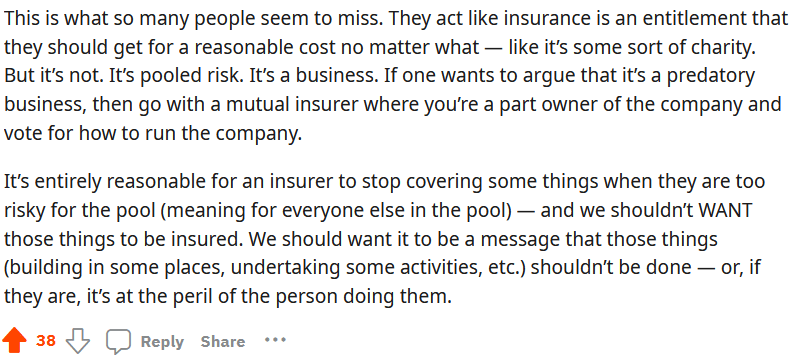
So finally, why is State Farm leaving California? Because they can’t make a profit. Most states regulate insurance incredibly heavily, to the extent that they put price caps on insurance premiums. That way the company cannot raise prices without the state’s say so. And if the state won’t let a company raise prices to cover rising costs (and costs ARE rising because of inflation and climate change), then the insurance company is not obligated to subsidize a state with coverage cheaper than costs.

As is so common, people blame the free market for a government-run system.

The point of government isn’t just to spend money

It’s election season, so I’m being inundated with election spam on every social media and traditional media I use. I know election posts probably aren’t people’s favorites, but this is the streams of my consciousness and I just wanted to vent.

To start with, some of the twitterati are pulling an absolute masterclass in doublethink. Centrists in the commentariat have been crowing for the last 4 years about how Biden has pumped more oil than any president in history. They’ve been dunking on Republicans about how despite Trump and the GOP’s rhetoric, Biden is more carbon friendly than Trump was.

Now, every words of this is true. I pointed out years ago how despite a small pandemic dip oil production has steadily increased during both Biden and Trump’s presidencies. Biden has inherited a fracking boom, and has not done anything to clamp down on it, so record-setting oil production is to be expected.

But the same commentariat that will crow about Biden’s oil boom will screech in anger and confusion when climate groups like the Sunrise Movement announce they won’t support Biden’s re-election. How can they do that? How can they refuse to support the president who has pumped more oil than any other in history? Gee, maybe because Democrats have said that Climate Change is an existential threat for years, and these folks actually believe it? Seems pretty obvious to me why the Sunrise Movement and other climate groups wouldn’t be happy with Biden’s energy policy.

As a defense, the commetariat likes to point to Biden’s massive spending bills. Billions and billions of dollars are being pumped into the green energy sector, and Democrat columnists are producting hockey-stick graphs comparing Biden’s green spending to previous presidents as proof of his climate success.

The problem with this is that the point of the government isn’t just to spend money. The point of the government is to get results. How much has that billions of dollars actually achieved?

For example, we all know that switching to electric cars is hard when there’s so few charging stations. Biden’s climate bills were supposed to build charging stations across the country to combat this. How many charging stations have Biden’s Billions actually created? As of May this year, just 8. But don’t worry, that number is growing! In March it was just 7! With a rough estimate of 1 charging station every 2 months, can anyone say these billions (trillions!) of dollars are being well spent?

This is exactly the kind of thing that If We Can Put a Man on the Moon… discussed. Politicians are incentivized to declare victory immediately for their re-election campaign. This leads to them touting metrics like “amount of money spent” instead of something actually useful like “miles of track laid” or “amount of actual EV infrastructure.” And since “money spent” is the only metric politicians are focusing on, that money gets spent extremely badly.

Years later, when the money is all spent and the infrastructure is still crumbling, a new campaign will of course arise, saying we now need to spend even *more* money to fix this thing that should have been fixed with the first tranche.

Let me be clear: I believe that climate change is a problem we need to address. But I do not think government spending is the best way to address that. In the last year, Tesla has built around 40 times more EV charging stations than Biden’s infrastructure bill, and they didn’t use taxpayer money to do it.

So why does it *have* to be government spending? I think it’s honestly because a lot of politicians don’t believe that companies can ever accomplish things. When you spend your entire life in government, every problem looks like a taxpayer-funded nail.

The government *can* solve these problems, but it doesn’t need to spend billions to do so. You really want to improve charging infrastructure? Tax gasoline. Tax oil. Tax every step of the refinement process. You will see how quickly consumers shift to electric cars, and how quickly companies spring up to service those electric cars. Hell, a network of gas stations already exists all across the country. If gas was taxed and consumers switched to electric cars, those stations would quickly be forced to switch from offering gas to offering fast electric charging.

You may say that a gas tax would hurt American consumers, but it would hurt them no more than the spending-fueled inflation that America has right now.

Here’s the funniest thing: politicians have adopted the language of the market and claimed that government spending is an investment. We are investing in green energy. But investment expects a return, and if the return on billions of dollars investment is 8 or so EV stations, that isn’t an investment, it’s a ripoff.

Biden chose to keep oil cheap and burn money on 8 EV charging stations. Is it any wonder climate activists don’t appreciate him? When success if measured in dollars spent, then failure is assured.