Nationalization

Nationalization (or rather Nationalisation) was a big part of Jeremy Corbyn’s manifesto during the 2017 and 2019 General Elections. If Labour won, it promised that anything and everything would be nationalized, usually at below market price.

I’ve always been skeptical of claims that nationalization leads to any kind of savings. The claim is that since a Government company doesn’t have to worry about profits for shareholders, it can be more efficient than a private company. All the profits that are paid out as dividends are instead re-invested into the company to provide better service at a lower cost.

But there truly isn’t any law saying a company ever has to provide dividends and profits. If Corbyn, McDonnell and co truly thought that companies could run better and more efficiently without profit, they could always just do that themselves without need of the government. Private citizens can always set up a non-profit corporation, they can take money from people (God know’s Corbyn was a fundraising machine) and set up a company that doesn’t pay dividends to shareholders, but instead re-invests everything to provide better service at a lower cost.

If such a non-profit did truly provide better service at a lower cost, then customers would flock to it over the for-profit companies that already exist. And again since this non-profit doesn’t hand out dividends, then Corbyn Co could easily be the fastest growing company in the world as it takes on more and more customers and reinvests into being better and better.

So why did they need nationalization? Why couldn’t they give the British people good services as a low price by just setting up a non-profit company and out-competing the for-profit ones? Why do socialists only ever think they can succeed by taking from someone else?

I think they simply didn’t have enough economic literacy to realize how their whole idea was such a shambles. Non-profit companies haven’t taken over the world because for-profit companies are actually way more efficient. They’re more efficient than non-profits and more efficient than Government companies, but socialists prefer to deny the lessons of history and keep acting like it’s the 1970s.

Not only are nationalized companies less efficient, but the act of nationalization creates inefficiencies. The idea that the government can force a sale of a profitable enterprise creates a chilling effect as investors become less likely to invest knowing it can all be taken from them at any moment. People don’t want to be forced to sell to the government, even at a “fair” price. Most eminent domain projects throughout history were done at a “fair” price, with people being paid the market value for their homes and then kicked out to make way for freeways and whatnot. But “fair” price or not, no one likes a forced sale.

And Corbyn Co wanted to take things a step further by paying below market value for the companies they wanted to nationalize. So not only was the government forcing a sale, but they were also committing theft at the same time.

I write all this because nationalization became a big word again during the recent bout of inflation, and I’ve seen way to many people jump on the bandwagon saying we need to nationalize energy companies, housing companies, and everything else to keep prices down. But prices don’t rise because companies are greedy, they rise because of fundamental shortages and inefficiencies. A nationalized company would have just as much trouble with inflation as a for-profit one, only a nationalized company could push its losses onto the taxpayers rather than be forced to raise prices and cut costs.

High prices are a signal that there is a shortage and that alternative avenues should be sought. When the price of gas rose, I decided I couldn’t justify driving to work every day so I tried to bike whenever possible. But would a nationalized American Gas company instead pass that cost onto the taxpayer? Wouldn’t they keep prices low so that I kept using as much gas as I always did? In that case every taxpayer who tries to be a good world citizen and use less carbon would be subsidizing me personally as a drove a distance that I could easily bike instead.

As inflation tapers off, it seems clear that nationalization was not the answer, and we are entering the Era of Corporate Generosity. But I doubt we’ve silenced forever the calls of nationalization, no matter how many times it leads to omnishambles. Still, I hope no serious nationalization proposal is put forward for a long time yet.

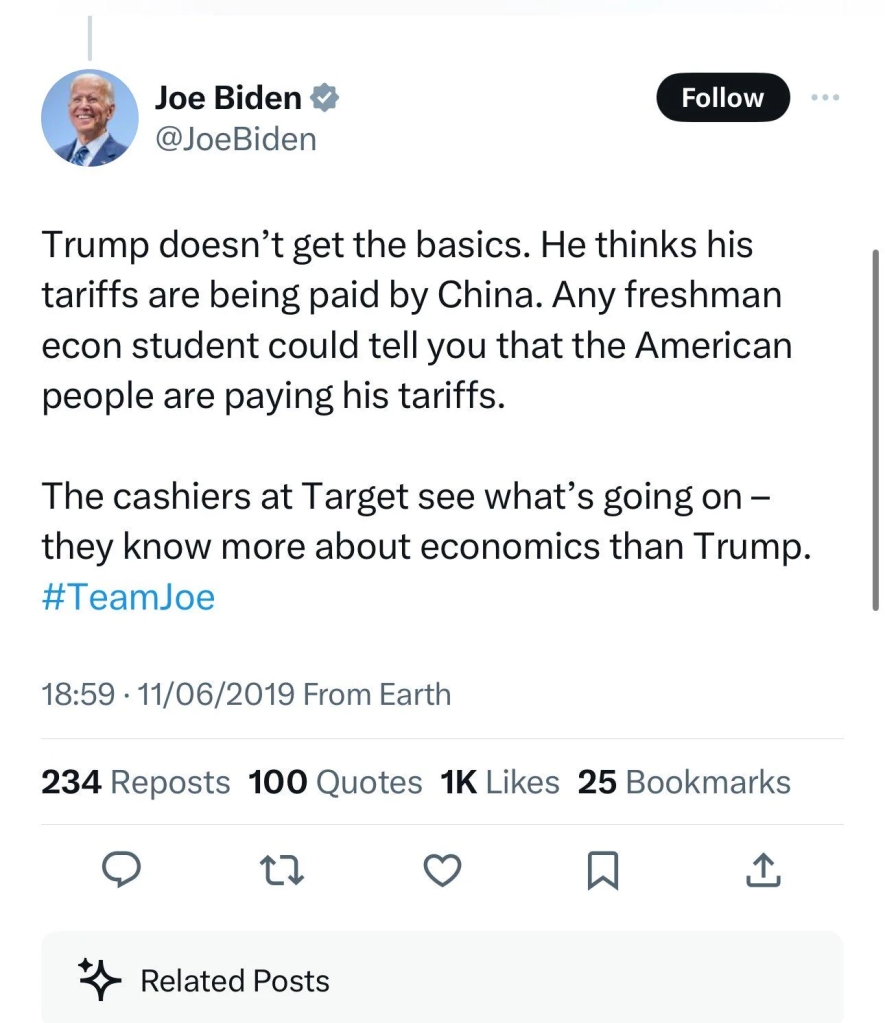
Tariffs are taxes, I’m tired of pretending otherwise

Every politician says they’re lowering taxes. Or if they raise taxes, it’s only on the rich, poor people definitely deserve lower taxes. So do middle class people (where “middle class” equals “everyone less than rich” and “rich” equals “everyone richer than my current audience and me”). Taxes are unpopular and taxes shouldn’t be raised.

But tariffs are fine apparently. In a new wave of protectionism, Biden and Trump have jacked up tariffs on everything from solar panels to lumbar. And despite claims of “national security” and “containing China” these tariffs have most strongly hit America’s allies such as Canada and Germany. The national security claims are bunk, these tariffs hit allies far more than they hit enemies.

But still Biden doesn’t get pushback for raising taxes because “tariffs” aren’t seen as taxes. Wrongly, most people don’t realize that slapping a tax on imported goods raises the price of all of those goods, even the locally made ones. Think of it like this: if Biden slapped a tax on Pepsi such that every Pepsi now costed 5$, would Coca-Cola sit back and keep their prices? Of course not, as a greedy company Coca-Cola knows that customers will flock to its lower-priced products, and this will give it the ammunition to raise prices to juuuuuuuust under what Pepsi has. So now 4$ Cokes will become the norm.

So too does it happen with tariffs. When you raise the price of Canadian lumbar, American lumbar companies also raise their prices because they know the consumer has no choice but to take it. When you raise the price of German steel, American steel raises its prices. These taxes on foreign goods have raised the price on all goods. They then raise the price of what those goods are used for, for example lumbar tariffs are raising house prices. And what do you call it when the price of goods rises over time? Inflation.

Biden’s tariffs are adding to inflation. Trump’s tariffs are adding to inflation. Tariffs are nothing more than a tax on goods, a tax that the poor and middle class pay most as they are the ones most damaged by inflation. I’m tired of house prices soaring in part because of these new taxes. I’m tired of solar panel prices soaring as well. It’s all very two-faced of the Biden admin to claim global warming is an existential threat and then do everything in their power to kill the solar industry with new tariffs. Taxing it into the ground only makes global warming worse.

So I’m tired of these tariffs, they’re nothing more than a tax. And I’m not going to pretend otherwise.

Have IPOs become more speculative?

This post is very late because I didn’t feel good about my conclusions, but here it is.

I’ve been wondering if IPOs have become more speculative of late. Rumors abound that OpenAI (makers of ChatGPT) may IPO soon and they’ve been quoted as having a billion dollars in revenue and a valuation of 80 billion. 80 times profit is already a pricey valuation, 80 times revenue is even moreso. And other even more speculative IPOs have happened in recent memory. Companies like CRISPR Therapeutics and Beam Therapeutics IPO’d when they have essentially no revenue, just patents.

It was once said to me that IPOs are “supposed” to be for a company that is profitable. The company shows the world that it is profitable and can thus afford to pay a dividend. The investors of the world will then pay for stock in the company in order to grow their money. So the company gets a big pile of cash by selling shares, and the investors get shares which pay a dividend and may grow in value also.

The above is a very 20th century view of investing, these days dividends aren’t all that popular to begin with. So too does it seem that many companies will IPO long before they can afford a dividend, and long before they are profitable at all, so why are investors investing and buying these stocks?

It isn’t necessarily a bad move for investors to buy stock in OpenAI if it does IPO. The investors are speculating that while it’s not profitable now, it will be in 10 or 20 years. In essence, an IPO like this lets investors play the role that venture capitalist play. Venture capitalists invest in many startups long before they see revenue or profit, and they bank on the fact that while 10 startups may fail, the 1 that succeeds will let them see more than 10x gains. With companies IPOing early, normal investors can now also play this game. Beam Therepeutics, CRIPSR Therapeutics, and OpenAI may all fail, but if you invest in them and 10 other speculative companies, then maybe 1 will succeed which will give you gains that wipe away all your loses.

So I can’t say that companies IPOing earlier and earlier is a bad thing. As long as they don’t lie on any of their forms, then investors know exactly what they’re getting into. Investors know that they’re buying into a very speculative, pre-profit, maybe even pre-revenue company. But if it works out, they can make big gains. And remember that “investors” here isn’t just faceless, deep pocketed billionaires. Investors is also every person with a 401k or IRA. They too can buy into these companies using their own money and play at being venture capitalists. And if its so profitable for venture capitalists to do this, then why shouldn’t the rest of us do the same?

But while I cannot say this is a bad thing, I also cannot say if this trend is even happening. Remember I started this story by asking if IPOs are happening earlier and earlier. Is it true that in the 20th century, most IPOs were of profitable companies, and in the 21st century most IPOs are of unprofitable ones? Or is that simply recency bias at work? I tried and tried but couldn’t find hard numbers on this kind of thing, which is why it took me so long to write this post.

Either way, if OpenAI does IPO I might toss a few dollars their way. Intellectually I know I probably can’t beat the market, but emotionally it’s fun to pretend I can. And where’s the harm in that?

Shadow boxing the NIMBYs again: luxury vs low income apartments

Warning, this post is longer than usual.

NIMBYs will give any excuse to block housing. There’s two examples of this I’d like to discuss, one is the “luxury vs low income” false dichotomy. The other is when NIMBYs try to change the subject and ban corporations or foreigners from owning housing.

Let’s get one thing clear: affordable market-rate housing is just housing that has been on the market for a while. Houses built in the 80s are affordable now, even if they weren’t affordable when they were built in the 80s. Houses built this year generally aren’t affordable, but will be in 40 years. In economics you’d generally assume that products will be built for every level of customer. For rich customers, expensive products with expensive material are built. And for poor customers, cheap products with cheap material. Housing doesn’t follow this because of a few reasons.

The first reason is that for the past 50 years, much of the cost of building a house comes simply from getting permission to do so. There is a huge barrier to making housing whether you’re trying to make cheap or expensive housing. Cheap products can usually make up the different by being mass produced, but these barriers to housing (aka zoning etc) excise most of the benefits of mass production. That means there’s no point trying to mass produce houses anymore and make up in quantity, you can only produce quality houses and make up the difference using high prices.

The other reason that housing doesn’t follow the pattern is because it’s a good that lasts so long. Food is gone very quickly, whether it’s expensive or cheap. But an expensive or cheap house can last a hell of a long time with regular repair. Of course it slowly degrades, but that just means an expensive house slowly becomes a cheap house as its value on the market declines (or this is what you’d expect to happen, but if housing supply is constricted, price remains elevated). So again, a developer isn’t incentivized to mass produce cheap housing because anything built more than a decade ago has already become cheap housing, a developer of cheap housing is thus competing with the entire city’s housing stock.

For those two reasons, developers like to build “luxury” housing, including condos and apartments. Whenever these things are built, certain NIMBYs come out of the woodwork to protest the housing using vaguely left-of-center vocabulary. They’ll say things like “these expensive apartments are only for rich people! That won’t help the housing crisis for poor people!” Then they try to stop development with their economic illiteracy.

Those NIMBY arguments are just plain wrong. ANY increase in housing supply will lower the cost of housing in the market, even if it’s luxury housing being built. If this luxury housing isn’t built, then the rich people are forced to compete with the middle class people for the middle-income housing. The rich can afford to spend more, and so they drive up the cost of middle-income housing. If instead the luxury housing gets built, then the rich are spending their money on that, so there’s less demand for middle-income housing. Now more middle class people can afford middle-income housing, so they don’t have to compete with poor people for cheap housing. All this means lower prices for the middle class and the poor as less people are competing for the same amount of housing, and it happened because the rich were able to move in to those new luxury units.

So stop protesting luxury apartments, they lower the cost of housing just as much as cheap affordable apartments. And in 40 years those luxury apartments will have worn down a bit and will now become affordable so anyone can move into them.

The other thing I’d like to hit out against is people trying to ban foreigners and corporations from owning homes. Canada recently enacted a ban on foreign home buyers, and I have two problems with this. One: it will not do anything for affordability, foreigners make up a tiny percentage of Canadian home buyers. Number 2 ties into the ban on corporations, so let me discuss that.

There’s a knee jerk reaction by some that corporations and investors are at fault for driving up the price of houses. But corporations don’t live in houses, people do. A corporation only buys a house because they think they can make back their money by selling or renting it to another person. This implicitly requires that corporations think the value of houses will continue to go up, and monumentally so, otherwise they’d lose money on this transaction. So are you angry at corporations buying houses? Then the solution is to build more houses so the market is flooded and the corporations lose out on their investment.

The second part of this knee-jerk is an economically illiterate idea that corporations are just vampires sucking value out of the economy. If only we banned corporations, then all the prices would go down due to less competition and there’d be no downsides whatsoever. But if you think about it economically you’d realize that corporations are providing a form of service by being in the housing market: they are providing liquidity to the housing market.

Liquidity is most well-studied in places like the stock market. A lack of liquidity can lead to wild swings in prices, both up and down, and is generally regarded as a bad thing for the market as it hurts both buyers and sellers. When you want to buy shares of stock, you don’t need to match yourself to a single individual who wants to sell the same number of shares you want to buy, at the same price you want to buy them at. Instead, market makers create the liquidity by buying and selling lots of stocks. The market makers don’t want to hold any stocks for long, they just want to buy and sell them.

When I buy a stock, the market maker is immediately able to get it for me, as much as I want, and at the market price. When I sell a stock, the market maker immediately takes it, and again they take as much as I give them, at the market price. I don’t have to find an individual buyer and seller, everything can happen through a single market maker who is interacting with not only me but every other buyer and seller in the market. This is actually much more efficient than if every buyer and seller had to go out and find someone to trade with, we all just go to a single person, the market maker, and get the market price from them.

The market makers are in turn taking on a lot of risk, and using a lot of stats and technology to mitigate that risk. When I sell them some Apple stock, they are willing to buy it immediately on the assumption that somewhere out there someone will buy it from them for more. They take a small cut, usually a cent or so per share, which helps hedge against falling prices in the few milliseconds it takes them to find a new buyer. But there’s a risk that if Apple stock falls fast, they’d be left holding my stock which is now worth less than I sold it to them for. But market makers are large and invest in a lot of technology and statistics to be able to take on that risk.

But now imagine there were no market makers, the stock market would have a lot less liquidity. Any time I wanted to sell Apple stock, I’d need to find an individual who was a willing buyer. But if the price of Apple is falling fast, investors will get skittish, they’ll be worried about getting caught out, and most of them won’t have statistics and technology that the current market makers have. Thus they may not be willing to buy from me, thus I’ll have to lower my price even more to find a buyer, but that makes the price of the stock fall even faster, meaning that investors get even more skittish and even less willing to buy

This is what’s called a liquidity crisis, it can happen to stocks moving both up and down. Lack of liquidity leads to wild swings in prices which hurt both buyers and sellers and generally mean people lose more money from the market than if it were liquid. But these days liquidity is generally smoothed out by the market makers. For all that conspiracy theorists hate them, the market makers are why buying and selling stock is so seamless, easy, and reliable these days. Large price movements are smoothed out by liquidity, and any buyer can find a seller and vice versa so people can enter and exist the market whenever they wish.

Now let’s say for a moment that corporations are prevented from buying any housing. Let’s even take the more radical proposal I’ve seen that says no one should be allowed to own more than 1 house. And let’s see the results this would have on the housing market. Spoiler alert: a lack of liquidity in the housing market would hurt both buyers and sellers.

So when you want to sell a house, you have to find a buyer. In our theoretical “no corporations, 1 house per person” market, you’d need to find someone who actually wanted to live there. Someone who wants to live exactly in your area and in your house. If your house is a fixer-upper, you need to find someone who is willing to buy and fix a house. The need to find someone willing to immediately live in your house, right now severely limits your potential pool of buyers. Maybe people just don’t want to fix a house these days, so even thought the repairs aren’t that bad, you’d now have to either do them yourself or lower your price by a lot in order to find a buyer.

Now when corporations are allowed to buy homes you can find a buyer immediately. The corporations then takes on the risk of finding people to buy the house, they take the cost of showing buyers around, of fixing up the house if need be, of advertising it, etc. Corporations are providing liquidity to the housing market, which prevents giant movements in price. Someone who needs to sell their house in a hurry might otherwise be forced to cut the price 20%, 30%, 50% if they just can’t find a buyer within a month or two. But a corporation can buy the house at its full price and can then afford to sit on it for a few months waiting for a new buyers to come along. So people selling their house get the best price possible because corporations are providing liquidity.

If you want to buy a house, you also have to find a seller. Most houses aren’t for sale at any one time. But it would be a nightmare without corporations because then you would actually have to find someone who is actively moving out of their current house. Very few houses are being built (thanks again, NIMBYs), so any house you want to buy will be pre-owned. And remember we’ve banned corporations and multiple home owners, so that house isn’t being kept empty, it’s lived in. That then means that you have to move in at precisely the time they want to move out, otherwise either you’ll be caught homeless for a time or they’ll run afoul of the law because they’ll own more than 1 house at a time. It would be difficult, maddening even to line up your schedules.

This maddening scenario is exactly what’s going on in Britain right now. The British housing market is extremely illiquid not because there are corporations but just because there is an extreme shortage of houses period. The UK has the largest housing shortage of any member of the G7 or G20, meaning that there’s basically no houses anywhere sitting empty. In America, about 9% of homes aren’t currently lived in. Some are dilapidated, but some are just being held while buyers and sellers find a price. In the UK, that number is around 3%, and again many of those are dilapidated and unlivable.

The lack of empty homes in the UK means that anyone looking to move in must first wait for the owners to move out. Of course no one wants to be left homeless, and no one wants to own two homes at once and be forced to pay taxes on both, so Britain has an insane system found no where else in the world called “chains.” In a chain, every property sale has to execute at exactly the same time so that multiple people can all move into/out of houses at the same time. These chains can have over a dozen links, and so of course you can imaging getting a dozen families to all agree on a move date is a nightmare. This system is basically completely unique to Britain, I haven’t heard of it anywhere else, and it is all due to a lack of liquidity in the market, although here brought on by comical undersupply and not the banning of liquidity-assisting corporations.

The chain system is an absolute mess, you can search social media for the horror stories of people losing jobs because move-ins were delayed, or losing money because they had to expedite a move-out. Nothing works the way it is supposed to because the market is so illiquid, and everyone in the British housing market is tangibly worse of because of it. And that’s exactly what we’d get if no one were allowed to own a home they didn’t actively live in.

Corporations and home investors, foreign or native supply liquidity to the housing market, they do not make house prices go up. House prices go up because there is a lack of housing supply. If you’re tired of corporations owning homes and want to force them to lose money, then you should demand your city allow anyone and everyone to build a house on any plot of land that they own. Yes even your neighbor. If your neighbor wants to subdivide his house to build a duplex, let them. If they want to sell to a builder who will demolish the house and build an apartment block, let them. If some developer wants to buy the vacant lot across the street to build condos, let them. If a big developer wants to buy the convenience store down the street and build a 5-over-1, let them. Only by having more housing in everyone’s back yard will the cost of housing go down.

Fitch Downgrades America’s credit rating

I’ve spoken before about how credit rating agencies are downgrading the debt of nations. Now, Fitch has downgraded America’s credit rating from AAA to AA+. Once again I’m seeing a lot of conspiracy theories about this and I thought I’d take a moment to hit back against them.

The first conspiracy is the common one that the financial system is conspiring against the common man. This sort of conspiracy is no different from the old “evil bankers control the world” trope, but it gets a lot more traction online when it’s framed with a leftist slant. To be blunt, the financial system is competing with itself more than it is conspiring with itself. Fitch is competing with the other credit rating agencies (Moody’s, S&P) and if it downgrades America’s credit for no reason, it would lose trust in the eyes of the financial institutions which pay for its ratings.

Ratings agencies rate all kinds of debt, not just sovereign bonds. And financial institutions will pay for those ratings so they know where to invest and where to avoid. Trust is key to this, and without trust, Fitch would die. If financial institutions don’t trust Fitch’s ratings, they simply won’t pay for them and will take their business elsewhere. So Fitch cannot in any way downgrade ratings in a way that the broader financial market would not agree with, otherwise it would destroy trust and tank its business model.

In this, there is a common chicken and egg problem with ratings agencies in that they usually only change their ratings when the broader market is already leaning in a certain direction. IE they are followers, not leaders. But that that just lends more credence to their ratings. The market was already very willing to believe that America needed a downgrade, so Fitch isn’t doing anything out of the ordinary. It’s the politicians who have screwed the people on this one, not the ratings agencies.

The other, similar conspiracy I’ve seen is that the ratings agencies are conspiring to undermine Biden and tank his presidency. Biden has been trying to tout the strong economy, and some liberal commentators have been upset that the public doesn’t always buy it. So of course this must be just another GOP plot to brainwash the voters that the Biden economy isn’t awesome.

I would point out however that American real wages are still below where they were when Biden took office. Note for example that real wages declined 3.6% from June 2021 to June 2022. That’s a big dip, and people notice it. People’s ambivalence about the economy isn’t some nefarious plot, it’s very clear when listening to people’s complaints (inflation) and looking at the data (real wages dropping). It’s also quite understandable that ratings agencies have looked at this very same data, as well as the rising debt amid partisan bickering over how to pay it. From this, they might reasonable downgrade America’s credit rating. Not everything is a conspiracy against one’s favorite politician.

Many people will point to 2008 and the financial crisis about why we can never trust ratings agencies again. But that was over a decade and a half ago and every country added new laws to constrain financial institutions. Saying you can’t trust Fitch because of 2008 is like saying you can’t trust the Labour Party because they were in charge during 2008.

So Fitch has downgraded America’s credit rating, and it seems the financial markets were broadly ready to believe them. Rather that stew in conspiracies, it is better to take these criticisms to heart and find a way to fix them.

Why are conspiracies about the stock market so common?

The obvious answer to the question posed in the title is that the market is complicated, and therefore people who don’t understand it are more likely to fall into conspiracies than to admit their ignorance. But I truly am blown away by how common stock market conspiracies are amongst “retail” investors. I don’t just mean the meme stock traders, many many retail investors I’ve spoken to have conspiracies about how the amorphous Wall Street is driving the market one way or the other in order to “punish” someone. Usually the argument goes that X company is a threat to Wall Street, either because it supports some politics that Wall Street doesn’t or because its technology is highly disruptive to an entrenched industry. Therefore Wall Street “punishes” it by deliberately pushing down its stock price.

Just as an aside, that disruptive tech idea is dumb merely on the face of it. The idea is usually said to me as “Wall Street has too much money invested in Y industry, and X company has a technology that could totally disrupt it. Wall Street is protecting its investment by forcing down X company.” This is dumb on the face of it: Tesla, Amazon, and Apple were all exceptionally disruptive and still grew by leaps and bounds. Just because some investors have their money tied up in Ford doesn’t mean other investors won’t give Tesla a shot. Not every investor on Wall Street is invested in the same things, so the idea that they would act as a collective unit is nonsense.

As another aside, I wrote early about how this was a conspiracy I see a lot when talking about nuclear fusion. The idea is that fusion is such an amazing energy source that all other energy sources can’t compete, so they work together to keep it down. But if they can keep down fusion, why haven’t they kept down every other disruptive tech that upended industries through creative destruction? I never get a good answer.

Anyway I think this widely held believe, that Wall Street “punishes” stocks and causes them to go down, is simply another case of people not understanding that the market is filled with individuals acting in their own selfish interest. The only way Wall Street could act as a collective would be if each and every investor was forced to act the same way no matter what.

Say Company X has stock selling at 20$. Some Wall Street investors think that 20$ is a fair price for that stock. But some Wall Street investors are angry that Company X has technology which will disrupt their investments, so they want to “punish” it and force its price down to 1$. They can try to do this by selling the stock, but if the stock falls to say 15$, then the investors who think 20$ is a fair price will happily snap it up, because if 20$ is a fair price, then 15$ is a deal. Quickly the buying pressure from investors who think it’s undervalued should overwhelm those who want to push it down, and the price would stabilize.

Now there are two reasons this mechanism could fail. One is that all investors are forced to act in concert, which again doesn’t make sense at all. Investors compete fiercely with one another, they do not work together for common benefit. And furthermore working together creates a huge prisoners’ dilemma, if even one investor breaks with the group at large, they can reap enormous rewards by buying up stock with a fair value of 20$ for just 1$. Getting to 20x your money for free is a huge incentive to break with the collective, and no greedy investor would pass such an inventive up.

The second reason this mechanism could fail is that there are very few investors who believe the fair value is 20$, and most agree the value is 1$. But that isn’t a conspiracy in action, that’s price discovery in action. The price is an equilibrium between the expectations of the buyers and the sellers. If more and more people think its fair value is higher than at present, its price will go up. If more and more people think its fair value is lower, price will go down.

Trying to “force down” the price of a stock below its fair value is not a profitable way of doing business. No one investor or group of investors control the market, the market is a huge competition between all investors. And so while selling a stock for a price below its fair value can momentarily drop the price, it’s also a great way to lose your own money. Meanwhile if the market is filled with investors who think the fair value is higher, they’ll buy the stock back up to the original point. All you’d succeed in doing with this trick is burning your own money.

The price of your favorite stock went down because more investors thought it was overvalued than thought it was undervalued, not because of some huge Wall Street conspiracy.

Don’t put all your money into bonds, a message for SVB

So remember a while ago I wrote a post about how you should diversify your investing, not just put all your money into bonds? I just realized that if SVB had listened to me they wouldn’t have been in this mess. I talked about how rising interest rates make old bonds worth less than you payed for them, and how you’d take a loss if you needed to sell them in a hurry. That’s exactly what caused SVB’s collapse, they were sitting on assets (bonds) that had lost tons of value due to rising interest rates. That triggered fears of insolvency which triggered a bank run.

If anyone knows a dumb bank that needs to hire a smart guy like me to do risk assessment, I’m always looking for a new job. Just email theusernamewhichismine@gmail.com.

It’s not a bailout unless it comes from the bailout region of DC

America is bailing out the banks again, but like Josh Barro writes, we don’t want to say we are. When the government hands billions of dollars to Silicon Valley hedge funds by guaranteeing their deposits, it makes us wonder why they can’t hand billions of dollars to those of us struggling with inflation. Maybe they can guarantee our rents? But this totally isn’t a bailout, just ask Biden.

For those who don’t know what I’m talking about, Silicon Valley Bank (SVB) was a bank holding deposits from hedge-fund backed startups and using them to make very risky plays. Those risks cased them to crash and burned due to rising interest rates. So the government had to bail them out, but it doesn’t want to call it a bailout.

So why isn’t this bailout really a bailout? Well, only the depositors will be getting all their money back, the bond and equity holders of SVB will be getting little to nothing. This has led some to even applaud this bailout as being re-distributive: money is going from the wealthy to the poor.

Let’s get one thing straight, this is a bailout of the rich. Depositors are ALREADY guaranteed to get their money back p to $250,000. The FDIC already made sure anyone with less than $250,000 in the bank got their money back. But what about the poor hedge funds and VCs with millions, even billions of dollars locked in the bank? Well normally they would get back $250,000, but it’s not fair that rich people lose money so that’s what this bailout is supposed to cover.

The wealthy depositors will be made whole at the expense of bond and equity holders of course. But that’s just moving money from the rich, politically connected people to the rich, not-so-connected, it’s classic graft of making sure your boys get the best from the government.

More to the point, the money may not come from the government per se but it is coming from the people, or at least the people with bank accounts. FDIC is the insurance that is paid by every bank account, and it in turn pays to cover all bank accounts up to 250,000 dollars should their be a bank run. The fact that the FDIC will now be covering more, potentially up to billions in dollars, means that money has to come from somewhere. It will come from all the other people with FDIC ensured bank accounts, all the people with a few hundred or thousand dollars in the bank.

The FDIC isn’t a line item you’ll see in your bank statement, it’s an invisible insurance policy to most people. But make no mistake it is paid by the account holders. If FDIC insurance did not exist, the bank would give you a higher interest rate on your savings account because they wouldn’t need to pay insurance on your bank account. Instead, interest on deposits is likely to be lower than expected as the FDIC will have to drawn on the insurance premiums from every small account in order to cover the billions of dollars they’ve pledged to rich hedge fund managers. Poor people with small bank accounts will be made tangibly more poor in order to ensure hedge funds get all their money back.

Not only that, there is a definite moral hazard with bailout out the rich in this manner. When a bank goes under, there is supposed to be a protocol of who gets what. Depositors up to 250,000 dollars will be covered by FDIC no matter what, everything else including bond holders, equity holders, and large depositors is fair game depending on the results of the bankruptcy.

Instead, it is know going to be assumed that depositors will always be bailed out at the expense of bond holders. People who want to make low interest money have a few options: they can give it to the bank and get interest, or they can buy a bond and get the coupon. They know that if their money is large, both of these carry risks. The deposit and interest are only covered up the 250,000 while bonds can be defaulted on or banks can go bankrupt. However now, the calculus changes. Deposits will always be bailed out by the FDIC at the expense of bonds, meaning that they are now much safer and bonds are much riskier. This could even make it worse for some banks as they will find they cannot raise money through bonds as easy as they used to. Who will buy your bond if a high-yield savings account gives roughly the same interest rate and is guaranteed zero risk by the FDIC no matter how much money you put in?

So this is a bailout that isn’t a bailout, it gives money to the rich at the expense of the poor.

Quick Post: WTF happened with Silicon Valley Bank

So I’m really only making this post so I can link to it in another post, but while there have been plenty of explainers going around about what happened with Silicon Valley Bank (SVB) I wanted to get all the facts as I know them in one place.

Basically, Silicon Valley Bank had a bank run and needed a bailout. Why?

When you deposit your money into a bank, the bank pays you interest on the money. You are giving what is essentially a loan to the bank, and they in turn use that money to give loans to other people. The assumption is that the interest they get on their loans is more than the interest they pay you for your money, so the bank can always stay profitable.

Banks have their best relationships with the people who deposit money into them, so those tend to be the ones they reach out to and offer loans. Whatever bank you deposit your paycheck into is likely going to be the one that offers you a car or a house loan. But SVB was taking deposits from Tech startups and Silicon Valley hedge funds. Those guys don’t need or want loans. They raise money through equity, not loans. So while lots of deposits flowed into SVB, far fewer loans flowed out.

So how could SVB make money without loans? They bought bonds instead. Government bonds are just a loan you give to the government after all, and SVB thought that using their deposits to buy bonds was a surefire strategy because the government will never default. Remember that banks don’t ever just sit on loads of cash, they have to sell assets if they want “liquidity” (finance speak for cash). But if depositors want their money back, SVB can just sell bonds and give them cash, while if depositors hand them more money, SVB will use that money to buy government bonds.

But then inflation came, and brought with it interest rates. We’ve discussed before about how when interest rates rise, the price of an old bond falls. If you bought a bond paying 0.25% and interest rates have gone up to 5%, no one will buy your bond without a heavy discount. So 3 years ago a tech startup deposited $100 dollars into SVB, and SVB bought 100$ worth of bonds. Now the startup wants its money back but the 100$ bond SVB has bought has given them almost no interest (0.25%!) and has collapsed in price. When SVB sells its bond, it gets back WAY less than 100$.

So when interest rates rose, SVB’s bonds were all worth a lot less, but they were obligated to sell them to pay back their depositors. That would be fine if only a few depositors wanted their money, SVB can take a loss and make back the difference with profit elsewhere. But if ALL their depositors want their money back, SVB cannot cover.

And the depositors did want their money back. Startups backed by hedge funds get piles of money by selling stock, IPO’ing, and selling equity. Then they handed that money to SVB. Stock prices collapsed in part due to rising interest rates, the flow of cheap money stopped. Because of that, startups needed to take their money back out of SVB to keep the lights on. Money was flowing out but nothing was flowing in.

So SVB had a massive interest rates risk on both sides of its balance sheet. Interest rates decreased the amount of money going in (by tanking the stock market and making IPOs and share selling less common) while also decreasing the value of the assets SVB held (by making their government bonds worth less). Add onto that that inflation increased the amount of money flowing out (since startups needed to pay more for everything) and SVB was primed for a bank run. Depositors realized SVB didn’t have enough cash to cover everyone’s deposits, and so they all rushed to take all their money out before it collapsed.

And so collapse it did, and the government handed it a bailout. I’ll write more about that tomorrow.

Do momentum strategies beat buy-and-hold?

This post has been a LONG time coming, but a while ago I wrote about the rate of return for investing in the S&P 500. In that article, I compared the returns of someone executing a buy-and-hold strategy starting in a certain year and ending 10 years later. Unsurprisingly, the best time to start a 10-year investment was in 1990 or early 1991, as the peak of the DotCom bubble happened 10 years later and you could sell out at the top.

Figure 1: Return over 10 years of a $10,000 investment, assuming buy-and-hold strategy

But what about someone who wants a more sophisticated strategy than simple buy-and-hold? The reason people day-trade is that they hope to beat the market, not just match it. One strategy that I have seen genuine, peer-reviewed literature discussing is the so-called “momentum” strategy of buying while the market is going up and selling while it’s going down. In this way you should avoid big loses (like the DotCom bust) but still have big gains (like the DotCom bubble).

Now, a momentum strategy can be done in different ways. It can look at specific time periods, it can include shorting, it can include sector rotation, etc. But the simplest momentum strategy I found was to simply sell out whenever the market dropped by 20%, and then buy back in when it recovered 20% from the bottom. This is intended to stop loses on the way down and avoid FOMO-ing back in during a bull trap, only buying stocks during a true bull market.

I wrote a program to calculate the return on a $10,000, 10-year investment using that strategy.

Figure 2: Return over 10 years of a $10,000 investment, assuming 20% momentum strategy

The results are fairly discontinuous because of the rigidity of the 20% cutoff, but some patterns do emerge. The return is almost identical for people who invested in 1990, because for that 10-year period the market never dropped 20%. Once you get into 1991 however, this strategy would have allowed some people to avoid the worst of the DotCom crash, as they would have sold out when the market dropped hard. In that case they would have done better than a buy-and-hold strategy.

However that’s just an example of the strategy working at it’s best. I decided to compare the two strategies. I simply subtracted the two graphs from each other, creating the below figure as a result. Any dot that is on the zero line is a point in which buy-and-hold performed identically to momentum. Any dot below is where momentum performed worse, and the few dots above are where it performed better.

Here, we see some interesting patterns, the momentum strategy actually performed pretty poorly for anyone who started a 10-year investment in the 2000s. The peaks in the early 90s are people who sold out during the DotCom bust and missed the worst of the loses. The peak around 1999 is people who sold out during the Financial Crisis and missed the worst of the loses. But the declining valley during the 2000s is the result of people who would have sold out during the Financial Crisis, but then waited for the market to get above where they had sold before buying back in.

Remember that the momentum strategy involves selling when the market has lost 20% and only re-buying when it’s regained 20% off the bottom. Less than 20% off the bottom and you can argue (as some have this year) that it’s just a “bull trap” and the market still has “another leg down” ie much further to fall. This can result in standing on the sidelines with your cash while the market makes money without you. And using this momentum strategy, that’s exactly what can happen.

I use this to illustrate a point I’ve talked about before, it’s not usually smart to just sit on cash waiting for the market to fall further. Sure the market can fall further, but it can also rise and leave you behind. Time in the market beats timing the market. Furthermore, this experiment is as generous as possible to the momentum strategy: there are no transaction costs (the bid-ask spread is an unavoidable real-world cost) and we ignore dividends (which further rewards time in the market at the expense of timing the marker). If total returns were taken into account along with transaction costs, it’s debatable as to whether any 10-year momentum investment would have beaten buy-and-hold. Even as it stands now, only a very few lucky investment windows would have benefited from momentum strategies, most would do best with buy-and-hold.

Just for kicks, I reran this data with a 10% momentum strategy instead of 20%, and the results were even worse for momentum. Selling out at the first sign of trouble, FOMO’ing back in to the first recovery, and then losing all over again makes for a terrible strategy and that can basically be what momentum trading is.

I can go forward and look at more exotic momentum strategies some other time (for example short stocks that are falling and long stocks that are rising), but for now I think I’ve proven my point.