Victoria 3: I hope you like GDPmaxxing

You may have thought this blog was abandoned.  Nope, I’m just lazy.  So I didn’t want to write about Factorio (which I have a lot of thoughts about), instead I asked my friend from the Victoria post if he’d talk to me about Victoria and I could type it and clean it up to use as a blog post.  As this was from a conversation, it’s very much in stream of consciousness.  But then isn’t that what this is all about?

I asked him to describe what drew him to playing Victoria 3, and he answered:

The Victoria series is a peculiar one.  A mix of economics, politics, and war that this time is much heavier on the economics than anything else.  The real strategy of Victoria is Soviet Planning meets Laisse-Faire capitalism: the state invests heavily into construction and heavy industry, while letting the capitalists build the consumer goods factories for the masses.

I start every game, no matter the country, by building a bunch of construction sectors. Then I build lumbar yards for wood and iron mines for iron.  Construction sectors are what actually build things, they’re kind of like building companies, and the capitalists can contract them out the same as you.  You get a couple to start but you want a lot more to get off the ground quickly.  Wood and iron are the base construction materials at the start of the game.  If you’re an industrialized nation, you can also add tool factories into the mix, as you’ll be building with tools too.  

I want as much wood, iron, tools, as possible, because the larger surplus you have the cheaper it is to construct things.  Building a port costs the same amount of materials no matter what, but if I can buy those for 30,000 dollars instead of 100,000, that’s a better deal.  Oh yeah Victoria has a sort of supply and demand to model prices, if there’s more of a good available than what is being used, it’s price is cheaper.  So when you have a surplus it’s cheap, when you have a shortage it’s expensive.  A surplus of construction materials makes construction cheap.

I also want a lot of construction sectors so building goes faster.  Construction can only happen at a certain rate, so even if I have infinite money and materials, I’d be waiting for years to build all the factories I wanted if I don’t have enough construction sectors.  

So while I’m building out the construction economy, I’m hoping the capitalists and aristocrats of my country privatize the mines and lumbar yards I’m building.  When they privatize, they give me cash and get themselves an asset in return.  That asset will make money (since I’m building so much stuff), and they can reinvest that money into building more buildings later.  Remember that.

But I’m spending money like water trying to build out my construction economy.  I can jack up taxes but that hurts government legitimacy and makes everyone rebellious (insert American Revolution joke).  And even with sky high taxes, I’ll still run a deficit while building up.  So eventually my national debt will become a problem and I have to stop building before I go bankrupt.  This is when I hope the rich people of my country are ready to reinvest, and give back for the good of the nation.

When rich people in Victoria own a farm or factory, they get dividends based on how profitable it is.  They then use those profits to reinvest back into the economy by building more farms and more factories.  Once I’ve built out the construction industry, it should be very cheap for them to start building things themselves, things like wheat farms and clothing factories.  These soft goods are what my people actually want, you can’t eat iron or wear wood.  So if the peasants actually want to their lives to improve, more wheat farms and clothing factories need to be built by the capitalists, which creates a food and clothing surplus letting the peasants buy things cheaper, meaning the peasants can afford to buy *more things* as well.  

This is industrialization in action.  The rich people who built the factories and farms reinvest their profits into building more things, like wine farms and furniture factories and eventually telephone lines. This makes all those things cheaper and now everyone can afford to live much more comfortably than when we were all living as dirt farmers.  Also the rich Job Creators™ will gracious pay a wage to the factory workers and farmhands, and this wage pays better than what you can get as a subsistence farmer.  So this puts extra money in my peoples’ pockets and is another way that their standard of living can increase.  And since people have more money, they can demand even more stuff, which is why my capitalists have to always be building.  No one is ever satisfied, we always want more, so we need to make more factories to make more goods to bring prices down, hire more people into higher and higher paying jobs so they can buy things, and reinvest all that profit we make so we can keep the cycle going.  Forever.

This is economics, and it’s why I like Victoria.  It takes a real stab at simulating an economy.  And like a real economy, industrializing creates a virtuous cycle that spurs on more industrialization and economic expansion.

EDITOR’S NOTE: this is also why I, the editor not the talker, enjoyed Victoria 2.  Vicky 2 and Vicky 3 both have their strengths, *severe* drawbacks, and plenty of edge-cases where things go crazy.  But they both try in earnest to develop a real, working economics simulator that models both why industrialization was so beneficial, and why it was so hard.

Anyway, as the economy expands, it is hopefully my capitalists doing most of the building, spending their hard-earned dividends on new clothing factories and lowering the price of clothes for my people.  Because as my people can afford more stuff, their Standard of Living (SOL) increases.  The Vicky 3 typeface infuriatingly makes SOL look like SOI, but forget that.  When the people’s SOL increases, they become more loyal to my magnanimous government that made it all happen.  Should their SOL decrease, they become more rebellious (imagine that!).

So we want capitalists to build more factories so people can afford more goods so their SOL increases so my regime becomes stronger and more resilient to all the violent revolutionaries/liberals who would overthrow my absolute monarchy.

See Chapel Comics to understand the joke about liberals https://www.chapelcomic.com/64/

Now I made it sound complicated-yet-manageable up there, but trust me like any good economic simulation there are a ton of moving parts.  In addition to micromanaging what your country builds, you can micromanage its trade, setting up each and every trade route with foreign nations.  It’s *kind* of OK.  Trade routes cost convoys (which you build at ports) and bureaucracy (which you build at government institutions).  So there is still the Victoria 2 problem of there being no travel cost for goods, (a sheaf of wheat costs the same whether you bought it from the next town over or from China).  But by having trade require limited resources the player is at least fenced as to how much trade they can easily do.

And while the game does sort of try to model different economic systems, you’re still playing God even in the Laisse-Faire capitalistic system, you’re still an all-knowing god building the construction sectors and various heavy industry.  

So that’s the stuff I like about Victoria 3, so why couldn’t I convince my friend to play it?

EDITOR’S NOTE: really I didn’t want to buy another paradox game and sign up to a lifetime of DLC

Well I love Victoria 3 as an industrialization simulator, but it doesn’t do much besides that.  

So let’s say you’ve built all the heavy industry and now construction is cheap in your country.  Let’s say you keep on top of things as your economy grows, expanding the construction sector to meet new demands, upgrading your factories with newer technology, and so on.  What else can you do once you have a strong, powerful empire?

Not much really.

In fact, upgrading your factories is sort of a frustrating minigame in and of itself.  In older games, researching a new technology would just apply a flat boost to all your factories that used it, researching a better plow made your farms better.  Now however, you have to actually tell all your farms to use that newer and better tech, and that tech will have some cost (of iron, or tools say) that your farms will have to pay in order to use it.  If you upgrade your farms without having enough iron or tools for them to use, you can actually cause them to lose money as the grain they sell doesn’t cover the cost of the tools they use.

But why am I an omniscient god telling everyone how to run their farms?  Who cares.

OK not sidetracked now: what can you do besides economy?

Well war sucks, so don’t do that.  I mean in the game by the way, it is never fun in real life but games should be fun and in this game war isn’t.  They decided moving every individual army was boring an unrealistic, so instead you vaguely tell all your units to go fight along a “front” and they’re supposed to do all the action for you.  A few problems with this:

First, a “front,” is very very vague and yet each army can only and exactly cover one front.  The whole border between Russia and China could be a front.  Or two neighboring towns in Germany could be two different fronts.  It all depends on how the AI decides to split up the map and sometimes it chooses poorly.  But regardless of how the fronts are split up, a single 60 division army can cover exactly one front, and it will always be able to reach every battle along a ridiculously long front, but will never be able to fight a battle happening on a different front even if it’s within spitting distance.

But then, how exactly do the armies even fight on these fronts?  It’s pure diceroll and I don’t know if any skill is involved.  I click to tell my armies to go to a frontline and fight the enemy, then war vaguely happens offscreen, and I can neither influence it nor does it influence me.

See, wars in Vicky 3 are strangely bloodless affairs.  Soldiers are supposedly dying, territory is blasted with artillery, but it doesn’t seem to affect anything besides a vague “war weariness” number that ticks up until you’re forced to surrender or you win.  If your territory is conquered, you still get all the money from it, your people are still working their jobs, and all the factories are still sending ammo and artillery to your frontline (even though the factories themselves are behind enemy lines).  If your army is annihilated, they flee back to your territory to rest and recuperate, but you never see units wiped out that you have to replace, or see the effects of all the dead soldiers on your populace.  It’s weird, bloodless is the only way I can really describe it.  It’s like they *had* to have wars, because you can’t simulate the 19th century without them, but they didn’t want war to interrupt the economics lesson so they just put it to the side.

EDITOR’S note (long one this time): This is a complete change to how war was in Victoria 2.  Not only on a higher level, in that Vicky2 let you move around every individual division, but on a lower level in how war effected the rest of the game.

Occupied provinces in Vicky2 didn’t send you taxes or resources.  Their factories were blasted to rubble, their farms were torn to pieces.  The people living there would slowly run out of supplies, which not only lowered their life expectancy but made them militant and angry, angry enough to start a revolution.  More than once I would be fighting a war only to see enemy rebels pop up in the lands I had occupied, the occupied people deciding now was the time for a revolution to overthrow both invaders and oppressors.  Wars could turn into an interesting 3-way dance in this way, or even a 4-way dance if multiple different groups rebelled simultaneously.  

And beyond the front lines, the soldier pops themselves were important.  Soldiers staffed their regiments, and as they died in battle new soldiers needed to replace them.  That meant that during war you’d have to use your national focus points to encourage other people to become soldiers and fill the ranks, essentially you put on a huge recruiting drive, and that took away from your abilities to raise literacy or factory output or anything else.  The soldiers themselves all had an identity too, and a home they were from.  

There might be a regiment of say Hungarian soldiers in Vienna.  They might have come from Hungarian people migrating to the Big City for work, and then being encouraged to become soldiers and join the army by your recruitment drive.  You can form them into a division, and as they take loses those Hungarian soldiers in Vienna will shrink more and more and more.  Eventually their division will take so many loses that it will completely disappear, along with the soldiers it was connected to.  

There may be other Hungarians, other Viennese divisions, but the *Hungarian Soldiers From Vienna* could come to an end, all because of a single bloody war where their division took the brunt of the fighting.

You could see these effects happening in real time.  If you recruited soldiers mostly from your nations ethnic minorities, then they’d be the ones to take most of the loses in your wars.  And if your nation discriminated against ethnic minorities, you could find that your own soldiers would rise up and join the rebels when the time came.

None of this seems to happen in Victoria 3 wars.  Farms, factories, and soldiers aren’t all that troubled by the killing, dying, and destruction.  It’s one of the biggest misses in a game full of misses, war doesn’t seem like war.

But unfortunately war is the major way you can interact with an affect the game world.  The AI knows it too, and can be a lot more trigger happy in this game than previous one.  Victoria 2 had a habit of AIs being fairly passive unless you screwed with them.  The “crisis” system was supposed to satisfy a player’s warlust by forcing all the great powers to have a showdown every decade or so, but if you weren’t in Europe you could ignore the crises and everyone else would ignore you (mostly).

Now though a strong AI is happy to march their army to war anywhere, anytime, for any reason.  Russia will send everything it has to Spain in order to support the independence of the Phillipines.  Britain will march on America because they want to change the rulership of Liberia (America’s protectorate).  Italy will send everything it has to Guatemala just because they didn’t want to join Italy’s alliance.  These are all wars that are possible, but somewhat fantastical because in the real world nations didn’t send large armies halfway across the world just for kicks.  Wars happen either with large armies close to home or with very small armies very far away, you don’t send out everything you have because what if your neighbors want to try something while your whole army is away?  You could be conquered in a day by someone far smaller than you.

EDITOR’S NOTE: fun fact, this was kind of the case in WW1.  I was watching a show that pointed out that Germany delayed the implementation of unrestricted warfare submarine warfare until it could bring units back from the Eastern front to station on the border with Denmark.  Submarine warfare didn’t just piss off the Americans and bring them into the war, it pissed off all Germany’s neighbors and could have brought any one of them into war.  There was a real fear that with literally the entire army in France and Russia, a nation as small as Denmark could pull a surprise invasion and be in Berlin before anyone could react, and they would definitely have a reason to if German subs started sinking a lot of Danish ships

So war feels very very gamey, AIs are way too willing to throw down for the slightest cause, but then again war is so painless that they might as well do so yeah?

On and politics?  It’s ok I guess.  Very confusing, very deep, very much something that you dream about and think “oh I wonder what cool things I can do!”  Then you actually play the politics and it’s not much.  

It’s not the worst when it interacts with economics I’ll say that much.  See the powerful people in your country are split up into interest groups (IGs) that have their own ideals and their own desires.  And in a non-industrialized nation, most of the power is held by the large landowning families.  And surprise surprise they don’t like changing the laws in any way that would negatively affect them.  So maybe you want to rationalize the economy to allow for private investment, open up trade to allow for importing of valuable goods, or ending serfdom to allow peasants to take factory jobs.  Any one of those is a threat to their power, so the landowners will forbid it.  And if you try to force the issue, they’ll rise in rebellion and overthrow you, reverting all your hard-fought laws to back to how they were before your reforms.

Reforming an economy in the politic sense is thus an uneasy balance of placating the powerful landowners, undermining their influence where possible, and desperately trying to enact laws before they can rise up against you.

But once you’re past that, the politics is just timers and dicerolls.  There really isn’t much you can do to direct the fate or your nation.  You can sometimes invite foreign agitators to try to start a movement for some cause or another.  You can suppress or support some interest groups to get them to be powerful enough to pass laws.  But it is really all down to chance and factors outside your control.  And there isn’t any real novelty to the politics either, there is pretty much always a “best” law that you want to be aiming for at any one time.  So no matter your nation no matter your starting position, you’ll be trying to pass the same laws the same way everywhere using the same dicerolls and timers.

Not exactly fun.

I’ll end on a final note about Power Blocs, or rather what they should be called which is the EU-lite.  Power Blocs aren’t what they seemed to be named after, where multiple countries join together for a common cause.  Instead they’re modelled almost exclusively after the British and Russian empires, where one nation (Britain, Russia) is *really* in charge but let’s other nations (Canada, Finland) have a tiny bit of sovereignty as a treat.  Those nations can set some of their own policies, but their ultimate fate is to either be swallowed up and annexed by their overlord, or fight a war and escape.  Or I guess wait for their overlord to fight a big war and then ask to leave, that works too.  

Anyway why would anyone join a power bloc, when it all leads to annexation?  Well the key is the EU part of it.  Nations in a power bloc all share a single market.  You should read an economist for a good deep dive as to how common markets are more efficient, but the game does do a damn good job at modeling that too.  You the player don’t have to make sure your own nation produces one of everything, instead other nations can produce some stuff and sell to you in exchange for your stuff.  This lets everyone specialize in their comparative advantage, and unlike the normal trade system this doesn’t cost bureaucracy or convoys, the trade is automatic.  

What this means is that as soon as Britain start building factories to make tools, the rest of its Empire benefits from lower priced tools.  Britain also benefits from having a captive market for its finished goods, sure it’s a lot harder to overproduce tools and cause a surplus that makes your construction cheaper, but you can also let your factories go wild on producing the most high value finished products, because you’ve always got a captive market to sell to.  In turn you can buy up their low value products to keep your population satisfied and keep their standard of living (SOL) rising.

It all makes a certain kind of sense.  I formed a power bloc as America that was a kind of Trade League, which seems to be the only type of Power Bloc that doesn’t end in Annexation.  I invited all of Central and South America into my EU-style trade league, and my population’s SOL shot through the roof.  Overproduction of a good isn’t always useful, because if the cost goes down too much then the people working in the factory don’t get paid (because there is no profit).  This can end with a depression cycle, where their income goes down so their SOL goes down so they buy less meaning the factories sell less meaning their income goes down more, etc.  But all of the Americas was my captive market, any time I build a factory there was someone somewhere to buy the surplus.

And since I had all the best tech, it was always better for the factories to be built in America rather than anywhere else, so it was always my people who got the high paying factory jobs.  The rest of the Americas usually only worked the jobs that were cut off by geography instead of economics.  Large scale coffee and rubber farming for instance.  My capitalists opened rubber farms anywhere they could in South America, and since my factories needed the rubber those rubber farms paid a lot better than any of the less efficient factories opening in those South American countries.

This created a sort of anti-capitalist’s nightmare, capitalism was working by way of a permanent underclass.  The workers in America were getting ever richer because they were producing finished goods to export to South America.  The workers in South America couldn’t compete with the American factories because their nations didn’t have the tech that America did.  They were instead relegated to rubber, coffee, and any other jobs that just couldn’t be done in America or couldn’t be done efficiently.  But they were still benefiting from a rising standard of living (SOL) because the cost of rubber/coffee/etc was rising thanks to American factories and American demand for goods.  This lead to South America also having a rising SOL, just one that was never as high as America, and was capped well below America’s.

The one problem is that that isn’t how it really works in real economics.

The technology of a factory isn’t determine by what country it’s built in, but by the technology available to the investor.  When Apple started building factories in China, they didn’t use Chinese technology (which at the time was well behind America’s).  They brought over all the innovations and insights from Silicon Valley and set up all the tech there.  The factories of China used all the same high tech you’d find anywhere else, just with a lower cost of labor.  

That should be the case in Victoria 3 as well.  It doesn’t make sense that South American factories can never keep up with American ones, if an American capitalist built both then the assembly lines, automatic sewing machines and so on can be brought and shipped to a factory whether it’s in Columbus or Colombia.  You’d expect outsourcing to happen in this scenario, same as happened with China in the 90s and 2000s, but since the technology of a factory is determined by where it’s built and not who builds it, we instead get the anti-capitalist’s nightmare described above.

One final fun fact to end this one: Hawaii was also in my Power Bloc.  I checked the rankings at one point and it was the damnest thing: Hawaii’s standard of living (SOL) was head and shoulders above anywhere else on earth, even my own SOL in America.  

Most nations start the game at SOL of 9 or so.  Industrialized may start at 10, lower tech nations may start at 8.  It’s long and hard to improve your SOL but I’d done a respectable job of bringing America’s SOL up to a baseline of about 20, double what it was at the start and bringing my nation from its starting point of “impoverished,” up through “middling” and into the giddy heights of “secure.”

Hawaii by contrast had an SOL of *35*, way past “secure” and “prosperous,” all the way to “affluent.”  I was shocked, how had this happened?

Well the EU is how, and in a funny way.  See since all the best paying jobs were in America, the people migrated to where the jobs were.  America starts the game with roughly open borders, and if you keep it that way the tired, poor, and huddled masses will be very happy to leave their rubber/coffee jobs and come live in America to work in car factories and get paid 3x as much.

Hawaii starts the game with a miniscule population, and it seemed almost every dang one of them had left and gone to America.  So who was even left to live it large in Hawaii with the SOL of 35?  The capitalists, of course.  

Capitalists can invest in factories remember, and at some point the Hawaiian capitalists had taken advantage of my EU power block to invest in an American factory.  Naturally it was doing gangbusters, and they in turn were swimming in dividends.  So of course they could live the high life, buying lots of stuff since my factories had made everything so cheap.  They could have lots of clothes, porcelain, furniture, even a car or two.  And since all the working classes had gone off to be Americans, the wealthy capitalists were the only ones left on the islands.  This defaulted Hawaii’s SOL to the SOL of the poorest capitalists, an affluent 35 or so.

But wait, if all the working classes left, who sold the capitalists their food?  Who brought over the cars from America, who built their homes and fixed them after the storm?  

No one, like a lot of things Victoria 3 abstracts that all away.  If goods aren’t moved by rail they move by magic, so everything can come off the factory floor in America and teleport magically to the rich capitalist in Hawaii, who never needs to hire a poor handyman to fix his windows or garage either.  

EDITOR’S NOTE: Anyway that’s Vicky 3 in a very long nutshell.  As my friend describes it, you’re here for the economy and *nothing else*.  If economics doesn’t interest you, I hope you don’t mind my blogging.  But if it does, I hope war doesn’t interest you because Vicky 3 doesn’t do it well.  I’d like to say this will be the last time I make a post this scattered and unusual, I wanted to write but didn’t want to so I had someone else write for me essentially.  Hopefully next week we’ll be back to Factorio, I swear I still have much to say about it.

If the government doesn’t do this, no one will

I’m not exactly happy about the recent NIH news. For reference the NIH has decided to change how it pays for the indirect costs of research. When the NIH gives a 1 million dollar grant, the University which receives the grant is allowed to demand a number of “indirect costs” to support the research.

These add up to a certain percentage tacked onto the price of the grant. For a Harvard grant, this was about 65%, for a smaller college it could be 40%. What it meant was that a 1 million grant to Harvard was actually 1.65 million, while a smaller college got 1.4 million, 1 million was always for the research, but 0.65 or 0.4 was for the “indirect costs” that made the research possible.

The NIH has just slashed those costs to the bone, saying it will pay no more than 15% in indirect costs. A 1 million dollar grant will now give no more than 1.15 million.

There’s a lot going on here so let me try to take it step by step. First, some indirect costs are absolutely necessary. The “direct costs” of a grant *may not* pay for certain things like building maintenance, legal aid (to comply with research regulations), and certain research services. Those services are still needed to run the research though, and have to be paid for somehow, thus indirect costs were the way to pay them.

Also some research costs are hard to itemize. Exactly how much should each lab pay for the HVAC that heats and cools their building? Hard to calculate, but the building must be at a livable temperature or no researcher will ever work in it, and any biological experiment will fail as well. Indirect costs were a way to pay for all the building expenses that researchers didn’t want to itemize.

So indirect costs were necessary, but were also abused.

See, unlike what I wrote above, a *university* almost never receives a government grant, a *primary investigator* (called a PI) does instead. The PI gets the direct grant money (the 1 million dollars), but the University gets the indirect costs (the 0.4 to 0.65 million). The PI gets no say over how the University spends the 0.5 million, and many have complained that far from supporting research, the University is using indirect costs to subsidize their own largess, beautifying buildings, building statues, creating ever more useless administrative positions, all without actually using that money how it’s supposed to be used: supporting research.

So it’s clear something had to be done about indirect costs. They were definitely necessary, if there were no indirect costs most researchers would not be able to research as Universities won’t allow you to use their space for free, and direct costs don’t always allow you to rent out lab space. But they were abused in that Universities used them for a whole host of non-research purposes.

There was also what I feel is a moral hazard in indirect costs. More prestigious universities, like Harvard, were able to demand the highest indirect costs, while less prestigious universities were not. Why? It’s not like research costs more just because you have a Harvard name tag. It’s just because Harvard has the power to demand more money, so demand they shall. Of course Harvard would use that extra money they demanded on whatever extravagance they wanted.

The only defense of Harvard’s higher costs is that it’s doing research in a higher cost of living environment. Boston is one of the most expensive cities in America, maybe the world. But Social Security doesn’t pay you more if you live in Boston or in Kalamazoo. Other government programs hand you a set amount of cash and demand you make ends meet with it. So too could Harvard. They could have used their size and prestige to find economies of scale that would give them *less* proportional indirect costs than could a smaller university. But they didn’t, they demanded more.

So indirect costs have been slashed. If this announcement holds (and that’s never certain with this administration, whether they walk it back or are sued to undo it are both equally likely), it will lead to some major changes.

Some universities will demand researcher pay a surcharge for using facilities, and that charge will be paid for by direct costs instead. The end result will be the university still gets money, but we can hope that the money will have a bit more oversight. If a researcher balks at a surcharge, they can always threaten to leave and move their lab.

Researchers as a whole can likely unionize in some states. And researchers, being closer to the university than the government, can more easily demand that this surcharge *actually* support research instead of going to the University’s slush fund.

Or perhaps it will just mean more paperwork for researchers with no benefit.

At the same time some universities might stop offering certain services for research in general, since they can no longer finance that through indirect costs. Again we can hope that direct costs can at least pay for those, so that the services which were useful stay solvent and the services which were useless go away. This could be a net gain. Or perhaps none will stay solvent and this will be a net loss.

And importantly, for now, the NIH budget has not changed. They have a certain amount of money they can spend, and will still spend all of it. If they used to give out grants that were 1.65 million and now give out grants that are 1.15 million, that just means more individual grants, not less money. Or perhaps this is the first step toward slashing the NIH budget. That would be terrible, but no evidence of it yet.

What I want to push back on though, is this idea I’ve seen floating around that this will be the death of research, the end of PhDs, or the end of American tech dominance. Arguments like this are rooted in a fallacy I named in the title: “if the government doesn’t do this, no one will.”

These grants fund PhDs who then work in industry. Some have tried to claim that this change will mean there won’t be bright PhDs to go to industry and work on the future of American tech. But to be honest, this was always privatizing profit and socializing cost. All Americans pay taxes that support these PhDs, but overwelmingly the benefits are gained by the PhD holder and the company they work for, neither of whom had to pay for it.

“Yes but we all benefit from their technology!” We benefit from a lot of things. We benefit from Microsoft’s suite of software and cloud services. We benefit from Amazon’s logistics network. We benefit form Tesla’s EV charging infrastructure. *But should we tax every citizen to directly subsidize Microsoft, Amazon, and Tesla?* Most would say. no. The marginal benefits to society are not worth the direct costs to the taxpayer. So why subsidize the companies hiring PhDs?

Because people will still do things even if the government doesn’t pay them. Tesla built a nation-wide network of EV chargers, while the American government couldn’t even build 10 of them. Even federal money was not necessary for Tesla to build EV chargers, they built them of their own free will. And before you falsely claim how much Tesla is government subsidized, an EV tax credit benefits the *EV buyer* not the EV seller. And besides, if EV tax credits are such a boon to Tesla, then why not own the fascists by having the Feds and California cut them completely? Take the EV tax credits to 0, that will really show Tesla. But of course no one will because we all really know who the tax credits support, they support the buyers and we want to keep them to make sure people switch from ICE cars to EVs

Diatribe aside, Tesla, Amazon, and Microsoft have all built critical American infrastructure without a dime of government investment. If PhDs are so necessary (and they probably are), then I don’t doubt the market will rise to meet the need. I suspect more companies will be willing to sponsor PhDs and University research. I suspect more professors will become knowledgeable about IP and will attempt to take their research into the market. I suspect more companies will offer scholarships where after achieving a PhD, you promise to work for the company on X project for Y amount of years. Companies won’t just shrug and go out of business if they can’t find workers, they will in fact work to make them.

I do suspect there will be *less* money for PhDs in this case however. As I said before, the PhD pipeline in America has been to privatize profits and subsidize costs. All American taxpayers pay billions towards the Universities and Researchers that produce PhD candidates, but only the candidates and the companies they work for really see the gain. But perhaps this can realign the PhD pipeline with what the market wants and needs. Less PhDs of dubious quality and job prospect, more with necessary and marketable skills.

I just want to push back on the idea that the end of government money is a deathknell for industry. If an industry is profitable, and if it sees an avenue for growth, it will reinvest profits in pursuit of growth. If the government subsidizes the training needed for that industry to grow, then instead it will invest in infrastructure, marketing, IP and everything else. If training is no longer subsidized, then industry will subsidize it themselves. If PhDs are really needed for American tech dominance, then I absolutely assure you that even the complete end of the NIH will not end the PhD pipeline, it will simply shift it towards company-sponsored or (for the rich) self-sponsored research.

Besides, the funding for research provided by the NIH is still absolutely *dwarfed* by what a *single* pharma company can spend, and there are hundreds of pharma companies *and many many other types of health companies* out there doing research. The end of government-funded research is *not* the end of research.

Now just to end on this note: I want to be clear that I do not support the end of the NIH. I want the NIH to continue, I’d be happier if its budget increased. I think indirect costs were a problem but I think this slash-down-to-15% was a mistake. But I think too many people are locked into a “government-only” mindset and cannot see what’s really out there.

If the worst comes to pass, and if you cannot find NIH funding, go to the private sector, go to the non-profits. They already provided less than the NIH in indirect costs but they still funded a lot of research, and will continue to do so for the foreseeable future. Open your mind, expand your horizons, try to find out how you can get non-governmental funding, because if the worst happens that may be your only option.

But don’t lie and whine that if the government doesn’t do something, then nobody will. That wasn’t true with EV chargers, it isn’t true with biomedical research, and it is a lesson we all must learn if the worst does start to happen.

Thomas Friedman’s the-world-is-flatitude

Flatitude is supposed to be a play on attitude

I remember reading about Thomas Friedman’s “The World is Flat” thesis years ago. Put simply: he proposed that globalization meant the USA no longer enjoyed a by-default pre-eminance in the world economy. American companies and workers now had to compete with the entire world, and that inevitably would lead to worldwide wages equalizing and other companies rising up to meet American dominance. Gone are the days when an American can work for the world’s biggest company, headquartered in their hometown, and then go on vacation to places where “everything is so cheap!” The world’s biggest companies will be more likely to be headquartered in China and India than America, and wages worldwide will rise to the point that every country is as expensive to visit as America.

20 years on, none of that has happened.

At times and at places, global wages have risen relative to America. At times and at places, global companies have risen into industries once dominated by America. But in 2005, when Friedman published his book, the top 10 global companies by market cap were 80% American. In 2024, they’re 90% American. And in certain years (like 2016 and 2017), they’ve been 100% American. American companies still rule the global roost, and American wages are still the highest on earth. International workers still prefer to immigrate to America, despite the massive costs and uncertainties, rather than find a job with a global company in their home country.

I don’t know how Friedman himself portrayed his thesis in 2005, but in my part of the world (liberal and anti-American-by-default because the sitting president was a Republican), there was a lot of “take that America! You won’t stay on top for long and you’d better get used to it!” I think Friedman had a misread of history, and the readers had an even greater misread of the present.

There is a default mindset that I feel many people fall into when talking about economics. The idea goes: America used to be on top of the world because of unfair, random advantages. Those could be colonialism, those could be early industrialization. But now that the world is more fair (or once we *make it* more fair), America can’t coast on inertia, it will have to compete on a level playing field, and *of course* the rest of the world, which has 95% of the population to America’s 5%, will eventually out-compete it in *many* areas.

I think this belies a misunderstanding of the unfair advantages that America has *right now*. India, Nigeria, and China all have large populations, lots of natural resources, and growing middle classes. But it’s difficult to do business there because of import/export and currency restrictions, and often-times everything can be taken from you by government fiat, so it’s harder to create success and you’re more likely to leave the country if you do manage it. And when you leave the country, you can always go to Europe, but if you want to keep growing your business or your personal finances you go to America where the wages are higher and the business climate friendlier.

Friedman said that globalization, the technology that connects us and the legal/social willingness to offshore jobs and production will inevitably lead to a flattening of global economies and global wages. Why would Microsoft pay $100,000 to a programmer in America, when a programmer just as good in India will cost $10,000? They won’t. And so there will be more demand for Indian programmers and less and less demand for American ones. Law of supply and demand means American wages will fall and Indian wages will rise until the two equalize.

But alternatively, why would Microsoft put its money into India (as it must do in order to have the bank accounts, rental agreements, and so on which allow it to employ Indian workers), when capital controls will restrict its ability to get its money back out again? Companies don’t exist for a country’s good, they exist for their own good, and Microsoft wants to be able to move its money anywhere and everywhere at a moment’s notice. Capital controls, like what the developing world still employs, make it harder to do so, and make companies like Microsoft and others far more leery about investing in those countries.

An employee in America costs 10x as much, but at least your money will never get stuck in America with no way out.

And this is just the one example that leapt off the page at me. There are plenty more reasons why the world is not flat and probably won’t ever be. There are network affects to the USA that may take centuries to undo, such as the preeminence of the US stock markets at the expense of all others. India investors throw their money into the S&P more than the Indian stock markets, so an Indian company looking to grow fast with public money also needs to list on the S&P. That draws it further and further into connecting with the American economy, until it starts making more and more sense to just do its business in America as well. Oh it would never think of uprooting from India (and the government won’t allow it anyway), but it will invest more in American operations and less in Indian operations than it would if it didn’t get drawn to America by all the money that’s there.

Then there’s security. For all the internet memes, America is a safer place with a generally lower death rate than developing nations like India and Nigeria. There’s a whole lot of reasons for this, but it isn’t something that can be fixed quickly and easily with a bit more money. So an Indian worker would still prefer to make their money in America if it means they get to live in America as well, even if they could make the same amount of money in India.

I think there is a general under-estimating of what makes the American economy so strong. A lot of people assume it’s just inertia: America industrialized early, got to coast on colonialism, and then wasn’t destroyed in World War 1 and 2. That meant that it emerged in the 50s as the strongest economy on earth, but without those lucky breaks it has no reason to stay the strongest. So people assume America has just been coasting and the rest of the world will quickly catch up. I don’t think that’s the truth. A lot less attention is paid to just how much America’s laws and economic setup make doing business here easier than anywhere else.

There’s a separate meme about how “lucky” America is that it keeps finding natural resources everywhere. Coal, oil recently Helium, America just seems “lucky.” But while hydrocarbons certainly aren’t found everywhere, America isn’t *really* just lucky. The recent American oil boom is driven by fracking, and Europe could have joined in the boom except that they banned fracking entirely. There is plenty of frack-able (is that a word?) oil underneath Europe, even if there aren’t any Saudi-style oil fields there, but Europe can’t join the oil boom because its laws don’t allow it.

And American finds of lithium, helium and so on aren’t just luck either. In America, if you own a piece of land you generally own the mineral rights beneath it. That makes it economically viable to just start searching the land for any big piles of lithium/helium and so on, because if you find any its yours by default and you win a lot of money.

But in Australia, many mineral rights are held by the states. So why would I ever go hunting for lithium/helium on my land if I may not be able to get money out of it? If I have to pay the state a portion of my winnings? There’s probably just as much ultra-precious metals in Australia as there are in America, but less of it gets found because there’s less incentive. Not to say *nothing* gets found, Australia does have a mining-intensive economy, but less than if individuals had an incentive to go looking.

I just wanted to post this to say that the world is not flat, and America is not just lucky. Luck may play a role, but writers and commentators often don’t understand how America’s current laws and economic setup give it a *current* competitive advantage relative to all the other countries on earth. It isn’t just coasting on its *past* competitive advantage from the 1950s, and there’s no guarantee that the rest of the world *must* catch up to America unless they loosen their economic laws in turn.

If I were president of Nigeria

You may have read in the news that Nigeria is going through an economic crisis. I feel most news agencies haven’t done a lot of due diligence, they have poured plenty of ink over the human interest stories of people unable to buy petrol, of the mass protests, and of the government’s response. But they haven’t done anything to explain the economic underpinnings of the crisis.

At best they may have given you a few basic facts. The president cut fuel subsidies and currency controls; the price of everything skyrocketed; the president says some pain is necessary. But they aren’t doing anything more than blaming the president’s actions for the crisis while also blandly repeating his assertions of “no pain, no gain.”

WHY did the president do what he did? Why does he think it’s necessary? What has it achieved? What has it *not* achieved? And what could he be doing differently?

Nigerian President Tinubu came into power only last year, amid an already languid economy. He comes from the same party as his predecessor, but was not content to be “Continuity Buhari,” he wanted to shake things up. At his inauguration, he announced the end of the fuel subsidy “with immediate effect.” People of course rushed out to buy the last of the subsidized fuel before prices skyrocketed. Not long after, he began loosening currency controls. The central bank had been artificially inflating the value of the Naira, and so without these controls it’s value came crashing down.

But I don’t think Tinubu did this because he hates poor people and doesn’t want to spend money on them. I think there were dire financial circumstances that demanded these actions, but not only do they demand *more* actions that Tinubu seems unwilling to entertain, but he himself has not been a great spokesman for why he did this.

To start with, the fuel subsidy was costing Nigeria an incredible amount each day. Nigeria maintains a relatively low tax environment thanks to a state monopoly on oil which is the government’s main source of revenue. The fuel subsidy hoovered up between 15 and 25 percent of this government revenue, a huge outflow that badly constrained government finances while also inhibiting a transition to renewable, perhaps even cheaper energy like wind and solar.

Meanwhile, the currency controls also costed Nigeria greatly. There are two ways to maintain an artificially powerful currency: buying currency on the local market and restricting the movement of currency into and out of the country.

The Nigerian central bank spent loads of dollars and euros from its vault buying up naira (Nigeria’s currency) on the global market, to raise the price of naira relative to these other currencies. But this was never enough to keep the value of the naira up, the central bank’s “official” exchange rate was always around 100 to 1000 times more expensive than what the naira was *actually* worth. The black market exchange rate pegged the naira as being worth way way less than what the central bank said.

In normal circumstances, this black market rate would quickly take over, obliterating the value of the naira as people trade naira for dollars at fair market prices, rather than the bank’s artificially set price. So currency controls were implemented to prevent this.

There were (and still somewhat are) huge restrictions on bringing dollars or foreign currency into Nigeria. It’s hard to bring cash on an airplane, and if you send money digitally through a bank, the Nigerian central bank will forcibly convert your dollars into naira at their set price, turning your 100 dollars into say 10,000 naira instead of the 1,000,000 naira they’re actually worth. This loses you a lot of money. And then there are crackdowns on any unofficial money changers, all this means that it’s very restrictive to move money into and out of the country.

But what if you’re a tourist, or a business that wants to invest in Nigeria? Then the central bank’s currency scheme is a certain way to fleece you for your dollars. Nigeria (like most countries) demands all transactions be in its local currency, the naira. So if you want to buy Nigerian yams, either because you’re a tourist who wants to eat yams or because you’re an exporter wanting to export them on the global market, you need to change your dollars into naira to do so. This either means losing 90% of your dollar’s value through the official exchange rate, or risking jail time by smuggling dollars into the country and using a black market money changer.

Either way, this makes investment *and* tourism a lot more precarious, and does even more to scare foreign money *out* of the country, at a time when Nigeria desperately needs money coming *in* to save its beleaguered industries.

To get back to Tinubu, he saw that Nigeria’s government finances were not good. The government deficit ran 5% of GDP, and was growing. It was difficult, and VERY expensive for Nigeria to borrow money on the world market because of this, so continuing the deficit-spending path was merely robbing future generations to pay for the present generation.

So he wanted to cut spending and boost investment. He cut the fuel subsidy, since it costed so much of the government’s revenue, and he loosened currency controls so that it’s easier to invest in Nigeria. In this way he hope to grow the economy and raise tax revenue. In the long run, this should provide *more* money to support the people.

Loosening currency controls however, led to triple digit inflation, as the naira’s official value finally caught up to its black market value. And combined with the end of the fuel subsidy this made everyone a lot poorer and made food and basic necessities a lot more expensive.

There’s a glimmer of hope that Tinubu’s plans are working, foreign investment is surging and perhaps after so much pain, Nigeria can come out the other side with a stronger economy that can actually spend more on its people, more on education, safety, and medical welfare instead of just subsidizing petrol. But it may also be far to little to save Tinubu’s presidency, and his successor can just undo it all to appease the populace.

I think the gains would come a lot faster for Tinubu if he were willing to be a truly radical reformer, and not just cut spending on the poor.

In addition to the fuel subsidy and currency restrictions which make investing in Nigeria difficult, the country also has a highly restrictive trade policy which isn’t making things any easier. Nigeria prohibits the import of a wide variety of products, from staple crops like cassava (related to the yam or sweet potato) to cement to eggs and meat. The only justification for this is to “protect domestic industry and farmers,” but let me rebut that:

First of all, people cannot afford food! The end of the fuel subsidy, the floating of the currency, these have put the price of food out of reach of many Nigerians. There are thousands of foreign companies, in West Africa and the rest of the world who can step in to provide more food if import restrictions are lifted. More food means a drop in the cost of food, through the laws of supply and demand, and so this increase in supply would go at least some way towards alleviating the hardships brought on by Tinubu’s other reforms.

And furthermore, importing food would create just as many jobs, if not more, than it “destroyed.” Markets need workers to staff them, trucks need drivers, loaders, unloaders and ports need all the same. Importing eggs so that people can afford to eat might make it harder to a poultry farmer to compete, but it would also create a number of jobs in logistics, supply, and customer-facing roles to get those eggs into people’s hands.

Furthermore, the unemployed farmer need not remain so. The high price of eggs makes it hard not only for customers to afford eggs, but also for any industry that uses eggs to afford them. Ice cream is very popular in Nigeria, but locally made ice cream is more expensive than it should be because the price of eggs remains high. But importing eggs would lower the price of eggs by driving up supply, and would allow ice cream manufacturers to buy more eggs, make more ice cream, and thus they’d need to hire more loaders and unloaders, more line workers, more mechanics for their ice cream machines, and so on. The loss of jobs in the poultry industry would easily be replaced by the gain of jobs in every manufacturing industry which uses eggs as an input.

And new industries could also be created. The thing about the government controlling the economy (as it does when it restricts the import and export of goods) is that the government doesn’t know as well as the market what a country’s competitive advantage is. And by stifling the import of so many goods, the Nigerian government makes it difficult for the economy to *find* those competitive advantages.

The USA eats far more pineapples than it produces, but imported pineapples are often packaged and canned in the USA, and that packaging and canning industry employs far more people than pineapple-growing alone ever could. And it’s not as if the USA *couldn’t* grow pineapples. California, and Florida all grow pineapples, but they have found competitive advantages in other products (like oranges or computer software) and the pineapple-growing jobs are instead pineapple-canning jobs, which are higher paid as well.

So if Nigeria ended its import restrictions, not only would individuals be able to afford groceries, but industries would be created and expanded, growing the economy. Nigeria would be able to find its competitive advantages, the things it does better than every country on earth, and would better exploit those advantages for growth and profit.

I will throw a bone to the populists who say that the fuel subsidies and currency controls may have been lifted *too fast*. I haven’t looked into it, but perhaps the pain would have been minimized, and the disruptions smoothed out, if these reforms were phased in such a way that the economy could better adjust. But if I were advising president Tinubu, my primary advice would be that he isn’t going far enough. End the trade restrictions, help the people afford basic goods, and help the industries grow through competitive advantage. The end result will be a much better economy than when you cut all the subsidies but still try to “protect” entrenched industries.

Perception and Reality

Well it’s been one of the most tumultuous 3 and a half weeks in politics, ever since the June debate between Biden and Trump. Since that debate:

  • The media perception of Biden has degraded from “frail but sharp old man” to “doesn’t always know what’s happening around him”
  • The Democratic Party line has gone from “Biden is the nominee, we can’t change him or it will cause chaos” to “Harris is the nominee”
  • Every Democrat in congress seemed to be calling for Biden to step down, and
  • Biden has stepped down as candidate, endorsing Harris

Some Democrats have (as they have all year) said that this was nothing more than an overblown media circus, that would have never caught fire if the lyin’ press hadn’t been so desperate for clicks that they cooked up a scandal. There’s a strong current among the Stancilite wing of the party to claim that every voter is an automaton who believes nothing except what the media says. So if the media says Biden is old, that’s what they believe. But the media *should* have said Biden was sharp as a tack and steering the ship of state, because then everyone would have believed that.

The idea that “The Media” (capital T capital M) is always against the Democrats is part and parcel of liberal mythmaking. Nevermind that it’s also part and parcel of *conservative* mythmaking, I encountered this liberal mythmaking first-hand in the aftermath of the Howard Dean campaign.

The liberal myth goes something like this: Howard Dean was a threat to the Establishment with powerful grassroots organization and nationwide appeal. But one night when trying to give a triumphant yell, he instead gave a weird-sounding scream. The Media repeated the “Dean Scream” endlessly, making a mockery of him to the voters and torching his campaign. In his stead, the underwelming, flip-flopping John Kerry was sent to lose against George W Bush. If *only* we’d stuck with Dean!

The problem with the “Dean Scream” myth is that it reverses cause and effect: it says that The Media used the Dean Scream to discredit him in the eyes of the voters. Yet looking at the record, the Dean Scream happened as he was trying to gin up his supporters after a dismal showing in the Iowa caucus, in which he vastly underperformed expectations and got just 18% of the vote, less than half of front-runner John Kerry and a very distant third behind the ascendant John Edwards.

Taken in context, The Media didn’t discredit Dean, the voters had already turned their backs on him. Dean was supposed to be a front-runner going into the caucus but his very poor showing put paid to that idea hours before his historic scream.

Kerry and Edwards would go on to be presidential and vice presidential nominees for that year.

Yet the idea that the Media creates perception (and therefore reality) still has power among the twitterati. When Biden was dealing with the fallout of the debate, many liberal commentators tore into The Media, claiming that if anyone was suffering from dementia it was rambly, half-awake Donald Trump. And since Biden has now dropped out, liberal commentators are trying to will a “Trump has dementia” angle into existence.

This seems like an insane take to me because *we all saw the debate*. No matter how much Trump lied and deflected, he said real words and you could understand them, Biden sounded like he was barely awake! The line of the night was Trump’s terrifyingly accurate quip of “I don’t know what he just said, and I don’t think he does either.”

And we can all see that Trump has done rally after rally after rally while Biden really *hasn’t*, and team Biden did everything in their power to prevent even a single off-script moment from ever being seen. All the while reports are coming in from allies all across congress and *across the Atlantic* that Biden hasn’t been all there for a really long time, and is confusing people and places left and right.

Meanwhile the curious voter can tune into any one of the many rallies that Trump holds, or just watch Fox News and see a man doing twice as many rallies, interviews and the like than Biden. As well as doing infinitely many more unscipted spots since Biden didn’t seem to do any.

Saying Trump is too old will certainly resonate, half the country already thought he was while 80% of the country thought Biden was. But trying to tar Trump with the same brush Biden got will not work I think because the reality doesn’t look like what the Democrats want out of a narrative. Like the Dean Scream myth, Democrats have taken away the idea that The Media creates reality, and if they can just *will* a narrative into existence, they can say anything about their opponents that their opponents say about them. I don’t think that works any more than Republicans trying to call Democrats election deniers works, because people have eyes.

At the end of the day The Media can certainly amplify stories and let narratives run away with things, but the idea that they can create something out of nothing is a myth. And Democrats trying to say *the media needs to be saying this” ie “Trump has dementia, Trump can’t speak straight,” trying to demand The Media simply reverse the story and put all of Biden’s flaws on Trump, well that isn’t going to work. They’d do a lot better hammering on things which are real instead of trying to create something out of nothing.

That may have been part of the problem for Democrats these past 3 weeks. While they were doing damage control for Biden, the most common rejoinder I saw was “Trump is just as old and just as senile!” The first is false, but at least close to true, Trump is very old. The second is an outright lie, 50 million people saw the debate, and you can’t lie to their face like that.

If Democrats lose, I think The Debate will enter the hall of myths alongside the Dean Scream, as a moment when The Media sharpened their knives and took out the strongest Democratic candidate available because (laughably) they were in the tank for Republican. And I think myths like that will make the party far weaker than it would otherwise be.

Why is State Farm leaving California?

note: I had intended to publish this months ago. But I never finished it, and now I’m struggling to get a post out in time, so I’ve tried to make this one acceptable.

There was recently news that State Farm insurance is leaving California, and will no longer accept new customers. Perhaps they may even kick old customers off their plans and refuse to do any business in California at all. This caused a wave of reactions, from consternation that a company could be so mean to California, to demands that State Farm “reimburse” customers who have paid for years with no claims, to calls to nationalize the insurance companies because “clearly” they’re just stealing from the little guy.

All these reactions will be addressed in turn, but first, let’s talk about how insurance works. If you recall my post from way back about Ric Flair and his gym, insurance is just a way to reduce your downside risk in exchange for a small lose of your upside gain. You pay a little every month and in exchange if your house or business is destroyed, you get some money back.

What’s important is that insurance is structured like a bet: the insurance company is betting that nothing bad will happen to your property during the period of your insurance, if they win the bet they keep your money and you get nothing in return (except maybe peace of mind). While they only pay out if they lose the bet and your property *is* damaged. Because of this, many people see insurance as a scam. Why would I ever pay if I don’t expect my property to be damaged? Well you’re mitigating risk, maybe there’s only a 1% chance your home is destroyed, but that’s a 1% chance that you lose *everything* and are left utterly homeless unless you have insurance to cover the cost of rebuilding your home. Isn’t it worth it to pay a little to ensure you aren’t homeless from an act of God?

Now first, I want to quickly call out a very dumb line of reasoning I’ve seen floating around regarding insurance. I’m not quoting any one tweet or post, but synthesizing what I’ve seen in many places at many times:

Why isn’t there a refund check for insurance like taxes? I’ve paid so much without using the policy, and even if I make a claim, they find ways to avoid paying. Total scam!

This sentiment belies a complete failure to understand insurance on even the most *basic* level. To start with, if you want a refund because you’ve paid in without using the policy, should the insurance company be able to demand more money if you paid in and then *did* use the policy? Of course not, you’d call them insane and selfish. But realize that it’s the identical situation, in reverse.

An insurance policy is simple: you pay regularly and they pay if certain conditions are met. Of course “certain conditions” can be interpreted differently by different people. And insurance companies are profit-maximizing (like all companies) they’ll try to avoid paying when they can. But this is a necessary evil, better the company try to limit payouts than it go bankrupt overpaying it’s customers. Because then every *other* customer would suddenly lose their insurance.

So finally, why is State Farm leaving California? Because they can’t make a profit. Most states regulate insurance incredibly heavily, to the extent that they put price caps on insurance premiums. That way the company cannot raise prices without the state’s say so. And if the state won’t let a company raise prices to cover rising costs (and costs ARE rising because of inflation and climate change), then the insurance company is not obligated to subsidize a state with coverage cheaper than costs.

As is so common, people blame the free market for a government-run system.

The point of government isn’t just to spend money

It’s election season, so I’m being inundated with election spam on every social media and traditional media I use. I know election posts probably aren’t people’s favorites, but this is the streams of my consciousness and I just wanted to vent.

To start with, some of the twitterati are pulling an absolute masterclass in doublethink. Centrists in the commentariat have been crowing for the last 4 years about how Biden has pumped more oil than any president in history. They’ve been dunking on Republicans about how despite Trump and the GOP’s rhetoric, Biden is more carbon friendly than Trump was.

Now, every words of this is true. I pointed out years ago how despite a small pandemic dip oil production has steadily increased during both Biden and Trump’s presidencies. Biden has inherited a fracking boom, and has not done anything to clamp down on it, so record-setting oil production is to be expected.

But the same commentariat that will crow about Biden’s oil boom will screech in anger and confusion when climate groups like the Sunrise Movement announce they won’t support Biden’s re-election. How can they do that? How can they refuse to support the president who has pumped more oil than any other in history? Gee, maybe because Democrats have said that Climate Change is an existential threat for years, and these folks actually believe it? Seems pretty obvious to me why the Sunrise Movement and other climate groups wouldn’t be happy with Biden’s energy policy.

As a defense, the commetariat likes to point to Biden’s massive spending bills. Billions and billions of dollars are being pumped into the green energy sector, and Democrat columnists are producting hockey-stick graphs comparing Biden’s green spending to previous presidents as proof of his climate success.

The problem with this is that the point of the government isn’t just to spend money. The point of the government is to get results. How much has that billions of dollars actually achieved?

For example, we all know that switching to electric cars is hard when there’s so few charging stations. Biden’s climate bills were supposed to build charging stations across the country to combat this. How many charging stations have Biden’s Billions actually created? As of May this year, just 8. But don’t worry, that number is growing! In March it was just 7! With a rough estimate of 1 charging station every 2 months, can anyone say these billions (trillions!) of dollars are being well spent?

This is exactly the kind of thing that If We Can Put a Man on the Moon… discussed. Politicians are incentivized to declare victory immediately for their re-election campaign. This leads to them touting metrics like “amount of money spent” instead of something actually useful like “miles of track laid” or “amount of actual EV infrastructure.” And since “money spent” is the only metric politicians are focusing on, that money gets spent extremely badly.

Years later, when the money is all spent and the infrastructure is still crumbling, a new campaign will of course arise, saying we now need to spend even *more* money to fix this thing that should have been fixed with the first tranche.

Let me be clear: I believe that climate change is a problem we need to address. But I do not think government spending is the best way to address that. In the last year, Tesla has built around 40 times more EV charging stations than Biden’s infrastructure bill, and they didn’t use taxpayer money to do it.

So why does it *have* to be government spending? I think it’s honestly because a lot of politicians don’t believe that companies can ever accomplish things. When you spend your entire life in government, every problem looks like a taxpayer-funded nail.

The government *can* solve these problems, but it doesn’t need to spend billions to do so. You really want to improve charging infrastructure? Tax gasoline. Tax oil. Tax every step of the refinement process. You will see how quickly consumers shift to electric cars, and how quickly companies spring up to service those electric cars. Hell, a network of gas stations already exists all across the country. If gas was taxed and consumers switched to electric cars, those stations would quickly be forced to switch from offering gas to offering fast electric charging.

You may say that a gas tax would hurt American consumers, but it would hurt them no more than the spending-fueled inflation that America has right now.

Here’s the funniest thing: politicians have adopted the language of the market and claimed that government spending is an investment. We are investing in green energy. But investment expects a return, and if the return on billions of dollars investment is 8 or so EV stations, that isn’t an investment, it’s a ripoff.

Biden chose to keep oil cheap and burn money on 8 EV charging stations. Is it any wonder climate activists don’t appreciate him? When success if measured in dollars spent, then failure is assured.

China is getting the trade war it deserves

And the US is getting the inflation it clearly wants.

Contrary to the title, this post will only be about America, because I don’t have any real insight into the CCP that hasn’t been covered elsewhere. But I read this article running cover for Biden’s disastrous policy of protectionism, and wanted to post my thoughts.

The central premise of the article is that cutting off trade with China is good because they’re a fascist and expansionist foreign adversary. Now, that’s also a great reason to cut off trade with Saudi Arabia, but America’s trade policy isn’t actually about foreign policy, as you’ll soon find out.

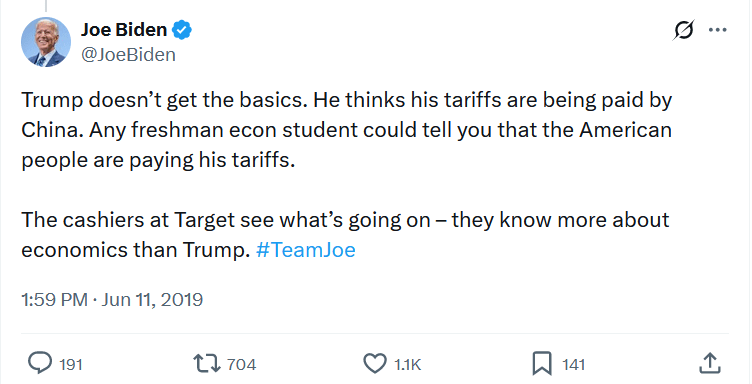
Even more importantly, tariffs don’t hurt the country you’re tariffing, or at least they hurt them *less* than they hurt your *own country*. Even Biden knows that, just ask the Biden of 2019

Tariffs are a great way to push up your own country’s inflation by taxing supply without reducing demand. Furthermore, even if you don’t buy Chinese products you will be paying for this inflation because of substitution effects: someone who is no longer able to buy a Chinese EV may instead purchase an American car, increasing demand for American cars and therefore driving up their price.

There’s two great ways to understand how terrible tariffs are. First, think of the oil shock in the 1970s: middle east nations cut off America’s access to oil and gas from their countries, causing spiraling prices and runaway inflation. By blocking America’s access to energy, they were able to put an economic squeeze that defined the decade.

China is being tariffed on solar power, wind power, and green industries of all kinds, and China makes up more of our imports than the middle east ever did. Spiraling prices are yet again on the menu.

Furthermore, think of Britain’s strategy against Germany during both World Wars. Britain used its powerful navy to prevent Germany from importing goods. This caused shortages and spiraling inflation, leading to riots that overthrew the government in the First World War and overwhelming shortages during the Second.

Tariffs are a way for us to do to ourselves what our enemies would do to us in war: restrict the import of needed goods.

Finally, consider Biden’s empty words about the “existential threat” posed by Climate Change. If Climate Change is dire, then why is Biden raising tariffs on solar power, wind power, and EVs, rather than Chinese oil and Chinese airplanes? Biden is essentially setting up an “anti-carbon tax,” in which polluting industries are exempt from a tax being paid by green industries.

The truth is that none of this is about national security, anymore than the Japan Scare of the 1980s was about national security. Just look at how Japan’s peaceful economic expansion was seen back then:

“The Danger from Japan.” Mr. White warned that the Japanese were seeking to create another “East Asia Co‐prosperity Sphere”-this time by their “martial” trade policies, and that they would do well to “remember the course that ran from Pearl Harbor to the deck of the USS Missouri in Tokyo Bay.

Biden is a 1980s style politician, with the (failed) economic outlook of that time. When he sees foreigners being successful it makes him scared, so he raises tariffs to “protect” American industries. But far from protecting industries, tariffs only harm them.

Industries rely on consumers to sustain them, but tariffs are a tax on consumers, sucking up consumer surplus and leaving less money for consumers to spend on domestic industries. Politicians think that domestic industries can magically appear to replace all the foreign ones, but simply put: no man is an island and nor is any country. Autarky is the failed economic policy of fascism, not an economic model for democracies.

Just look at a country like Brazil. Heavy tariffs were supposed to promote domestic industries and help consumers. Instead, consumers pay exorbitant prices for things like video games, while Brazil’s gaming industry remains anemic relative to the nation’s size and wealth. Brazilian cars, Brazilian microchips, and Brazilian steel are not the envy of the world.

And it isn’t because Brazilians are bad at industry, its because their government is doing everything it can to stop them. The high tariffs on everything from steel to cars to microchips are supposed to spur domestic industry, but who’s going to open up a factory when you have to pay those high tariffs just to import the machines and inputs needed to make your products?

Biden is a protectionist because he’s a protectionist. Not because China or Canada are scary or because he needs to fight climate change. But to be fair, Trump is just as protectionist as Biden if not more-so. It’s clear that the current crop of American politicians supports higher inflation and poorer consumers. And that bodes ill if you want to see America succeed and its enemies fail.

Chickenhawks

Jingoism is a hell of a drug.

20 years ago during the end of Bush’s presidency, military intervention was anathema to most of the Democratic party. New interventions were treated with suspicion, and getting out of current wars was seen as paramount.

5 years ago, during Trump’s presidency, military intervention was again evil and bad. Trump’s assassination of an Iranian general was yet another reckless decision that would lead us to world war for little to no gain.

Yet today, the Democratic party is again making common cause with many of the foreign policy “hawks” that drove support for the wars in Iraq and Afghanistan. And somehow no one sees what’s wrong with this.

In 2023, the Houthis in Yemen began attacking ships transiting through the Red Sea on their way to the Suez Canal. The Red Sea and Suez Canal bring an enormous volume of trade to Europe, Africa and Asian. Shutting off this passage means ships have to take the long way around Africa, which greatly raises prices and increases shortages.

Then in January of 2024, Biden put the Houthis back on the Global Terrorism list (he’d removed them from the list as one of his first acts as president), and announced the USA would begin bombing Yemen to stop the Houthi attacks.

Social media lit up with stupid talking points about America’s military might, and how “the Houthis are going to learn why America doesn’t have free healthcare.” Social media is overwhelmingly populated by the young and left-leaning, so seeing the same demographic group that protested the Iraq War now beating their chests over a bombing campaign was jarring to say the least.

And what happened? After months of bombing, the Houthis are still attacking ships. Shipping companies are still avoiding the Red Sea. Transit through the Suez is still down and prices due to circumnavigating Africa are still up.

And America still doesn’t have free healthcare.

The bombing campaign has clearly failed at its goal of ensuring safe traffic through the Red Sea. So much so that Biden has now offered a ceasefire where he will again remove the Houthis from the global terror list if they will stop attacking ships. America’s military might could not silence the enemy guns or enforce America’s will, and so we are once again forced to negotiate with terrorists.

To be fair to Biden, this may be the right move. He openly stated that he was only placing them on the global terrorism list because of their attacks against ships, removing them from that list if they stop attacking ships is only natural. It is a low-cost concession to the Houthis, as removing them from the list makes it easier for them to access international markets, but doesn’t do much to harm America directly.

But it’s still obvious that this was a failed bombing campaign, and it raises the question of if we’re negotiating with terrorists now, why didn’t we *start* with negotiations *before* bombing them? The bombing does not seem to have done anything to reduce the frequency or intensity of Houthi attacks, if anything it has only given the Houthis greater credibility in Yemen as it has galvanized the populace to “rally ’round the flag.”

Hawks will complain that I’m being unfair: the bombing campaign was *not* a failure, America just wasn’t even trying to win. And it’s true, America has the capacity to conduct Dresden-level bomb campaigns and Desert Storm level ground campaigns nearly at-will. Neither of those happened, so America clearly wasn’t using its full might.

But was there any political will for carpet bombing or a ground invasion? Absolutely not, a tepid bombing campaign was all that would have been acceptable in an election year. And so if you take America as both a military and political entity, then yes this bombing campaign was about all America was capable of.

But none of the chickenhawks who beat their chest in January will ever admit that the campaign was a failure, ever admit that we are negotiating with terrorists, ever admit that there were other options or other solutions. Thousands of politicians and military aficionados went to their graves believing that the War in Vietnam could have, should have been won, and if we’d just stayed in a little longer (or nuked Hanoi), we could have won it. I have no doubt this campaign (much much smaller as it is) will also be remembered thus by many.

But the fact is that there are not always military solutions. It’s a classic slogan to say that “we don’t negotiate with terrorist,” but it’s just not true, we negotiate with terrorists all the time.

An FBI negotiator brings a suitcase full of cash to a terrorist who has hijacked a plane.

There are times when terrorists have leverage over you, and the problem with leverage is that it exists whether you want it to or not. Whether that leverage is hostages, military might, or geographic position, you can’t just wish it away and pretend it doesn’t exist. Nations also have constraints: budgetary, political, logistic, which can constrain their military response significantly.

So while it’s true that in an open field with no holding back the American military would destroy the Houthi military without a single casualty, that’s not the war that Biden fought. Trying to remove terrorists from their own country that supports them without a ground invasion or naval blockade will always be a challenge. And if a nation is politically, economically, or logistically incapable of doing that, then they need to look hard at what they are *actually trying to accomplish*.

I have seen precious few cases in my adult life of military intervention leading to a lasting improvement in the situation. The best example would be the bombing campaign in Yugoslavia from nearly 3 decades ago. The second best example would be the few years of near-normality that the American military gave to Afghanistan, prior to the Taliban returning.

But one success and one partial success is a terrible track record for the number of military campaigns we’ve been engaged in. And it seems the Houthi campaign will be yet another mark in the failure column, as it has done nothing to eliminate Red Sea attacks which will almost certainly be ended only by negotiations if they are even ended at all.

So the next time social media lights up with chest-thumping about how American military might should be directed at a problem, think for more than a few seconds about whether a military solution is even possible.

Vibes and the economy

I don’t want to get too political, but it’s an election year (in several countries) and The Discourse is inevitable. But I want to quickly push back on something I’ve seen all too often on social media recently.

In America, the numbers for the economy look “good.” Unemployment is low, *really* low. Inflation is high, but wage growth is higher. And the stock market is up. So why are Americans’ perceptions of the economy so poor? Why is consumer confidence lower than it *should* be?

Some partisans and twitterati have decided that Trump Was Right and the problem is fake news. Legacy media and social media are both driving relentlessly negative press and this is brainwashing people into believing that the “good” economy is “bad.”

But instead I’d like to take take a step back and see if polls are telling us something that “the numbers” just aren’t. And I think I have good evidence that they are.

First, here’s a graph from the Federal Reserve Bank of Dallas. It shows that housing affordability is lower than at any time since the 80, lower even than during the housing bubble that precipitated the Great Recession. If you’re a millennial or a zoomer, *never in your life has housing been less affordable than it is today*.

And housing isn’t just a “nice-to-have,” it sits at the bottom of Mazlo’s Hierarchy of Needs for a reason. A stable housing situation is (for most people) a necessary ingredient before they feel confident starting a family, putting down roots, or just feeling like they “belong” to where they live.

Now, you *can* have a stable housing situation in an apartment, but it’s much harder. Rent increases can drive you out, and rent-controlled apartments are hard to come by. Apartments also aren’t always conducive to the types of living that people want in their life.

So the price of housing is driving a *real crisis* in millennial and zoomer living, as people with otherwise high earnings are unable to obtain what lower-earnings folks could get in the past, namely a house to live in.

Then there’s the fact that datapoints about “all” millennials are missing key differences *between* millennials. See the next graph

The *median* millennial is doing worse than the median boomer was at this point in their life, in terms of net wealth, net assets, and housing. But the top 10% of millennials are doing way better than the boomers ever could, so taken together it seems like millennials are doing well overall. It’s like looking at a city where 1 person is a billionaire and 99 are destitute and saying that overall the city is very wealthy.

These kinds of mean/median differences are well-known to people in liberal circles, because they signal high inequality. But because a liberal is currently president, these differences are ignored by much of the twitterati.

I could say more about this topic, and I wish I had the energy to, but I’ve been so tired lately with my new medicine. Nevertheless, next time you see someone like Will Stancil screech that the kids are all morons and that everyone is rich, note that he is a member of that top 10%, not the median.

When people’s answers in polling are different than what “the fundamentals” suggest, it may be that the people are just stupid. But it’s far more likely that polling is capturing something that your data is ignoring. And right now that’s housing costs and growing inequality.