I’ve been lacking motivation recently, lacking the drive to do all the things I want to do. So I don’t do things.
That makes me depressed that I haven’t gotten anything done. So I get even more demotivated. So I don’t do more things.
This spiral is a bad place to be in. I’m trying to get out. I’m going to set goals to work out on specific days (MWF). I’m setting measurable deadlines for things to get done in both my work and my personal life. I’m going to set goals to reach out to my friends more often, because being with friends always motivates me.
And I’m going to try to get less depressed when things don’t go right. I think that’s been part of the problem, when things go poorly I take it too hard on myself.
I’m a scientist, the hallmark of science is that while we can predict what may happen, we then have to test it through experiments. If our experiments go a certain way, then our prediction was wrong and we have to find out what to do now. That’s just part of science, it’s all part of the process.
But when my experiments aren’t going as I expected them to, I take it too personally. I haven’t yet learned enough how to step back and just accept it, just find out what happened, alter the conditions, and revise the predictions. Instead I keep wondering if I myself am to blame, and if I myself and uniquely unqualified to do this job I’ve been doing my entire adult life.
What makes people successful isn’t just a single moment of brilliance, but a determination to keep being brilliant, which takes work. Whether its physical determination, mental fortitude in the case of adversity, or what have you, success if a pattern of behavior, not a lottery ticket.
And I need to remember that and act like that. It won’t help me if I just get things right once and then rest on my laurels, that won’t bring success. And likewise it won’t help me to mope about whenever I get things wrong.
This is all something that I’m sure everyone deals with, no one needs me to tell them, but it’s something I want to tell myself and I feel like writing it down is the best way to do that.
I need to keep going, keep trying, and keep acting like this matters, even in the face of failure. Letting every failure spiral me further into depression is just a recipe for more failure.
I watched this video doing a breakdown of Mike’s PhD thesis. His thesis is riddled with failures across every page. His research was shoddily done, with worthless statistics, and with technical errors littering every single paragraph that he wrote. The thesis proves that he cannot do research, cannot write research, and probably cannot *read* research either, since he misunderstands many of the papers and articles he actually cites.
This is sad to me, because as long-time readers know, I followed Israetel and took his advice seriously.
Why it matters: You may say that a thesis is just some bs he did in college, and has no bearing on his current position. But Mike Israetel’s entire brand is based around his PhD, that he is a sport *scientist* and not just a jacked dude. He mentions his PhD in his every ad and video, and so he wants viewers and customers to believe that he’s giving them *scientific advice*, which would be based on *research and testing* and not just vibes.
Yet Mike’s thesis is proof that not only can he not do research, nor write a research paper, he can’t even *read* a research paper as he misunderstands and misrepresents the papers he cites. He tells his readers that the science that *other people do* is saying something completely different than what it actually says, and that’s a big problem.
So Mike’s advice and supplements and apps aren’t actually based on science, they’re based on vibes just like every other gym bro on youtube.
Why else it matters: Some have said that Mike’s PhD program wasn’t like a “normal” program, and shouldn’t be held to the same standards. His program works closely with a lot of US olympic athletes, and it wasn’t focused on research that will help the broader public, but on learning the specific techniques to help the specific elite athletes that Mike worked with.
But if that’s the case then Mike has no business claiming that his PhD gives his knowledge applicable to anyone in his general audience. He isn’t giving advice that you, the listener should actually take, his supplements and programs won’t help you, specifically, instead they are tailored toward the special subset of people who are genuine olympic athletes, and who require a very different program to succeed than what an average 9-5er needs
Likewise, if Mike’s program wasn’t held to the standards of a “normal” PhD, then it should not have *awarded* him a PhD and he shouldn’t call himself doctor. The standards of a PhD, the reason it confers upon you the title of “Doctor” is supposed to be because it proves you have met the highest standards for science and scientific communication. That you are not only knowledgeable, but able to use and communicate your knowledge effectively to help the scientific community and educate the non-scientific community at large. But Mike’s thesis proves he just can’t do that.
He has not met the highest standards for science, and he has not even met a *high school level* standard for scientific communication. And yet he still trades on his title of “PhD,” using it as a crutch to gain legitimacy, and as a shield to deflect criticism. It matters that his thesis is worthless and that his PhD was substandard, because is means his crutch should be kicked out from under him, and his shield should be broken like the trash it is.
Finally some have said that many of these criticisms are “nitpicks.” But it matters because a PhD-level of research is supposed to be held to the highest standard of quality. You aren’t supposed to publish something without feeling certain that you can defend its integrity and its conclusions, and yet it is clear Mike’s thesis was written without any thought whatsoever. If he had even re-read his thesis once, he would not have typos and data-fails across whole swaths of it.
I have had many typos in my own blog, but these are streams-of-consciousness posts that I usually type up and publish without a second read, I’m not acting like these are high quality research publications. Mike *is* claiming that his thesis is high quality, that’s the whole reason he got a PhD for it, so it being as shoddily researched, as shoddily written, and as completely absent of a point as it is really proves that he should never have been given a PhD in the first place.
So is that the end for my following of Mike Israetel? Will I stop doing weight workouts and go back to running, since everything he says about “how to lose weight” is clearly wrong?
No.
Mike’s research is crap, and it always did skeeve me out that he leaned so hard on his “Dr” label. I’ve never bought his app or his supplements, but that doesn’t mean I can’t take his advice. Most of what he says is the same as what my *real* doctor has told me with regards to losing weight. And while his PhD is bogus it’s clear he’s taken a few undergraduate level science classes and is more knowledgeable than most of the gym bros with a youtube channel.
Ultimately his advice is probably fine on the whole. The low-level advice he gives is mostly the same as what you’ll hear from non-cranks, and the high-level advice he gives is mostly his personal opinions like any other influencer. He’s probably correct in the broad strokes that weight-lifting and caloric deficits are the best way to lose weight. And he’s probably correct that you should focus on exercises that improve your “strength” and ignore exercises that improve your “balance” unless you have an inherent balancing issue you need to improve on. He’s probably also right that the hysteria around Ozempic and other GLP-1 drugs is overblown, and that if they help you lose weight you should go ahead and use them. As he says: it’s ok to save your willpower for other parts of your life.
But I have no reason to believe his specific advice around high level concepts like training to failure, periodization, muscle group activation, etc. If you don’t know what those are, then it’s a good idea to ignore what he says about them and just focus on lifting and (if you’re overweight), cutting calories.
I don’t think Mike is a complete idiot who should be ignored entirely. I think he’s a hustler like any other influencer and if the things he says work for you, then do them. But he’s not backed by science like he claims he is, so ignore any of his ramblings if they don’t work for you. Talk to your doctor instead, or an *actual* exercise scientist, although if Mike’s PhD thesis is “the norm” for that discipline, then most exercise scientists aren’t really scientists at all.
I’ve long lamented that the fitness and sports landscape is overrun by bro-science and dude-logic. It’s ruled by the kinds of shoddy science and appeals to tradition that we would normally call “old wives’ tales.” But when a jacked dude says something crazy, like “you should lie upside down to regain your breath so that your blood rushes to your lungs,” a lot of people might say “well he’s jacked, he must know *something*.”
I had thought Mike Isratel was an escape from the wider landscape, and that he was perhaps a trendsetter for actual science to creep into this mess. But it seems he’s just another grifter trying to get rich. Ah well, such is life.
Glacier National Part in Montana [has] fewer than 30 glaciers remaining, [it] will be entirely free of perennial ice by 2030, prompting speculation that the park will have to change its name – The Ravaging Tide, Mike Tidwell
Americans should plan on the 2004 hurricane season, with its four super-hurricanes (catagory 4 or stronger) becoming the norm […] we should not be surprised if as many as a quarter of the hurricane seasons have five super-hurricanes – Hell and High Water, Joseph Romm
Two points of order:
In 2006, when Mike Tidwell wrote about glaciers, Glacier national park had 27 glaciers. It now has 26 glaciers, and isn’t expected to suddenly suddenly lose them all in 5 years.
Since 2007, when Joseph Romm wrote about hurricanes, just four hurricane seasons have had four so-called “super-hurricanes,” and just one season has had five. The 2004 season has not become the norm, and we are averaging less than 6% of seasons having five super-hurricanes
I do not write this to dunk on climate science, I write only to dunk on the popular press. The science of global warming is fact, it is not a myth or fake news. But the popular press has routinely misused and abused the science, taking extreme predictions as certainties and downplaying the confidence interval.
What do I mean by that? Think of a roulette wheel, where a ball spins on a wheel and you place a bet as to where it will land. If you place a bet, what is the maximum amount of money you can win (aka the “maximum return”)? In a standard game the maximum amount you can win is 36 times what you bid, should you pick the exact number the ball lands on. But remember that in casinos, the House Always Wins. Your *expected* return is just 95/100 of your bid. You’re more likely to lose than to win, and the many many loses wipe out your unlikely gains, if you play the game over and over.
So how should we describe the statistical possibilities of betting on a roulette wheel? We should give the expected return (which is like a mean value how much money you might win), we should give the *most likely* return (the mode), and we should give the minimum and maximum returns, as well as their likelihood of happening. So if you bet 1$ on a roulette wheel:
Your expected return is 0.95$
Your most likely return is 0$ (more than half of the time you win nothing, even if betting on red or black. If you bet on numbers, you win nothing even more often).
Your minimum return is 0$ (at least you can’t owe more money than you bet), this happens just over half the time if you bet on red/black, and happens more often if you bet on numbers
Your maximum return is 36$. This happens 1/38 times, or about 2.6% of the time.
But would I be lying to you if I said “hey, you *could* win 36$”?
By some standards no, this isn’t lying. But most people would acknowledge the hiding of information as a lie of omission. If someone tried to entice someone else to play roulette only by telling them that they could win 36$ for every 1$ they put down, I would definitely consider that lying.
So too does the popular press lie. Climate science is a science of statistics and of predictions. Like Nate Silver’s election forecasting, climate modeling doesn’t just tell you a single forecast, they tell you what range of possibilities you should expect and how often you should expect them. For instance, Nate Silver made a point in 2024 that while his forecast showed Harris and Trump with about even odds to win, you shouldn’t have expected them to split the swing states evenly and have the election come down to the wire. The most common result (the mode) was for either candidate to win *all* the swing states together, which is indeed what happened.
Bad statistics and prediction modellers will misstate the range of possible probabilities. They will heavily overstate their certainties, understate the variance, and pretend that some singular outcome is so likely as to be guaranteed.
This kind of bad statistics was central to Sam Wong of the Princeton Election Consortium‘s 2016 prediction, which gave Hillary Clinton a greater than 99% chance of victory. Sam *massively* overstated the election’s certainty, and frequently attacked anyone who dared to caution that Clinton wasn’t guaranteed to win.
Nate Silver meanwhile was widely criticized for giving Hillary such a *low* chance of victory, at around 70%. He was “buying into GOP propaganda” so Sam said. Then after the election Silver was attacked by others for giving Clinton such a *high* chance, since by that point we knew she had lost. But 30% chance events happen 30% of the time. Nate has routinely been more right than anyone else in forecasting elections.
I don’t doubt that some people read and believed Sam Wong’s predictions, and even believed (wrongly) that he was the best in the business. When he was proven utterly, completely wrong, how many of his readers decided forecasting would never be accurate again? How much damage did Sam Wong do to the popular credibility of election modeling?
However much damage Sam did, the popular press has done even more to damage the statistical credibility of science, and here we return to climate change. Climate change is happening and will continue to accelerate for the foreseeable future until drastic measures are taken. But how much the earth will warm, and what effects this will have, have to be modeled in detail and there are large statistical uncertainties, much like Silver’s prediction of the 2016 election.
Yet I have been angry for the last 20 years as the popular press continues to pretend long-shot possibilities are dead certainties, and to understate the range of possibilities. Most of the popular press follows the Sam Wong school.
In the roulette table, you might win 36$, but that’s a long-shot possibility. And in 2006 and 2007, we might have predicted that all the glaciers would melt and super-hurricanes would become common. But those were always long-shot possibilities, and indeed these possibilities *have not happened*.
The climate has been changing, the earth has been warming, but you don’t have to go back far to see people making predictions so horrendously inaccurate that they destroy the trust of the entire field. If I told you that you were dead certain to win 36$ when putting 1$ on the roulette wheel, you might never trust me again after you learned how wrong I was. Is it any wonder so many people aren’t trusting the science these days, when this is how it’s presented? When we were told 20 years ago that all the glacier in America would have melted by now? Or that every hurricane season would be as bad as 2004?
And it isn’t hard either to find numerous even more dire predictions couched in weasel words like “may” and “possibly.” The oceans “may” rise by a foot, such and such city “may” be under water. It’s insidious, because while it isn’t *technically* wrong (“I only said may!”) it makes a long-shot possibility seem far more likely than it really is. Again, it’s a clear lie of omission, and it’s absolutely everywhere in the popular press.
We have to be accurate when modelling our uncertainty. We have to discuss the *full range of possibilities*, not just the possibility we *want* to use for fear-mongering. And we have to accurately state the likelihoods for our possibilities, not just declare the long-shot to be a certainty.
Because the earth *has* warmed. A glacier has disappeared from Glacier national park and the rest are shrinking. Hurricane season power is greater than it was last century. But writers weren’t content to write those predictions, and instead filled books with nonsense overstatements that were not born out by the data and are easily disproven with a 2025 google search. When it’s so easy to prove you wrong, people stop listening. And they definitely won’t listen to you when you “update” your predictions to match the far less eye-catching trend that you should have written all along. Lying loses you trust, even if you tell the truth later.
I think Nate Silver should be taken as the gold standard for modelers, statistician, and more importantly *the popular press*. You *need* to model the uncertainties, and more importantly you need to *tell people* about those uncertainties. You need to tell them about the longshots, but also about *how longshot they are*. You need to tell them about the most likely possibility too, even if it isn’t as flashy. And you need to tell them about the range of possibilities along the bell curve, and accurately represent how likely they all are.
In *every* election Silver has covered, he has been the primary modeller accurately measuring the range of possibilities, and preparing his readers for every eventuality. That gets him dogpiled when he says things that people don’t like, but it means he’s accurate, and accuracy is supposed to be more important than popularity in science.
So my demand to the popular press is to be more like Nate Silver and less like Sam Wong. Don’t overstate your predictions, don’t downplay uncertainties, don’t make extreme predictions to appeal to your readers. Nate Silver has lost a lot of credibility for his temerity to continue forecasting accurately even in elections that Democrats don’t win, but Sam Wong destroyed his credibility in 2016 and has been an utter joke ever since. If science is to remain a force of informing policy, it needs to be credible. And that means making accurate predictions even if they aren’t scary enough to grab headlines, or even if they aren’t what the twitterati would prefer.
I don’t have a catchier title, but this *is* a question I’ve been pondering. When I was young I thought that having someone else do housework for you was the height of luxury, but these days it doesn’t seem to be that uncommon. I don’t know anyone who paints their own fence, mows their own yard, or cleans their own roof. These jobs used to be seen as just part of owning a house, either you did it or you forced your kid to do it as part of their chores. But it seems nowadays most people hire professionals to do it instead.
Even the most basic housework has been outsourced, with services available to clean your bathroom and kitchen twice a month, or your whole house if you like. And of course think about restaurants and fast food: eating outside your own home has almost doubled in the past 50 years. That’s a lot less meals that people have to cook, a lot less dishes they have to clean, and even less groceries that they have to buy.
So housework is being outsourced, and is it related to how Americans seem to work many more hours than the rest of the developed world?
But Josh Barro on twitter has pushed back against claims about European quality-of-life: they don’t have dryers. Reddit too has a huge thread about the lack of dryers and high-energy appliances in Europe. Can a place without such creature comforts really be comfortable?
I don’t want to dwell on the dryer debate. Yes Europeans can dry their clothes in the sun. Yes, it may be cheaper. But does it require more work? Is an electric dryer not a labor-saving device that lets you cut out the work of hanging up your clothes and taking them down?
And coming back to housework, doesn’t paying someone to do your housework also save you from doing that labor? And if so, how much is your time worth it to you? To restate the question from the title of this post: if working 45 hours a week instead of 40 meant you never had to do housework, would you take it?
Some people like doing housework, I get that. But for most people, it’s a chore. And so I wonder if Americans on the whole have made a choice: they work more at work so they can work less at home, and I wonder if anyone has quantified this. European’s extra housework may not show up in the metrics, but it should still be quantified to know if Americans really do “work more hours.”
Working at work vs working at home is a dichotomy any student of economic history understands. When women first entered the private sector workforce, it didn’t mean that women *started working*, and that they weren’t working before that. Women had been doing work at home without pay since the dawn of time. If you calculate the labor done by homebound women and compare it to the paid labor plus housework done by working women, women’s’ overall working hours went down when they entered the workforce. They could use the money they made at work to pay for other people’s labor or labor-saving devices at home.
Men had also taken this leap from housework to paid work centuries before. During the days of subsistance farming, men, women, everyone had to do a hell of a lot of odd jobs to keep themselves housed, clothed, and fed, even when they weren’t actively “working” on their farm. This is why claims of how few hours medieval farmers worked are so misleading: they had many “holidays,” sure, but besides attending church those days would still be spent doing work around the house even if they wouldn’t be spent in the field.
If you were a medieval peasant, you might have a roof that needs mending, food that needs preserving, you need a new chair to fix the old one, a new patch to cover the hole in your cloak, and you had to do all this yourself or it wouldn’t get done. It didn’t show up in “hours worked” because it’s housework in the home. But it still needed to be done to maintain quality of life.
When men started moving from farms to factories, they traded their labor in for money, and could then use that money to *have their roof fixed, buy their own food, buy a new chair, or have their cloak patched*. They could use money to get someone else to do labor for them. They started working *less hours* when you account for both house work and factory work.
Factories workers worked a *lot*. But subsistence farmers worked far more for far less. But if you only calculate “hours worked” using work *outside* the house, then you’d wrongly conclude that subsistence farmers lived cushy lives and that women’s liberation destroyed women’s free time. Nothing could be further from the truth, instead, people these days work much more outside the house in exchange for working much less in it.
And I wonder how much that feeds in to the America vs Europe debate on working hours. How much labor do Europeans do around their homes that Americans *don’t* do. How much labor do Americans save by using dryers, by hiring landscapers, by hiring homecleaners, and are they happy with the extra hours they work to afford that? Do Americans work more hours to save themselves from housework?
I’m going for a “clickbait” vibe with this one, is it working?
When I was getting my degree, I heard a story that seemed too creepy to be real. There was a research lab studying the physiology of white blood cells, and as such they always needed new white blood cells to do experiments on. For most lab supplies, you buy from a company. But when you’re doing this many experiments, using this many white blood cells, that kind of purchasing will quickly break the bank. This lab didn’t buy blood, it took it.
The blood drives were done willingly, of course. Each grad student was studying white blood cells in their own way, and each one needed a plethora of cells to do their experiment. Each student was very willing to donate for the cause, if only because their own research would be impossible otherwise.
And it wasn’t even like this was dangerous. The lab was connected to a hospital, the blood draws were done by trained nurses, and charts were maintained so no one gave more blood than they should. Everything was supposedly safe, sound, by the book.
But still it never seemed enough. The story I got told was that *everyone* was being asked to give blood to the lab, pretty much nonstop. Spouses/SOs of the grad students, friends from other labs, undergrads interning over the summer, visiting professors who wanted to collaborate. The first thing this lab would ask when you stepped inside was “would you like to donate some blood?”
This kind of thing quickly can become coercive even if it’s theoretically all voluntary. Are you not a “team player” if you don’t donate as much as everyone else? Are interns warned about this part of the lab “culture” when interviewing? Does the professor donate just like the students?
Still, when this was told to me it seemed too strange to be true. I was certain the storyteller was making it up, or at the very least exaggerating heavily. The feeling was exacerbated since this was told to me at a bar, and it was a “friend of a friend” story, the teller didn’t see it for themself.
But I recently heard of this same kind of thing, in a different context. My co-worker studied convalescent plasma treatments during the COVID pandemic. For those who don’t know, people who recover from a viral infection have lots of antibodies in their blood that fight off the virus. You can take samples of their blood and give those antibodies to other patients, and the antibodies will help fight the infection. Early in the pandemic, this kind of treatment was all we had. But it wasn’t very effective and my co-worker was trying to study why.
When the vaccine came out, all the lab members got the vaccine and then immediately started donating blood. After vaccination, they had plenty of anti-COVID antibodies in their blood, and they could extract all those antibodies to study them. My co-worker said that his name and a few others were attached to a published paper, in part because of their work but also in part as thanks for their generous donations of blood. He pointed to a figure in the paper and named the exact person whose antibodies were used to make it.
I was kind of shocked.
Now, this all seems like it could be a breach of ethics, but I do know that there are some surprisingly lax restrictions on doing research so long as you’re doing research on yourself. There’s a famous story of two scientists drinking water infected with a specific bacteria in order to prove that it was that bacteria which caused ulcers. This would have been illegal had they wanted to infect *other people* for science, but it was legal to infect themselves.
There’s another story of someone who tried to give themselves bone cancer for science. This person also believed that a certain bone cancer was caused by infectious organisms, and he willingly injected himself with a potentially fatal disease to prove it. Fortunately he lived (bone cancer is NOT infectious), but this is again something that was only legal because he experimented on himself.
But still, those studies were all done half a century ago. In the 21st century, experimenting with your own body seems… unusual at the very least. I know blood can be safely extracted without issue, but like I said above I worry about the incentive structure of a lab where taking students’ blood for science is “normal.” You can quickly create a toxic culture of “give us your blood,” pressuring people to do things that they may not want to do, and perhaps making them give more than they really should.
So I’m quite of two minds about the idea of “research scientists giving blood for the lab’s research projects.” All for the cause of science, yes, but is this really ethical? And how much more work would it really have been to get other people’s blood instead? I just don’t think I could work in a lab like that, I’m not good with giving blood, I get terrible headaches after most blood draws, and I wouldn’t enjoy feeling pressured to give even more.
Is there any industry besides science where near-mandatory blood donations would even happen? MAYBE healthcare? But blood draws can cause lethargy, and we don’t want the EMTs or nurses to be tired on the job. Either way, it’s all a bit creepy, innit?
I haven’t written in far too long, so here’s the streams of my consciousness.
I recently learned an acquaintance of mine cheated a fair bit in college. They took classes during COVID, and have confessed to cheating on the at-home exams for difficult classes during the time when distance learning was new and Universities were lax.
I wish I could say otherwise, but it does lower my opinion of this person.
I don’t like cheating at all. A recent bugbear of mine has been the increase in “cheating” I’m seeing on the roads. This may sound like a topic change, but hear me out:
We all have a duty to drive safely. That means obeying posted speed limits, obeying lights, no unsafe behavior. Any car breaking this duty makes the roads less safe for all of us. But we all know why so many cars speed, run red lights, or make right turns from the far left lane: it gets them home faster.
They want to get to where they’re going ASAP and they don’t care how unsafe they make the road. Not just for themselves, but for all the cars around them who now have to swerve out of the way of their dangerous driving and maybe cause secondary wrecks in the process.
Dangerous drivers cheat the system that keeps us safe for very minor gains. And I really despise it. Deaths on the roads have continued to increase year after year since the pandemic, and it seems no city or police force is willing to tackle this. An increase in death is just what the city government wants I guess, revealed preference and all that.
They could halt the dangerous drivers by enforcing traffic laws. Have cops patrol the street, give tickets to any speeder, anyone running a red. Automate the ticketing process if need be, revoke people’s license for dangerous driving, and jail them for years if they drive without a license. Time and time again, research has shown that vigilant enforcement is the only mechanism to reduce lawlessness. If less than 1% of the lawbreakers are ever punished, why wouldn’t everyone break the law?
In times like this you can only fall back on your own morality. Your own willingness to obey the social contract and not endanger your neighbors, even if it would benefit you to get home a few minutes earlier. But many people can’t do that, and so they drive like maniacs.
Going back to my acquaintance, they told their cheating story to me in a moment of weakness. They are struggling a lot with their current work, and I wonder if they revealed this in part as a way to say-without-saying “I’m so stupid, I only succeeded by cheating.” I think this person is smart, but doesn’t know how to apply their effort properly. They feel like they’re grinding themselves into dust to succeed yet still failing. I feel like they’ve completely misplaced their efforts, and they need to step back and analyze the situation instead of just grinding harder and harder for no gain.
But while I hate to admit it, this revelation does color my opinion of them just a bit. I can’t say I’ve been unmoved by the desire to cheat. I can’t say there weren’t times when I wished I could just crack open a book during the test, or ask someone to write a paper for me.
I tell a story that maybe the real reason I never cheated was I was too unimaginative or even lazy to do so. I resisted getting a smart phone until almost the end of college. I never wanted to write notes in tiny writing that I could look at during the test.
Once, in high school, I remember having to write a paper and wishing someone else could do it for me. I did a bit of googling and sure enough there was a website I could find that seemed to have a pre-written paper on exactly my topic. But clicking the link, I could only read the first 2 sentences before a pop-up demanded payment. And as a high schooler without a credit card to my name, I closed the link and went back to procrastinating until I FINALLY wrote the paper myself.
But while I’ve toyed with the idea of cheating, I never fell into it. My acquaintance clearly did.
Everyone justifies their actions of course. “It wasn’t even in my major, so I would never have to know this stuff again, why not cheat” (blatant lie, it was a pre-req for further classes, and I don’t know why they’d even lie about it this).
“I liked the first half of the course, but the second half was just all memorization and it was so boring” (I know the course myself, you shouldn’t be memorizing, you should be studying patterns. You should have studied smarter instead of studied harder, learn the patterns and you don’t need to memorize).
But while it reduces my opinion of them a little, I still think (know?) this person is bright and CAN succeed if they just learn how to properly place their effort. Then again, maybe this cheating story shows a pattern. They didn’t know how to spend their effort to find patterns instead of memorizing, so in the end their only recourse was cheating. They don’t know how to spend their effort now… there won’t be any recourse if they can’t figure it out.
I still want to finish my Stardew Valley miniseries, but I also want to get something off my chest: it’s ok to not like things other people like, and I wish more people felt this way.
I’ve written before about games I like, but I’ve also been honest about how some of them are the kinds of games I wouldn’t recommend to others, just because I know some folks won’t like them. I really enjoyed Pillars of Eternity, but I wouldn’t be surprised if you didn’t.
What turned you off of it? Was it the 30+ different status ailments to keep track of? The overabundances of resistances and damage types? The stats each doing 5 different things? The rest-heal system? I loved all that shit, but you don’t have to. Or maybe you just don’t like real-time-with-pause, I’ve been open that I’m probably the only one who prefers it to turn-based-tactics in RPGs, so while I’d be disappointed at your criticism I wouldn’t be surprised.
Or maybe you played Cult of the Lamb, but hated how the base building got in the way of your dungeon crawler. Or you tried Ace Attorney, but couldn’t get over how it was a visual novel with pixel hunting for puzzles.
If you told me you didn’t like any of these games, I’d understand. If you said they were *bad* games, I’d disagree but I could probably at least understand your viewpoint. Even if a game is loved by 99/100 people who play it, that still means a game with a million buys is disappointing *at least* 10,000 people.
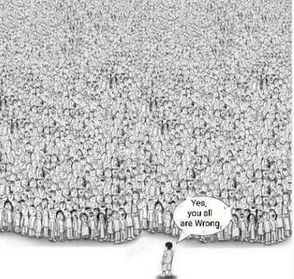
Our culture has even had a resurgence of memes pointing this out. Standing up and telling the whole world that they are wrong has become a point of pride for some people. So if you don’t like a game I like, I try not to hold it against you.
But I feel some people just can’t accept this. If you don’t like something, you must be *bad* at it, or impatient, or stupid, or you didn’t read the tutorials, or you mashed through the story. The reason you didn’t enjoy it is a *moral failing* on your part because *I* liked it and *I’m* a good person so anyone who thinks differently than me must be a *bad* person.
If this feels like a petty call-out of “gamer” culture, that’s because it is. Too often I’ve seen people disliking things be attacked for being bad, or salty, or unmanly because they can’t handle the “difficulty” of a game that can never just be criticized. I’m tired of this shit, I see it all the time, and it’s why I almost never talk to people about video games.
Because no one is ever allowed to just think something is good or bad, no one can accept that different people have different opinions. You must be too stupid to understand Pillars of Eternity, or too illiterate to appreciate Ace Attorney, or too impatient to enjoy Cult of the Lamb.
And yes this post is a subtweet, because when talking to a friend recently, I had exactly this kind of conversation. I didn’t like part of a game, and this was thrown back at me as a *moral failing* on my part. That because I didn’t play *the right way*, my complaints about not having fun were invalid, and were instead a reflection of my impatience and ignorance for not reading the correct menus or using the correct strategies.
And I hate that shit. Sometimes people just hate your favorite game, or favorite movie, or favorite book. And part of being an adult and not a child should be accepting these opinions, allowing people to complain if they want, and if you feel obligated to defend the honor of your favorite media, to at least couch your defense as how “you” feel, and how “you” played, rather that attacking the other person for their failure to enjoy it.
I just feel like too many people treat and attack on their preferred media as an attack on them. If you thought Ace Attorney was bad, I disagree. And it could be fore any reason, you can think that the murders are too contrived, or the world is unrealistic, you can think the characters like Mia and Pearls are creepy, or that Phoenix is an empty suit, you can think investigations are boring, and trials drone on and on, you can think it’s too simple or too convoluted or anything else. And I’d disagree, but I would hope I’d be willing to see that an attack on my favorite media is just you venting, and not an attack on me.
Nothing you say is an attack on me. “How was I supposed to know to press on that statement!” Fair criticism, I get people can get bored when most presses yield no new information. “I think Mia’s power is creepy,” is something I disagree with, but I can accept others think this way. “The murders are unrealistic and convoluted,” I like it because every case feels engaging and nothing is ever simple or straightforward, but you don’t have to like it yourself. Unless you go out of your way to say “only idiots/perverts/misanthropes enjoy this game,” I’m not going to hold your critiques against me.
So please give me the same treatment. If I dislike a game or movie or book, I’m not attacking you or the people who like it. I’m talking about my dislike because all people like talking about themselves. You just told me about your day, can’t I tell you about mine? So just let me say I don’t like it, say you liked it and that’s fine. But don’t attack me, because I’m not attacking you.




 Streams of Consciousness