What exactly *isn’t* Ezra Klein’s “Abundance Agenda?”

Answer: It isn’t neoliberalism.

Unfortunately, Klein killed my joke. Because between my last post and this one, he made his own post in the New York Times where he clarified that “Abundance” is *not* about neoliberalism. Be warned, I’m writing at night again so this post will be more streamsofconsciousness-y than the last.

First, an intro paragraph: Ezra Klein says the problem with America (and especially Blue States) is that they are Unable To Build. They can’t build rail, or houses, or energy infrastructure. And while nowhere in America can build these well, Blue States are doing *especially badly*. This inability to build means our transport is expensive, our houses are expensive, our energy bills are expensive, and we need to embrace Abundance (aka “build more stuff”) in order to fix our economy. Abundance means building lots of stuff to bring down prices and make everyone happier.

I’ve been amused to see “Abundance” described as some form of rebranded “neoliberalism.” Neoliberalism is a slippery term, but the shackling of the state was a thoroughly neoliberal project.

The above is a quote from Klein, but here he himself falls into the trap of “neoliberalism is whatever I don’t like.” No wonder neoliberalism been described as an “ideological trashbin,” neoliberalism is the political equivalent of a wastebasket taxon.

He describes this “shackling of the state” as the reason we Can’t Have Nice Things in this country, or rather it’s the reason all of our government building projects are way over-time and way over-budget. He does think that some deregulation should be done to allow the free market to build things (like houses), but he is still a partisan Democrat and believes that the government should always take the first step in transportation and energy. Secretly I also think he wants to flex his left-of-center bonafides so he can quell accusations that he’s a secret Reganite, but regardless, he says we cannot have Abundance simply by deregulating, we also have to “unshackle the state.” But what does it mean to “unshackle the state?”

See, the “shackling of the state” as he calls it was really a reaction to the post-World War 2 economic consensus. It was common consensus after World War 2 the State should be allowed to buy up land and invest in infrastructure whenever it wanted, which is exactly what Klein says they should do now, and exactly what Biden said he would do from 2020 to 2024. But the authority of the state is unchecked, it has a “monopoly on the use of force” as they say in poli-sci. So eminent domain aka *forcing people to sell their land* was the common way for the state to build infrastructure, since forced sales (rather than negotiations) are always the best way to make a project happen on-time and under-budget.

We can debate whether or not eminent domain was a bad thing, but in my experience it’s basic Democratic Party orthodoxy that it was *really really bad*. You may recall former Secretary of Transport Pete Buttigieg talking about how the highways were racist by design. This quote was wildly taken out of context, but what he meant was that the government eminent domain’d poor neighborhoods in order to build our highways. Now, in American, eminent domain still requires you to pay a “fair value” to the people whose house or land you buy up. So when using eminent domain, the government buys poor neighborhoods instead of rich ones because poor ones are cheaper to buy, this is obvious. But since minorities are more likely to be poor, this means the poor neighborhoods that were bought up and paved over to build highways were more likely to be minority ones. Hence eminent domain = bad.

In reaction to eminent domain, America “shackled the state.” The power to use eminent domain was massively curtailed, and demands were placed on the state and elected leaders to find other ways to complete infrastructure without this kind of forced-sale.

But unshackling the state is exactly what Klein wants to do to enact the “Abundance Agenda,” and that would mean allowing minority neighborhoods to be bought up and their residents displaced so the government can build infrastructure. It would also mean the government can do other things it did under the pre-shackled consensus, like flooding native tribal land to build the Hoover Dam, floodiung rural Tennessee to build the Tennessee Valley Authority dams, and in many many cases of displacing people who would rather have stayed where they were.

This unshackled state was seen as an injustice by the socially-minded on the left, and so they pushed for strong laws that would prevent the government OR ANYONE ELSE from being able to do this again. The so-called “shackling of the state” was done in the name of Social Justice, not neoliberalism.

And here is a point I would like to make: Klein routinely fails to grapple with the trade-offs that his “Abundance Agenda” would create. He says that we need to “unshackle the state” in order to build lots of good things and bring about Abundance. He says that we *used* to be a country that could do this, and points to the New Deal and the Eisenhower Interstate System as proof of this, and as a model Democrats (and America) should follow. But he doesn’t realize or fails to mention that this unshackling would cause all the problems that are still complained about to this day, bulldozed neighborhoods and displaced people.

Ezra Klein wants to build railroads in the way Eisenhower built interstates, but that’s going to mean blasting through poor neighborhoods in order to get a rail line into the city, just as Eisenhower did. That’s going to mean building across Native land because that’s the shortest way to build a line between many of our Western cities. And since minorities in America are still more likely to be poor, that means the neighborhoods you’ll be blasting through will be minority ones, and you’ll be fought every step of the way by the groups who worked to “shackled the state” in the first place.

Klein is very clearly interested in social justice, but he paints a picture in which the shackling of the state was just caused by misguided leftists and hairbrained libertarians, not his social justice co-partisans. He refuses to grapple with the question of “is it just to bulldoze a poor, black neighborhood to build infrastructure that will be used by millions?” Unless he has an answer for that, then he doesn’t actually have an answer for how to “unshackle” the state.

This refusal to grapple with trade-offs runs rampant through Klein’s Abundance Agenda. He frequently makes the claim that we just need to cut red tape and *get building* and that this will allow us to achieve our every dream. But what exactly is stopping us from building, and who demanded that red tape in the first place?

The sources of Red Tape can be discussed, but I want to keep in mind a few things:

  • Every source of Red Tape *agrees that we need to cut Red Tape*
  • Every source of Red Tape thinks that *their objectives are the most important*
  • Every source of Red Tape just thinks *someone else’s objectives are the ones that should be cut* in order to cut the Red Tape and achieve Abundance
  • Klein falls into the trap of imagining a sort of Red Tape “Legion of Doom” who just stop government projects because they’re evil and don’t like government. But in fact Red Tape is always put there at the behest of some interest group that is trying to protect its members wherever possible

The sources of red tape I’d like to discuss are, in order:

  • Local democracy
  • Environmentalism
  • Taxpayers
  • Unions

Local Democracy is the one that Klein and the Abundance folks feel the strongest in attacking. Everyone hates NIMBYs, but local democracy is more than just them. As I said in the previous post, there are usually listening sessions for any new building project to get neighbor buy-in. These sessions are a great way for NIMBYs to stop projects by demanding so many listening sessions that the project becomes too expensive to be profitable, but any other interest group can also use the demand for listening sessions in order to hamstring an unwanted project.

When framed as “NIMBYs vs infrastructure,” I’m sure it’s easy to get online consensus that local democracy should be crushed beneath the Federal boot. But your political opponents will always try to frame the argument in their way, and supporters of local democracy will frame it in terms of democracy (duh) but also minority rights (why should their minority neighborhoods and native land be forced to bear the burden of all this construction?), social justice (why are these things always built in poor neighborhoods?) and local knowledge (the DC bureaucrats need to listen to the locals because they don’t understand the needs of this area).

If you don’t have a response for these framings, then you won’t be able to bulldoze the NIMBYs and build your railroads. The problem for Klein is that this is a trade-off, are we willing to sacrifice social justice and build our railroads through a poor minority neighborhood, just like we built our highways? It’s easy to attack NIMBYs in the abstract, much harder when we have actual history telling us what happens when we *do* let the Federal Boot stamp on local democracy. And while the Interstate System is widely loved, it has seen a lot of pushback by Ezra’s ideological allies, and Ezra himself is pretending that their concerns over local democracy won’t affect his Abundance Agenda.

Next let’s discuss environmentalism, which is another soft target for the Abundance folks. Abundance folks like Klein laments that “surely we shouldn’t have years of environmental review slowing down our *wind farms*. Surely we shouldn’t allow people to block solar panels in *the dessert*”. But reframed in terms of unknown environmental risks and biodiversity and it gets a lot thornier.

The Abundance Agenda seems to argue we should be fine with building a new railroad/wind farm/solar farm without the years of environmental review demanded by environmentalists. Environmentalists will hit back that we don’t know 100% what chemicals might seep into the water lines, or how many species will go extinct due to habitat destruction, or how much deforestation and de-greening the new construction will cause. I trust the engineers to do their due diligence, and I trust the EPA to monitor situations as they come up. But can Ezra really sell that to America and the environmental movement at large?

The whole point of environmental review is preventing those kinds of “chemicals in the water/mass deforestation” catastrophes, even if the review takes years or decades (in the case of California High Speed Rail). It only takes one research paper to assert that a new train *may* lead to elevated Lithium levels in the rivers of southern California, and then you’ve lost public buy-in for the project at large. And of course if the railroad *does* lead to Lithium in the water, what then? It’s easy for Klein to talk about “cutting environmental review” but he never grapples with how to respond to the claims *within his own coalition* that doing so will make America more sick.

Abundance is an ideology that to some extent wants to be bipartisan. Klein uses Red States as his model to harangue Blue states, and congress recently created a bipartisan Abundance Caucus to champion Klein’s ideas. Although this bipartisan group still voted overwelmingly for the exact kind of anti-abundance legislation that Klein laments, so whatever. But still, I’ve used this post to discuss the conflicts between the Abundance agenda and some parts of Klein’s otherwise partisan orthodoxy, I’d like to use the next post to discuss some of its conflicts with other orthodoxies.

I’d meant these to all be one post, but couldn’t get my thoughts out in time. See you again soon.

Assuming your political opponents are just “misinformed” only guarantees that you won’t win them over

A bit more streamsofconsciousness than other posts, because I’m writing late at night. But here goes:

I don’t know much about the right-of-center political shibboleths, but it’s been a shibboleth on the left that people only vote conservative because they “don’t know any better.” They’re “misinformed,” they’re “voting against their own interests,” they’re “low-information voters,” these are the only reason anyone votes for the GOP. Nevermind that the “low-information voters” tag was first (accurately) applied to the *Obama* coalition before Trump upset the political balance of power.

Remember that in the 2012 matchup, Obama voters consumed less news than Romney voters, and were less informed on the issues at large. But in those days calling someone a low-information voter was nothing less than a racist dog-whistle (at least among the left-of-center). By 2016, Trump had upended American politics by appealing to many voters of the Obama coalition, and now this racist dog-whistle was an accurate statement of fact on the left.

“Yes some voters just don’t know any better. They don’t know the facts, they don’t know right from wrong, they just don’t know. And if they don’t know, the quickest solution is to teach them, because once we give them the knowledge that “we” (the right thinking people) have, they’ll vote just like we do.”

But attacking liberals (in 2012) and conservatives (in 2016 and 2024) as “low-information” is old hat, what about attacking leftists?

That’s what the Atlantic’s Jonathan Chait has done in a recent article. Now, he doesn’t directly state “leftists are misinformed” like he would say about conservatives. It’s obvious Chait still wants leftists in his coalition and doesn’t want to insult them too badly. But he’s laying out the well-worn left-of-center narrative that his political opponents do not understand things, and that he needs to teach them how the government actually works so they can agree with his positions and support his favorite policies.

In Chait’s view, leftists just don’t get that the government is too restrictive, and that these restrictions are the cause of the housing crisis. They don’t realize it’s too regulatory, and those regulations harm growth. And they don’t get that government red tape is the reason all our infrastructure is dying and nothing new can be built. Chait attacks California High Speed Rail and Biden’s Infrastructure bill as hallmarks of this red tape. California HSR is 10 times over budget and still not a single foot of track laid down, while Biden signed the Infrastructure bill in 2021 and wrongly believed that he could have photo-ops in front of new bridges, factories, and ports in time for 2024.

The fruits of Biden’s infrastructure bills are still almost entirely unbuilt, their money still mostly unspent. And this lets Republicans make calls to overturn those bills and zero-out Biden’s spending. If his projects were actually finished on-time and during his presidency, Biden’s enemies could never attack his legacy like that. But government red tape stood in the way.

See, with claims like these, Chait is arguing in favor of the Abundance Agenda. I’m not entirely opposed to it. See my many posts on de-regulation.

But Chait is once again missing the mark here. He claims that Leftists don’t *understand* abundance, and that’s half of why they oppose it. He claims the other half is that they’ve built their power base as being the people who “hold government accountable” and oppose its over-reach. But Chait is mostly arguing that Leftists don’t realize that their crusade against Big Government is a “bad thing” that has made our economy worse. And I don’t think Leftists are misinformed at all, I think they just have different priorities than me and Jonathan Chait.

Let me explain though a specific example: Josh Shapiro is well-loved for repairing an I-95 overpass in rapid time. He did so by suspending all the red tape that usually slows down such infrastructure projects. Chait then argues, if we know we need to suspend the rules to get things done quickly, then why do we need to have these rules in the first place? They’re slowing us down and preventing us from building what’s needed, so shouldn’t we just remove some of them?

But here’s the red tape that Shapiro suspended:

  • There was no bidding process for procurement, contractors were selected quickly based on the Govenor’s office’s recommendations
  • There were no impact studies for the building process
  • On-site managers were empowered to make decisions without consulting their superiors or headquarters
  • Pennsylvania waived detailed financial reporting processes
  • Pennsylvania waived most environmental reviews
  • Pennsylvania waived the requirement to notify locals of the construction, and to gain local approval for that construction

I don’t exactly have a problem with these ideas, and if Chait wants to make these de-regulations a central part of the Democratic brand, more power to him. But Chait is wrong that leftists are simply misinformed, I think many leftists would say that while these waivers are fine in an emergency, we should not support this deregulation for all projects, even if it saves us time and money. The reasons (for a leftist) are obvious.

  • Deregulating procurement is central to the Trump/DOGE agenda, and opponents say this opens the door to government graft as those in power can dole out contracts to their favorites.
  • Impact studies were also deregulated under Trump in two different executive orders. Biden revoked both orders at the start of his term because of his focus on health and the environment. I think most leftists would assert that protecting the environment and health is more important than other government priorities.
  • On-site vs HQ is less of an emotive topic, but the need for “oversight” is still a driving idea any time the government Does Stuff
  • Waiving of financial reporting opens up accusations of fraud
  • Waiving environmental reviews, see point 2
  • Waiving local notification and buy-in. You can probably get away with this when “re-“building, but will ANY democrat stick their neck out and say locals shouldn’t have a say in new highway construction? I doubt it. Highways change communities, and any change needs community buy-in (so they say). This focus on localism is very popular on the right, left and center, no matter how much I and the Abudance-crats may oppose it.

So Chait, do the leftists not understand Abundance? Or do they have strongly-held beliefs which are incompatible with Abundance?

This whole theory of “low-information voters” is always appealing to democracies biggest losers. It’s why the GOP liked it in 2012, and it’s why Democrats like it in 2024. The idea cocoons us in a comforting lie that we alone have Truth and Knowledge, and that if only everyone was As Smart As Me, everyone would Vote Like Me.

It also seems Obviously True on the face of it. “The best argument against Democracy is a conversation with the average voter,” so the saying goes. And when you see any of your opponent’s voters interviewed directly, you can’t help but notice how much information they are *lacking*. And it’s obviously true, most people don’t know how government works, they don’t understand permitting, they don’t get that environmental impact reviews cost so much money and time. So obviously if we gave them that knowledge, they’d start voting “correctly,” right?

This misses an important point about political coalitions and humans in general: the wisdom of the crowds. Most people don’t know most things, but we all (mostly) take our cues from those who do know.

Think about the leftist coalition in America, the Berniecrats, the AOC stans, the DSA and the WFP. Most of the voters in this coalition don’t have a clue how environmental review works. But there are some in the coalition (probably including Bernie and AOC) who do know how it works, and the rest of the coalition takes its cues from those people.

There are certainly some people who have looked long and hard at the Abundance Agenda, and they have concluded that (for instance) removing environmental reviews would lead to Americans being exposed to more pollution and harmful chemicals. It was only because of environmental reviews that the EPA took action against PFAS, for instance.

So Chait is arguing that we need to reduce regulatory burden and reduce the ability of locals and activists to halt projects with their red tape and environmental reviews. I agree with this.

But Chait then argues that the only reason leftists don’t agree with us is because they don’t understand how harmful red tape and reviews are, and thus leftists have lead a wrong-headed campaign of being the people who say “no” to new buildings. I disagree with this.

I think the evidence shows that leftists simply have different beliefs than me and Chait. Leftists believe that red tape and reviews are necessary to protect the environment. And a leftist might argue that Chait complaining about environmental reviews is like a conservative complaining that “cars would be cheaper if they weren’t forced to have seatbelts and useless safety stuff.” Chait says environmental review doesn’t help us. Well I’ve never needed my seltbelt either, because I’ve never crashed.

I’m sure you can see how stupid the seatbelt argument is, well that’s probably how stupid leftists would see Chait. Yes 99% of the time an environmental review finds nothing objectionable about a project, but what about those few times when they do? Do we scrap the whole system because it’s usually a waste of time? I say again: without environmental review, the EPA would not yet have taken action on PFAS. A leftist could seriously say to Chait: do you support allowing PFAS in the water? Because it might still be allowed without environmental review.

I don’t know what Chait’s response would be, I’m sure he’d try to say “well that’s different,” because any review that *found* something was clearly a good review. But you don’t know beforehand which reviews will find something dangerous and which won’t. To a leftist, that means you have to do them all.

Now, most leftists *do not understand environmental review* just like most liberals, moderates, conservatives, and reactionaries. Most people don’t understand most things. But the leftist coalition includes people who *do* understand it, and they’ve weighed the costs and benefits and come out with a different stance than Chait has. The rest of the coalition takes its cues from the understanders, just like the every other coalition does.

But Chait’s thesis is built on a lie that because most leftists don’t understand, they’ll side with him and Abundance once they *do* understand. I disagree strongly. Most leftists will continue taking their cues from the informed leftists, and Chait is not saying anything new to inform those informed leftists. The coalition will only modify its position on this issue once the majority loses faith in the understanders (and thus seeks new ones with new positions), or when enough of the current understanders retire and are replaced by new ones. Coalitions, like science, advance one funeral at a time.

But this idea that people are misinformed and just need a smart guy like *me* to set them straight, this is a central tenant of politics that I think needs to die. You shouldn’t assume your opponents are just misinformed, you need to understand that they *actually have different ideas than you do*, and try to win them over by finding common ground. Otherwise you’ll continue to be the Loser Coalition just like Rush Limbaugh and the Romney-ites of 2012.

What exactly is Ezra Klein’s “Abundance Agenda?”

Answer: it’s neoliberalism. But if that answer fills you with disgust, fear, or just confusion, please read on as I promise the explanation will be worth it.

In the wake of the 2024 election, Ezra Klein and buddies published a book called “Abundance,” and in talks and interviews they have been trying to sell it as a way forward for the defeated Democrats. The key question of the book is this: if liberal policies are so great, why do blue states have the most homelessness? Why do they have the highest overruns on their infrastructure projects? Why do they have the most difficulty building renewable energy?

These are difficult questions because they cut at the heart of the liberal/progressive promise for America. There was a half-century long political touchstone (within the American media sphere) that the Democrats were who you voted for if you cared about social issues, but you voted Republican if you cared about economics. Never mind that this misses the many socially conservative/economically re-distributive voters who saw things the opposite way, this “vote Republican for the economy” belief was one that Democrats wanted to push back on.

For my entire adult life, Democrats have been making the argument that no, “Republicans are actually bad for the economy, vote Democrat if you care about economics.” In the wake of the Financial Crisis, this message resonated, but after 4 years of inflation it seems voters no longer bought it.

Worse still, Ezra Klein’s “Abundance Agenda” argues that *you can’t blame voters for coming to this conclusion*. Blue states may be the *richest states*, but it is the Red states that are *growing*. They are building housing, they are building infrastructure, and in the next census it is predicted that Blue States (California and New York especially) will lose electoral votes to Red states (such as Florida and Texas). People are literally voting with their feet, moving from Blue states to Red states when every part of the liberal mindshare says that’s insane, and that all migration should be happening in the *other direction*. The only explanation is that people believe they’ll have higher quality of life in these Red states than what they have in the Blue states, how can that be?

Ezra Klein’s answer is that Democrats haven’t lived up to their economic promise, and they need to embrace Abundance if they are going to do so.

Much of his suggestions are things I myself have blogged about, land use should be deregulated, housing and energy should be made easier to build, and the free market should at times be deferred to to bring down prices for consumers. Government bureaucrats can’t run markets.

In this sense, Ezra Klein is making a (small) break with Bidenism. Tariffs on solar panels make it more expensive to build clean energy, tariffs on lumber make it more expensive to build houses.

When it’s more expensive to build things, then the supply is lower. When the supply is lower, the price is higher. If we want consumers to enjoy low prices, we should encourage higher supply by making it less expensive to build, this is the core of the Abundance Agenda. “Build what?” you ask? Everything. Housing needs houses to be built, energy needs power plants to be built, jobs need companies and factories to be built, and the Abundance Agenda encourages policies that make it cheaper to build all those things.

In essence, the Abundance Agenda is deregulation.

See, Biden is actually a pre-Carter Democrat, recall that he was elected to the Senate in 1972. The New Deal consensus at that time included a lot of skepticism of markets, and a certain degree of autarky in which the government should step in to ensure the economy is making the things it “needs” to make. So if car companies are struggling, we need to give them subsidies or protect them with tariffs, because cars are so important. Same with solar panels, microchips, and steel.

Biden’s economic record is actually reminding me a lot of Jean Jacque Servan-Schreiber, who you may remember from previous posts. Like JJSS, Biden seemed to be trying to use government power to “direct” the economy, and my criticisms of JJSS apply just as well here: governments can’t predict the future and so don’t actually know what the best investments are. Companies can’t predict either, but at least companies have price signals and the profit motive directing them towards the best bets, governments are immune from both by their sovereign nature.

JJSS wanted the Europe of the 1960s to invest heavily in supersonic planes, but we now know that those bets were quite wasteful as the fruits of their labor (Concorde) were outcompeted by the private sector (Boeing) who had already abandoned supersonic travel entirely. Will Biden’s chip foundries built in Arizona stand the test of time? Or will they be like Concorde, an unprofitable venture held up solely by the demands of national prestige, until such time as prestige becomes to expensive to maintain?

While Ezra still sees a need for government “leadership” (which I don’t, but more on that later), he is more comfortable in the post-Carter consensus, stating that governments should cut back the regulations which prevent companies from giving us cheap goods and services. Housing is expensive because governments don’t let us build houses. Energy and infrastructure are expensive because solar farms and railroads get blocked by environmental review. Even healthcare and education are burdened by over-regulation which prevents competition and protects the current megacorporations that dominate the market.

So Ezra Klein could be most accurately described as a “left-capitalist.” He is solidly on the left with regards to all social and moral issues, but does not have the skepticism of profit and corporations that Bernie and Biden do. In other words, he’s a neoliberal.

Now that is a *very* loaded term, because my time around the Internet has shown me that many people define neoliberalism as “anything I don’t like.” But philosophically neoliberalism *was* a thing, and in many ways did represent a real ideology. It was a break with the New Deal consensus on governments directing the economy, while still accepting a government role in social welfare and poverty reduction. Carter and Clinton both governed this way, and so are usually considered “neoliberals” by people who don’t consider it a slur.

Ezra Klein is therefore arguing that this “neoliberalism” should be part of the way forward for Democrats and America at large. California and New York should take more cues from Texas and Florida, at least economically. But to do so means touching a lot of third rails within the liberal coalition:

  • To deregulate housing, you need to remove the ability of local residents to block new housing. This can easily be reframed as “removing local control” and “overturning democracy” if the neighborhood votes against a new house and you let it be built anyway. This deference to localism is hard to overcome politically when it’s framed in terms of gentrification and “Residents vs Corporate Developers”
  • To deregulate energy and infrastructure, you need to end a lot of environmental regulations. You need to get acceptance from the coalition that sometimes we’ll have to cut down a meadow to build a solar farm, or pave over a creek to build a railroad. And if there’s a species of animal or plant that *only lives* in that meadow or creek, then you have to get buy-in that biodiversity is less important that fighting climate change.
  • Energy and infrastructure also touch on “local control” and activist veto. Ezra Klein wants to make it easier for companies to get environmental lawsuits dismissed, and would likely applaud the recent supreme court decision on NEPA. But in any fight between “corporations” and “climate activists,” the coalition is inclined to side with the activists, and that will be hard to overcome
  • To deregulate schools and childcare, you need to remove laws that were put there in the name of “safety.” Many states have very low caps on child-to-adult ratio in daycares, as low as 1:3, as well regulations that the workers must have a degree in childcare and training in a wide variety of emergency medical scenarios. When a certain democrat suggested raising the child-to-adult ratio to 1:4 in one city, I saw comments that “this change will kill babies,” which is a thought-terminating incitement intended to protect regulations by force of emotion, rather than reason. If 1:4 will kill babies, then isn’t 1:3 already killing babies, since we could instead be having a 1:2 ratio? Or 1:1? At some point you have to weigh up the costs and benefits, even in cases of life and death.
  • And to deregulate any of these things, you need to overcome the cries that “every regulation is written in blood,” ie no deregulation should ever happen. This is yet another thought-terminating cliche but it’s one that has a lot of power on the left-side of the political spectrum.

So will Abundance succeed? Will Ezra Klein and the new “Abundance Caucus” make New York and California as affordable as Texas and Florida? Will they reverse the migration trends and made New York lose so many of its electoral votes? I don’t know, but I have more to say on this later. Now that I’ve defined what abundance is, I’d like my next post to discuss what it isn’t. Stay tuned…

Protectionism wears the skin of health and safety

Regulations wrapped in red tape

Trump is an unusual figure among the world’s politicians. It is not that he is a nativist and a protectionist, but that he is open and direct about his nativist and protectionist beliefs. Trump says that foreign companies are harming American companies by undercutting on price, and that foreigners are stealing American jobs by working in America.

There are many reasons to attack these beliefs and to tell Trump he’s wrong. Here are some reasons give on the left or the right, maybe you agree with one of them:

  • If foreign companies sell for cheaper, than that means blocking foreign goods raises prices. And raising prices (aka inflation) directly harms all American consumers way worse than foreign goods harm a single American company
  • “Oh your company can’t compete? Sounds like a skill issue. Your company deserves to go bankrupt, free market in action.”
  • Foreigners do jobs Americans don’t want to do
  • It’s unethical to prevent foreigners from moving to America to look for a better life
  • “Oh you can’t compete against foreign workers? Sounds like a skill issue. You deserve to go bankrupt, free market in action.”
  • Trade barriers will wreck the economy by driving up prices, and any claims of fairness are necessarily secondary to this single overriding truth: trade barriers are bad for the economy

Politicians in and out of America have made each of these arguments in turn as they argue against Trumps new tariffs. But the single-minded opposition to tariffs hides something deeper: almost every politician globally throws up trade barriers just like Trump, but they have different excuses.

  • “Those goods contain chemicals that harm our health”
  • “Those goods contain chemicals that harm our environment”
  • “For national security or data privacy, we cannot allow foreigners to hold our market or buy our data”
  • And the old reliable: “those goods and services don’t comply with our regulations.”

This last one is pernicious because of how vapid and all-encompassing it is. It only works because people have a knee-jerk reaction against deregulation, but as I have pointed out, there’s a lot of anti-consumer regulation out there raising our prices and harming our economies. Regulation doesn’t actually mean “good,” but enough people believe it does that politicians can hide all their protectionist bullshit behind an aegis of “regulations.”

I say all this because I’m bashing the EU again today. A former EU minister of parliament put out a post which demonstrates a lot of this BS EU protectionism. I had already known that the EU uses “regulation” to protect its market from foreign goods, what is commonly termed “protectionism.” What I did not know is how much EU countries use this to protect their national markets from the single market itself.

The whole idea of the single market is free trade and free movement. If a company is allowed to sell goods in one country, it should be allowed to sell goods in all of them. If a person is allowed to work in one country, they should be allowed to work in all of them. This reduces barriers, brings countries closer together, and is much more efficient economically than a world of barriers and tariffs. It should bring everyone prosperity.

But the countries of the single market still want to “protect” their national markets and their national workers, just like Trump does. But unlike Trump, EU countries are legally forbidden from erecting tariffs. So they use health, safety, and regulation instead to do their dirty work. Here’s some examples from the article:

  • Denmark claiming that adding vitamins and nutrients to breakfast cereal “could be toxic,” with absolutely no justification whatsoever. The cereals are consumed EU-wide, and one would think the burden of proof would be on the accuser in that case. But no, a baseless “could be toxic” claim is enough to ban a product in Denmark unless the company making it is willing to go through a long court battle against a national government.
  • Spain and Italy trying to force foreign chocolate (consumed in every EU state, legally chocolate by EU law) to be explicitly marketed as “not true chocolate” even though every law says its chocolate.
  • France forcing Dutch biodiesel to comply with expensive testing that is waived for French biodiesel.
  • Germany forcing foreign professionals to undergo expensive “equivalence checks” before allowing them to work in the country. This is just more BS occupational licensing by the way, a horse-groomer shouldn’t need a license to begin with let alone an “equivalence check” to make sure their Italian license is valid in Germany.
  • Adding new national regulation that must be complied with *on top* of any EU regulation. This is the most pernicious, because most EU regulations explicitly mention that they are there to “harmonize” the market, make goods acceptable in every country. But EU regulations in the past decade have not decrease trade barriers, because countries have learned to add a new national regulation on top of every EU one, forcing foreign companies to increase their compliance cost if they want to break into a national market.

For years and years, Europe was indeed a continent of decreasing trade barriers. While they continued to be strongly protectionist against the outside world (erecting anti-GMO laws primarily as protectionism for EU farms), they were at least reducing barriers within the block. But Europe is not immune to the anti-globalization sentiment that has swept across Britain and America since 2016. It’s just that much like Biden, European politicians are caught between maintaining their appearance as internationalists while still wanting to be protectionists and nativists.

So rather than erect tariffs, the EU countries have recently relied on “soft” barriers, barriers which don’t *technically* forbid entry of foreign goods, but which do place onerous costs on anyone who wants to enter the market. And a supposed internationalist has to justify their protectionism somehow, they don’t have Trump’s luxury of just honestly stating their beliefs. So they rely on their old faithful excuses: health and safety.

Biden claimed that foreign goods were a national security issue. China was the security threat that we were supposedly countering, but we countered China in part by banning Vietnamese solar panels, Mexican cars, and Canadian lumber.

And for the EU countries health, environmentalism, and data privacy are paramount. They’re part of what separates Europe from America after all. So who cares that added calcium isn’t unhealthy, or that Dutch companies are making biodiesel the same way French companies do, if it’s foreign we can claim it’s unhealthy and unsafe by default. And then we ban it until they comply with our expensive tests, or until they start making the product in our country, or until they stop being foreign and sell themselves to locals.

This is exactly what Biden and Trump wanted: American goods instead of foreign goods. But the EU countries use regulation to achieve this goal since they can’t tariff the single market.

And this is one of the main reasons I push back against regulation. I’ve said over and over, regulation is not intrinsically good or bad. Good regulation is good, bad regulation is bad. But I’ve seen over and over how politicians hide their protectionism behind a coat of regulation. And I’ve seen how most people have an intrinsic distrust of deregulation, meaning whenever I point this protectionism out I’m accused of wanting to destroy health and safety.

“Foreign cereal is unhealthy,” “foreign biodiesel is bad for the environment,” “foreign Tech companies will steal our data,” it’s very easy to just claim this without evidence and get people on board with you. And it’s *surprisingly* easy to do when “foreign” just means another country in the EU, wasn’t Europe supposed to have solidarity?

And it’s impossible to prove a negative, so proving that the cereal is no less unhealthy, the biodiesel is no different, the foreign Tech has the same policies as the native Tech, this is a losing proposition and expensive to boot. So protectionism goes on unabated, and then people wonder why the EU is still falling behind economically. Well Mario Draghi told you why, it’s because even before Trump the EU was putting tariffs on itself.

I write this in part out of frustration and in part as an attempt at education. People are negatively polarized against Trump, and so even people who never heard or cared about tariffs are deciding that tariffs are bad and we shouldn’t do them. Some neoliberal Democrats are hoping that this lets them finally remake the coalition, and kick out the protectionists like Biden and Sanders in favor of rebuilding the Clinton-Bush-Obama consensus of free trade.

But even if this happens, I’ve seen way too much evidence that this will not be a radical remaking of ideology. Protectionism will, as it has in the EU, simply become the purvey of health and safety. Even the neoliberals of the party have trouble arguing against health and safety, especially when Democrats as a whole are so negatively polarized against deregulation.

So that’s what I really wanted to say: regulations are not always good. They are not always bad, but they are not always good. Don’t assume that just because the government banned something, it was right to do so. Be open to the possibility that they’re protecting their markets just like Trump is.

Forecasting 101: all good trends will continue forever

This is a small addendum to yesterday’s post about forecasting.

Whenever you’re forecasting future trends, there are two general rules for the hack forecaster:

1. Every good trend will continue forever

2. Every bad trend will turn around soon

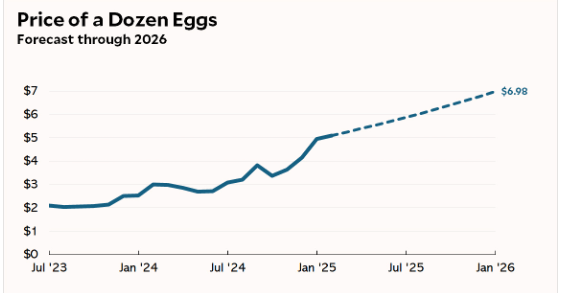
This doubly true when your forecasting has a political purpose, in which “good” and “bad” can be thought of as “supports” and “doesn’t support” your chosen narrative. A certain twitterati demonstrated this succinctly in their egg prices prediction from earlier this year:

Source

Now I don’t want to dunk too hard on this prediction (the man died between when I first saw this and when I finally got around to posting about it), but it seems like the clearest cut case of motivated reasoning I can find.  The writer was a political blogger who didn’t like the current US administration.  Saddling the administration with ever-rising prices sends a strong signal that “this administration is bad for the economy.”  So that was the prediction they wanted, and that was what they ran with.

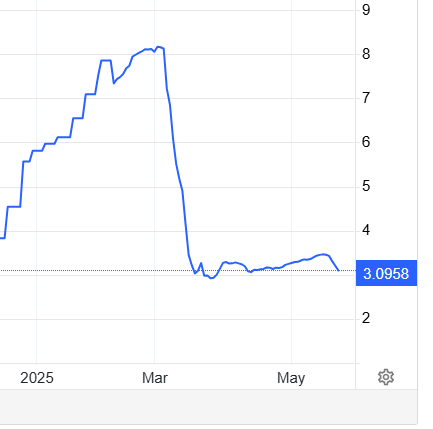
Unfortunately for motivated reasoning, this is the chart of US egg prices since the start of the year.

Source, that 3.0958 just rounds to $3.10 by the way

Trends don’t usually continue monotonically forever.

Why does this matter?  Well it doesn’t matter much, this is a small post.  But I wanted to make clear that forecasting is easy to do when you don’t expect accountability.  It’s the easiest thing in the world to draw a trendline continuing forever to support your narrative, and if you ever get pushback later for being wrong you can attack the complainers for “focusing on the past.”  

I think there needs to be a lot more social accountability in forecasting.  We need to stop giving a microphone to people who constantly proclaim a doom or paradise that never comes.  And our society needs to be willing to hold people accountable for their predictions. 

Back when 538 still existed and was run by Nate Silver, the thing that impressed me most about their predictions was the honesty with which they *scored* those predictions after-the-fact.  Every election cycle they looked at every race for which they made a prediction and compared the predictions to the actual outcomes.

And surprise surprise, predictions from an actual data scientist were quite accurate.  People hate on Nate Silver for predicting Trump had a 30% chance of winning in 2016 (instead of 100%, since he *did* win, or 0% since so many people claimed he could *never* win).  But true to form, any event that 538 gave a 30% chance to had about a 30% chance of happening.  Over the hundreds of elections that they predicted, they gave out a lot of 30% chances, and yes those 30% events did happen 30% of the time. They didn’t *always* happen, they didn’t *never* happen, they happened about 30% of the time.

That’s the kind of accountability we need, and its a shame that we lost it along with 538.  

Carter and Thatcher: Champions of deregulation

When people talk about the British economy, one complaint floats to the top of the internet discourse: the Financial Sector. According to the Twitterati, the UK spent too much money “building up” a sector of the economy that has done nothing but push up inequality, force everyone into London, and doesn’t even do anything useful.

You’ll hear it said that while finances pay most of the taxes and provide most of the GDP of the UK, this was due to a stupid choice the Government made not a fact of nature. Britain should have been more like Germany, investing in industry so they could have more middle class jobs spread around the whole country. Instead they invested in Finance and got one single city filled with rich people and their servants while the entire rest of the country goes to waste.

This complaint is wrong in many ways, but the most direct falsehood is that successive Governments *did not* “invest in” or “build up” the Financial services industry, services succeeded so rapidly because the Government *kept out*. For a long time, British financial services were heavily regulated and weren’t much larger than than what was available on the continent. But then the Government stepped away from the sector, dropped its regulations, and the sector thrived. The Government didn’t put money and time *into* finances, instead the Government was taken *out* of finances.

Maybe the Government should have gotten out of more industries?

But I’m getting ahead of myself, the changes to Britain’s financial sector all happened in a “Big Bang,” named such because instead of piecemeal deregulation over many years, there was massive, sweeping deregulation all at once. The sudden drop of onerous requirements made the sector highly competitive, and drove massive investment into London/the UK at the expense of the rest of Europe.

But most people look askance at “deregulation.” They think there must be some “catch” to this story. What regulation was dropped, and how did this secretly allow Bankers to suck blood from the unions and the working class? Well here are a few regulations that were dropped:

Broker price fixing: before the big bang, if you wanted to buy a stock from a broker they were required to charge you a minimum price for the service of selling you the stock. This price was set by the Government, and it was illegal to offer lower prices. This is bad for consumers and bad for business, I mean should the Government set a *minimum price* for food? For rent? Hell no. So why a minimum price for stocks?

Ending the price fixing meant suddenly bankers had to compete on price. The price to trade a stock went lower and lower, and this had the effect of opening up the stock market to the common people as well. Suddenly there wasn’t some onerous price on top of any stock you wanted to buy, you could pay for just the stock plus a paltry service fee of a few pence. And in time, even this few pence fee went away, as brokers offered fee-less trading in an attempt to compete on volume.

Price ceilings are terrible, but leftist will still argue they are at least good for the consumer. Price *floors* are exactly as terrible, and I hope even leftist realize they aren’t good for the consumer.

Electronic trading: before the big bang, it was mandated that to buy or sell a stock, two people had to meet in person and agree to the sale. You put in your order to a broker, they wired the order to someone else, and eventually your order would make its way to two people standing on a crowded floor screaming at each other to haggle over the price of your stock. They weren’t screaming in anger, but just to be heard over everyone else on the floor, who was also screaming.

The big bang introduced electronic screens with prices and volumes, and allowed orders to be made totally electronically. This helped end the monopoly of overpaid men screaming at each other. It made ordering easier, allowed it to be done from anywhere, and by cutting out the middlemen it helped bring down the price for buying and selling stock. Once again, this helped democratize the stock market, few workers today would be able to invest for their retirement on the stock market if prices to buy and sell were still as high as the 70s.

Foreign ownership: the big bang allowed foreign companies and individuals to act as brokers. Much like electronic trading, this broke the monopoly on overpaid men screaming at each other, and lowered prices; are you seeing a pattern here? Anyway foreign banks and brokers could now bring outside investment and outside technology to the British stock market, where before they’d been banned.

The ban on foreign brokers had been done solely to “protect” the profits of British banks and British brokers. But like tariffs, it did not help the British economy nor protect British wages. It was just another facet of a Government sanctioned oligarchy, which allowed only certain, connected individuals to profit from Britain’s stock market. Foreign investment created competition, and it also created a flood of incoming money, which boosted demand for workers and drove up British wages. These new brokers needed buildings, needed computers, needed employees etc. The flood of incoming money was a great boon for workers and builders in every sector of the British economy.

These are just a few of the deregulations brought on by Thatcher’s big bang, but they all had the same theme. They broke the monopoly of the overpaid bankers and brokers, and brought in competition that brought down prices and democratized the stock market. The financial industry grew like never before, eclipsing every other sector of the British economy. And it did so not through Government support, but because the Government *kept out*.

But let us turn now to Jimmy Carter.

Deregulation is too often seen as a boogieman of the right wing. The conservative party (whichever party it is in your country), wants to deregulate because they secretly want to destroy the environment and make workers their slaves. It is a too-common dogma on the left that any regulation is necessary and sacrosanct for the good of the economy, and that deregulation doesn’t even help GDP but merely lets well-connected CEOs impose a monopoly that makes everyone poorer.

So I thought I’d push against that view with a man no one could accuse of being a right-wing conservative: Jimmy Carter. Jimmy came to the presidency at a time of great difficulty. Inflation, oil crisis, stagflation even, the American economy was nuts in the 70s. There was even fear that the USSR would overtake America. Jimmy would fix that.

One of Carter’s signature policies was deregulating the airline industry. Once again, a modern leftist might see this as a betrayal: what did Carter’s deregulation do to break the unions, harm the workers, and price-gouge the people, and how much did the airlines pay him to do this? But nothing could be further from the truth. Prior to Carter’s deregulation, the airline industry worked like a Gilded Age trust, with strict rules that protected the big players at the expense of workers, people, and anyone trying to get a foot in the door.

First, to make a new airline route, companies had to submit their request to a centralized body. This body would then look to see if the new route created too much competition with any other airline’s route, and if it did, the route was forbidden. Imagine if Walmart could forbid anyone from opening a store within 5 miles of their own, that was basically what this law did.

The airline submitting the new route had to basically get a hospital-style “certificate of need” proving that there weren’t enough flights for the amount of passengers who *wanted* to travel. This was of course very difficult to prove, and the airlines already serving that route could try to maintain their monopoly by promising to increase flights, so usually the monopoly was protected.

In addition, a centralized agency set a price floor on airline tickets. Like we discussed earlier: price floors are bad. They only serve to enrich the big players by making it impossible for new companies with better tech to come in and compete on price.

In fact, even *starting a new airline company* was all but impossible, as any new company had to get permission to run airlines. Imagine if Walmart could forbid the creation of Costco solely on the basis of “we were here first.”

Airlines in America had a ton of overregulation that only served to protect the big players at the expense of everyone else. No one benefited from this, not the workers, not the fliers, not the American economy, no one except the big boys who lobbied hard to prevent deregulation from passing.

In the end, deregulation democratized flight in America the way same way it democratized the stock market in Britain. Adjusted for inflation, the average New York to LA flight was 1,200$ in 1970, today you can fly that route for under 300$. There is no question in my mind that the American people are better off without being price-gouged by airline lobbyist. And Carter made all that possible.

So my final thought is this: deregulation is a dirty word, but it shouldn’t be. Regulations are not necessarily good. They are not necessarily bad either, but don’t assume they are always good. Deregulation is likewise value neutral. It is good to remove bad regulations, it is bad to remove good regulations.

Britain has a lot of bad regulations holding it back, that’s why I suggested deregulation to Keir Starmer. Starmer has a once-in-a-generation opportunity to change Britain for the better. He’s got a big majority, there is wide agreement that his predecessors were bad for the economy, and he’s hemmed in by debt and deficits preventing any big spending. This is the perfect time for deregulation.

So I say cut the red tape, kick out the cartels, and trample all over the lobbyists who want to protect their corporate fiefdoms. If Britain is going to build, it needs change, the kind of change that Jimmy Carter understood. And even if Thatcher deregulated, that doesn’t mean deregulation is always bad. Would you like to pay 10 pounds every time you wanted to purchase a stock? Would you like to pay 4 times as much to fly to another city? Starmer should cut costs for the working folk, and deregulation can make that happen.

If I Ruled Britannia: economic reforms

Sir Keir Starmer, the newly elected King of England, 2024 pencil sketch

Last time on Streams of Consciousness, I was talking about the economy of Great Britain and what they needed to change to improve things. They’ve tried raising taxes, they’ve tried cutting spending, but their fiscal deficit is only rising and new loans to cover the deficit are getting ever more expensive. My previous recommendation was spicy and probably unpopular, so I quarantined it in its own post and am putting the rest of my recommendations here.

But first: what should Great Britain *not* do? Well first of all I agree with Tony Blair: they shouldn’t put retaliatory tariffs on America. And this isn’t because I’m biased and don’t want them to hurt America, it’s because *I want what’s best for Britain and don’t want them to hurt themselves*.

It may sting to allow Donald Trump a “win.” He’s jacked up tariffs and demanded that no one else retaliates with their own. If you do what he’s asking, aren’t you letting him win? Well if you think retaliatory tariffs are a smart move, you must think that because you believe they will hurt America with only a modest affect on your own country. But that’s wrong, tariffs are a huge blow to your own country, with only a modest affect on the one you’re tariffing. Doing what Donald Trump wants just means letting him win the foot-shooting competition.

Tariffs are inflation in action: everything gets more expensive for absolutely no reason. Because everything is more expensive, everyone is poorer (since their money doesn’t go as far). And tariffs don’t “protect” domestic industries, they destroy them. They destroy competitiveness because there is no market force pushing companies to improve their products. With tariffs, it’s always more viable to increase your profits by rent seeking (demanding the tariffs rise yet further) rather than by self-improvement. Thus the companies stagnate and rust out. Less goods are produced at a much higher cost, everyone is poorer.

This is true even when your tariffs are “targeted.” It’s just that “targeted” tariffs destroy only a few industries instead of all of them. Donald Trump tariffed you, but if you retaliate with tariffs on on American fuel and aircraft (major American exports), you’ll harm your own airline industry by raising their costs. Needless to say your airlines will have to raise their own costs, harming your tourism/travel industries, and thereby harming your citizens who can no longer afford airfares. America will feel some harm, yes, but not as much as your own people.

“We’ll substitute American goods by buying goods from Europe!” Trump wants to substitute foreign goods with American goods, do you think that will work for him? It won’t work for you either.

Tariffs also destroy industries by raising the cost of all their inputs, since again tariffs are just inflation. The steel company can raise its prices since it’s no longer competing with Chinese steel, and has no incentive to innovate because it plans to ask for more tariffs next year. So if you’re a manufacturing company making anything with steel, all your steel just got very expensive and will only get more expensive from here. Might as well cut wages, it’s the only cost you can control.

Many manufacturers will go bankrupt, they can’t afford the higher prices. A few dozen steel jobs will be “saved” at the cost of thousands of higher-paying manfacturing jobs. Those steel workers will then be laid off because with all the manufacturers going bankrupt, no one needs so much steel. And besides, the cost of iron has gone up with the tariffs on iron (and the iron mine is soon to go bankrupt as they can’t afford the machines needed to keep mining).

Think of it this way: if you think retaliatory tariffs are a good idea, then you think Trump’s tariffs in general are a good idea. You agree with him that the tariffs hurt the target countries more than they hurt the country placing them. You think Trump is doing smart economic policy, and are just mad that he’s doing it to *you*.

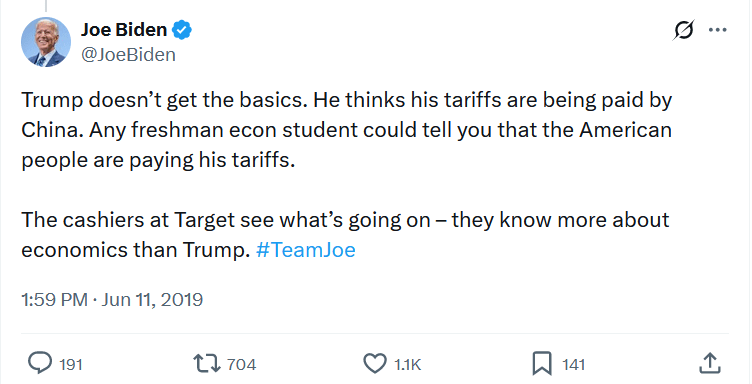
So again, don’t complain about giving Trump a *win*, reject the cognitive dissonance on tariffs and accept the one and only truth: tariffs are bad for growth, bad for prices, and bad for workers. Biden knew this in 2019, but I fear the cognitive decline hit him fast since he forgot it by 2021. (example, example, example)

Anyway that’s what Britain *shouldn’t* do, so what *should* it do?

How about reducing the need for occupational licensing? “Licensing” sounds good in theory, the Government is going to step in and demand minimum qualifications for certain professions. But everything sounds good when you ignore the costs and handwave the benefits.

Licensing sounds nice because you immediately think of doctors and nurses. But many many jobs have mandatory licenses that simply do not need them. Does a horse trainer really need a license? A piano tuner? A wig-maker? Adding a license does nothing except make it harder for people to get jobs. It’s part of what’s killed “entry-level” positions, there is no such thing as “entry-level” in an industry where any work at all requires a specific license.

20% of UK jobs need a specific license, which ossifies the labor marker and prevents workers from job-hopping to find better wages. You may have veterinary training, a fondness for horses, and see well-paying jobs opening up in the horse-racing industry. But without a long and arduous licensing process, you’re cut out from that part of the labor market, forced to keep working at Tesco for almost nothing.

You may ask “but without a license, how can we ensure these workers are competent?” You interview them, you look at their CV, you contact prior employers. An incompetent employee can do damage yes, for instance an incompetent Tesco stocker can leave heavy merchandise off-balance to crush unwary shoppers, so do shelf stockers need a license? Be honest, exactly how much is saved by having entry-level jobs be licensed? Quantify all the harms, both physical and monetary, then weigh them up against the costs.

Because licensing *does* have a cost. It lowers social mobility since the lower class can’t afford to spend years getting licensed before getting their first job. It hampers growth by preventing industries from growing to meet demand. And it drastically raises costs for licensed labor, without really raising wages.

How can that be? Aren’t licensed jobs paid more than unlicensed? Yes but look at the cost of getting that license, with its years of training and bureaucracy. Look at the cost of *keeping* that license, with mandatory retraining, continuing education, and the like. Time is money, and all the time it takes getting and keeping a license usually drains any additional pay that the license brings.

And look at how that license locks you into a single career, unable to switch things up to chase a higher wage. I’m sorry, you’re a *horse* trainer, *dog* training is a different license.

And study after study shows that very few licenses improve outcomes. Doctor, nurse, these require years of training and understudy, a license here may be warranted. But this kind of thinking is needlessly applied to far too many jobs, most of which show no difference in quality between licensed professionals (in countries where a license is needed), and unlicensed professionals (in countries where it isn’t). License medical and legal practitioners, let everyone else be.

So that’s occupational licensing. My next suggestion for Keir: end planning permission and build housing on the green belt. I wrote about the Green Belt before, but for those of you who missed it: the Green Belt isn’t green, and Britain should build on it.

“The Green belt” of is a bunch of land surrounding many of Britain’s largest cities. The name conjures to mind beautiful forests and fields, untouched by Man since the days of yore. But it’s actually car parks and monoculture farms, forbidden from being built on so that landowners can prevent their neighbor’s property from being bought up by the urban bourgeoisie. It’s a NIMBY version of feudalism.

And the Green Belt does have houses by the way. NIMBY houses for people who don’t want anyone to live near them, but also don’t want to pay for that privilege. Instead of buying the land surrounding their house (and thus paying tax on it), they simply demand no one *else* be allowed to build anything there.

So build on the Green Belt, put apartments on the car parks. Housing is unaffordable in Britain, build more houses and prices will come down. Build more apartments and rent will come down. And with housing and rent getting cheaper, people can afford to spend more on buying goods and services, pumping more money into the economy and creating more jobs.

Importantly, *the Government does not need to do this building*. Too many people think that if the Government is not actively building things, either with its own taxpayer-funded corporation or through special subsidies, then things just won’t get built. But that is not at all true. A plethora of private companies would love to build and sell houses, but Government laws prevent them. So just repeal the laws and the companies will build, no special subsidies or taxpayer-funded company necessary.

And while we’re at it, do away with local planning permission. People complain about developers “banking” land, holding it without building for years. That’s only done because it takes on average a *decade* to get permission to build anything. If someone wants to build and sell houses, buying the land is step 1, steps 2-90 are all planning permission. Cut out those steps and the houses will be built faster and cheaper.

Local councils hold far too much power to block housing, get rid of that power. Instead of a situation where council have to give “permission,” create a national “by-right” system of planning. Developers submit a proposal to build a dwelling at a location, a national organization makes sure it’s up to code, and once they OK it development starts. No more veto-ocracy by local NIMBYs.

Great Britain is no longer a feudal society, you shouldn’t require the permission of the local landlords to build on your own land. Local landlords don’t want you to build a nice apartment that competes with their crack house? Tough. End local planning permission and kick the landlords to the curb.

And now here’s my final suggestion for Keir Starmer, get rid of bank ring-fencing.

Actually that’s not my suggestion, but it was raised as a possibility by British politicians. And the suggestion isn’t that outlandish, Germany ended its ring-fencing over a decade ago

But wait, what is/was ring-fencing? In 2008, the Financial Crisis/Great Recession happened when banks made risky loans, those loans defaulted, and the banks went bust. This cause a knock-on effect throughout the economy.

The risky loans often came from the “investment” side of the banking business, but when the bank went bust even the the “core” side (which held consumer’s money) was hit. Ring-fencing meant keeping investment banking separate from consumer banking, so any bad investment bets would have no effect on consumer savings.

But banks are banks, and economies of scale mean one bank doing two things is usually more efficient than two separate banks. That’s why some want to get rid of ring-fencing and let banks make more money. Germany already did so, why shouldn’t Great Britain? Let the good times roll again.

I don’t know if ending ring-fencing is good or not because honestly I don’t actually know much about its effect. What efficiency is gained by combining consumer banking and investment banking? What is lost by ring-fencing? But I don’t reflexively hate this idea the way I probably would have hated it 10 years ago, less than a decade after the Financial Crisis. I don’t know, I’ll need to do more reading.

So anyway those are my proposals the economy of Great Britain. Keir, if you’re reading: work on this for me, would you?

Deregulation is a dirty word on the left mostly because it’s a clean word on the right. But this reflexive partisanship isn’t helpful, regulations are not always good. Removing bad ones is necessary for an economy to grow. And if Labour wants growth, if they want to stop having to come out with more taxes and less spending every six months, then they need deregulation.

Post Script: Talking about the banking deregulation, I was reminded of Thatcher’s “Financial Big Bang.” No time to discuss it today, but I hope I remember to do so soon, because it’s a fascinating topic that explains a lot about today’s Great Britain.

If the government doesn’t do this, no one will

I’m not exactly happy about the recent NIH news. For reference the NIH has decided to change how it pays for the indirect costs of research. When the NIH gives a 1 million dollar grant, the University which receives the grant is allowed to demand a number of “indirect costs” to support the research.

These add up to a certain percentage tacked onto the price of the grant. For a Harvard grant, this was about 65%, for a smaller college it could be 40%. What it meant was that a 1 million grant to Harvard was actually 1.65 million, while a smaller college got 1.4 million, 1 million was always for the research, but 0.65 or 0.4 was for the “indirect costs” that made the research possible.

The NIH has just slashed those costs to the bone, saying it will pay no more than 15% in indirect costs. A 1 million dollar grant will now give no more than 1.15 million.

There’s a lot going on here so let me try to take it step by step. First, some indirect costs are absolutely necessary. The “direct costs” of a grant *may not* pay for certain things like building maintenance, legal aid (to comply with research regulations), and certain research services. Those services are still needed to run the research though, and have to be paid for somehow, thus indirect costs were the way to pay them.

Also some research costs are hard to itemize. Exactly how much should each lab pay for the HVAC that heats and cools their building? Hard to calculate, but the building must be at a livable temperature or no researcher will ever work in it, and any biological experiment will fail as well. Indirect costs were a way to pay for all the building expenses that researchers didn’t want to itemize.

So indirect costs were necessary, but were also abused.

See, unlike what I wrote above, a *university* almost never receives a government grant, a *primary investigator* (called a PI) does instead. The PI gets the direct grant money (the 1 million dollars), but the University gets the indirect costs (the 0.4 to 0.65 million). The PI gets no say over how the University spends the 0.5 million, and many have complained that far from supporting research, the University is using indirect costs to subsidize their own largess, beautifying buildings, building statues, creating ever more useless administrative positions, all without actually using that money how it’s supposed to be used: supporting research.

So it’s clear something had to be done about indirect costs. They were definitely necessary, if there were no indirect costs most researchers would not be able to research as Universities won’t allow you to use their space for free, and direct costs don’t always allow you to rent out lab space. But they were abused in that Universities used them for a whole host of non-research purposes.

There was also what I feel is a moral hazard in indirect costs. More prestigious universities, like Harvard, were able to demand the highest indirect costs, while less prestigious universities were not. Why? It’s not like research costs more just because you have a Harvard name tag. It’s just because Harvard has the power to demand more money, so demand they shall. Of course Harvard would use that extra money they demanded on whatever extravagance they wanted.

The only defense of Harvard’s higher costs is that it’s doing research in a higher cost of living environment. Boston is one of the most expensive cities in America, maybe the world. But Social Security doesn’t pay you more if you live in Boston or in Kalamazoo. Other government programs hand you a set amount of cash and demand you make ends meet with it. So too could Harvard. They could have used their size and prestige to find economies of scale that would give them *less* proportional indirect costs than could a smaller university. But they didn’t, they demanded more.

So indirect costs have been slashed. If this announcement holds (and that’s never certain with this administration, whether they walk it back or are sued to undo it are both equally likely), it will lead to some major changes.

Some universities will demand researcher pay a surcharge for using facilities, and that charge will be paid for by direct costs instead. The end result will be the university still gets money, but we can hope that the money will have a bit more oversight. If a researcher balks at a surcharge, they can always threaten to leave and move their lab.

Researchers as a whole can likely unionize in some states. And researchers, being closer to the university than the government, can more easily demand that this surcharge *actually* support research instead of going to the University’s slush fund.

Or perhaps it will just mean more paperwork for researchers with no benefit.

At the same time some universities might stop offering certain services for research in general, since they can no longer finance that through indirect costs. Again we can hope that direct costs can at least pay for those, so that the services which were useful stay solvent and the services which were useless go away. This could be a net gain. Or perhaps none will stay solvent and this will be a net loss.

And importantly, for now, the NIH budget has not changed. They have a certain amount of money they can spend, and will still spend all of it. If they used to give out grants that were 1.65 million and now give out grants that are 1.15 million, that just means more individual grants, not less money. Or perhaps this is the first step toward slashing the NIH budget. That would be terrible, but no evidence of it yet.

What I want to push back on though, is this idea I’ve seen floating around that this will be the death of research, the end of PhDs, or the end of American tech dominance. Arguments like this are rooted in a fallacy I named in the title: “if the government doesn’t do this, no one will.”

These grants fund PhDs who then work in industry. Some have tried to claim that this change will mean there won’t be bright PhDs to go to industry and work on the future of American tech. But to be honest, this was always privatizing profit and socializing cost. All Americans pay taxes that support these PhDs, but overwelmingly the benefits are gained by the PhD holder and the company they work for, neither of whom had to pay for it.

“Yes but we all benefit from their technology!” We benefit from a lot of things. We benefit from Microsoft’s suite of software and cloud services. We benefit from Amazon’s logistics network. We benefit form Tesla’s EV charging infrastructure. *But should we tax every citizen to directly subsidize Microsoft, Amazon, and Tesla?* Most would say. no. The marginal benefits to society are not worth the direct costs to the taxpayer. So why subsidize the companies hiring PhDs?

Because people will still do things even if the government doesn’t pay them. Tesla built a nation-wide network of EV chargers, while the American government couldn’t even build 10 of them. Even federal money was not necessary for Tesla to build EV chargers, they built them of their own free will. And before you falsely claim how much Tesla is government subsidized, an EV tax credit benefits the *EV buyer* not the EV seller. And besides, if EV tax credits are such a boon to Tesla, then why not own the fascists by having the Feds and California cut them completely? Take the EV tax credits to 0, that will really show Tesla. But of course no one will because we all really know who the tax credits support, they support the buyers and we want to keep them to make sure people switch from ICE cars to EVs

Diatribe aside, Tesla, Amazon, and Microsoft have all built critical American infrastructure without a dime of government investment. If PhDs are so necessary (and they probably are), then I don’t doubt the market will rise to meet the need. I suspect more companies will be willing to sponsor PhDs and University research. I suspect more professors will become knowledgeable about IP and will attempt to take their research into the market. I suspect more companies will offer scholarships where after achieving a PhD, you promise to work for the company on X project for Y amount of years. Companies won’t just shrug and go out of business if they can’t find workers, they will in fact work to make them.

I do suspect there will be *less* money for PhDs in this case however. As I said before, the PhD pipeline in America has been to privatize profits and subsidize costs. All American taxpayers pay billions towards the Universities and Researchers that produce PhD candidates, but only the candidates and the companies they work for really see the gain. But perhaps this can realign the PhD pipeline with what the market wants and needs. Less PhDs of dubious quality and job prospect, more with necessary and marketable skills.

I just want to push back on the idea that the end of government money is a deathknell for industry. If an industry is profitable, and if it sees an avenue for growth, it will reinvest profits in pursuit of growth. If the government subsidizes the training needed for that industry to grow, then instead it will invest in infrastructure, marketing, IP and everything else. If training is no longer subsidized, then industry will subsidize it themselves. If PhDs are really needed for American tech dominance, then I absolutely assure you that even the complete end of the NIH will not end the PhD pipeline, it will simply shift it towards company-sponsored or (for the rich) self-sponsored research.

Besides, the funding for research provided by the NIH is still absolutely *dwarfed* by what a *single* pharma company can spend, and there are hundreds of pharma companies *and many many other types of health companies* out there doing research. The end of government-funded research is *not* the end of research.

Now just to end on this note: I want to be clear that I do not support the end of the NIH. I want the NIH to continue, I’d be happier if its budget increased. I think indirect costs were a problem but I think this slash-down-to-15% was a mistake. But I think too many people are locked into a “government-only” mindset and cannot see what’s really out there.

If the worst comes to pass, and if you cannot find NIH funding, go to the private sector, go to the non-profits. They already provided less than the NIH in indirect costs but they still funded a lot of research, and will continue to do so for the foreseeable future. Open your mind, expand your horizons, try to find out how you can get non-governmental funding, because if the worst happens that may be your only option.

But don’t lie and whine that if the government doesn’t do something, then nobody will. That wasn’t true with EV chargers, it isn’t true with biomedical research, and it is a lesson we all must learn if the worst does start to happen.

Thomas Friedman’s the-world-is-flatitude

Flatitude is supposed to be a play on attitude

I remember reading about Thomas Friedman’s “The World is Flat” thesis years ago. Put simply: he proposed that globalization meant the USA no longer enjoyed a by-default pre-eminance in the world economy. American companies and workers now had to compete with the entire world, and that inevitably would lead to worldwide wages equalizing and other companies rising up to meet American dominance. Gone are the days when an American can work for the world’s biggest company, headquartered in their hometown, and then go on vacation to places where “everything is so cheap!” The world’s biggest companies will be more likely to be headquartered in China and India than America, and wages worldwide will rise to the point that every country is as expensive to visit as America.

20 years on, none of that has happened.

At times and at places, global wages have risen relative to America. At times and at places, global companies have risen into industries once dominated by America. But in 2005, when Friedman published his book, the top 10 global companies by market cap were 80% American. In 2024, they’re 90% American. And in certain years (like 2016 and 2017), they’ve been 100% American. American companies still rule the global roost, and American wages are still the highest on earth. International workers still prefer to immigrate to America, despite the massive costs and uncertainties, rather than find a job with a global company in their home country.

I don’t know how Friedman himself portrayed his thesis in 2005, but in my part of the world (liberal and anti-American-by-default because the sitting president was a Republican), there was a lot of “take that America! You won’t stay on top for long and you’d better get used to it!” I think Friedman had a misread of history, and the readers had an even greater misread of the present.

There is a default mindset that I feel many people fall into when talking about economics. The idea goes: America used to be on top of the world because of unfair, random advantages. Those could be colonialism, those could be early industrialization. But now that the world is more fair (or once we *make it* more fair), America can’t coast on inertia, it will have to compete on a level playing field, and *of course* the rest of the world, which has 95% of the population to America’s 5%, will eventually out-compete it in *many* areas.

I think this belies a misunderstanding of the unfair advantages that America has *right now*. India, Nigeria, and China all have large populations, lots of natural resources, and growing middle classes. But it’s difficult to do business there because of import/export and currency restrictions, and often-times everything can be taken from you by government fiat, so it’s harder to create success and you’re more likely to leave the country if you do manage it. And when you leave the country, you can always go to Europe, but if you want to keep growing your business or your personal finances you go to America where the wages are higher and the business climate friendlier.

Friedman said that globalization, the technology that connects us and the legal/social willingness to offshore jobs and production will inevitably lead to a flattening of global economies and global wages. Why would Microsoft pay $100,000 to a programmer in America, when a programmer just as good in India will cost $10,000? They won’t. And so there will be more demand for Indian programmers and less and less demand for American ones. Law of supply and demand means American wages will fall and Indian wages will rise until the two equalize.

But alternatively, why would Microsoft put its money into India (as it must do in order to have the bank accounts, rental agreements, and so on which allow it to employ Indian workers), when capital controls will restrict its ability to get its money back out again? Companies don’t exist for a country’s good, they exist for their own good, and Microsoft wants to be able to move its money anywhere and everywhere at a moment’s notice. Capital controls, like what the developing world still employs, make it harder to do so, and make companies like Microsoft and others far more leery about investing in those countries.

An employee in America costs 10x as much, but at least your money will never get stuck in America with no way out.

And this is just the one example that leapt off the page at me. There are plenty more reasons why the world is not flat and probably won’t ever be. There are network affects to the USA that may take centuries to undo, such as the preeminence of the US stock markets at the expense of all others. India investors throw their money into the S&P more than the Indian stock markets, so an Indian company looking to grow fast with public money also needs to list on the S&P. That draws it further and further into connecting with the American economy, until it starts making more and more sense to just do its business in America as well. Oh it would never think of uprooting from India (and the government won’t allow it anyway), but it will invest more in American operations and less in Indian operations than it would if it didn’t get drawn to America by all the money that’s there.

Then there’s security. For all the internet memes, America is a safer place with a generally lower death rate than developing nations like India and Nigeria. There’s a whole lot of reasons for this, but it isn’t something that can be fixed quickly and easily with a bit more money. So an Indian worker would still prefer to make their money in America if it means they get to live in America as well, even if they could make the same amount of money in India.

I think there is a general under-estimating of what makes the American economy so strong. A lot of people assume it’s just inertia: America industrialized early, got to coast on colonialism, and then wasn’t destroyed in World War 1 and 2. That meant that it emerged in the 50s as the strongest economy on earth, but without those lucky breaks it has no reason to stay the strongest. So people assume America has just been coasting and the rest of the world will quickly catch up. I don’t think that’s the truth. A lot less attention is paid to just how much America’s laws and economic setup make doing business here easier than anywhere else.

There’s a separate meme about how “lucky” America is that it keeps finding natural resources everywhere. Coal, oil recently Helium, America just seems “lucky.” But while hydrocarbons certainly aren’t found everywhere, America isn’t *really* just lucky. The recent American oil boom is driven by fracking, and Europe could have joined in the boom except that they banned fracking entirely. There is plenty of frack-able (is that a word?) oil underneath Europe, even if there aren’t any Saudi-style oil fields there, but Europe can’t join the oil boom because its laws don’t allow it.

And American finds of lithium, helium and so on aren’t just luck either. In America, if you own a piece of land you generally own the mineral rights beneath it. That makes it economically viable to just start searching the land for any big piles of lithium/helium and so on, because if you find any its yours by default and you win a lot of money.

But in Australia, many mineral rights are held by the states. So why would I ever go hunting for lithium/helium on my land if I may not be able to get money out of it? If I have to pay the state a portion of my winnings? There’s probably just as much ultra-precious metals in Australia as there are in America, but less of it gets found because there’s less incentive. Not to say *nothing* gets found, Australia does have a mining-intensive economy, but less than if individuals had an incentive to go looking.

I just wanted to post this to say that the world is not flat, and America is not just lucky. Luck may play a role, but writers and commentators often don’t understand how America’s current laws and economic setup give it a *current* competitive advantage relative to all the other countries on earth. It isn’t just coasting on its *past* competitive advantage from the 1950s, and there’s no guarantee that the rest of the world *must* catch up to America unless they loosen their economic laws in turn.

If I were president of Nigeria

You may have read in the news that Nigeria is going through an economic crisis. I feel most news agencies haven’t done a lot of due diligence, they have poured plenty of ink over the human interest stories of people unable to buy petrol, of the mass protests, and of the government’s response. But they haven’t done anything to explain the economic underpinnings of the crisis.

At best they may have given you a few basic facts. The president cut fuel subsidies and currency controls; the price of everything skyrocketed; the president says some pain is necessary. But they aren’t doing anything more than blaming the president’s actions for the crisis while also blandly repeating his assertions of “no pain, no gain.”

WHY did the president do what he did? Why does he think it’s necessary? What has it achieved? What has it *not* achieved? And what could he be doing differently?

Nigerian President Tinubu came into power only last year, amid an already languid economy. He comes from the same party as his predecessor, but was not content to be “Continuity Buhari,” he wanted to shake things up. At his inauguration, he announced the end of the fuel subsidy “with immediate effect.” People of course rushed out to buy the last of the subsidized fuel before prices skyrocketed. Not long after, he began loosening currency controls. The central bank had been artificially inflating the value of the Naira, and so without these controls it’s value came crashing down.

But I don’t think Tinubu did this because he hates poor people and doesn’t want to spend money on them. I think there were dire financial circumstances that demanded these actions, but not only do they demand *more* actions that Tinubu seems unwilling to entertain, but he himself has not been a great spokesman for why he did this.

To start with, the fuel subsidy was costing Nigeria an incredible amount each day. Nigeria maintains a relatively low tax environment thanks to a state monopoly on oil which is the government’s main source of revenue. The fuel subsidy hoovered up between 15 and 25 percent of this government revenue, a huge outflow that badly constrained government finances while also inhibiting a transition to renewable, perhaps even cheaper energy like wind and solar.

Meanwhile, the currency controls also costed Nigeria greatly. There are two ways to maintain an artificially powerful currency: buying currency on the local market and restricting the movement of currency into and out of the country.

The Nigerian central bank spent loads of dollars and euros from its vault buying up naira (Nigeria’s currency) on the global market, to raise the price of naira relative to these other currencies. But this was never enough to keep the value of the naira up, the central bank’s “official” exchange rate was always around 100 to 1000 times more expensive than what the naira was *actually* worth. The black market exchange rate pegged the naira as being worth way way less than what the central bank said.

In normal circumstances, this black market rate would quickly take over, obliterating the value of the naira as people trade naira for dollars at fair market prices, rather than the bank’s artificially set price. So currency controls were implemented to prevent this.

There were (and still somewhat are) huge restrictions on bringing dollars or foreign currency into Nigeria. It’s hard to bring cash on an airplane, and if you send money digitally through a bank, the Nigerian central bank will forcibly convert your dollars into naira at their set price, turning your 100 dollars into say 10,000 naira instead of the 1,000,000 naira they’re actually worth. This loses you a lot of money. And then there are crackdowns on any unofficial money changers, all this means that it’s very restrictive to move money into and out of the country.

But what if you’re a tourist, or a business that wants to invest in Nigeria? Then the central bank’s currency scheme is a certain way to fleece you for your dollars. Nigeria (like most countries) demands all transactions be in its local currency, the naira. So if you want to buy Nigerian yams, either because you’re a tourist who wants to eat yams or because you’re an exporter wanting to export them on the global market, you need to change your dollars into naira to do so. This either means losing 90% of your dollar’s value through the official exchange rate, or risking jail time by smuggling dollars into the country and using a black market money changer.

Either way, this makes investment *and* tourism a lot more precarious, and does even more to scare foreign money *out* of the country, at a time when Nigeria desperately needs money coming *in* to save its beleaguered industries.

To get back to Tinubu, he saw that Nigeria’s government finances were not good. The government deficit ran 5% of GDP, and was growing. It was difficult, and VERY expensive for Nigeria to borrow money on the world market because of this, so continuing the deficit-spending path was merely robbing future generations to pay for the present generation.

So he wanted to cut spending and boost investment. He cut the fuel subsidy, since it costed so much of the government’s revenue, and he loosened currency controls so that it’s easier to invest in Nigeria. In this way he hope to grow the economy and raise tax revenue. In the long run, this should provide *more* money to support the people.

Loosening currency controls however, led to triple digit inflation, as the naira’s official value finally caught up to its black market value. And combined with the end of the fuel subsidy this made everyone a lot poorer and made food and basic necessities a lot more expensive.

There’s a glimmer of hope that Tinubu’s plans are working, foreign investment is surging and perhaps after so much pain, Nigeria can come out the other side with a stronger economy that can actually spend more on its people, more on education, safety, and medical welfare instead of just subsidizing petrol. But it may also be far to little to save Tinubu’s presidency, and his successor can just undo it all to appease the populace.

I think the gains would come a lot faster for Tinubu if he were willing to be a truly radical reformer, and not just cut spending on the poor.

In addition to the fuel subsidy and currency restrictions which make investing in Nigeria difficult, the country also has a highly restrictive trade policy which isn’t making things any easier. Nigeria prohibits the import of a wide variety of products, from staple crops like cassava (related to the yam or sweet potato) to cement to eggs and meat. The only justification for this is to “protect domestic industry and farmers,” but let me rebut that:

First of all, people cannot afford food! The end of the fuel subsidy, the floating of the currency, these have put the price of food out of reach of many Nigerians. There are thousands of foreign companies, in West Africa and the rest of the world who can step in to provide more food if import restrictions are lifted. More food means a drop in the cost of food, through the laws of supply and demand, and so this increase in supply would go at least some way towards alleviating the hardships brought on by Tinubu’s other reforms.

And furthermore, importing food would create just as many jobs, if not more, than it “destroyed.” Markets need workers to staff them, trucks need drivers, loaders, unloaders and ports need all the same. Importing eggs so that people can afford to eat might make it harder to a poultry farmer to compete, but it would also create a number of jobs in logistics, supply, and customer-facing roles to get those eggs into people’s hands.

Furthermore, the unemployed farmer need not remain so. The high price of eggs makes it hard not only for customers to afford eggs, but also for any industry that uses eggs to afford them. Ice cream is very popular in Nigeria, but locally made ice cream is more expensive than it should be because the price of eggs remains high. But importing eggs would lower the price of eggs by driving up supply, and would allow ice cream manufacturers to buy more eggs, make more ice cream, and thus they’d need to hire more loaders and unloaders, more line workers, more mechanics for their ice cream machines, and so on. The loss of jobs in the poultry industry would easily be replaced by the gain of jobs in every manufacturing industry which uses eggs as an input.

And new industries could also be created. The thing about the government controlling the economy (as it does when it restricts the import and export of goods) is that the government doesn’t know as well as the market what a country’s competitive advantage is. And by stifling the import of so many goods, the Nigerian government makes it difficult for the economy to *find* those competitive advantages.

The USA eats far more pineapples than it produces, but imported pineapples are often packaged and canned in the USA, and that packaging and canning industry employs far more people than pineapple-growing alone ever could. And it’s not as if the USA *couldn’t* grow pineapples. California, and Florida all grow pineapples, but they have found competitive advantages in other products (like oranges or computer software) and the pineapple-growing jobs are instead pineapple-canning jobs, which are higher paid as well.

So if Nigeria ended its import restrictions, not only would individuals be able to afford groceries, but industries would be created and expanded, growing the economy. Nigeria would be able to find its competitive advantages, the things it does better than every country on earth, and would better exploit those advantages for growth and profit.

I will throw a bone to the populists who say that the fuel subsidies and currency controls may have been lifted *too fast*. I haven’t looked into it, but perhaps the pain would have been minimized, and the disruptions smoothed out, if these reforms were phased in such a way that the economy could better adjust. But if I were advising president Tinubu, my primary advice would be that he isn’t going far enough. End the trade restrictions, help the people afford basic goods, and help the industries grow through competitive advantage. The end result will be a much better economy than when you cut all the subsidies but still try to “protect” entrenched industries.