“Why don’t they only film the hits?”

There’s a joke from “That Mitchel and Webb Look” that I want to dissect like a frog for a moment. The video is just one minute long, but if you don’t want to watch it I can summarize it here:

  • “So for the sketches we’re filming, I’m thinking we’ll make them “hit, hit, miss, hit, miss, miss”
  • “Do we have to film all the misses as well as the hits? Why not only film the hits and use those for the show?”
  • “Well it’s a sketch comedy show, it has to be hit and miss.”

The joke doesn’t need to be explained, but I will anyway: why does a sketch comedy show have a lot of sketches that miss the mark, as well as ones that are laugh out loud funny? Isn’t it easier to just film the hits? Well obviously the writers didn’t think those misses would miss the mark, they thought those misses might be hits as well, that’s why they wrote them and filmed them. You don’t know for sure what will be a hit and what will be a miss before you release the show.

A similar pattern is discussed with venture capital investing. Venture capitalists invest in hundreds of startups on the assumption that around 90% of them will fail and make no money at all. The 10% that succeed are expected to pay for all the failures. Well then why don’t venture capitalists *only* invest in the successes and not waste money investing in the failures? Again: they don’t know for sure what will succeed or fail before investing. A huge amount of time and money goes into predicting the success or failure of startups so these VCs can try to invest wisely, but it isn’t a solved problem by any means.

And if you think this investing problem has an obvious solution, take out a personal loan and invest 50,000$ in a single startup that *you know for sure* is guaranteed to be successful. You’ll 1000x your money and be able to pay off the loan and interest easily.

But this pattern of “why not only go for the hits?” holds true in science as well. But here many people don’t seem to understand or believe it.

Governments, corporations, and charities invest billions into potentially lifesaving treatments every year. 90% of those scientific ventures will come to nothing, only a few will be successful. But you don’t know for sure which will succeed and which won’t before you try.

I think of this because I all too often see people complain about “why did we invest X number of dollars into researching such and such, when Y was invented with so much less?” A World War 2 version of this is the infamous refrain about how the project to develop a better bomb-sight for American planes costed more than the Manhattan Project which made nuclear bombs. A modern version of this complaint might be complaining that the Amyloid hypothesis in Alzheimer’s disease has received so much funding despite never curing Alzheimer’s.

In both cases though, our best foreknowledge seemed to indicate that this was the right path. Nuclear fission was completely unproven tech, the scientists themselves were pessimistic about their abilities to make a bomb out of it. When the first test of a real nuclear bomb took place, the scientists involved had a bet going for how much power the bomb would produce (with some predicting it would be a dud). *EVERY SINGLE ONE OF THEM* drastically underestimated the power of the bomb they had created, the most wildly optimistic predictions underestimated the bomb’s power by half.

By contrast air-power was a proven war winner when the USA started spending billions on bomb-sights. Germany’s blitzkrieg had used massive air power to help them overwhelm, surround, and destroy, other nations all across Europe. Air power could destroy the railroads and bridges that let troops move across modern battlefields, it could destroy the factories where the troop’s guns and tanks were made, and domination of the air allowed an army a far better picture of the battlefield then their enemies had. In this scenario, the allies looked at the success of German air power and believed that upping their own air power might similarly prove dividends. They never got the total success of the German blitzkrieg, but overwhelming air power was at least part of how the USA held on in the Korean war, so it wasn’t a complete waste.

Similarly, the evidence for Alzheimer’s disease has always seemed to point toward Amyloid Beta playing a key role. The evident failure of drugs targeting Amyloid Beta means there’s a lot more we have to learn, but just because the Amyloid Hypothesis is flawed doesn’t mean a competing hypothesis is automatically right. Putting billions towards the Tau or neurotransmitter hypotheses is not guaranteed to have brought success, in fact these hypotheses were studied even during the dominance of the Amyloid Hypothesis, and neither of them produced working drugs either.

People have a video-game understanding of research, as I’ve complained about before. They think that if we just put enough money towards the correct hypothesis, we’ll find what we’re looking for. But we don’t know what’s correct before we commit our money, and if our hypothesis fails, we don’t even know if we just haven’t thrown *enough* money at the problem, or if we’re chucking good money after bad. Which answer you lean to likely says more about your politics than about the quality of the research itself. Should we throw more and more money towards commercial nuclear fusion, even though that industry has never once succeed in even the most modest goals set for itself? Should we cut off the Amyloid Hypothesis, even though a century of research shows that Amyloid Beta does play a key role in Alzheimer’s disease? Everyone seems to think they already know the answer, but few are willing to prove it with evidence.

So whatever happened with Aduhelm?

Aduhelm and Leqimbi were hot news a few years ago. They are both antibodies that work as anti-Alzheimer’s disease drugs by binding to and hopefully destroying amyloid beta. The hypothesis that amyloid beta is the causative agent of Alzheimer’s, and that reducing amyloid beta will lessen the disease, is known as the Amyloid Hypothesis. And while the Amyloid Hypothesis is still the most widely supported, I wonder if the failures of Aduhelm and Leqimbi to make much of a dent to Alzheimer’s disease has damaged the hypothesis somewhat.

Because think about it, the whole job of an antibody is to help your body clear a foreign object. When antibodies bind to something, they trigger your immune system to destroy it. And this is why you get inflammation whenever you get a cut or scrape, antibodies will bind to whatever microscopic dirt and bacteria that enter your body, and your immune system flooding that area to destroy them is felt by you as inflammation.

And we know that Aduhelm and Leqimbi are working as antibodies against amyloid beta. They bind strongly to amyloid beta, they induce inflammation when given to Alzheimer’s patients (although inflammation in the brain can cause multiple side effects), and tests show that they seem to be reducing the amount of amyloid beta in the patients who take them.

Yet the prognosis for Alzheimer’s is not much better with these drugs than without them. Maybe they just aren’t destroying *enough* amyloid beta, but they are barely reducing the rate at which Alzheimer’s patients decline in mental faculty, and are not at all causing patients to improve and regain their mental state. Maybe the brain just *can’t* be fixed once it’s been damaged by amyloid beta, but you’d hope that there would at least be some improvement for patients if the Amyloid hypothesis is correct.

This has caused the field to seemingly split, with many still supporting the Amyloid hypothesis but saying these drugs don’t target amyloid beta correctly, with others now fractured in trying to study the many, many other possible causes of Alzheimer’s diesease. Tau, ApoE, neurotransmitters, there’s lots of other stuff that might cause this disease, but I want to focus on the final hail mary of the Amyloid hypothesis: that the drugs aren’t targeting amyloid beta correctly.

Because it’s honestly not the stupidest idea. One thing I learned when I researched this topic was the variety of forms and flavors that *any* protein can come in, and amyloid beta is no different.

When it’s normally synthesized, amyloid beta is an unfolded protein, called “intrinsically disordered” because it doesn’t take a defined shape. Through some unknown mechanism, multiple proteins can then cluster together to form aggregates, again of no defined shape. But these aggregates can fold into a very stable structure called a protofilament, and protofilaments can further stabilize into large, long filaments.

Each of these different structures of amyloid beta, from the monomers to the aggregates to the filaments, will have a slightly different overall shape and will bind slightly differently to antibodies. One reason given for why Aduheim causes more brain bleeds than Leqimbi is because Aduheim binds to the large filaments of amyloid beta, which are often found in the blood vessels of the brain. By siccing the body’s immune system on these large filaments, the blood vessels get caught in the crossfire, and bleeding often results.

Meanwhile other antibodies are more prone to target other forms of amyloid beta, such as the protofilaments or the amorphous aggregates.

But what amyloid beta does or what it looks like in its intrinsically disordered state is still unknown, and still very hard to study. All our techniques for studying small proteins like this require them to have a defined shape. Our instruments are like a camera, and amyloid beta is like a hummingbird flapping its wings too fast. We can’t see what those wings look like because they just look like a blur to our cameras.

So maybe we’ve been looking at the wrong forms of amyloid beta, rather than the filaments and protofilaments which are easy to extract, see, and study, maybe we should have been looking at the intrinsically disordered monomers all along, and we only studied the filaments and protofilaments because we were *able* to study them, not because they were actually important.

There’s a parable I heard in philosophy class about a drunk man looking for his keys. He keeps searching under the bright streetlight but can never seem to find them. But he’s only searching under the streetlight because *that’s where he can see*, he isn’t searching because *that’s where his keys are*.

Endlessly searching the only places you *can* search won’t necessarily bring results, you may instead need to alter your methods to search where you currently can’t. And if the Amyloid hypothesis is to be proven true, that will probably be necessary. Because right now I’ve heard nothing to write home about Aduheim and Leqimbi, many doctors won’t even proscribe them because the risk of brain bleeds is greater than the reward of very marginally slowing a patient’s mental decline, not even reversing the decline.

I no longer directly research Alzheimer’s disease, but the field is in a sad place when just 4 years ago it seemed like it was on the cusp of a breakthrough.

Research labs are literally sucking the blood from their graduate students

I’m going for a “clickbait” vibe with this one, is it working?

When I was getting my degree, I heard a story that seemed too creepy to be real. There was a research lab studying the physiology of white blood cells, and as such they always needed new white blood cells to do experiments on. For most lab supplies, you buy from a company. But when you’re doing this many experiments, using this many white blood cells, that kind of purchasing will quickly break the bank. This lab didn’t buy blood, it took it.

The blood drives were done willingly, of course. Each grad student was studying white blood cells in their own way, and each one needed a plethora of cells to do their experiment. Each student was very willing to donate for the cause, if only because their own research would be impossible otherwise.

And it wasn’t even like this was dangerous. The lab was connected to a hospital, the blood draws were done by trained nurses, and charts were maintained so no one gave more blood than they should. Everything was supposedly safe, sound, by the book.

But still it never seemed enough. The story I got told was that *everyone* was being asked to give blood to the lab, pretty much nonstop. Spouses/SOs of the grad students, friends from other labs, undergrads interning over the summer, visiting professors who wanted to collaborate. The first thing this lab would ask when you stepped inside was “would you like to donate some blood?”

This kind of thing quickly can become coercive even if it’s theoretically all voluntary. Are you not a “team player” if you don’t donate as much as everyone else? Are interns warned about this part of the lab “culture” when interviewing? Does the professor donate just like the students?

Still, when this was told to me it seemed too strange to be true. I was certain the storyteller was making it up, or at the very least exaggerating heavily. The feeling was exacerbated since this was told to me at a bar, and it was a “friend of a friend” story, the teller didn’t see it for themself.

But I recently heard of this same kind of thing, in a different context. My co-worker studied convalescent plasma treatments during the COVID pandemic. For those who don’t know, people who recover from a viral infection have lots of antibodies in their blood that fight off the virus. You can take samples of their blood and give those antibodies to other patients, and the antibodies will help fight the infection. Early in the pandemic, this kind of treatment was all we had. But it wasn’t very effective and my co-worker was trying to study why.

When the vaccine came out, all the lab members got the vaccine and then immediately started donating blood. After vaccination, they had plenty of anti-COVID antibodies in their blood, and they could extract all those antibodies to study them. My co-worker said that his name and a few others were attached to a published paper, in part because of their work but also in part as thanks for their generous donations of blood. He pointed to a figure in the paper and named the exact person whose antibodies were used to make it.

I was kind of shocked.

Now, this all seems like it could be a breach of ethics, but I do know that there are some surprisingly lax restrictions on doing research so long as you’re doing research on yourself. There’s a famous story of two scientists drinking water infected with a specific bacteria in order to prove that it was that bacteria which caused ulcers. This would have been illegal had they wanted to infect *other people* for science, but it was legal to infect themselves.

There’s another story of someone who tried to give themselves bone cancer for science. This person also believed that a certain bone cancer was caused by infectious organisms, and he willingly injected himself with a potentially fatal disease to prove it. Fortunately he lived (bone cancer is NOT infectious), but this is again something that was only legal because he experimented on himself.

But still, those studies were all done half a century ago. In the 21st century, experimenting with your own body seems… unusual at the very least. I know blood can be safely extracted without issue, but like I said above I worry about the incentive structure of a lab where taking students’ blood for science is “normal.” You can quickly create a toxic culture of “give us your blood,” pressuring people to do things that they may not want to do, and perhaps making them give more than they really should.

So I’m quite of two minds about the idea of “research scientists giving blood for the lab’s research projects.” All for the cause of science, yes, but is this really ethical? And how much more work would it really have been to get other people’s blood instead? I just don’t think I could work in a lab like that, I’m not good with giving blood, I get terrible headaches after most blood draws, and I wouldn’t enjoy feeling pressured to give even more.

Is there any industry besides science where near-mandatory blood donations would even happen? MAYBE healthcare? But blood draws can cause lethargy, and we don’t want the EMTs or nurses to be tired on the job. Either way, it’s all a bit creepy, innit?

The need for data, the need for good data

Another stream of consciousness, this one will be a story that will make some people go “no shit sherlock,” but it’s a lesson I had to learn on my own, so here goes:

My work wants me to make plans for “professional development,” every year I should be gaining skills or insights that I didn’t have the year before.  Professional development is a whole topic on its own, but for now let’s just know that I pledged to try to integrate machine learning into some of my workflows for reasons.

Machine learning is what we used to call AI.  It’s not necessarily *generative* AI (like ChatGPT), I mean it can be, but it’s not necessarily so.

So for me, integrating machine learning wasn’t about asking ChatGPT to do all my work, rather it was about trying to write some code to take in Big Data and give me a testable hypothesis.  My data was the genetic sequences of many different viruses, and the hypotheses were: “can we predict which animal viruses might spill over and become human viruses?” and “can we predict traits of understudied viruses using the traits of their more well-studied cousins?”.

My problem was data.  

There is actually a LOT of genetic data out there in the internet.  You can search a number of repositories, NCBI is my favorite, and find a seemingly infinite number of genomes for different viruses.  Then you can download them, play around with them, and make machine learning algorithms with them.

But lots of data isn’t useful by itself.  Sure I know the sequences of a billion viruses, what does that get me?  It gets me the sequences of a billion viruses, nothing more nothing less.

What I really need is real-world data *about* those sequences.  For instance: which of these viruses are purely human viruses, purely animal viruses, or infect both humans AND animals?  What cell types does this virus infect?  How high is the untreated mortality rate if you catch it?  How does it enter the cell?

The real world data is “labels” in the language of machine learning, and while I had a ton of data I didn’t have much *labelled* data.  I can’t predict whether an animal virus might become a human virus if I don’t even know which viruses are human-only or animal-only.  I can’t predict traits about viruses if I don’t have any information about those traits.  I can do a lot of fancy math to categorize viruses based on their sequences, but without good labels for those viruses, my categories are meaningless.  I might as well be categorizing the viruses by their taste, for all the good it does me.

Data labels tell you everything that the data can’t, and without them the data can seem useless.  I can say 2 viruses are 99% identical, but what does that even mean?  Is it just two viruses that give you the sniffles and not much else?  Or does one cause hemorrhagic fever and the other causes encephalitis?  

I don’t know if that 1% difference is even important, if these viruses infect 2 different species of animals it’s probably very important.  But if these viruses infect the same animals using identical pathways and are totally identical in every way except for a tiny stretch of DNA, then that 1% is probably unimportant.

Your model is only as good as your data and your data is only as good as your labels.  The real work of machine learning isn’t finding data, it’s finding labelled data.  A lot of machine learning can be about finding tricks to get the data labelled, for instance ChatGPT was trained on things like Wikipedia and Reddit posts because we can be mostly sure those are written by humans.  Similarly if you find some database of viral genomes, and a *different* database of other viral traits (what they infect, their pathway, their mortality rate), then you can get good data and maybe an entire publication just by matching the genomes to their labels.

But the low-hanging fruit was picked a long time ago.  I’m trying to use public repositories, and if there was anything new to mine there then other data miners would have gotten to it first. I still want to somehow integrate machine learning just because I find coding so enjoyable, and it gives me something to do when I don’t want to put on gloves.  But clearly if I want to find anything useful, I have to either learn how to write code that will scrape other databases for their labels, create *my own data*, or maybe get interns to label the data for me as a summer project.  

Stay tuned to find out if I get any interns.

If the government doesn’t do this, no one will

I’m not exactly happy about the recent NIH news. For reference the NIH has decided to change how it pays for the indirect costs of research. When the NIH gives a 1 million dollar grant, the University which receives the grant is allowed to demand a number of “indirect costs” to support the research.

These add up to a certain percentage tacked onto the price of the grant. For a Harvard grant, this was about 65%, for a smaller college it could be 40%. What it meant was that a 1 million grant to Harvard was actually 1.65 million, while a smaller college got 1.4 million, 1 million was always for the research, but 0.65 or 0.4 was for the “indirect costs” that made the research possible.

The NIH has just slashed those costs to the bone, saying it will pay no more than 15% in indirect costs. A 1 million dollar grant will now give no more than 1.15 million.

There’s a lot going on here so let me try to take it step by step. First, some indirect costs are absolutely necessary. The “direct costs” of a grant *may not* pay for certain things like building maintenance, legal aid (to comply with research regulations), and certain research services. Those services are still needed to run the research though, and have to be paid for somehow, thus indirect costs were the way to pay them.

Also some research costs are hard to itemize. Exactly how much should each lab pay for the HVAC that heats and cools their building? Hard to calculate, but the building must be at a livable temperature or no researcher will ever work in it, and any biological experiment will fail as well. Indirect costs were a way to pay for all the building expenses that researchers didn’t want to itemize.

So indirect costs were necessary, but were also abused.

See, unlike what I wrote above, a *university* almost never receives a government grant, a *primary investigator* (called a PI) does instead. The PI gets the direct grant money (the 1 million dollars), but the University gets the indirect costs (the 0.4 to 0.65 million). The PI gets no say over how the University spends the 0.5 million, and many have complained that far from supporting research, the University is using indirect costs to subsidize their own largess, beautifying buildings, building statues, creating ever more useless administrative positions, all without actually using that money how it’s supposed to be used: supporting research.

So it’s clear something had to be done about indirect costs. They were definitely necessary, if there were no indirect costs most researchers would not be able to research as Universities won’t allow you to use their space for free, and direct costs don’t always allow you to rent out lab space. But they were abused in that Universities used them for a whole host of non-research purposes.

There was also what I feel is a moral hazard in indirect costs. More prestigious universities, like Harvard, were able to demand the highest indirect costs, while less prestigious universities were not. Why? It’s not like research costs more just because you have a Harvard name tag. It’s just because Harvard has the power to demand more money, so demand they shall. Of course Harvard would use that extra money they demanded on whatever extravagance they wanted.

The only defense of Harvard’s higher costs is that it’s doing research in a higher cost of living environment. Boston is one of the most expensive cities in America, maybe the world. But Social Security doesn’t pay you more if you live in Boston or in Kalamazoo. Other government programs hand you a set amount of cash and demand you make ends meet with it. So too could Harvard. They could have used their size and prestige to find economies of scale that would give them *less* proportional indirect costs than could a smaller university. But they didn’t, they demanded more.

So indirect costs have been slashed. If this announcement holds (and that’s never certain with this administration, whether they walk it back or are sued to undo it are both equally likely), it will lead to some major changes.

Some universities will demand researcher pay a surcharge for using facilities, and that charge will be paid for by direct costs instead. The end result will be the university still gets money, but we can hope that the money will have a bit more oversight. If a researcher balks at a surcharge, they can always threaten to leave and move their lab.

Researchers as a whole can likely unionize in some states. And researchers, being closer to the university than the government, can more easily demand that this surcharge *actually* support research instead of going to the University’s slush fund.

Or perhaps it will just mean more paperwork for researchers with no benefit.

At the same time some universities might stop offering certain services for research in general, since they can no longer finance that through indirect costs. Again we can hope that direct costs can at least pay for those, so that the services which were useful stay solvent and the services which were useless go away. This could be a net gain. Or perhaps none will stay solvent and this will be a net loss.

And importantly, for now, the NIH budget has not changed. They have a certain amount of money they can spend, and will still spend all of it. If they used to give out grants that were 1.65 million and now give out grants that are 1.15 million, that just means more individual grants, not less money. Or perhaps this is the first step toward slashing the NIH budget. That would be terrible, but no evidence of it yet.

What I want to push back on though, is this idea I’ve seen floating around that this will be the death of research, the end of PhDs, or the end of American tech dominance. Arguments like this are rooted in a fallacy I named in the title: “if the government doesn’t do this, no one will.”

These grants fund PhDs who then work in industry. Some have tried to claim that this change will mean there won’t be bright PhDs to go to industry and work on the future of American tech. But to be honest, this was always privatizing profit and socializing cost. All Americans pay taxes that support these PhDs, but overwelmingly the benefits are gained by the PhD holder and the company they work for, neither of whom had to pay for it.

“Yes but we all benefit from their technology!” We benefit from a lot of things. We benefit from Microsoft’s suite of software and cloud services. We benefit from Amazon’s logistics network. We benefit form Tesla’s EV charging infrastructure. *But should we tax every citizen to directly subsidize Microsoft, Amazon, and Tesla?* Most would say. no. The marginal benefits to society are not worth the direct costs to the taxpayer. So why subsidize the companies hiring PhDs?

Because people will still do things even if the government doesn’t pay them. Tesla built a nation-wide network of EV chargers, while the American government couldn’t even build 10 of them. Even federal money was not necessary for Tesla to build EV chargers, they built them of their own free will. And before you falsely claim how much Tesla is government subsidized, an EV tax credit benefits the *EV buyer* not the EV seller. And besides, if EV tax credits are such a boon to Tesla, then why not own the fascists by having the Feds and California cut them completely? Take the EV tax credits to 0, that will really show Tesla. But of course no one will because we all really know who the tax credits support, they support the buyers and we want to keep them to make sure people switch from ICE cars to EVs

Diatribe aside, Tesla, Amazon, and Microsoft have all built critical American infrastructure without a dime of government investment. If PhDs are so necessary (and they probably are), then I don’t doubt the market will rise to meet the need. I suspect more companies will be willing to sponsor PhDs and University research. I suspect more professors will become knowledgeable about IP and will attempt to take their research into the market. I suspect more companies will offer scholarships where after achieving a PhD, you promise to work for the company on X project for Y amount of years. Companies won’t just shrug and go out of business if they can’t find workers, they will in fact work to make them.

I do suspect there will be *less* money for PhDs in this case however. As I said before, the PhD pipeline in America has been to privatize profits and subsidize costs. All American taxpayers pay billions towards the Universities and Researchers that produce PhD candidates, but only the candidates and the companies they work for really see the gain. But perhaps this can realign the PhD pipeline with what the market wants and needs. Less PhDs of dubious quality and job prospect, more with necessary and marketable skills.

I just want to push back on the idea that the end of government money is a deathknell for industry. If an industry is profitable, and if it sees an avenue for growth, it will reinvest profits in pursuit of growth. If the government subsidizes the training needed for that industry to grow, then instead it will invest in infrastructure, marketing, IP and everything else. If training is no longer subsidized, then industry will subsidize it themselves. If PhDs are really needed for American tech dominance, then I absolutely assure you that even the complete end of the NIH will not end the PhD pipeline, it will simply shift it towards company-sponsored or (for the rich) self-sponsored research.

Besides, the funding for research provided by the NIH is still absolutely *dwarfed* by what a *single* pharma company can spend, and there are hundreds of pharma companies *and many many other types of health companies* out there doing research. The end of government-funded research is *not* the end of research.

Now just to end on this note: I want to be clear that I do not support the end of the NIH. I want the NIH to continue, I’d be happier if its budget increased. I think indirect costs were a problem but I think this slash-down-to-15% was a mistake. But I think too many people are locked into a “government-only” mindset and cannot see what’s really out there.

If the worst comes to pass, and if you cannot find NIH funding, go to the private sector, go to the non-profits. They already provided less than the NIH in indirect costs but they still funded a lot of research, and will continue to do so for the foreseeable future. Open your mind, expand your horizons, try to find out how you can get non-governmental funding, because if the worst happens that may be your only option.

But don’t lie and whine that if the government doesn’t do something, then nobody will. That wasn’t true with EV chargers, it isn’t true with biomedical research, and it is a lesson we all must learn if the worst does start to happen.


Exercise and shibboleths

I’ve been trying to lose weight and gain muscle for years. But despite being in the target Young Male demographic, I never listened to Joe Rogan, or Logan Paul, or any of the exercise/fitness influences. Part of that was that they just didn’t interest me. Part of that was that fitness is filled with a lot of pseudoscience, and as a scientist myself I could see that almost everything said online was tinged with nonsense and falsehood. Everyone is looking for “one weird trick” to get abs of steel and 4% body fat, which leads to a proliferation of voodoo practitioners giving terrible advice and selling you supplements.

I stayed away from online exercise discussions.

But while idly scrolling one day, I found a video by Dr Mike Israetel of Renaissance Periodization. And for the first time in my life, I’m hooked. I’m watching his videos, I’m trying to learn his techniques, I’m putting into practice what he say I should be doing.

I think a large part of this sudden switch is that Dr Mike seems to have legit credentials. A teaching record at Lehman College, a genuine publication history, this guy is clearly doing science, not voodoo. But I think even more than his credentials are his shibboleths.

Put simply, Mike Israetel says all the right words as a scientist to make me (a fellow scientist) believe he knows what he’s saying. There are certain words that started out in science but have reached the mainstream: anyone can talk about carbohydrates and calories. But few people know what a motor unit is, or can accurately talk about the immune system. Dr Mike is saying things that pass the smell test to me (I am a fellow biology but not an exercise scientist specifically), and that helps me believe him when he says things I might otherwise be skeptical of.

And those shibboleths… make me nervous. Because I know I’m not actually doing research, I’m not actually seeking out all sides of the debate and forming my own rational conclusions. There’s hundreds of hucksters selling you on “the best way” to do exercise, so am I trusting Dr Mike for all the wrong reasons? Maybe he knows his biochemistry, but his exercise science is dogshit. I’d never know.

And even if Dr Mike is truly giving me the most accurate, up-to-date information in the scientific literature, that information could be wrong, and I could spend my time following baseless advice and getting less fit than if I’d just trusted the gymbro with a 6-pack and pecs.

I haven’t looked for any advice outside of Dr Mike, because to be honest I don’t have the time or the background necessary to know if he’s *really* got the goods or is a huckster like all the others. I have the background to know he knows his biochemistry, but beyond that I’m lost. But as someone without much time to exercise anyway, I feel like latching on to a charismatic Youtube professor is at least better than latching on to any other charismatic Youtuber, and is hopefully better than flying blind like how I used to exercise.

Time will tell.

So just how *do* you get good at teaching?

As a scientist with dreams of becoming a professor, I know teaching is part of the package. Whether it’s a class of undergraduates or a single student in a lab, your knowledge isn’t worth anything if you cannot teach it to others. I always say: no one would have cared about Einstein if he couldn’t accurately explain his theories. It doesn’t matter how right you are, science demands you explain your reasoning, and if you can’t explain in such a way to convince others, you still have a ways to go as a scientist.

Einstein was a teacher. After discovering the Theory of Relativity, he wrote and lectured so as to teach his theory to everyone. Likewise I must be a teacher, whether teaching basic concepts to a class of dozens, or teaching high-level concepts to an individual or a small group, teaching is part of science, and mandatory for a professor.

But how do I get good at it?

The first problem is public speaking. I don’t think I get nervous speaking in public, but I do have a tendency to go too fast, such that my words don’t articulate what I’m actually thinking. It’s hard to realize that the concepts you know in your head will be new and novel to the whole world that lives *outside* your head. When teaching these concepts to someone else, you need to go step by step so that they understand the logical progression, you can’t just make a logical leap because you already know the intervening steps.

So OK, I need to practice speaking more, but beside that, what’s the best method for teaching? And here we get to the heart of why I’m writing this post, *I don’t know and I don’t think anyone does*.

Every decade it seems sociologists find One Weird Trick to make students learn, and every decade it seems that trick is still leaving many students behind. When I went to school, teaching was someone standing at the front of the class, giving a lecture, after which students would go home and do practice problems. This “classic” style of teaching is now seen as passe at best, outright harmful at worst, and while it’s still the norm it’s actively shunned by most newer teachers.

Instead, teachers now have a battery of One Weird Tricks to get students to *really* learn. “ACTIVE learning” is the word of the day, the teacher shouldn’t just lecture but should involve the students in the learning process.

For instance, the students could each hold remote controls (clickers) with the numbers 1 through 4 on them. Then the teacher will put up a multiple-choice question at random points during class, and the students will use their clicker to give the answer they think is correct. There’s no grade for this except participation, and the students’ answers are anonymized, but the teacher will give the correct answer after all the students answer, and a pie chart will show the students how most of their classmates answered. So the theory is that this will massively improve student learning in the following ways:

  • Students will have a low-stakes way to test their knowledge and see if they’re right or wrong, rather than the high-stakes tests and homework that they’re graded on. They may be more willing to approach the problem with an open mind, rather than being stressed about how it will affect their grade.
  • The teacher will know what concepts the students are having trouble on, and can give more time to those prior to the test.
  • Students stay more engaged in class, rather than falling asleep, and likewise teachers feel more validated with an attentive class

The only problem is that the use of clickers has been studied, and has failed to improve student outcomes. Massive studies and meta-analyses with dozens of classes, thousands of students, and clickers don’t improve student’s learning at all over boring old lectures.

Ok, how about this One Weird Trick: “flipped classrooms.” The idea is that normally the teacher lectures in class and the students do practice problems at home. What if instead the students’ homework is to watch the lecture as a video, then in class students work on problems and the teacher goes around giving them immediate and personalized feedback on what they’re doing right or wrong?

In theory this again keeps students far more active, they’re less likely to sleep through class and the immediate feedback they receive while working through the problem sets helps the teachers and students know what they need to work more on. Even better, this One Weird Trick was claimed to narrow the achievement gap in STEM classes.

But another large meta-analysis showed that flipped classrooms *again* don’t improve student learning, and in fact *widen* the achievement gap between minority and white students. Not at all what we wanted!

In theory, science teaches us the way to find the truth. Our methods of storing information have gotten better and better and better as we’ve used science to improve data handling, data acquisition, and data transmission. I read both of those meta-analyses on my phone, whereas even just 30 years ago I would have had to physically go to a University Library and check out one of their (limited) physical journals if I wanted to read the articles and learn if Active Learning is even worth it or not.

But while we’ve gotten so much better at storing information, have we gotten any better at teaching it? We’ve come up with One Weird Trick after One Weird Trick, and yet the most successful (and common) form of teaching is a single person standing in front of 20-30 students, just talking their ears off. A style of teaching not too far removed from Plato and Aristotle, more than 2,000 years ago.

I want to get better at teaching, and I think public speaking is part of that. But beyond just speaking gooder, does anyone even know what good teaching *is*?

More about primes

Last time I blogged, we were dividing 1 by prime numbers using long division on a hand-written piece of paper. We saw that while 1/5 in base 10 is the simple, easy-to-remember 0.2, 1/5 in base 12 is 0.2497… with infinitely repeating digits. Why is that?

The answer I think has to do with prime factors. 10 has prime factors of 2 and 5, so in base 10 every prime number *except 2 and 5* will have infinitely repeating digits when you take its reciprocal (again, reciprocal just means “divide 1 by that number” ie the reciprocal of 5 is 1/5). When I used base 12, the reciprocal of the prime number 5 now had infinitely repeating digits, because 5 is *not* a prime factor of 12. The reciprocal of 2 in base 12 was still well-behaved, but that’s because 2 *is* a prime factor of 12.

I can generalize the above point as this: “the reciprocal of any prime number will have infinitely repeating digits, *unless* that number is a prime factor of the base you are using.”

So in base 10, the reciprocals of 2 and 5 do *not* infinitely repeat, while the reciprocal of any other prime does. In base 12, the reciprocals of 2 and *3* do not repeat, while the reciprocal of any other prime does. In base 210, the reciprocals of 2, 3, 5, and 7 do not repeat, and I can prove that because 2, 3, 5, and 7 are the prime factors of 210.

But that got me thinking, what about non-prime numbers? (For the record, mathematicians call non-primes “composite” numbers but there’s already enough jargon here so I’ll go with “non-primes”)

Do the reciprocals of non-primes repeat infinitely or do they not? Well a few examples show mixed results, 1/20 is 0.05, but 1/21 is 0.047619… with infinitely repeating 047619s. Then there are cases like 1/24, where the reciprocal starts with some non-repeating digits and then later digits repeat infinitely, 1/24 is 0.04166… with only the 6s repeating, not the 041.

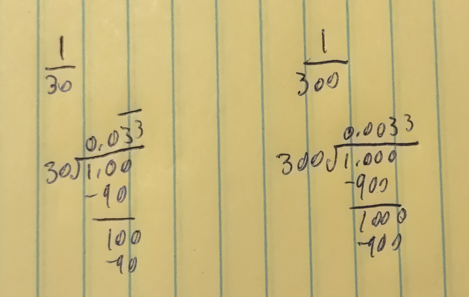
It makes sense why these reciprocals all have a leading zero, when you do the long division you need to bring down more zeros before you get a number you can divide into. So the reciprocal of any number between 10 and 100 will have 1 leading zero, and between 100 and 1000 will have 2 leading zeros, etc.

See above, the reciprocal of 30 and 300 is the same except for how many zeros you need in the front before you get to something you can divide into. (EDIT: just imaging I put the line over the 3s in 1/300, I just realized in editing that I forgot to do that, -2 points on the test for me).

But aside from leading zeros, why do some reciprocals have *only* infinitely repeating numbers and some have a set of numbers that repeat and a set of numbers that do not? I surmise again that it has to do with prime factors.

If *all* the prime factors of a non-prime number are *also* prime factors of the base you’re using (so in base 10, 2 and 5 are its factors), then the reciprocal of the non-prime number will be finite and well behaved like 1/20. On the other hand, if *all* the prime factors of a non-prime are not shared with the base (such as 21), then the reciprocal will only have repeating digits (baring leading zeros if the number is bigger than 10, 100, 1000 etc). Finally, the prime factors of a non-prime are mixed between those shared with the base and those not shared, then the reciprocal will have a bit at the beginning that does *not* repeat and will then go into repeating digits.

This should all hold true in other bases as well. In base 28, the reciprocal of 25 should be infinitely repeating (since they share no prime factors) while the reciprocal of 224 should be some non-repeating number (as 28 and 224 have the exact same prime factors, 2 and 7). I won’t show you the calculations as they’re quite messy but I think 1/224 in base 28 is 0.035 (I don’t dare do the reciprocal of 25, I’m sure to mess it up).

I’m sure mathematicians have known all this for year, but I enjoyed finding it out myself, and just wanted to share.

What’s so special about prime numbers?

If you’ve ever watched Numberphile, you’ve probably heard a *lot* about prime numbers. In school prime numbers are mostly just curiosities. They’re numbers that can only be (cleanly) divided by 1 and themselves, so you hate getting them in a fraction. But the further you go in higher math, the more prime numbers seem to show up *everywhere* even in places you wouldn’t expect them.

My new favorite Numberphile video is on the reciprocals of prime numbers. A “reciprocal” of a number is just 1 divided by that number. So the reciprocal of “10” is “1/10” or in decimal form 0.1 . The video shows off the work of a 19th century mathematician named William Shanks who exhaustively catalogued the reciprocals of primes.

Because you see, prime numbers are special this way. Prime numbers don’t make “clean” reciprocals like 1/10 . The reciprocal of a prime tends to be made up of infinitely repeating digits instead. 1/7 is equal to 0.142857142857142857142857142857142857142857142857142857 with the “142857” part repeating infinitely. In math class we represented this with a line over the repeating digits. But I’m having trouble getting wordpress to properly display bars over numbers, so I’ll use “…” to represent repeating digits instead. So 1/7 would be 0.142857… in my decimal notation.

Now back to primes. What Shanks did was he took the reciprocal of larger and larger prime numbers and counted how many digits it took before the the numbers start repeating. So 1/7 repeats after 6 digits while 1/11 repeats after just 2 digits (0.09…). Shanks catalogued these repeating digits all the way up to prime numbers in the 80,000 range, whose reciprocals don’t start repeating until 60,000 digits or more.

The video is well worth a watch, and it’s fascinating to wonder if there’s any pattern to the data. But what struck me was a question from the host Brady near the beginning of the video: “do the reciprocals of all primes repeat?” The mathematician Matt Parker answered “yes” and continued the math lecture, but this got me thinking.

As soon as I told this question to a friend, they immediately said what many of you are probably thinking: “what about 1/5?” 5 is a prime number itself, but 1/5 is a nice, clean, non-repeating number of 0.2 . 2 is also a prime number and makes a clear 0.5 with its reciprocal. Maybe Matt Parker just wasn’t so attentive when he answered “yes” but it seems that not all reciprocals of primes repeat.

But then why are 2 and 5 so special? Why, out of every single prime number, are they the only ones with non-repeating reciprocals? Again I think everyone knows the answer: it has to do with Base 10, but I wanted to study this phenomenon a bit more so I did some math myself.

First, a quick note: we say our counting system is “base 10” because when writing a large number, each position in the number corresponds to units of 10 raised to some power. You may remember from school writing a number like 435 and being taught that is has “4 hundreds,” “3 tens,” and “5 ones.” AKA 435 is (4*100) + (3*10) + (5*1). It’s important that all the positions in a base 10 counting system correspond to 10x for some value X. The hundreds place represents 102, the tens place represents 101, and the ones place represents 100.

Now what about a base 12 counting system instead? What does the number 435 mean in base 12? Just like before, each position corresponds to some power of 12. So 122 is 144, meaning that 4 is in the “144s” place. The 3 is in the “12s” place and the 5 is still in the “1s” place because 120 and 100 both equal 1. So a 435 in base 12 is equal to (4*144) + (3*12) + (5*1), which would be 617 in base 10.

Now my question: do the reciprocals of primes still repeat the same way in a base 12 counting system as they do in base 10? We already know that 2 and 5 are special primes in base 10, their reciprocals don’t repeat. How about in base 12?

Well the reciprocal of 2 still works, it’s just equal to 0.6 instead of 0.5. But the reciprocal of 5 suddenly becomes madness

Here I did the long division for 1/5 in base 12. To keep myself on track I wrote a base-10 version of the subtractions I was doing at each step of the long division. And I don’t know how real mathematicians do it, but since I don’t have a number to represent “10” and “11” as single digits, I used “A” and “B”.

As you can see, *now* this prime’s reciprocal *does* repeat, even though it didn’t in base 10!

I think the mathematician was getting at something deeper when he said all reciprocals of primes repeat, but I’ll have to save it for another post as I had wanted to publish this one on Sunday and I’m already 3 days late.

Gene drives and gingivitis bacteria

One piece of sci-fi technology that doesn’t get much talk these days is gene drives. When I was an up and coming biology student, these were the subject of every seminar, the case study of every class, and they were going to eliminate malaria worldwide.

Now though, you hardly hear a peep about them. And I don’t think, like some of my peers, that this is because anti-technology forces have cowed scientists and policy-makers into silence. I don’t see any evidence that gene drives are quietly succeeding in every test, or that they are being held back by Greenpeace or other anti-GMO groups.

I just think gene drives haven’t lived up to the hype.

Let me step back a bit: what *is* a gene drive? A gene drive is a way to manipulate the genes of an entire species. If you modify the genes of a single organism, when it reproduces only at most 50% of its progeny will have whatever modification you give it. Unless your modification confers a lot of evolutionary fitness to the organism, there is no way to make every one of the organism’s descendants have your modification.

But a gene drive can do just that. In fact, a gene drive can confer an evolutionary disadvantage to an organism, and you can still guarantee all of the organism’s decedents will have that gene. The biggest use-case for gene drives is mosquitoes. You can give mosquitoes a gene that prevents them from sucking human blood, but since this confers an evolutionary disadvantage, your gene won’t last many generations before evolution weeds it out.

But if you put your gene in a gene drive, you can in theory release a population of mosquitoes carrying this gene and ensure all of their decedents have the gene and thus won’t attack humans. In a few generations, a significant fraction of all mosquitoes will have this gene, thus preventing mosquito bites as well as a whole host of diseases mosquitoes bring.

Now this is a lot of genetic “playing God,” and I’m sure Greenpeace isn’t happy about it. But environmentalist backlash has never managed to stamp out 100% of genetic technology. CRISPR therapies and organisms are on the rise, GMO crops are still planted worldwide, environmentalists may hold back progress but they cannot stop it.

But talk about gene drives *has* slowed considerably and I think it’s because they just don’t work as advertised.

See, to be effective a gene drive requires an evolutionary contradiction: it must reduce an organism fitness but still be passed on to the progeny. Mosquitoes don’t just bite humans for fun, we are some of the most common large mammals in the world, and our blood is rich in nutrients. For mosquitoes, biting us is a necessity for life. So if you create a gene drive that knocks out this necessity, you are making the mosquitoes who carry your gene drive less evolutionarily fit.

And gene drives are not perfect. The gene they carry can mutate, and even if redundancy is built in, that only means more mutations will be necessary to overcome the gene drive. You can make it more and more improbable that mutations will occur, but you cannot prevent them forever. So when you introduce a gene drive, hoping that all the progeny will carry this gene that prevents mosquitoes biting humans, eventually one lucky mosquito will be born that is resistant to the gene drive’s effects. It will have an evolutionary advantage because it *will* bite humans, and so like antibiotic resistant bacteria, it will grow and multiply as the mosquitoes who still carry the gene drive are outcompeted and die off.

Antibiotics did not rid the world of bacteria, and gene drives cannot rid the world of mosquitoes. Evolution is not so easily overcome.

I tell this story in part to tell you another story. Social media was abuzz recently thanks to a guerilla marketing campaign for a bacteria that is supposed to cure tooth decay. The science can be read about here, but I was first alerted to this campaign by stories of an influencer who would supposedly receive the bacteria herself and then pledged to pass it on to others by kissing them. Bacteria can indeed be passed by kissing, by the way.

But like gene drives, this bacteria doesn’t seem to be workable in the context of evolution. Tooth decay happens because certain bacteria colonize our mouth and produce acidic byproducts which break down our enamel. Like mosquitoes, they do not do this just for fun. The bacteria do this because it is the most efficient way to get rid of their waste.

The genetically modified bacteria was supposed to not produce any acidic byproducts, and so if you colonized someone’s mouth with this good bacteria instead of the bad bacteria, their enamel would never be broken down by the acid. But this good bacteria cannot just live in harmony and contentment, life is a war for resources and this good bacteria will be fighting with one hand tied behind its back.

Any time you come into contact with the bad bacteria, it will likely outcompete the good bacteria because it’s more efficient to just dispose of your waste haphazardly than it is to wrap it in a nice, non-acidic bundle first. Very quickly the good bacteria will die off and once again be replaced by bad bacteria.

So I’m quite certain this little marketing campaign will quietly die once its shown the bacteria doesn’t really do anything. And since I’ve read that there aren’t even any peer reviewed studies backing up this work, I’m even more certain of its swift demise.

Biology has brought us wonders, and we have indeed removed certain disease scourges from our world. Smallpox, rinderpest, and hopefully polio very soon, it is possible to remove pests from our world. But it takes a lot more work than simply releasing some mosquitoes or kissing someone with the right bacteria. And that’s because evolution is working against you every step of the way.