I wanted to write this half a year ago, but with Trump’s tariffs back in the news, I figured I’d give it another go.
When Trump first enacted his so-called “Liberation Day” tariffs, many experts (mostly partisan experts though) predicted the apocalypse. It was bad enough that many news sources started educated their readers on the Smoot-Hawley tariffs, which anyone who watched Ferris Bueler’s Day Off will know were the tariffs enacted during the Great Depression. These tariffs have been blamed for contributing to the depth and intensity of the Great Depression, and naturally partisans wanted voters to make that connection to Trump’s Tariffs.
I myself also started watching out. I live in a major city with a major train hub, and as I commute past it I like to look out and check how many boxcars are being loaded and unloaded by trains. Earlier this year it seemed the tariffs might have actually been apocalyptic, the train yard was empty on some days. But despite partisans stoking fears of COVID-level shortages, tariffs have seemed to have a marginal effect on the US economy. Growth has remained strong in 2025, with the US well ahead of pretty much every advanced economy on earth in terms of growth rate. The EU may be a massive free trade area, and the USA may have become an increasingly protectionist autarky throughout the Trump-Biden years, but that hasn’t been enough to make the EU more competitive or the US less.
It’s likely because the tariffs are indeed marginal. Tariffs are a tax on imports, but like any other tax they can be avoided and mitigated by changing behaviors. Companies have shifted to sourcing their products from areas with lower tariffs, changing their production line to build more things in America, or in some cases are simply accepting lower profits and not passing the cost of the tariffs onto consumers because they need to maintain market share. In other cases the tariffs *are* leading to a rise in prices, but consumers still have the chance to substitute tariffed goods for other goods or just stop buying alltogether.
The tariffs have likely contributed to inflation remaining well-above target, and have likely made certain consumers much poorer without realizing it (as they purchase tariffed products and can’t find substitutes), but the tariffs have not had nearly the destructive effects that I and many others believed they would.
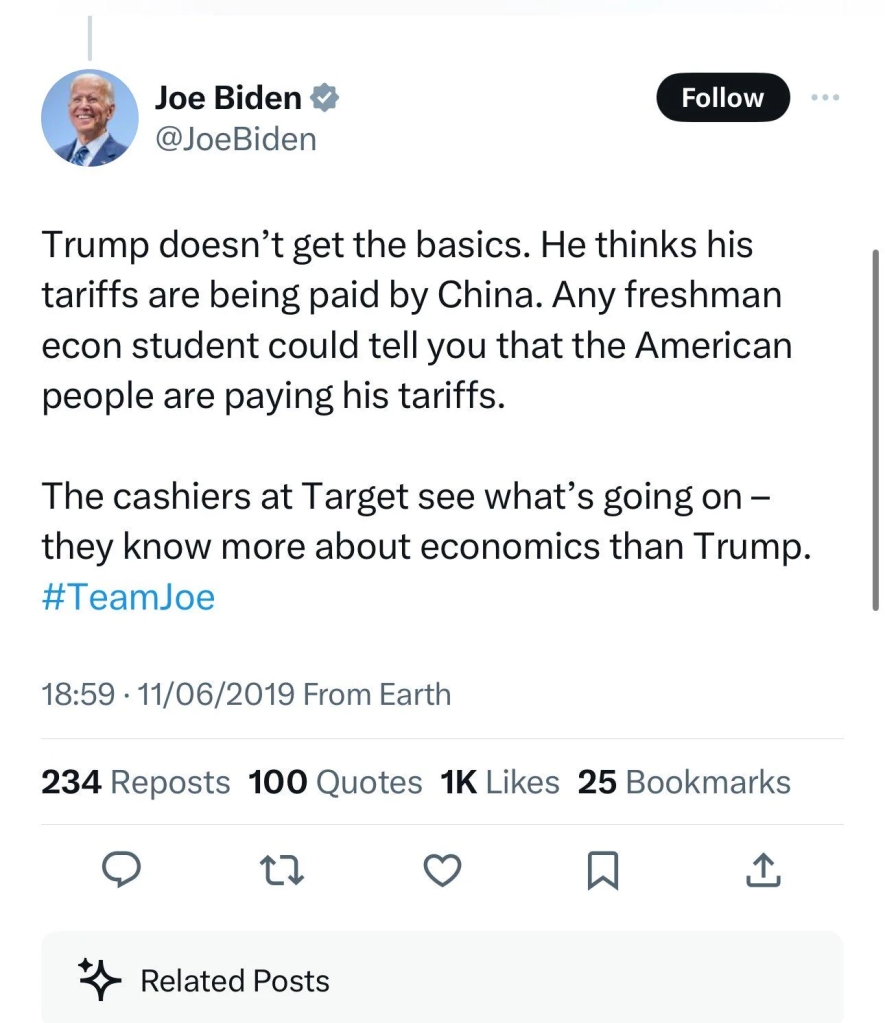
But the biggest problem for Trump’s detractors is highlighting the adverse effects of Trump’s tariffs. Remember that the American people seem to broadly like tariffs: Biden expanded Trump’s tariffs, Bernie surged in the Democratic Party by denouncing Clinton’s pro-corporate policies (which were usually also pro-trade policies) and Trump has completely remade the GOP into a protectionist party. America’s two parties are dominated by protectionists, and many free-trade Democrats have been furious that 2028 hopefuls have mostly denounced Trump’s tariffs as being “too high, too broad,” rather than hitting out that “tariffs are just plain bad and shouldn’t be used.”
It seems that Americans really do like tariffs, so trying to attack Trump for his tariff policy doesn’t hit as well as it “should.” This is a big problem for free-trade Democrats because to them it’s patently obvious that Trump’s tariffs have led to higher inflation and lower growth, but Americans aren’t necessarily buying it.
Enter Amazon. As the foremost distributor of direct-to-consumer goods, Amazon is acutely sensitive to trade policy. Any raise in tariffs will cause a raise in prices for imported goods, causing consumers to purchase less and that hurts Amazon’s bottom line. Amazon has every reason to lobby as strongly as possible *against* tariffs, and as a consumer-facing company that everyone knows, free-trade Democrats thought they’d found their edge.
The idea went like this: what if Amazon *shows consumers* how much higher their prices are because of tariffs? What if every time a consumer buys a 100$ imported product, Amazon shows its base cost but then hits them with a “+15$ because of tariffs” fee at the checkout? Consumers would be furious at these hidden costs, but their fury would be directed at Trump and his tariffs. The tariffs would become unpopular, Trump would become unpopular, the free-trade Democrats and Amazon would be the big winners in 2026 and 2028 when (hopefully) less protectionist Democrats would be swept into power on a wave of consumer backlash.
It all seemed so perfect, leaked reports even claimed that Amazon was openly considering this idea.
But then Amazon made an official statement that they would not under any condition display tariff prices. Their statement said that while such a move was considered, it was never approved, which isn’t unusual as companies are constantly considering many thousands of moves that are never approved. Furthermore Amazon spokesmen pointed out that the company had never shown consumers the cost of tariffs during the Biden administration, even though Biden had hiked tariffs to their highest point since Jimmy Carter.
Amazon felt the move would damage its own brand, worsen its political position, and bring basically no benefit. If Amazon was an arm of the Democratic party, then maybe it would make sense. But as a profit-maximizing entity, pissing off your customers with hidden fees *and* wading into the political arena with a nakedly partisan endorsement of the opposition (by blaming the current administration for high prices) just doesn’t make sense.
So Amazon will *not* be part of the Anti-Trump Resistance. As Michael Jordan once said, Republicans buy sneakers too, and most profit-maximizing companies find it best to *not* piss off half the country by taking overtly partisan stances. They may try to take political stances, but they will always present themselves as non-partisan to consumers, because they don’t want to lose business from angry voters. And directly blaming Trump’s Tariffs for high Amazon prices, after 4 years of never doing such for Biden’s Tariffs would indeed be an overtly partisan act, because it’s an attempt to blame Republicans for high prices and push consumers towards supporting the Democrats.
This then made Amazon a target of April’s 2-minute-hate in the eyes of free-trade democrats. These Democrats don’t see “showing the cost of tariffs” as partisan at all (because people always believe their own beliefs are just “the obvious truth,” and not a partisan stance). Rather, when Amazon *refused* to show the cost of tariffs, it was blamed for kowtowing to a “fascist” government, comparisons to 1930s German companies were ever-present, and Bezos himself was derided as a coward and a collaborator, rather than the profit-maximizing businessman that he is.
The simple fact is that obviously no multinational company is going to want to lose half its customers, so no multinational company is going to make their storefront an advertisement for the Democrats and against the Republicans. I’m sure Amazon is lobbying the administration on reducing tariffs, it was widely reported that tech giants did this exact same lobbying last time Trump was in power. But just because Amazon doesn’t like tariffs doesn’t mean they want to torch their credibility with Republican consumers. Because Republican consumers might angrily ask why Amazon is sourcing products from overseas (and showing people a tariff) rather than sourcing *American* products like Trump (and Joe Biden, and Bernie Sanders) would prefer they be doing.
Anyway I’ve found a dozen ways to restate this one point: Amazon is not going to become part of the Resistance, it will not show consumers what the price of Trump’s tariffs are in part because that would be a partisan move that would invite blowback and boycotts from Republicans: “why isn’t Amazon buying American instead, and why didn’t Amazon do this stunt during the Biden administration?”
But I wanted to note one additional reason Amazon won’t be showing consumers the price of tariffs, and it’s isn’t because of what Amazon wants, it’s because of what their suppliers want.
The relationship between Amazon and its legion of medium-sized suppliers is a tricky one. On the one hand some random clothing store like Shoes&Shirts LLC (fake name) probably likes that Amazon gives them a massive amount of customers to sell to. Amazon’s global consumer base makes it easier to scale up by just having a single contract with Amazon, rather than having to negotiate multiple deals with brick-and-mortar stores in every single country.
On the other hand, Amazon’s dominance of the market gives them a lot of power over their suppliers, they can negotiate a large cut of the proceeds, demand suppliers abide by Amazons rules and regulations, and overall an agreement with Amazon can be like a pair of golden handcuffs. If you’ve seen how indie developers complain about Steam, you’ll understand how small and medium suppliers complain about Amazon.
The situation can be even worse, since Amazon competes directly with its own suppliers. Say Shirts&Shoes LLC has a new style of Comfy Sweater that is flying off the digital shelves. Amazon can see this, and see that another company makes a nearly identical sweater for a fraction of the cost. Amazon can then source their own Comfy Sweater from this other company and try to undercut Shirts&Shoes LLC on price, fulfilling the orders themselves and taking Shirts&Shoes’s business out from under them.
Amazon suppliers are therefore very very cautious with what information they give to Amazon. They do *not* want to tell Amazon the price it costs them to make something, they only want to reveal the price they’re selling it for. Giving away the price to make something makes it even easier for Amazon to undercut them.
If Shirts&Shoes’s sweater is selling for 100$, and you can source it for 60$, you still don’t know for sure if you can undercut them. Maybe Amazon lists their own sweater for 75$, but Shirts&Shoes responds by cutting the price down to 50$ because they can actually make it for even less than that. Amazon would be putting a lot of money into a failed attempt at capturing new market share, Shirts&Shoes would be furious at the attempted betrayal, AND both would now be making less money because the shirt is selling for less so both sides get less of a cut. The only winners would be the consumers.
So Amazon’s suppliers DO NOT want to give Amazon any information more than they need to. And that by the way includes the price of tariffs.
When Shirts&Shoes brings a shirt into America, customs charges them a tariff based on the declared value of the shirt. Shirts&Shoes then has to set the sale price at a level high enough to cover not only the cost of the shirt, but also the cost of the tariff. If the value of the shirt is 20$ and there’s a 100% tariff, then they can’t sell the shirt for less than 40$ without taking a lose.
But they may be selling the shirt for 100$ anyway and taking 60$ of profit. Now, the shirt’s price may have gone up because there used to be no tariff and now there’s a 100% tariff. So the free-trade Democrats would love if the shirt was listed on Amazon for a price of 80$, but had an extra 20$ “tariff tax” at the checkout that would be directly blamed on Donald Trump.
But Shirts&Shoes doesn’t want to reveal that the base cost of their shirt is 20$ with a 20$ tariff on top. Because at that point if Amazon can source the same shirt for 35$, then they can undercut Shirts&Shoes and steal their business, and both sides know it. Instead, Shirts&Shoes would like the costs going into the shirt to be as obfuscated as possible.
They’d probably like their customers to think that it costs them 90$ to make a shirt and they’re selling it for 100$, because that way they don’t seem to be making “too” much profit. If customers knew Shirts&Shoes had such a high mark-up, customers might think they were getting ripped off, and would make nasty posts on the internet to complain about Shirts&Shoes’s prices. This could harm Shirts&Shoes’s brand.
And they’d probably like Amazon to think that it costs them 5$ to make a shirt and they’re selling it for 100$. Because they don’t want Amazon to attempt to undercut them and either steal their business or initiate a price war which harms their profit margins.
So ambiguity is entirely in Shirts&Shoes’s interests, and so they don’t want to reveal any tariff information to Amazon. That in turn means that even if Amazon wanted to, it wouldn’t be able to reveal tariff information on any third party products, only on products it sources itself. That could backfire if Amazon even decided to reveal tariff prices, as *only Amazon’s own goods would show the tariff as a hidden cost*. Buy a good sourced by Shirts&Shoes? What You See Is What You Get. Buy a good sourced by Amazon? You have no idea WHAT the real price will be.
To summarize, Amazon (and other profit-seeking companies) will NOT be part of the resistance, as they do not want to damage their brand in the eyes of partisans. Likewise, it’s not even a simple thing for Amazon to JOIN the resistance and reveal to customers the true price of tariffs. They’d be pissing off their own customers by making customers feel like the price is a bait-and-switch, they’d be demanding information from their suppliers that the suppliers don’t want to reveal, and if the suppliers DON’T reveal that information, then only Amazon-sourced products would show a tariff anyway, meaning Amazon gets all of the blowback for “high prices” while their suppliers can claim “Same Low Prices As Ever,” even if prices everywhere are actually rising.
Partisans think everyone should join their fight, and that the only reason not to is base cowardice. They’re usually wrong.


 Streams of Consciousness