So what’s up with China’s Economy?

I meant to post this about 6 months ago. I meant to do more research. But I didn’t, and I haven’t, so this will just be stream of consciousness, like always.

When I was a kid, China was the world’s miracle economy. In the 20th century, the world’s developing economies actually tended to grow slower than the developed ones, but when China adopted capitalism (or “socialism with Chinese characteristics”) under Deng Xiaopang, their economy exploded with exactly the sort of dynamic growth that western capitalists dream of.

The rural “villages” of China were themselves already the homes of 10 to 50 thousand people, and giving these people the right to start businesses and open up shops meant China speedran the exact same capitalist development cycle that Europe had in the 18th and 19th centuries, when most European cities were themselves just tens of thousands in population. A successful shoemaker had the right to keep his profits, buy better tools, a factory floor etc, and before you knew it shoe factories and businesses for every other consumer good were popping up everywhere in China. China became a bastion of consumer surplus at exactly the time the USSR was sliding into consumer shortages.

Not only that, unlike “Indian socialism,” “Chinese socialism” had emphasized universal literacy and education. Thus, when foreign firms invested to build factories using cheap Chinese labor, they could do so with the knowledge that every worker hired would be able to read their instructions as well as any reminder safety posters all around the factory floor. Retraining a laborer for a new machine could be as simple as giving them a pamphlet saying “we’re doing this now” rather than the floor manager having to walk each worker through their new job, as happens when retraining illiterate workers.

So not only did China’s domestic capitalists start churning out factories and goods, foreign investment poured into China in unimaginable sums, lured by the exceedingly low wages yet high skill ceilings of its massive, literate workforce.

Even the Great Recession of 2008 couldn’t break China’s stride. The Chinese Communist Party decided on a massive stimulus package to maintain their high rate of growth, which saw China posting near-double digit growth rates at a time when Europe and America languished in stagnation.

But 2008 was almost 20 years ago (feel old yet?). What’s happening today?

I’m just going to throw some factoids at you to get things started. In 2025 China experienced capital flight to the tune of about $500 billion, more than any other nation in the world. That’s more than the capital flight experienced by Russia, India, Mexico and Brazil combined for that year.

Capital flight, if you don’t know, is the large scale exit of money from a country. In a nation like America, capital flight is perfectly legal: if I think the American stock market is going to crash and the American government will go bankrupt, I’m free to sell all my stocks and buy Eurobonds instead. There’s no barrier to moving money around (anti-money-laundering regulations notwithstanding), and America usually records net capital *inflows* rather than outflows. This is because the vast majority of investors don’t think the American stock market will crash or the American government will go bankrupt, rather most investors currently see America as the safest port in the current storm, not perfect mind but better than the other choices.

China on the other hand has massive capital controls. To move large sums of money out of China requires clearance from the federal government of some kind, whether as a business or an individual. The fact that half a trillion dollars of money is still leaving China *despite* these laws (and their onerous penalties) shows just how little faith many investors (especially Chinese investors) have in the overall economy, and how much they’re willing to do to get around those laws and get their money somewhere safe.

This money leaving China is hardly consequence free either. That’s half a trillion dollars of spending and investment that has vanished. If that half a trillion was spent on goods and services inside China, then perhaps more young Chinese people could find jobs in the consumer economy. Instead, China is experiencing a youth unemployment crisis, with outside estimates putting Chinese youth unemployment at greater than 20%, over twice as high as in America or Mexico, and close to the worst nations in the EU like Spain.

This capital flight tells us there’s a problem *right now*: investors, especially Chinese investors, don’t think the Chinese economy is trustworthy. They don’t think their money can grow their and turn a profit, and even if they can eke out a profit, they think the Government could take it from them like what it did to Jack Ma and the school tutoring industry.

This capital flight *also* tells us there’s going to be problems in the future: money is fleeing China and so the next generation of business and jobs aren’t being created. Future growth will be well below where it “should” be if that capital was reinvested into the economy.

But ok, why are Chinese investors so down on the Chinese economy? They’re still the factory of the world, right? They’re still dominant in solar panels and EVs, right?

Remember that investment is forward looking. China built up its dominance throughout the 2000s, but its future might not be so bright. Chinese green tech companies are facing unprofitability now, and the possibility of further unprofitability ahead even if they “win” the price wars. Let me explain.

China is made up of provinces just like America is made up of states. And both provinces and the central government will give funding to companies to build factories and create jobs locally. The original spark to the Chinese solar/EV revolution was these very government subsidies.

But eventually some of those funded companies won’t be able to compete. It happens all the time, see Solyndra in America at roughly the same timeframe. In a normal economy a company that can’t make it, even if it received government funding, will eventually go bankrupt. But bankruptcy would lead to job loses, lose of province prestige, and perhaps social unrest. So the Chinese central and provincial governments have become experts at propping up failing companies.

A government might mandate that local banks give low or zero interest loans to keep bailing out one of these companies. Now there’s zero incentive for the bank to do it, it would rather write profitable loans to good companies instead. But the banks must answer to the government and so the loans get written. These toxic loans remain a drag on the bank’s balance sheet, reducing their profitability and reducing the amount of loans they can write to actually good companies.

Or perhaps a government might coerce a profitable company to merge with its unprofitable competitor. This new company is bigger sure, but the profitable bit is now being dragged down by having to still pay laborers and leases on the unprofitable bit. Sure they could try to restructure the unprofitable bit to make it profitable, without cutting jobs of course as the state doesn’t want them to do that. But trying to fix someone else’s company is like trying to rewrite someone else’s code, at times it’s just so much more efficient to start over and write it yourself. But efficiency isn’t being rewarded here, party loyalty is. So a profitable company gets an albatross hung around their neck, and their growth and efficiency is hamstrung going forward.

So we’ve got zombie companies propped up by toxic loans, plus severe misallocation of capital so that no province’s pet factory goes bust. All this leads to lower profits, and profits have indeed been unusually low in Chinese companies of late.

Low profits aren’t just painful for the fat cat sitting at the top of the ladder, they’re painful for everyone.

First, an unprofitable company can’t afford to grow by enticing the best workers with higher wages. Americas most profitable companies like Google, Facebook and so on also have the highest wages, as they can afford to compete for the best of the best. Unprofitable Chinese companies can’t afford to do that. Wage growth in China was actually lower than in America during the post-pandemic period. With American wages already so much higher than Chinese wages, this should be almost impossible, but the Chinese economy was just that stagnant.

Second, there’s the stock market. Americans by in large invest in the stock market for retirement, the majority of Americans own some sort of stock. The long-term reason for a stock to grow in value is if its profits are or expected to start growing soon. But Chinese companies are unprofitable. This means Chinese stocks don’t grow in value. And this means most Chinese people can’t have a nest egg for retirement like Americans can. The Chinese workers used to use real estate as their nest egg, with 70% of Chinese household wealth tied up in real estate (often second and third homes that are supposed to be sold or rented out in retirement). That real estate has dropped by half in value. Compare this to the numbers for America during the Great Recession, just 35% of American wealth was in real estate, and prices dropped by only a third. Chinese citizens have experienced a destruction of their household wealth on an apocalyptic scale, far in excess of anything experienced in America.

And even if you live in your home, you’re likely now paying back a mortgage on property worth less than the mortgage. You’re now inexorably tied to your current location, unable to move for a better opportunity because you literally can’t afford it, selling your house won’t cover your mortgage and let you get a new one for a new house. Many Chinese people are even paying mortgages for houses that don’t exist, mortgages written and sold to them with the expectation that the house *would* be built, but in the meantime the company building those houses went bankrupt.

So Xi Jinping is sitting there looking at an economy with the following characteristics:

  • High youth unemployement
  • Low investor confidence, everyone wants to get their money out of China even if they have to break the law
  • Low profitability for companies
    • This in turn leads to low growth of the stock market, and the inability for the middle class to save and invest for retirement the way Westerners do
    • This also leads to low growth of wages
  • Low consumer confidence. Chinese consumers just experiences Great Depression levels of wealth destruction, and most are preferring to stick their money in a bank rather than increase their spending or invest in their future.
    • These banks meanwhile are being told to take this consumer money and hand it as a loan to zombie companies that will never pay it back

And what does Xi Jinping do about all this? He makes it worse.

It’s clear that the state-backing of companies has created a problem. Low profits, low growth, and any growth to be had is sustained not by Chinese consumers (who are refusing to spend) but instead by selling products to foreign countries (who are increasingly erecting tariffs to “protect” local businesses). But Xi has doubled down on this state-directed, state-funded growth model.

China’s most recent innovations to kickstart the economy have been for the state to increase how much it directs the economy. Xi Jinping wants China to be the builder of the “new productive forces” of the 21st century. Things like AI, quantum computing, autonomous robots, etc.

From a “video game” perspective of economics, this looks like Xi Jinping is making all the right moves. Europeans online so often look back with despair at how their continent missed the boat on the tech industry. Why didn’t Europe build its own Google and Microsoft? Why are all the big tech companies American? So if you believe that these “new productive forces” are the future, then surely Xi is ensuring China won’t make the same mistakes as Europe did, China will be a leader, not a follower, in these new technologies.

But the world isn’t a video game. We don’t know beforehand which techs will succeed, or even which specific companies will succeed. Plenty of people thought that supersonic jets were the “new productive force” of the late 20th century, and I’ve extensively catalogued all of those failures. And some European tech companies *did* exist, they just didn’t grow as fast or were hamstrung by regulation and eventually got bought or outcompeted by American companies. If these European tech companies had instead been funded and propped up by European governments, they wouldn’t have turned into a European Google or Microsoft, they weren’t profitable or efficient enough, *that’s why they lost*. They’d have turned into a zombie company and a drag on government finances or a drag on the balance sheet of whatever bank was ordered to bail them out.

So the last time Xi Jinping unleashed the “new productive forces” of China, he created a green manufacturing economy that has nonetheless led to stagnant wages, low profits (which in turn leads to low consumer wealth since you don’t want to invest in the market), rock bottom investor confidence, and a huge number of zombie firms propped up by government handouts or by leeching off more profitable firms and banks. There’s no reason to believe that this current crop of “new productive forces” will do anything differently.

But Xi Jinping is at his heart a Marxist. At his heart, he clearly believes that the State (with a capital S) can always manage and direct the economy better than the private sector can. He joins the long list of ideologues who believed just that, from the Soviet Union to pre-1990 India to South America and beyond. And every time they were wrong.

China used to post double digit growth. Americans used to believe that China overtaking them was right around the corner. But at the rate they’re going, that’s not going to happen for a long time, if ever.

The EU beclowns itself with tariffs

Josh Barro once said “Trump has only taken the dignity from those who gave it willingly and Jeb Bush.” What he meant is that while Jeb Bush was utterly humiliated by 2016 in general, most of the Republican bigwigs suffered reputational damage not so much from Trump himself, but from their own insistence that he was dangerous, economically illiterate, but also the only logical choice for president. The two-faced insistence that tariffs were stupid and dumb and anti-business, followed by an abrupt about-face on the subject once Trump won the nomination, did huge reputational damage to the GOP in the business community. Just as their two-faced-ness on Trump’s other “novel” policies did damage to them in the immigrant community, the LGBT community, and so on.

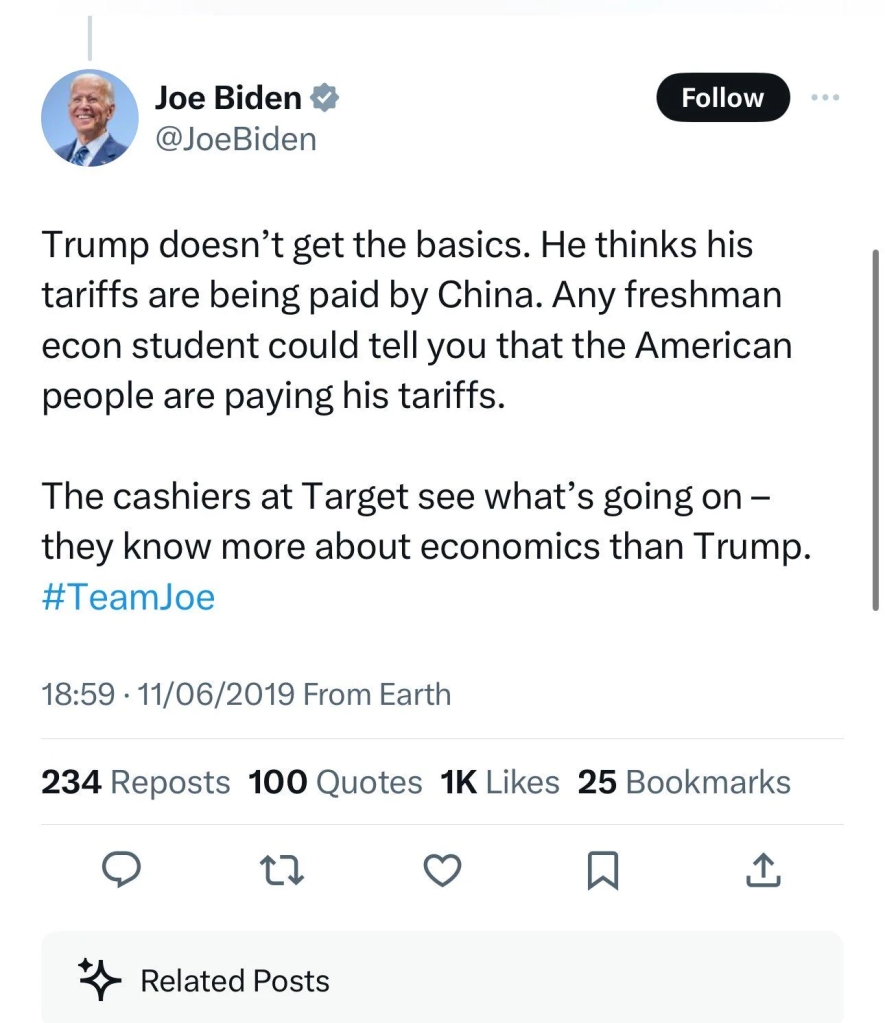
Biden later gave his dignity to Trump too, as I have repeatedly dunked on Biden for insisting that tariffs are bad and harmful and must not be done, only to turn about and support them himself once he got into office.

I’ve said before that I think a large part of the literati’s opposition to tariffs is not so much that Trump is *wrong* about them, but that Trump is *right*. The “textbook” definition of tariffs is what Biden and the EU said back in 2019, tariffs only hurt the country which puts them up, they are a tax on your own consumers, they don’t hurt any other country more than they hurt you. Trump disagrees, he thinks that tariffs hurt other countries more than they hurt America.

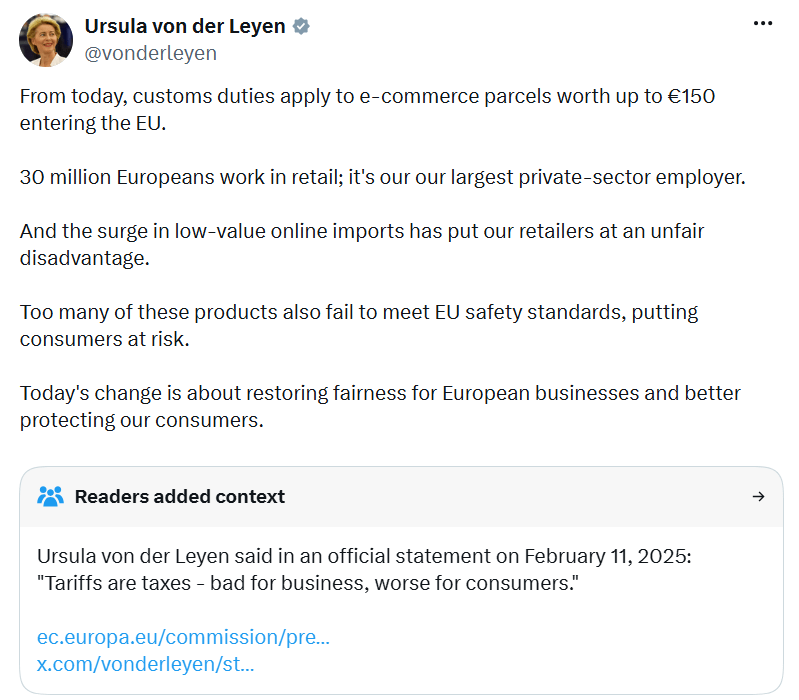
And now it seems Ursula Von Der Leyen has likewise beclowned herself at the altar of Trump. VdL, for those who don’t know, is the top dog of the EU pantheon, and a long-time critic of Trump’s tariffs. But now, in the name of protecting EU business, she too has begun putting up new and bigger tariffs on foreign product. Because she, like Biden, and like Trump, all seem to agree that in reality tariffs hurt the other countries more than they hurt you. And that the damage they do to your own country is “worth it” in order to protect local industry.

I should be aghast. But I’m not even surprised. The free trade consensus of the late 20th century has died entirely because its adherents were always two-faced in their support of it. While the EU preaches free trade, they have always erected huge tariff and non-tariff barriers to protect local industries, especially farming, from foreign commerce. Likewise, the Bidenist democrats may have paid lip service to free trade, but it and economic growth in general always sat at the bottom of their hierarchy of social good. High prices are always worth paying for some other social good, in this framing. And tariffs therefore are not tools of economic self-sabotage but rather can be a means to whatever social end you want, whether it’s protecting rust belt jobs or competing with Chinese solar panels.

Free trade fell apart in the world because it seems its adherents never really believed it. Every politician treated it like a little white lie: we’ll all pretend that tariffs are always bad and wrong so that the hoi polloi don’t demand we start erecting tariffs and eventually drag us into a trade war. But when the chips are down the white lie crumbles, and now tariffs are a part of everyday politics. And more and more politicians beclown themselves by having argued so forcefully against Trump’s tariffs and then arguing even more forcefully in favor of their own.

Amazon will not be part of the “Resistance”

I wanted to write this half a year ago, but with Trump’s tariffs back in the news, I figured I’d give it another go.

When Trump first enacted his so-called “Liberation Day” tariffs, many experts (mostly partisan experts though) predicted the apocalypse. It was bad enough that many news sources started educated their readers on the Smoot-Hawley tariffs, which anyone who watched Ferris Bueler’s Day Off will know were the tariffs enacted during the Great Depression. These tariffs have been blamed for contributing to the depth and intensity of the Great Depression, and naturally partisans wanted voters to make that connection to Trump’s Tariffs.

I myself also started watching out. I live in a major city with a major train hub, and as I commute past it I like to look out and check how many boxcars are being loaded and unloaded by trains. Earlier this year it seemed the tariffs might have actually been apocalyptic, the train yard was empty on some days. But despite partisans stoking fears of COVID-level shortages, tariffs have seemed to have a marginal effect on the US economy. Growth has remained strong in 2025, with the US well ahead of pretty much every advanced economy on earth in terms of growth rate. The EU may be a massive free trade area, and the USA may have become an increasingly protectionist autarky throughout the Trump-Biden years, but that hasn’t been enough to make the EU more competitive or the US less.

It’s likely because the tariffs are indeed marginal. Tariffs are a tax on imports, but like any other tax they can be avoided and mitigated by changing behaviors. Companies have shifted to sourcing their products from areas with lower tariffs, changing their production line to build more things in America, or in some cases are simply accepting lower profits and not passing the cost of the tariffs onto consumers because they need to maintain market share. In other cases the tariffs *are* leading to a rise in prices, but consumers still have the chance to substitute tariffed goods for other goods or just stop buying alltogether.

The tariffs have likely contributed to inflation remaining well-above target, and have likely made certain consumers much poorer without realizing it (as they purchase tariffed products and can’t find substitutes), but the tariffs have not had nearly the destructive effects that I and many others believed they would.

But the biggest problem for Trump’s detractors is highlighting the adverse effects of Trump’s tariffs. Remember that the American people seem to broadly like tariffs: Biden expanded Trump’s tariffs, Bernie surged in the Democratic Party by denouncing Clinton’s pro-corporate policies (which were usually also pro-trade policies) and Trump has completely remade the GOP into a protectionist party. America’s two parties are dominated by protectionists, and many free-trade Democrats have been furious that 2028 hopefuls have mostly denounced Trump’s tariffs as being “too high, too broad,” rather than hitting out that “tariffs are just plain bad and shouldn’t be used.”

It seems that Americans really do like tariffs, so trying to attack Trump for his tariff policy doesn’t hit as well as it “should.” This is a big problem for free-trade Democrats because to them it’s patently obvious that Trump’s tariffs have led to higher inflation and lower growth, but Americans aren’t necessarily buying it.

Enter Amazon. As the foremost distributor of direct-to-consumer goods, Amazon is acutely sensitive to trade policy. Any raise in tariffs will cause a raise in prices for imported goods, causing consumers to purchase less and that hurts Amazon’s bottom line. Amazon has every reason to lobby as strongly as possible *against* tariffs, and as a consumer-facing company that everyone knows, free-trade Democrats thought they’d found their edge.

The idea went like this: what if Amazon *shows consumers* how much higher their prices are because of tariffs? What if every time a consumer buys a 100$ imported product, Amazon shows its base cost but then hits them with a “+15$ because of tariffs” fee at the checkout? Consumers would be furious at these hidden costs, but their fury would be directed at Trump and his tariffs. The tariffs would become unpopular, Trump would become unpopular, the free-trade Democrats and Amazon would be the big winners in 2026 and 2028 when (hopefully) less protectionist Democrats would be swept into power on a wave of consumer backlash.

It all seemed so perfect, leaked reports even claimed that Amazon was openly considering this idea.

But then Amazon made an official statement that they would not under any condition display tariff prices. Their statement said that while such a move was considered, it was never approved, which isn’t unusual as companies are constantly considering many thousands of moves that are never approved. Furthermore Amazon spokesmen pointed out that the company had never shown consumers the cost of tariffs during the Biden administration, even though Biden had hiked tariffs to their highest point since Jimmy Carter.

Amazon felt the move would damage its own brand, worsen its political position, and bring basically no benefit. If Amazon was an arm of the Democratic party, then maybe it would make sense. But as a profit-maximizing entity, pissing off your customers with hidden fees *and* wading into the political arena with a nakedly partisan endorsement of the opposition (by blaming the current administration for high prices) just doesn’t make sense.

So Amazon will *not* be part of the Anti-Trump Resistance. As Michael Jordan once said, Republicans buy sneakers too, and most profit-maximizing companies find it best to *not* piss off half the country by taking overtly partisan stances. They may try to take political stances, but they will always present themselves as non-partisan to consumers, because they don’t want to lose business from angry voters. And directly blaming Trump’s Tariffs for high Amazon prices, after 4 years of never doing such for Biden’s Tariffs would indeed be an overtly partisan act, because it’s an attempt to blame Republicans for high prices and push consumers towards supporting the Democrats.

This then made Amazon a target of April’s 2-minute-hate in the eyes of free-trade democrats. These Democrats don’t see “showing the cost of tariffs” as partisan at all (because people always believe their own beliefs are just “the obvious truth,” and not a partisan stance). Rather, when Amazon *refused* to show the cost of tariffs, it was blamed for kowtowing to a “fascist” government, comparisons to 1930s German companies were ever-present, and Bezos himself was derided as a coward and a collaborator, rather than the profit-maximizing businessman that he is.

The simple fact is that obviously no multinational company is going to want to lose half its customers, so no multinational company is going to make their storefront an advertisement for the Democrats and against the Republicans. I’m sure Amazon is lobbying the administration on reducing tariffs, it was widely reported that tech giants did this exact same lobbying last time Trump was in power. But just because Amazon doesn’t like tariffs doesn’t mean they want to torch their credibility with Republican consumers. Because Republican consumers might angrily ask why Amazon is sourcing products from overseas (and showing people a tariff) rather than sourcing *American* products like Trump (and Joe Biden, and Bernie Sanders) would prefer they be doing.

Anyway I’ve found a dozen ways to restate this one point: Amazon is not going to become part of the Resistance, it will not show consumers what the price of Trump’s tariffs are in part because that would be a partisan move that would invite blowback and boycotts from Republicans: “why isn’t Amazon buying American instead, and why didn’t Amazon do this stunt during the Biden administration?”

But I wanted to note one additional reason Amazon won’t be showing consumers the price of tariffs, and it’s isn’t because of what Amazon wants, it’s because of what their suppliers want.

The relationship between Amazon and its legion of medium-sized suppliers is a tricky one. On the one hand some random clothing store like Shoes&Shirts LLC (fake name) probably likes that Amazon gives them a massive amount of customers to sell to. Amazon’s global consumer base makes it easier to scale up by just having a single contract with Amazon, rather than having to negotiate multiple deals with brick-and-mortar stores in every single country.

On the other hand, Amazon’s dominance of the market gives them a lot of power over their suppliers, they can negotiate a large cut of the proceeds, demand suppliers abide by Amazons rules and regulations, and overall an agreement with Amazon can be like a pair of golden handcuffs. If you’ve seen how indie developers complain about Steam, you’ll understand how small and medium suppliers complain about Amazon.

The situation can be even worse, since Amazon competes directly with its own suppliers. Say Shirts&Shoes LLC has a new style of Comfy Sweater that is flying off the digital shelves. Amazon can see this, and see that another company makes a nearly identical sweater for a fraction of the cost. Amazon can then source their own Comfy Sweater from this other company and try to undercut Shirts&Shoes LLC on price, fulfilling the orders themselves and taking Shirts&Shoes’s business out from under them.

Amazon suppliers are therefore very very cautious with what information they give to Amazon. They do *not* want to tell Amazon the price it costs them to make something, they only want to reveal the price they’re selling it for. Giving away the price to make something makes it even easier for Amazon to undercut them.

If Shirts&Shoes’s sweater is selling for 100$, and you can source it for 60$, you still don’t know for sure if you can undercut them. Maybe Amazon lists their own sweater for 75$, but Shirts&Shoes responds by cutting the price down to 50$ because they can actually make it for even less than that. Amazon would be putting a lot of money into a failed attempt at capturing new market share, Shirts&Shoes would be furious at the attempted betrayal, AND both would now be making less money because the shirt is selling for less so both sides get less of a cut. The only winners would be the consumers.

So Amazon’s suppliers DO NOT want to give Amazon any information more than they need to. And that by the way includes the price of tariffs.

When Shirts&Shoes brings a shirt into America, customs charges them a tariff based on the declared value of the shirt. Shirts&Shoes then has to set the sale price at a level high enough to cover not only the cost of the shirt, but also the cost of the tariff. If the value of the shirt is 20$ and there’s a 100% tariff, then they can’t sell the shirt for less than 40$ without taking a lose.

But they may be selling the shirt for 100$ anyway and taking 60$ of profit. Now, the shirt’s price may have gone up because there used to be no tariff and now there’s a 100% tariff. So the free-trade Democrats would love if the shirt was listed on Amazon for a price of 80$, but had an extra 20$ “tariff tax” at the checkout that would be directly blamed on Donald Trump.

But Shirts&Shoes doesn’t want to reveal that the base cost of their shirt is 20$ with a 20$ tariff on top. Because at that point if Amazon can source the same shirt for 35$, then they can undercut Shirts&Shoes and steal their business, and both sides know it. Instead, Shirts&Shoes would like the costs going into the shirt to be as obfuscated as possible.

They’d probably like their customers to think that it costs them 90$ to make a shirt and they’re selling it for 100$, because that way they don’t seem to be making “too” much profit. If customers knew Shirts&Shoes had such a high mark-up, customers might think they were getting ripped off, and would make nasty posts on the internet to complain about Shirts&Shoes’s prices. This could harm Shirts&Shoes’s brand.

And they’d probably like Amazon to think that it costs them 5$ to make a shirt and they’re selling it for 100$. Because they don’t want Amazon to attempt to undercut them and either steal their business or initiate a price war which harms their profit margins.

So ambiguity is entirely in Shirts&Shoes’s interests, and so they don’t want to reveal any tariff information to Amazon. That in turn means that even if Amazon wanted to, it wouldn’t be able to reveal tariff information on any third party products, only on products it sources itself. That could backfire if Amazon even decided to reveal tariff prices, as *only Amazon’s own goods would show the tariff as a hidden cost*. Buy a good sourced by Shirts&Shoes? What You See Is What You Get. Buy a good sourced by Amazon? You have no idea WHAT the real price will be.

To summarize, Amazon (and other profit-seeking companies) will NOT be part of the resistance, as they do not want to damage their brand in the eyes of partisans. Likewise, it’s not even a simple thing for Amazon to JOIN the resistance and reveal to customers the true price of tariffs. They’d be pissing off their own customers by making customers feel like the price is a bait-and-switch, they’d be demanding information from their suppliers that the suppliers don’t want to reveal, and if the suppliers DON’T reveal that information, then only Amazon-sourced products would show a tariff anyway, meaning Amazon gets all of the blowback for “high prices” while their suppliers can claim “Same Low Prices As Ever,” even if prices everywhere are actually rising.

Partisans think everyone should join their fight, and that the only reason not to is base cowardice. They’re usually wrong.

Ten Episodes in China’s Diplomacy: the uncanny resemblance between communist countries and monarchies

I’m reading Ten Episodes in China’s Diplomacy, a written account by former Chinese Diplomat Qian Qichen of ten episodes when China made a name for itself on the world stage. What strikes me though is how much of communist diplomacy in the 1980s revolved around funerals.

I don’t know how true this is, but I was told that funerals were important parts of diplomacy for European monarchs and states. The funeral of a sovereign is a time when even old enemies can be temporarily reconciled in a shared expression of mourning. The Christian funeral service allows the separate nations to find familiarity in their shared religious observances, and the priest may even give a sermon reminding us that every death is a new beginning: a time to bury the hatchet and forge bonds anew.

The event of a ruler dying in office, and of their neighbors coming together under the banner of their shared religion, gives a chance for old enemies to make amends. If the sovereign themselves had enemies, those enemies might take the opportunity to make nice with the sovereign’s successor. Or if his neighbors were enemies with each other but friends with him, they can at least exchange pleasantries at the Christian funeral and perhaps promise to meet again and bury the hatchet.

All this to say: this kind of funeral diplomacy was a key part of Chinese diplomacy in the 1980s. China was severely isolated in the 1980s, they had almost no relations with Russia, they had fought a war with Vietnam, their main ally was the economic basket case North Korea, and the West hated them only marginally less than their fellow communists.

But under Deng Xiaoping, China wanted to reset its foreign relations and normalize its borders in both the North and the South. But while Deng was ready, his fellow communists were non-committal. In fact Qian Qichen’s book makes clear how little China spoke to the other communist countries, and how little those countries listened to China.

But several moments came together to allow China to approach its neighbors in a more friendly manner. Several leaders of both the USSR and Vietnam died in rapid succession, and each funeral was a chance for the communist world to come together to mourn the leaders’ passing and forge new ties of friendship. China rapidly sent an emissary to Leonid Brezhnev’s funeral to make clear that they wanted to reset Sino-Soviet relations. And the death of Le Duan in Vietnam allowed the Chinese and Soviet ambassadors a chance to speak privately, even if they avoided each other in public.

The parallels between this communist “funeral diplomacy” and the Christian “funeral diplomacy” I outlined above are quite striking. And it does put into perspective how many communist countries acted like monarchies. Unlike in a Democracy, monarchies assume the ruler will reign until death, and reign undisputed. There are very few opportunities in a monarchy for policy change because the guy in charge probably believes the same things he believed 20 years ago. So the death of a monarch is a rare opportunity to bring about a policy change.

And like in the old Christian tradition, these communist monarchs could come together under a shared banner of mourning. They may denounce each other in public, but once a communist leader dies his fellow communists can usually agree that at least he was a Marxist instead of a capitalist. That alone creates a shared ideology which can underpin the “let’s bury the hatchet” feeling during the funerary events. Just as a priest may remind the attendants of their shared Christianity, so too may a communist orator remind the attendants of their shared communism.

Qian Qichen naturally asserts that it was China’s skillful policy and diplomacy that brought about the positive resolution to these 10 events, but many of the early events were mostly matters of circumstance. Leonid Brezhnev was a hardliner, so of course he wouldn’t accept resolving the Sino-Soviet border dispute in China’s favor, nor would he or Le Duan accept resolving Cambodia in China’s favor. But Gorbachev was a reformer (or a lightweight if you believe his critics) who was happy to make deals in China’s favor in order to reduce the political and military pressure on the Soviet Union while he tried to reform it economically.

In the end it’s likely all of these events would have been resolved one way or another as China industrialized and became a real player on the world’s stage. But communist funeral diplomacy allowed Deng Xiaoping to resolve most of these disputes in the 80s when China was still a mostly agricultural nation that still had to import food to survive.

It’s something to think about.

Draghi wants to unify Europe’s capital markets 

Note that this one’s more rambly than I wish, but I have a lot of thoughts and am not good at editing.  Suggestions for how to cut this down are appreciated if you want to leave a comment or an email. 

You might as well be lighting your money on fire…

When talking about the American vs European economies, the discussion always turns towards Tech.  “Europe missed the Tech boom” is a true, but surface level description of Europe’s stagnation in high tech industries.  Cloud computing, social media, AI, all the buzzwords of the last 20 years have been American, and some wonder why Europe doesn’t have trillion-dollar companies like Apple and Microsoft.  I’ve already pushed back on the “cultural” explanations for this, but I want to look deeper at some of the proposed solutions for helping Europe’s economy catch up. 

If you ask why Europe has a smaller Tech industry, there’s a few common answers given.  One is that Europe is fragmented linguistically, most people don’t speak each other’s language, while America has 300 million people all speaking one language.  But I’ve never been convinced by the argument that tech companies stop at the border.   

You can maybe make the argument that social media spreads fastest among people who speak the same language, but I’ve never seen this argument be well-quantified.  Facebook is used by half the earth’s population, they don’t all speak English, so why did it spread so easily even after maxing out in the English-speaking world?  And TikTok has been a viral hit among westerners, even though it started in China.  The language argument is often presented as obvious but without any evidence to support it, and I don’t think it’s reasonable until I see some evidence. 

Furthermore, social media is just a tiny piece of the Tech industry.  Apple, Microsoft, Spotify, Samsung, these aren’t social media companies.  So what explains why half of them are American, and the non-American ones aren’t even in the top 10? 

Another argument is that Europe is fragmented economically.  Still, I don’t really buy this.  It’s true that Europe is not wholly unified, different countries have different regulations.  But the EU is a common market of goods and services, overwhelmingly products sold in one country can likewise be sold in another.  If there was a European version of Apple or Samsung, their smartphones would almost certainly be buyable in any EU country.  Indeed, the market fragmentation never stopped Nokia from its 1-time dominance of cell phones, so why did this fragmentation prevent the emergence of a European smartphone company, if it never stopped the top European cell phone company? 

The final common answer is the one I want to discuss today: European investment is low because there is no unified capital market.  German investors invest in German companies, French investors in French companies, and this drastically limits how much capital is available for startups.  While Europe is trying to have 27 different capital markets, American capital is clustered in just 1 (Silicon Valley) or 2 (if you count Boston, New York, or one of the other “also rans”). 

I buy this argument more, but I want to start with some clarity on what it *really means* for a capital market to be “unified.” 

We’d say a market is unified when investors from one area are equally capable of investing in any other area.  Why might investors not invest across the border?  Tax and regulation mostly.   

Taxes don’t have to be *higher* to deter investment, *different* is more than enough.  Think of capital gains tax when an investor sells something they’ve invested in.  Some places allow a lower tax when you hold the investment longer (long-term capital gains), while others don’t make a distinction.  This may lead to a lower tax burden overall, but more tax-season headache in proving how long each investment was held, and proving it was held in the correct jurisdiction which allows this long-term capital gains distinction.  Sometimes it’s better to just invest everything in one place and hire less accountants. 

Different regulations would also be self-explanatory, there’s more bureaucratic overhead in understanding and applying different regulations for each different investment.  But here we come to the difficult part, and why I think Draghi’s drive for unification will face stiff headwinds.  Regulations have a moral component for lack of a better word.  When discussing regulations online, it’s not uncommon to see “regulations are written in blood” as an emotive argument put forth against deregulation.  Any attempt to pair back anything in the way of “red tape” faces a mountain of pushback from voters, and unifying the regulations will require *some* deregulation.   

*Some* country’s regulations will have to be cut, even if they’re simply replaced with those of another countries.  Even if regulations are “harmonized” by trying to bring them closer together, that still means some things get cut and some things get added.  And this will necessarily inflame the passions of the voters and commentators who say that “regulations are written in blood.”  Because while regulation of the capital markets might not have to do with healthcare and worker’s rights directly, they do have much to do with bankruptcy and ownership, which can be even more emotive. 

Trump is often jeered for his numerous corporate bankruptcies.  He in turn calls bankruptcy a smart business move when needed.  It’s true that an investor can expect 9 investments to go bust for every 1 that succeeds.  And it’s true that American bankruptcy laws are quite lenient.  And it’s also true that a smart investor be foolish to not take advantage of any edge the law can give them, lenient bankruptcy is one such edge. 

But bankruptcy stirs passions because someone’s left holding the bag.  If Europe is going to unify its capital markets, it’s going to inflame those passions.  When the banks went bankrupt in 2008, it stirred immense passion because of who had to pay and who was left holding the bag.  Changing these laws raises the specter of the financial crisis, and any recent bankruptcies will get put under a microscope to point out how things would be different in a unified EU capital market.   

To put some meat on these bones, let’s say a car company is going bankrupt in Bulgaria.  We’ll call it “Bulgarian Cars,” its owner and CEO is Mr Car, its workers belong to the “United Car Workers Union,” UCWU.  It has purchasing agreements for steel with “Steely Corp” and its sole creditor is “Big Banking,” who is unfortunately unaware that Mr Car is about to go bankrupt. 

Under the current Bulgarian system, Big Banking can (if they desire) simply take possession of all the “Bulgarian Cars” assets, and sell them in a fire sale to get back the money they are owed.  This means the factory, the showroom, and anything else could be closed down in an instant.  Big Banking gets back their money, Mr Car is broke, UCWU are out of their jobs, and Steely Corp lost its biggest customer. 

But how would this situation be effected by Draghi’s directive to unify EU capital markets?  How would the bankruptcy be altered?  Who would win, and who would lose? 

Draghi has already signaled that unified EU bankruptcy must allow for “debtor in possession,” meaning Mr Car can keep control of his company while working out a repayment plan with Big Banking.  This system allows Mr Car (or any investor) to try to rescue their company, even in bankruptcy. It’s part of what made Trump’s bankruptcies so painless. 

In France, a debtor is immediately granted relief from creditors upon filing restructuring plans.  In Germany, the debtor may *request relief*, but it isn’t automatic.  But if the capital markets are to be unified, Bulgaria must follow the direction of France and Germany and give Mr Car a reprieve from his creditors.

But should Mr Car even be *granted* relief?  He drove the company into the ground in the first place!  Why does he get to stay in charge, paying himself an obscene salary all the while?  Draghi’s unified capital markets would allow a lot more “Trump-like” bankruptcies ripe for this kind of outrage-bait, with a villainous CEO stiffing creditors, unions, and business partners while still bringing home fat checks. 

And what happens to UCWU?  They just finished negotiating a new contract with Bulgarian Cars. The contract included conditions and a long notice period before a new contract can be renegotiated.  But most EU countries allow the suspension of a union contract to help the company exit bankruptcy.  So Draghi’s unified capital market raises the possibility of workers losing out so that bankers and executives can keep the company going.  Workers’ pain for bosses’ gain. 

And through all this, what about Steely Corp, who just lost its biggest customer?  Bankruptcies are always politically fraught as they can cause a domino effect into other industries.  This is why some nations focus so much on business continuity, even if it comes at the expense of creditors and workers.  Steely Corp will want to lobby the government that UCWU and Big Banking can go to hell, they want to ensure that Bulgarian Cars returns to solvency no matter what.  Otherwise Steely Corp itself may go under, and the national news will blame the Government for letting not one, but *two* major employers go bankrupt.   

How much will Draghi’s unified capital market allow Governments to “save” companies this way?  Under certain restructuring scenarios, the Government will essentially be picking winners and losers in the market.  Demand Big Banking take a debt restructuring, demand UCWU accept a new contract, and you’re making banks and workers lose so that car and steel companies can win.  This doesn’t always fly with EU rules around fairness, and certainly won’t fly with some sections of the commentariat. 

This post was a lot less focused than usual, but it’s been in my mind for weeks.  “Unify the EU’s capital markets” sounds so obvious, why haven’t they done it?  They haven’t done it because it involves politically fraught trade-offs about ownership and hierarchy.  “Who wins and loses in a bankruptcy case” is just the top of the mountain.  Questions of equity investment, investor’s rights, corporate governance, union rights, these are also fraught questions that will have to be answered in a unified capital market.  Whatever answer is chosen will inevitably piss *someone* off, which is why countries are so slow to change these laws.  But until countries are willing to make big changes, the EU capital markets will never be unified. 

Not knowing your Enemies

One of the oldest maxims in military strategy is this: know your enemies. Colonel Santiago of the Spartans added “do not forget above all to yourself.” It’s amazing how badly people fail at this most basic maxim when “knowing your enemy” requires understanding their political goals and ideology instead of just guessing how many tanks and artillery pieces they have on hand.

a nuclear explosion

I’ve been watching a lot of Indy Neidell recently. For those who don’t know, he’s a youtube historian who presents a lot of programs where he recounts the history of a conflict in chronological order. He has presented “World War 1: Week by Week,” “The Cuban Missile Crisis: Day by Day,” and “The attack on Pearl Harbor: Minute by Minute.” It’s the Cuban Missile Crisis I’d like to talk about today.

I’m sure you all know the story of the Cuban Missile Crisis: the Soviet Union puts nukes in Cuba and the world sits on the brink of Armageddon as America and the Soviets decide if they want to nuke each other or not. Eventually the Soviets agree to remove the nukes on Cuba in exchange for America removing its nukes in Turkey, and a direct phone line is established between DC and Moscow so the leaders of the two superpowers can try to hash things out more peacefully in the future.

But what’s striking about the crisis is that no one involved understood each other’s motives, and that nearly led to ruin.

Soviet leader Nikita Khrushchev was the first mover. He was upset that America could threaten him with nukes from Turkey while he couldn’t threaten America with a similar first-strike. He placed nukes in Cuba so he could have such a threat in his back pocket.

Castro was mostly a bystander in the crisis, a sad state of affairs since it was his nation that the crisis was about. Castro was sold the idea that the nukes were there to protect Cuba from any future Bay Of Pigs style invasion. He thought the nukes were primarily for his benefit, and urged the Soviets to give him operational control over them.

When America found out about the nukes, they completely misunderstood things. They seemed primarily worried about West Germany, and thought the nukes were there to distract them from an upcoming West Berlin crisis. Or that the nukes were to dissuade them from coming to Germany’s aid if the Soviets invaded there. Throughout the crisis, many American decision-makers remained stuck on the question of “how does this relate to West Berlin?”

It’s somewhat understandable that the American thought this way, since West Berlin was so important to them. It was the shining beacon of freedom in the middle of Soviet Communism. And every East German who escaped to West Berlin was a diplomatic coup, proof positive that the Western system was better, and that Communism was *so bad* that it was the first government in history that needed to build a wall to keep citizens *in*.

But this fixation caused America to dangerously misjudge the USSR during the crisis. They didn’t understand that Khrushchev and Castro had their own motives for doing this, and American policy-makers were constantly looking for a West Berlin connection. America made plans to knock out the nuclear missiles in Cuba either with air strikes or a ground invasion. These ideas were ultimately shelved partly because “what if the Soviets want to tie us down here while they invade West Berlin?”

But what America *should* have realized was that the Soviets weren’t going to install nuclear missiles on Cuba without a *lot* of troops to guard them. The proposed American ground invasion would have been *severely* outnumbered by the USSR Red Army troops that America didn’t know were on the island. And that’s without even mentioning the tactical nukes that were also there to guard the strategic nukes. An American invasion would have been a slaughter, possibly including the use of said tactical nukes against the US Navy, but the Americans assumed Cuba was a small sideshow because that was how they saw it themselves.

And while the USSR was *more* interested in Cuba than the Americans thought, they were *less* interested in Cuba than Castro thought. When the USSR was moving the nukes out, Castro threw a fit and tried in vain to retain control of the tactical nukes. This earned him no favor in Moscow, as the USSR wanted to bring everything home and put the whole thing put behind them. The end of the crisis created a lot of bad blood between Cuba and the USSR, when it could have been a unifying moment instead.

In fact, I saw much the same level of American misunderstanding in Indy Neidell’s series on the Korean War. Yet again the Americans began this war being most worried about Germany, “what if they want us to pull our troops from Europe into this war in Korea?” This hamstrung troop movements and decision-making in the crucial early stages when South Korea was being overrun.

Later on, the Americans showed another failure of understanding that I’ve seen repeated in the modern day: the assumption that their enemies were united and working in lock-step against them.

The idea went like this: the USSR, China, and North Korea were all Communist. Communists were all opposed to America, and thus Communists all moved in lock-step to work against America. It became clear early on that the USSR wasn’t moving its European troops to support North Korea, and that the USSR would *not* join the Korean War with ground forces. That proved (in America’s mind) that the Korean War *was* just a side-show, and that they had to remain focused on protecting West Berlin.

It *also* proved that the “Forces of Communism” were willing to cut North Korea loose and not support them if US troops occupied the North. If the USSR wasn’t supporting them, you could be damn well sure China wasn’t supporting them either, because the two moved in lock-step. And that meant no ground forces would swoop in to aid North Korea, meaning America was free to occupy the whole country.

The USSR certainly treated Korea with less importance than its European commitments. But the Communists were *not* operating in lock-step, and China was willing, even eager to send ground forces to Korea. More than just fighting the Capitalists, China wanted to prove that the “Century of Humiliation” was over, and that the Communists had brought China back to being a super-power on the world’s stage, able to go toe to toe with anyone.

America took the lack of USSR ground troops as proof that the Forces of Communism were in no way prepared to fight them face to face in Korea. American generals and planners ignored the massive amount of Chinese ground troops even as those troops moved into Korea to start fighting. America failed to understand: China was willing to fight even if the Soviets weren’t.

This strange idea, that our enemies are all united and move in lock-step against us, is a common one amongst small-minded jingoists. Jingoists are often too intellectually stunted to understand other people having motives that don’t involve them. In the 50s that meant they didn’t realize how important Korea was to China, because Korea was a sideshow for the jingoists. In the modern day, I’ve seen jingoists propose that Iran, China, and Russia are acting in unison to oppose American interests, rather than each nation acting in its own interests even if their interest sometimes align with each other.

When Iran launched missiles at Israel, it was suggested by morons that this was in part because Russia wanted to take America’s attention and effort away from Ukraine. When the Houthis shut down Red Sea Trade, this was supposedly done because Iran wanted to help Russia by hurting Europe. And the whole war in Ukraine itself is supposedly part of China’s big strategy to put pressure on America and Europe so China can swoop in and take Taiwan.

Let’s get one thing clear: this is nonsense cooked up by morons. Russia, Iran, China, the Houthis, they all have their own beliefs, goals, and strategies. China is no more ordering Russia around than the USSR ordered China around in the Korean War. Iran is supporting the Houthis but the Houthis act mostly on their own initiative.

And this misunderstanding continues on to suggestions of strategy. There is a stupid video-game ideology that goes through the heads of jingoists: if we cut off the command center we end the rest of the war. So they propose war in Iran to stop the Houthis and war in Russia to contain China.

Yet history tells us that we time and time again misunderstand the motives of our enemies. America thought the Cuban missile crisis revolved around Europe, and believed that a resolution to the crisis must be sought there.

They were wrong.

Khrushchev offered to remove his nukes from Cuba in exchange for American nukes from Turkey, because that was what he was focused on all along. This surprised the Americans. In fact Khrushchev announced this “deal” before Kennedy and co had even agreed to it, or even heard of it, they learned it from the newspapers and were obliged to go along with it as the best way to exit the crisis.

Throughout the entire Cuban Missile Crisis and Korean War, America misunderstood its enemies, believed them to be united in opposing America, and was fixated only on what *it* saw as important. This led to failures and near catastrophe, as they didn’t predict China would enter Korea and didn’t think the Soviets would send tens of thousands of troops to guard a strategic “backwater” like Cuba.

If America had understood that China and the USSR were not joined at the hip, they might have stopped their troops half-way up the Korean peninsula and allowed the Republic of Korea to invade north on its own, since China had said that they wouldn’t attack if only Korean forces came north. Maybe Korea would have been unified. And if America had understood that the USSR was more worried about American nukes in Turkey than American bases in Germany, then they wouldn’t have courted disaster with a plan to send a few thousand troops against a vastly superior Red Army garrison in Cuba.

I’d hope that modern jingoists would take these lessons to heart, and understand that our enemies have initiative and agency all their own. Sadly most do not.

China is getting the trade war it deserves

And the US is getting the inflation it clearly wants.

Contrary to the title, this post will only be about America, because I don’t have any real insight into the CCP that hasn’t been covered elsewhere. But I read this article running cover for Biden’s disastrous policy of protectionism, and wanted to post my thoughts.

The central premise of the article is that cutting off trade with China is good because they’re a fascist and expansionist foreign adversary. Now, that’s also a great reason to cut off trade with Saudi Arabia, but America’s trade policy isn’t actually about foreign policy, as you’ll soon find out.

Even more importantly, tariffs don’t hurt the country you’re tariffing, or at least they hurt them *less* than they hurt your *own country*. Even Biden knows that, just ask the Biden of 2019

Tariffs are a great way to push up your own country’s inflation by taxing supply without reducing demand. Furthermore, even if you don’t buy Chinese products you will be paying for this inflation because of substitution effects: someone who is no longer able to buy a Chinese EV may instead purchase an American car, increasing demand for American cars and therefore driving up their price.

There’s two great ways to understand how terrible tariffs are. First, think of the oil shock in the 1970s: middle east nations cut off America’s access to oil and gas from their countries, causing spiraling prices and runaway inflation. By blocking America’s access to energy, they were able to put an economic squeeze that defined the decade.

China is being tariffed on solar power, wind power, and green industries of all kinds, and China makes up more of our imports than the middle east ever did. Spiraling prices are yet again on the menu.

Furthermore, think of Britain’s strategy against Germany during both World Wars. Britain used its powerful navy to prevent Germany from importing goods. This caused shortages and spiraling inflation, leading to riots that overthrew the government in the First World War and overwhelming shortages during the Second.

Tariffs are a way for us to do to ourselves what our enemies would do to us in war: restrict the import of needed goods.

Finally, consider Biden’s empty words about the “existential threat” posed by Climate Change. If Climate Change is dire, then why is Biden raising tariffs on solar power, wind power, and EVs, rather than Chinese oil and Chinese airplanes? Biden is essentially setting up an “anti-carbon tax,” in which polluting industries are exempt from a tax being paid by green industries.

The truth is that none of this is about national security, anymore than the Japan Scare of the 1980s was about national security. Just look at how Japan’s peaceful economic expansion was seen back then:

“The Danger from Japan.” Mr. White warned that the Japanese were seeking to create another “East Asia Co‐prosperity Sphere”-this time by their “martial” trade policies, and that they would do well to “remember the course that ran from Pearl Harbor to the deck of the USS Missouri in Tokyo Bay.

Biden is a 1980s style politician, with the (failed) economic outlook of that time. When he sees foreigners being successful it makes him scared, so he raises tariffs to “protect” American industries. But far from protecting industries, tariffs only harm them.

Industries rely on consumers to sustain them, but tariffs are a tax on consumers, sucking up consumer surplus and leaving less money for consumers to spend on domestic industries. Politicians think that domestic industries can magically appear to replace all the foreign ones, but simply put: no man is an island and nor is any country. Autarky is the failed economic policy of fascism, not an economic model for democracies.

Just look at a country like Brazil. Heavy tariffs were supposed to promote domestic industries and help consumers. Instead, consumers pay exorbitant prices for things like video games, while Brazil’s gaming industry remains anemic relative to the nation’s size and wealth. Brazilian cars, Brazilian microchips, and Brazilian steel are not the envy of the world.

And it isn’t because Brazilians are bad at industry, its because their government is doing everything it can to stop them. The high tariffs on everything from steel to cars to microchips are supposed to spur domestic industry, but who’s going to open up a factory when you have to pay those high tariffs just to import the machines and inputs needed to make your products?

Biden is a protectionist because he’s a protectionist. Not because China or Canada are scary or because he needs to fight climate change. But to be fair, Trump is just as protectionist as Biden if not more-so. It’s clear that the current crop of American politicians supports higher inflation and poorer consumers. And that bodes ill if you want to see America succeed and its enemies fail.