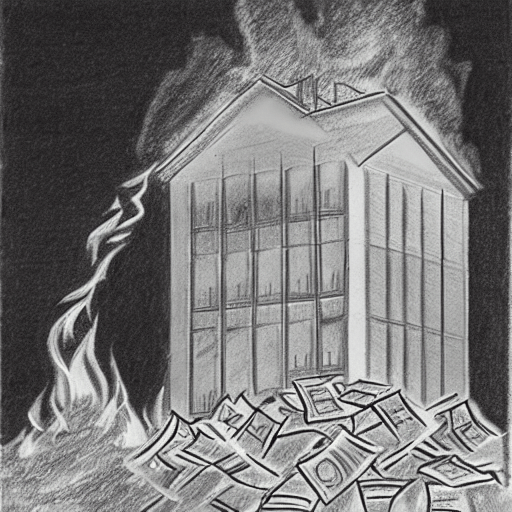
Rent control is like burning money AND apartments
This is going to be disjointed and streamsofconscious-y as usual, but here goes
The economic concept of the “marginal” is a bit difficult to explain in part because our word “margin” already has a number of definitions that people are more familiar with. I’m not an economist, and the dictionary definition doesn’t get across everything I want to say about this, but I want to give you an intuitive reason for why there are so many domino effects with any economic policy change.
Let me start with rent control. It is a truism, even most of the internet knows it, that rent control is Bad. While good “in theory” for helping current tenants make their rent payments, it is bad in theory (and practice) for the housing market as it depressed the supply of new housing leading to higher prices in non-controlled apartments. It’s also bad for non-current tenants (such as teens who need to move out of their parents houses soon) because they have to pay the much higher starting price for an apartment, not the reduced rate their parents pay thanks to decades of rent control.
But socialists still want to make rent control work, and still want to defend it saying that rent control isn’t the problem, greedy landlords are. Nevermind that landlords don’t build the buildings, they rent them out, let’s see why rent control makes builders less likely to build.
Some people have suggested that even in a rent-controlled apartment, the landlord is making a profit, just not “as much” as he could be. Thus rent control isn’t making his business unprofitable, and since it isn’t unprofitable there’s no reason for rent control to be decreasing the supply of housing this way. But let’s look at this:
- So the landlord is making less profit, that means he has less money to buy a *new* apartment with, and also other investors looking to be landlords know they’ll make less profit and will be less willing to spend their own money on new apartments. This decreases the sale price for new apartment buildings.
- This also decreases the likelihood of an empty-nester deciding to fix up their nest, rent it out, and move elsewhere, as their rent income is capped. Again this decreases supply, increases cost.
- But let’s focus on apartment towers for simplicity.
- So the price of new apartment buildings is down, that means builders know they can’t make as much money as they want.
Now here’s where a socialist might get heated: the builders *can still make a profit building a new apartment complex*, the landlord *can still make a profit buying that complex and renting it out*. They just make *less* profit thanks to rent control, but if they *choose not to make that profit*, they’re just being spiteful and greedy. Rent control isn’t the problem here because apartments are still profitable!
But here’s the thing: nothing ever happens in a vacuum.
- So the price of an apartment building is down because of rent control, but the price of an office building is unchanged, because no rent control.
- The builders don’t have infinite money to build with, each building project has to make the choice to build one or the other.
- More builders will shift towards office buildings instead of apartment buildings because we’ve reduced the price of apartment buildings through rent control.
- Less apartment buildings means less supply of apartments, meaning higher rent if demand stay the same.
So while rent control kept apartments profitable, it still depressed the building of them. On the margin, every builder is making a choice between building an apartment or an office complex (or a supermarket, or a warehouse, or whatever). And reducing the profit you can make off an apartment building reduces the marginal investment into apartments. You don’t have to make renting *unprofitable* to decrease investment, making it *less profitable* is enough.
Rent control increases the cost of housing for everyone except current tenants who never, ever move. This is true even if it doesn’t reduce profitability to zero.
Let’s talk about another, even more controversial application of margins: taxes. Wealth taxes on the rich, raising income taxes on the rich, these have become popular policy proposals for populist parties preaching the perishment of deficits (I really strained on that alliteration and still couldn’t stick the landing). Populists argue that rising taxes *doesn’t* drive off the wealthy at all, because no one would pack up their whole life and move just because of a measly 2% of their income or wealth. This is especially true when the district raising the tax (such as California or New York City) already has such a phenomenal pull on top-dollar jobs. Silicon Valley and Wall Street aren’t just going to move to Austin or Atlanta, are you crazy!?!
But again, we need to think of the *margins*. Think not about the 20-year Silicon Valley veteran, with 2 kids in middle school and a 30-year mortgage, grumbling about an extra 2% of their paycheck every fortnight. Think instead about the fresh grad juggling jobs offers and trying to find the best one. Silicon Valley pays a lot more than Austin, but this grad plugs the incomes into a tax-and-cost-of-living-calculator (plenty of free online) and finds that the extra 2% bumps Silicon Valley down below Austin in after-tax disposable income. The fresh grad takes the Austin job and California loses a high-income resident to tax.
Or think about the Silicon Valley empty-nester with less ties to the city. Their friends may still be here, but their children and families may be in other states. They may be juggling competitive job offers and wondering about where they’d like to retire too. They may want to live in Austin so they can be near their aging parents, and an extra 2% tax on their income might be enough to push them to make the jump and take the job offer in Texas. Again, California loses a high income resident.
How often do these types of anecdotes happen? How much do these anecdotes outweigh the people who are faced with an extra 2% tax, but still move to California or New York anyway? Well, that’s the whole reason we should be looking at the *data* on these things. The data suggests that rising income taxes really do result in marginally less high earners moving or staying in. Whether that outweighs the benefits is another conversation, but there *is still* an effect. And the data is *clear* that wealth taxes cause the wealthy to move *out*. Europe is littered with nations that instituted and the revoked their wealth taxes due to exactly this, in fact wealth taxes often *reduce* total taxation as so many high earners flee for foreign shores.
But again, the argument online ignores data and builds its own anecdotes. It’s often argued that *no one will ever leave California or New York, Wall Street and Silicon Valley have too much pull, no one would pack up their whole life and move out just for a measly 2% tax*. These arguments completely ignore the marginal tax-payer who is already pulled in two directions, that tax-payer may very well move out.
The final example I want to discuss is the most controversial of all: the marginal voter.
I’ll try to keep this generic: when a politician comes out with a policy that is popular in their party but very unpopular in the country at large, partisans often have an excuse up their sleeve:
“No one is going to change their vote over this, anyone who says they will is a liar was already voting for the other party to begin with.”
The partisans make another crucial mistake, they assume every voter is a strict partisan and aren’t taking the marginal voter into account. The marginal voter does exist, even if the strict partisan is too small-minded to comprehend such a person. There are people in this country who, for their own reasons, are torn each election between voting democrat and voting republican. Or voting for democrat and not voting at all. Or voting republican and not voting at all. Or voting third party vs voting for a main party, or writing in Mickey Mouse vs casting an actual vote.
A partisan may not understand these voters, or worse they may actively refuse to understand and simply throw up their hands saying “these people are all just stupid.” But our own small-mindedness does not change the reality of this world.
Many many voters cast their vote while wishing they had other options. And for many of those voters a controversial policy announcement, one beloved by the partisans but hated by most non-partisan voters, could be enough to make them switch sides or not vote at all. They could decide that that’s the last straw, the final thing they just won’t accept. They already didn’t like the candidate for many of the reasons the partisan loved the candidate, but were willing to vote for them anyway for whatever reason. But one more unpopular policy could just be a bridge too far.
So yes, voters *will* change their vote over this. Marginal voters. People the partisan doesn’t want to believe exist because partisans prefer to group the world into “righteous” and “evil” people, with elections being a game of turning out the righteous and discouraging the evil. Or worse, the partisan believes in a tripartide division of “righteous,” “evil,” and “stupid,” with the “stupid” not worth thinking or talking about, except as targets for advertisement demanding they choose “righteous” over “evil.”
But if you look at the data unemotionally, you will see that many many voters are already marginal, and your favorite policy proposal, if sufficiently unpopular, can turn off a hell of a lot of them and turn a winnable race into a lost one. It’s very hard to be objective about politics since it controls every aspect of our lives. But it was hard for our ancestors to be objective about say World War 2, since its outcome would also decide the lives of millions. Yet objective analysis was still required to defeat emotional flailing, so keep that in mind the next time you try to say that politics is too important to let analysts give their input.

Above: pencil-sketch version of the Downfall meme





 Streams of Consciousness