-
Would you work more hours if it meant you didn’t have to do housework?

I don’t have a catchier title, but this *is* a question I’ve been pondering. When I was young I thought that having someone else do housework for you was the height of luxury, but these days it doesn’t seem to be that uncommon. I don’t know anyone who paints their own fence, mows their own yard, or cleans their own roof. These jobs used to be seen as just part of owning a house, either you did it or you forced your kid to do it as part of their chores. But it seems nowadays most people hire professionals to do it instead.
Even the most basic housework has been outsourced, with services available to clean your bathroom and kitchen twice a month, or your whole house if you like. And of course think about restaurants and fast food: eating outside your own home has almost doubled in the past 50 years. That’s a lot less meals that people have to cook, a lot less dishes they have to clean, and even less groceries that they have to buy.
So housework is being outsourced, and is it related to how Americans seem to work many more hours than the rest of the developed world?
Shifting gears now, I’ve written before about the Europe vs America economic debates. Inevitably in such debates, the conversation shifts to working hours, workers in Europe work less hours than workers in America.
But Josh Barro on twitter has pushed back against claims about European quality-of-life: they don’t have dryers. Reddit too has a huge thread about the lack of dryers and high-energy appliances in Europe. Can a place without such creature comforts really be comfortable?
I don’t want to dwell on the dryer debate. Yes Europeans can dry their clothes in the sun. Yes, it may be cheaper. But does it require more work? Is an electric dryer not a labor-saving device that lets you cut out the work of hanging up your clothes and taking them down?
And coming back to housework, doesn’t paying someone to do your housework also save you from doing that labor? And if so, how much is your time worth it to you? To restate the question from the title of this post: if working 45 hours a week instead of 40 meant you never had to do housework, would you take it?
Some people like doing housework, I get that. But for most people, it’s a chore. And so I wonder if Americans on the whole have made a choice: they work more at work so they can work less at home, and I wonder if anyone has quantified this. European’s extra housework may not show up in the metrics, but it should still be quantified to know if Americans really do “work more hours.”
Working at work vs working at home is a dichotomy any student of economic history understands. When women first entered the private sector workforce, it didn’t mean that women *started working*, and that they weren’t working before that. Women had been doing work at home without pay since the dawn of time. If you calculate the labor done by homebound women and compare it to the paid labor plus housework done by working women, women’s’ overall working hours went down when they entered the workforce. They could use the money they made at work to pay for other people’s labor or labor-saving devices at home.
Men had also taken this leap from housework to paid work centuries before. During the days of subsistance farming, men, women, everyone had to do a hell of a lot of odd jobs to keep themselves housed, clothed, and fed, even when they weren’t actively “working” on their farm. This is why claims of how few hours medieval farmers worked are so misleading: they had many “holidays,” sure, but besides attending church those days would still be spent doing work around the house even if they wouldn’t be spent in the field.
If you were a medieval peasant, you might have a roof that needs mending, food that needs preserving, you need a new chair to fix the old one, a new patch to cover the hole in your cloak, and you had to do all this yourself or it wouldn’t get done. It didn’t show up in “hours worked” because it’s housework in the home. But it still needed to be done to maintain quality of life.
When men started moving from farms to factories, they traded their labor in for money, and could then use that money to *have their roof fixed, buy their own food, buy a new chair, or have their cloak patched*. They could use money to get someone else to do labor for them. They started working *less hours* when you account for both house work and factory work.
Factories workers worked a *lot*. But subsistence farmers worked far more for far less. But if you only calculate “hours worked” using work *outside* the house, then you’d wrongly conclude that subsistence farmers lived cushy lives and that women’s liberation destroyed women’s free time. Nothing could be further from the truth, instead, people these days work much more outside the house in exchange for working much less in it.
And I wonder how much that feeds in to the America vs Europe debate on working hours. How much labor do Europeans do around their homes that Americans *don’t* do. How much labor do Americans save by using dryers, by hiring landscapers, by hiring homecleaners, and are they happy with the extra hours they work to afford that? Do Americans work more hours to save themselves from housework?
-
Not knowing your Enemies
One of the oldest maxims in military strategy is this: know your enemies. Colonel Santiago of the Spartans added “do not forget above all to yourself.” It’s amazing how badly people fail at this most basic maxim when “knowing your enemy” requires understanding their political goals and ideology instead of just guessing how many tanks and artillery pieces they have on hand.

I’ve been watching a lot of Indy Neidell recently. For those who don’t know, he’s a youtube historian who presents a lot of programs where he recounts the history of a conflict in chronological order. He has presented “World War 1: Week by Week,” “The Cuban Missile Crisis: Day by Day,” and “The attack on Pearl Harbor: Minute by Minute.” It’s the Cuban Missile Crisis I’d like to talk about today.
I’m sure you all know the story of the Cuban Missile Crisis: the Soviet Union puts nukes in Cuba and the world sits on the brink of Armageddon as America and the Soviets decide if they want to nuke each other or not. Eventually the Soviets agree to remove the nukes on Cuba in exchange for America removing its nukes in Turkey, and a direct phone line is established between DC and Moscow so the leaders of the two superpowers can try to hash things out more peacefully in the future.
But what’s striking about the crisis is that no one involved understood each other’s motives, and that nearly led to ruin.
Soviet leader Nikita Khrushchev was the first mover. He was upset that America could threaten him with nukes from Turkey while he couldn’t threaten America with a similar first-strike. He placed nukes in Cuba so he could have such a threat in his back pocket.
Castro was mostly a bystander in the crisis, a sad state of affairs since it was his nation that the crisis was about. Castro was sold the idea that the nukes were there to protect Cuba from any future Bay Of Pigs style invasion. He thought the nukes were primarily for his benefit, and urged the Soviets to give him operational control over them.
When America found out about the nukes, they completely misunderstood things. They seemed primarily worried about West Germany, and thought the nukes were there to distract them from an upcoming West Berlin crisis. Or that the nukes were to dissuade them from coming to Germany’s aid if the Soviets invaded there. Throughout the crisis, many American decision-makers remained stuck on the question of “how does this relate to West Berlin?”
It’s somewhat understandable that the American thought this way, since West Berlin was so important to them. It was the shining beacon of freedom in the middle of Soviet Communism. And every East German who escaped to West Berlin was a diplomatic coup, proof positive that the Western system was better, and that Communism was *so bad* that it was the first government in history that needed to build a wall to keep citizens *in*.
But this fixation caused America to dangerously misjudge the USSR during the crisis. They didn’t understand that Khrushchev and Castro had their own motives for doing this, and American policy-makers were constantly looking for a West Berlin connection. America made plans to knock out the nuclear missiles in Cuba either with air strikes or a ground invasion. These ideas were ultimately shelved partly because “what if the Soviets want to tie us down here while they invade West Berlin?”
But what America *should* have realized was that the Soviets weren’t going to install nuclear missiles on Cuba without a *lot* of troops to guard them. The proposed American ground invasion would have been *severely* outnumbered by the USSR Red Army troops that America didn’t know were on the island. And that’s without even mentioning the tactical nukes that were also there to guard the strategic nukes. An American invasion would have been a slaughter, possibly including the use of said tactical nukes against the US Navy, but the Americans assumed Cuba was a small sideshow because that was how they saw it themselves.
And while the USSR was *more* interested in Cuba than the Americans thought, they were *less* interested in Cuba than Castro thought. When the USSR was moving the nukes out, Castro threw a fit and tried in vain to retain control of the tactical nukes. This earned him no favor in Moscow, as the USSR wanted to bring everything home and put the whole thing put behind them. The end of the crisis created a lot of bad blood between Cuba and the USSR, when it could have been a unifying moment instead.
In fact, I saw much the same level of American misunderstanding in Indy Neidell’s series on the Korean War. Yet again the Americans began this war being most worried about Germany, “what if they want us to pull our troops from Europe into this war in Korea?” This hamstrung troop movements and decision-making in the crucial early stages when South Korea was being overrun.
Later on, the Americans showed another failure of understanding that I’ve seen repeated in the modern day: the assumption that their enemies were united and working in lock-step against them.
The idea went like this: the USSR, China, and North Korea were all Communist. Communists were all opposed to America, and thus Communists all moved in lock-step to work against America. It became clear early on that the USSR wasn’t moving its European troops to support North Korea, and that the USSR would *not* join the Korean War with ground forces. That proved (in America’s mind) that the Korean War *was* just a side-show, and that they had to remain focused on protecting West Berlin.
It *also* proved that the “Forces of Communism” were willing to cut North Korea loose and not support them if US troops occupied the North. If the USSR wasn’t supporting them, you could be damn well sure China wasn’t supporting them either, because the two moved in lock-step. And that meant no ground forces would swoop in to aid North Korea, meaning America was free to occupy the whole country.
The USSR certainly treated Korea with less importance than its European commitments. But the Communists were *not* operating in lock-step, and China was willing, even eager to send ground forces to Korea. More than just fighting the Capitalists, China wanted to prove that the “Century of Humiliation” was over, and that the Communists had brought China back to being a super-power on the world’s stage, able to go toe to toe with anyone.
America took the lack of USSR ground troops as proof that the Forces of Communism were in no way prepared to fight them face to face in Korea. American generals and planners ignored the massive amount of Chinese ground troops even as those troops moved into Korea to start fighting. America failed to understand: China was willing to fight even if the Soviets weren’t.
This strange idea, that our enemies are all united and move in lock-step against us, is a common one amongst small-minded jingoists. Jingoists are often too intellectually stunted to understand other people having motives that don’t involve them. In the 50s that meant they didn’t realize how important Korea was to China, because Korea was a sideshow for the jingoists. In the modern day, I’ve seen jingoists propose that Iran, China, and Russia are acting in unison to oppose American interests, rather than each nation acting in its own interests even if their interest sometimes align with each other.
When Iran launched missiles at Israel, it was suggested by morons that this was in part because Russia wanted to take America’s attention and effort away from Ukraine. When the Houthis shut down Red Sea Trade, this was supposedly done because Iran wanted to help Russia by hurting Europe. And the whole war in Ukraine itself is supposedly part of China’s big strategy to put pressure on America and Europe so China can swoop in and take Taiwan.
Let’s get one thing clear: this is nonsense cooked up by morons. Russia, Iran, China, the Houthis, they all have their own beliefs, goals, and strategies. China is no more ordering Russia around than the USSR ordered China around in the Korean War. Iran is supporting the Houthis but the Houthis act mostly on their own initiative.
And this misunderstanding continues on to suggestions of strategy. There is a stupid video-game ideology that goes through the heads of jingoists: if we cut off the command center we end the rest of the war. So they propose war in Iran to stop the Houthis and war in Russia to contain China.
Yet history tells us that we time and time again misunderstand the motives of our enemies. America thought the Cuban missile crisis revolved around Europe, and believed that a resolution to the crisis must be sought there.
They were wrong.
Khrushchev offered to remove his nukes from Cuba in exchange for American nukes from Turkey, because that was what he was focused on all along. This surprised the Americans. In fact Khrushchev announced this “deal” before Kennedy and co had even agreed to it, or even heard of it, they learned it from the newspapers and were obliged to go along with it as the best way to exit the crisis.
Throughout the entire Cuban Missile Crisis and Korean War, America misunderstood its enemies, believed them to be united in opposing America, and was fixated only on what *it* saw as important. This led to failures and near catastrophe, as they didn’t predict China would enter Korea and didn’t think the Soviets would send tens of thousands of troops to guard a strategic “backwater” like Cuba.
If America had understood that China and the USSR were not joined at the hip, they might have stopped their troops half-way up the Korean peninsula and allowed the Republic of Korea to invade north on its own, since China had said that they wouldn’t attack if only Korean forces came north. Maybe Korea would have been unified. And if America had understood that the USSR was more worried about American nukes in Turkey than American bases in Germany, then they wouldn’t have courted disaster with a plan to send a few thousand troops against a vastly superior Red Army garrison in Cuba.
I’d hope that modern jingoists would take these lessons to heart, and understand that our enemies have initiative and agency all their own. Sadly most do not.
-
Research labs are literally sucking the blood from their graduate students

I’m going for a “clickbait” vibe with this one, is it working?
When I was getting my degree, I heard a story that seemed too creepy to be real. There was a research lab studying the physiology of white blood cells, and as such they always needed new white blood cells to do experiments on. For most lab supplies, you buy from a company. But when you’re doing this many experiments, using this many white blood cells, that kind of purchasing will quickly break the bank. This lab didn’t buy blood, it took it.
The blood drives were done willingly, of course. Each grad student was studying white blood cells in their own way, and each one needed a plethora of cells to do their experiment. Each student was very willing to donate for the cause, if only because their own research would be impossible otherwise.
And it wasn’t even like this was dangerous. The lab was connected to a hospital, the blood draws were done by trained nurses, and charts were maintained so no one gave more blood than they should. Everything was supposedly safe, sound, by the book.
But still it never seemed enough. The story I got told was that *everyone* was being asked to give blood to the lab, pretty much nonstop. Spouses/SOs of the grad students, friends from other labs, undergrads interning over the summer, visiting professors who wanted to collaborate. The first thing this lab would ask when you stepped inside was “would you like to donate some blood?”
This kind of thing quickly can become coercive even if it’s theoretically all voluntary. Are you not a “team player” if you don’t donate as much as everyone else? Are interns warned about this part of the lab “culture” when interviewing? Does the professor donate just like the students?
Still, when this was told to me it seemed too strange to be true. I was certain the storyteller was making it up, or at the very least exaggerating heavily. The feeling was exacerbated since this was told to me at a bar, and it was a “friend of a friend” story, the teller didn’t see it for themself.
But I recently heard of this same kind of thing, in a different context. My co-worker studied convalescent plasma treatments during the COVID pandemic. For those who don’t know, people who recover from a viral infection have lots of antibodies in their blood that fight off the virus. You can take samples of their blood and give those antibodies to other patients, and the antibodies will help fight the infection. Early in the pandemic, this kind of treatment was all we had. But it wasn’t very effective and my co-worker was trying to study why.
When the vaccine came out, all the lab members got the vaccine and then immediately started donating blood. After vaccination, they had plenty of anti-COVID antibodies in their blood, and they could extract all those antibodies to study them. My co-worker said that his name and a few others were attached to a published paper, in part because of their work but also in part as thanks for their generous donations of blood. He pointed to a figure in the paper and named the exact person whose antibodies were used to make it.
I was kind of shocked.
Now, this all seems like it could be a breach of ethics, but I do know that there are some surprisingly lax restrictions on doing research so long as you’re doing research on yourself. There’s a famous story of two scientists drinking water infected with a specific bacteria in order to prove that it was that bacteria which caused ulcers. This would have been illegal had they wanted to infect *other people* for science, but it was legal to infect themselves.
There’s another story of someone who tried to give themselves bone cancer for science. This person also believed that a certain bone cancer was caused by infectious organisms, and he willingly injected himself with a potentially fatal disease to prove it. Fortunately he lived (bone cancer is NOT infectious), but this is again something that was only legal because he experimented on himself.
But still, those studies were all done half a century ago. In the 21st century, experimenting with your own body seems… unusual at the very least. I know blood can be safely extracted without issue, but like I said above I worry about the incentive structure of a lab where taking students’ blood for science is “normal.” You can quickly create a toxic culture of “give us your blood,” pressuring people to do things that they may not want to do, and perhaps making them give more than they really should.
So I’m quite of two minds about the idea of “research scientists giving blood for the lab’s research projects.” All for the cause of science, yes, but is this really ethical? And how much more work would it really have been to get other people’s blood instead? I just don’t think I could work in a lab like that, I’m not good with giving blood, I get terrible headaches after most blood draws, and I wouldn’t enjoy feeling pressured to give even more.
Is there any industry besides science where near-mandatory blood donations would even happen? MAYBE healthcare? But blood draws can cause lethargy, and we don’t want the EMTs or nurses to be tired on the job. Either way, it’s all a bit creepy, innit?
-
Carter and Thatcher: Champions of deregulation

When people talk about the British economy, one complaint floats to the top of the internet discourse: the Financial Sector. According to the Twitterati, the UK spent too much money “building up” a sector of the economy that has done nothing but push up inequality, force everyone into London, and doesn’t even do anything useful.
You’ll hear it said that while finances pay most of the taxes and provide most of the GDP of the UK, this was due to a stupid choice the Government made not a fact of nature. Britain should have been more like Germany, investing in industry so they could have more middle class jobs spread around the whole country. Instead they invested in Finance and got one single city filled with rich people and their servants while the entire rest of the country goes to waste.
This complaint is wrong in many ways, but the most direct falsehood is that successive Governments *did not* “invest in” or “build up” the Financial services industry, services succeeded so rapidly because the Government *kept out*. For a long time, British financial services were heavily regulated and weren’t much larger than than what was available on the continent. But then the Government stepped away from the sector, dropped its regulations, and the sector thrived. The Government didn’t put money and time *into* finances, instead the Government was taken *out* of finances.
Maybe the Government should have gotten out of more industries?
But I’m getting ahead of myself, the changes to Britain’s financial sector all happened in a “Big Bang,” named such because instead of piecemeal deregulation over many years, there was massive, sweeping deregulation all at once. The sudden drop of onerous requirements made the sector highly competitive, and drove massive investment into London/the UK at the expense of the rest of Europe.
But most people look askance at “deregulation.” They think there must be some “catch” to this story. What regulation was dropped, and how did this secretly allow Bankers to suck blood from the unions and the working class? Well here are a few regulations that were dropped:
Broker price fixing: before the big bang, if you wanted to buy a stock from a broker they were required to charge you a minimum price for the service of selling you the stock. This price was set by the Government, and it was illegal to offer lower prices. This is bad for consumers and bad for business, I mean should the Government set a *minimum price* for food? For rent? Hell no. So why a minimum price for stocks?
Ending the price fixing meant suddenly bankers had to compete on price. The price to trade a stock went lower and lower, and this had the effect of opening up the stock market to the common people as well. Suddenly there wasn’t some onerous price on top of any stock you wanted to buy, you could pay for just the stock plus a paltry service fee of a few pence. And in time, even this few pence fee went away, as brokers offered fee-less trading in an attempt to compete on volume.
Price ceilings are terrible, but leftist will still argue they are at least good for the consumer. Price *floors* are exactly as terrible, and I hope even leftist realize they aren’t good for the consumer.
Electronic trading: before the big bang, it was mandated that to buy or sell a stock, two people had to meet in person and agree to the sale. You put in your order to a broker, they wired the order to someone else, and eventually your order would make its way to two people standing on a crowded floor screaming at each other to haggle over the price of your stock. They weren’t screaming in anger, but just to be heard over everyone else on the floor, who was also screaming.
The big bang introduced electronic screens with prices and volumes, and allowed orders to be made totally electronically. This helped end the monopoly of overpaid men screaming at each other. It made ordering easier, allowed it to be done from anywhere, and by cutting out the middlemen it helped bring down the price for buying and selling stock. Once again, this helped democratize the stock market, few workers today would be able to invest for their retirement on the stock market if prices to buy and sell were still as high as the 70s.
Foreign ownership: the big bang allowed foreign companies and individuals to act as brokers. Much like electronic trading, this broke the monopoly on overpaid men screaming at each other, and lowered prices; are you seeing a pattern here? Anyway foreign banks and brokers could now bring outside investment and outside technology to the British stock market, where before they’d been banned.
The ban on foreign brokers had been done solely to “protect” the profits of British banks and British brokers. But like tariffs, it did not help the British economy nor protect British wages. It was just another facet of a Government sanctioned oligarchy, which allowed only certain, connected individuals to profit from Britain’s stock market. Foreign investment created competition, and it also created a flood of incoming money, which boosted demand for workers and drove up British wages. These new brokers needed buildings, needed computers, needed employees etc. The flood of incoming money was a great boon for workers and builders in every sector of the British economy.
These are just a few of the deregulations brought on by Thatcher’s big bang, but they all had the same theme. They broke the monopoly of the overpaid bankers and brokers, and brought in competition that brought down prices and democratized the stock market. The financial industry grew like never before, eclipsing every other sector of the British economy. And it did so not through Government support, but because the Government *kept out*.
But let us turn now to Jimmy Carter.
Deregulation is too often seen as a boogieman of the right wing. The conservative party (whichever party it is in your country), wants to deregulate because they secretly want to destroy the environment and make workers their slaves. It is a too-common dogma on the left that any regulation is necessary and sacrosanct for the good of the economy, and that deregulation doesn’t even help GDP but merely lets well-connected CEOs impose a monopoly that makes everyone poorer.
So I thought I’d push against that view with a man no one could accuse of being a right-wing conservative: Jimmy Carter. Jimmy came to the presidency at a time of great difficulty. Inflation, oil crisis, stagflation even, the American economy was nuts in the 70s. There was even fear that the USSR would overtake America. Jimmy would fix that.
One of Carter’s signature policies was deregulating the airline industry. Once again, a modern leftist might see this as a betrayal: what did Carter’s deregulation do to break the unions, harm the workers, and price-gouge the people, and how much did the airlines pay him to do this? But nothing could be further from the truth. Prior to Carter’s deregulation, the airline industry worked like a Gilded Age trust, with strict rules that protected the big players at the expense of workers, people, and anyone trying to get a foot in the door.
First, to make a new airline route, companies had to submit their request to a centralized body. This body would then look to see if the new route created too much competition with any other airline’s route, and if it did, the route was forbidden. Imagine if Walmart could forbid anyone from opening a store within 5 miles of their own, that was basically what this law did.
The airline submitting the new route had to basically get a hospital-style “certificate of need” proving that there weren’t enough flights for the amount of passengers who *wanted* to travel. This was of course very difficult to prove, and the airlines already serving that route could try to maintain their monopoly by promising to increase flights, so usually the monopoly was protected.
In addition, a centralized agency set a price floor on airline tickets. Like we discussed earlier: price floors are bad. They only serve to enrich the big players by making it impossible for new companies with better tech to come in and compete on price.
In fact, even *starting a new airline company* was all but impossible, as any new company had to get permission to run airlines. Imagine if Walmart could forbid the creation of Costco solely on the basis of “we were here first.”
Airlines in America had a ton of overregulation that only served to protect the big players at the expense of everyone else. No one benefited from this, not the workers, not the fliers, not the American economy, no one except the big boys who lobbied hard to prevent deregulation from passing.
In the end, deregulation democratized flight in America the way same way it democratized the stock market in Britain. Adjusted for inflation, the average New York to LA flight was 1,200$ in 1970, today you can fly that route for under 300$. There is no question in my mind that the American people are better off without being price-gouged by airline lobbyist. And Carter made all that possible.
So my final thought is this: deregulation is a dirty word, but it shouldn’t be. Regulations are not necessarily good. They are not necessarily bad either, but don’t assume they are always good. Deregulation is likewise value neutral. It is good to remove bad regulations, it is bad to remove good regulations.
Britain has a lot of bad regulations holding it back, that’s why I suggested deregulation to Keir Starmer. Starmer has a once-in-a-generation opportunity to change Britain for the better. He’s got a big majority, there is wide agreement that his predecessors were bad for the economy, and he’s hemmed in by debt and deficits preventing any big spending. This is the perfect time for deregulation.
So I say cut the red tape, kick out the cartels, and trample all over the lobbyists who want to protect their corporate fiefdoms. If Britain is going to build, it needs change, the kind of change that Jimmy Carter understood. And even if Thatcher deregulated, that doesn’t mean deregulation is always bad. Would you like to pay 10 pounds every time you wanted to purchase a stock? Would you like to pay 4 times as much to fly to another city? Starmer should cut costs for the working folk, and deregulation can make that happen.
-
If I Ruled Britannia: economic reforms

Sir Keir Starmer, the newly elected King of England, 2024 pencil sketch
Last time on Streams of Consciousness, I was talking about the economy of Great Britain and what they needed to change to improve things. They’ve tried raising taxes, they’ve tried cutting spending, but their fiscal deficit is only rising and new loans to cover the deficit are getting ever more expensive. My previous recommendation was spicy and probably unpopular, so I quarantined it in its own post and am putting the rest of my recommendations here.
But first: what should Great Britain *not* do? Well first of all I agree with Tony Blair: they shouldn’t put retaliatory tariffs on America. And this isn’t because I’m biased and don’t want them to hurt America, it’s because *I want what’s best for Britain and don’t want them to hurt themselves*.
It may sting to allow Donald Trump a “win.” He’s jacked up tariffs and demanded that no one else retaliates with their own. If you do what he’s asking, aren’t you letting him win? Well if you think retaliatory tariffs are a smart move, you must think that because you believe they will hurt America with only a modest affect on your own country. But that’s wrong, tariffs are a huge blow to your own country, with only a modest affect on the one you’re tariffing. Doing what Donald Trump wants just means letting him win the foot-shooting competition.
Tariffs are inflation in action: everything gets more expensive for absolutely no reason. Because everything is more expensive, everyone is poorer (since their money doesn’t go as far). And tariffs don’t “protect” domestic industries, they destroy them. They destroy competitiveness because there is no market force pushing companies to improve their products. With tariffs, it’s always more viable to increase your profits by rent seeking (demanding the tariffs rise yet further) rather than by self-improvement. Thus the companies stagnate and rust out. Less goods are produced at a much higher cost, everyone is poorer.
This is true even when your tariffs are “targeted.” It’s just that “targeted” tariffs destroy only a few industries instead of all of them. Donald Trump tariffed you, but if you retaliate with tariffs on on American fuel and aircraft (major American exports), you’ll harm your own airline industry by raising their costs. Needless to say your airlines will have to raise their own costs, harming your tourism/travel industries, and thereby harming your citizens who can no longer afford airfares. America will feel some harm, yes, but not as much as your own people.
“We’ll substitute American goods by buying goods from Europe!” Trump wants to substitute foreign goods with American goods, do you think that will work for him? It won’t work for you either.
Tariffs also destroy industries by raising the cost of all their inputs, since again tariffs are just inflation. The steel company can raise its prices since it’s no longer competing with Chinese steel, and has no incentive to innovate because it plans to ask for more tariffs next year. So if you’re a manufacturing company making anything with steel, all your steel just got very expensive and will only get more expensive from here. Might as well cut wages, it’s the only cost you can control.
Many manufacturers will go bankrupt, they can’t afford the higher prices. A few dozen steel jobs will be “saved” at the cost of thousands of higher-paying manfacturing jobs. Those steel workers will then be laid off because with all the manufacturers going bankrupt, no one needs so much steel. And besides, the cost of iron has gone up with the tariffs on iron (and the iron mine is soon to go bankrupt as they can’t afford the machines needed to keep mining).
Think of it this way: if you think retaliatory tariffs are a good idea, then you think Trump’s tariffs in general are a good idea. You agree with him that the tariffs hurt the target countries more than they hurt the country placing them. You think Trump is doing smart economic policy, and are just mad that he’s doing it to *you*.
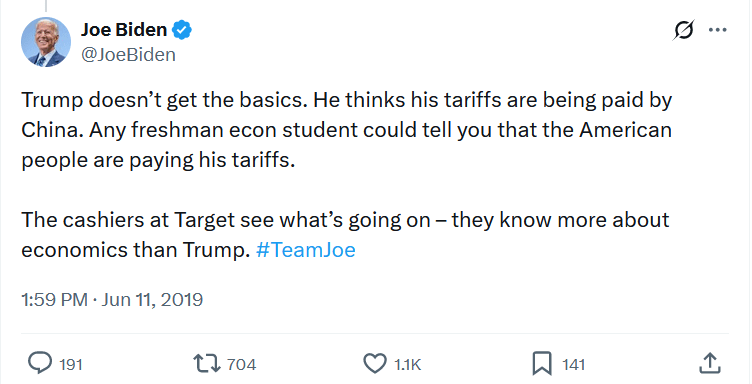
So again, don’t complain about giving Trump a *win*, reject the cognitive dissonance on tariffs and accept the one and only truth: tariffs are bad for growth, bad for prices, and bad for workers. Biden knew this in 2019, but I fear the cognitive decline hit him fast since he forgot it by 2021. (example, example, example)
Anyway that’s what Britain *shouldn’t* do, so what *should* it do?
How about reducing the need for occupational licensing? “Licensing” sounds good in theory, the Government is going to step in and demand minimum qualifications for certain professions. But everything sounds good when you ignore the costs and handwave the benefits.
Licensing sounds nice because you immediately think of doctors and nurses. But many many jobs have mandatory licenses that simply do not need them. Does a horse trainer really need a license? A piano tuner? A wig-maker? Adding a license does nothing except make it harder for people to get jobs. It’s part of what’s killed “entry-level” positions, there is no such thing as “entry-level” in an industry where any work at all requires a specific license.
20% of UK jobs need a specific license, which ossifies the labor marker and prevents workers from job-hopping to find better wages. You may have veterinary training, a fondness for horses, and see well-paying jobs opening up in the horse-racing industry. But without a long and arduous licensing process, you’re cut out from that part of the labor market, forced to keep working at Tesco for almost nothing.
You may ask “but without a license, how can we ensure these workers are competent?” You interview them, you look at their CV, you contact prior employers. An incompetent employee can do damage yes, for instance an incompetent Tesco stocker can leave heavy merchandise off-balance to crush unwary shoppers, so do shelf stockers need a license? Be honest, exactly how much is saved by having entry-level jobs be licensed? Quantify all the harms, both physical and monetary, then weigh them up against the costs.
Because licensing *does* have a cost. It lowers social mobility since the lower class can’t afford to spend years getting licensed before getting their first job. It hampers growth by preventing industries from growing to meet demand. And it drastically raises costs for licensed labor, without really raising wages.
How can that be? Aren’t licensed jobs paid more than unlicensed? Yes but look at the cost of getting that license, with its years of training and bureaucracy. Look at the cost of *keeping* that license, with mandatory retraining, continuing education, and the like. Time is money, and all the time it takes getting and keeping a license usually drains any additional pay that the license brings.
And look at how that license locks you into a single career, unable to switch things up to chase a higher wage. I’m sorry, you’re a *horse* trainer, *dog* training is a different license.
And study after study shows that very few licenses improve outcomes. Doctor, nurse, these require years of training and understudy, a license here may be warranted. But this kind of thinking is needlessly applied to far too many jobs, most of which show no difference in quality between licensed professionals (in countries where a license is needed), and unlicensed professionals (in countries where it isn’t). License medical and legal practitioners, let everyone else be.
So that’s occupational licensing. My next suggestion for Keir: end planning permission and build housing on the green belt. I wrote about the Green Belt before, but for those of you who missed it: the Green Belt isn’t green, and Britain should build on it.
“The Green belt” of is a bunch of land surrounding many of Britain’s largest cities. The name conjures to mind beautiful forests and fields, untouched by Man since the days of yore. But it’s actually car parks and monoculture farms, forbidden from being built on so that landowners can prevent their neighbor’s property from being bought up by the urban bourgeoisie. It’s a NIMBY version of feudalism.
And the Green Belt does have houses by the way. NIMBY houses for people who don’t want anyone to live near them, but also don’t want to pay for that privilege. Instead of buying the land surrounding their house (and thus paying tax on it), they simply demand no one *else* be allowed to build anything there.
So build on the Green Belt, put apartments on the car parks. Housing is unaffordable in Britain, build more houses and prices will come down. Build more apartments and rent will come down. And with housing and rent getting cheaper, people can afford to spend more on buying goods and services, pumping more money into the economy and creating more jobs.
Importantly, *the Government does not need to do this building*. Too many people think that if the Government is not actively building things, either with its own taxpayer-funded corporation or through special subsidies, then things just won’t get built. But that is not at all true. A plethora of private companies would love to build and sell houses, but Government laws prevent them. So just repeal the laws and the companies will build, no special subsidies or taxpayer-funded company necessary.
And while we’re at it, do away with local planning permission. People complain about developers “banking” land, holding it without building for years. That’s only done because it takes on average a *decade* to get permission to build anything. If someone wants to build and sell houses, buying the land is step 1, steps 2-90 are all planning permission. Cut out those steps and the houses will be built faster and cheaper.
Local councils hold far too much power to block housing, get rid of that power. Instead of a situation where council have to give “permission,” create a national “by-right” system of planning. Developers submit a proposal to build a dwelling at a location, a national organization makes sure it’s up to code, and once they OK it development starts. No more veto-ocracy by local NIMBYs.
Great Britain is no longer a feudal society, you shouldn’t require the permission of the local landlords to build on your own land. Local landlords don’t want you to build a nice apartment that competes with their crack house? Tough. End local planning permission and kick the landlords to the curb.
And now here’s my final suggestion for Keir Starmer, get rid of bank ring-fencing.
Actually that’s not my suggestion, but it was raised as a possibility by British politicians. And the suggestion isn’t that outlandish, Germany ended its ring-fencing over a decade ago
But wait, what is/was ring-fencing? In 2008, the Financial Crisis/Great Recession happened when banks made risky loans, those loans defaulted, and the banks went bust. This cause a knock-on effect throughout the economy.
The risky loans often came from the “investment” side of the banking business, but when the bank went bust even the the “core” side (which held consumer’s money) was hit. Ring-fencing meant keeping investment banking separate from consumer banking, so any bad investment bets would have no effect on consumer savings.
But banks are banks, and economies of scale mean one bank doing two things is usually more efficient than two separate banks. That’s why some want to get rid of ring-fencing and let banks make more money. Germany already did so, why shouldn’t Great Britain? Let the good times roll again.
I don’t know if ending ring-fencing is good or not because honestly I don’t actually know much about its effect. What efficiency is gained by combining consumer banking and investment banking? What is lost by ring-fencing? But I don’t reflexively hate this idea the way I probably would have hated it 10 years ago, less than a decade after the Financial Crisis. I don’t know, I’ll need to do more reading.
So anyway those are my proposals the economy of Great Britain. Keir, if you’re reading: work on this for me, would you?
Deregulation is a dirty word on the left mostly because it’s a clean word on the right. But this reflexive partisanship isn’t helpful, regulations are not always good. Removing bad ones is necessary for an economy to grow. And if Labour wants growth, if they want to stop having to come out with more taxes and less spending every six months, then they need deregulation.
Post Script: Talking about the banking deregulation, I was reminded of Thatcher’s “Financial Big Bang.” No time to discuss it today, but I hope I remember to do so soon, because it’s a fascinating topic that explains a lot about today’s Great Britain.
-
“No more austerity! The Government needs to invest!”
“Government” is capitalized here because we’re talking about the UK today. I meant to write about it earlier, but Keir Starmer and Rachel Reeves have been announcing that benefits cuts will hit the UK this year. On top of last year’s tax hikes, this has raised the specter of Austerity, and fears of another Lost Decade in the UK, only this time with Labour at the helm.
Critics of the cuts abound, bringing complains and counsel:
“What happened to the tax rises from last year?!?”
“Austerity failed already! We can’t keep cutting!”
“Tax the rich! Don’t cut off the poor!”
And finally: “We should invest, not cut!”
Let me address these one by one. First, as much as the left-of-center despises the Laffer Curve, it is still an accurate reflection of reality. Raising taxes increases prices and reduces demand. This nearly always leads to a tax rise bringing in less money than the government predicts. They may claim to be modelling the demand reduction, but governments that raise taxes are heavily incentivized to make broad claims about bringing in lots of money to balance the books. Accurate modeling plays second fiddle.
And this has been the case in the UK, the 40 billion pound tax rise announced last year isn’t expected to bring in quite that much. For instance, a tax on private school education was expected to raise money while affecting a minimal number of pupils. But the government underestimated how many families would be unable to afford the tax, pushing those kids back into the public schools, where they aren’t paying the tax and the government will have to pay for their education.
So the government’s tax rise didn’t bring in near enough, and they even raised spending on top of it. The UK now faces a yawning deficit, nearly 5% of GDP. With Debt to GDP already over 100%, the government is finding borrowing unaffordable. The cost of financing all that debt is soaring, it’s 25% higher than it was a year ago at more than 100 billion pounds a year. Remember, that 100 billion pounds is *just the cost of the interest payments*, assuming no money is spent actually paying down the debt. Labour is then adding that 5% deficit on top of that, which will need even more borrowing.
So borrowing is going to cost way more than Labour expected. If they don’t want to enter a debt spiral, they need to manage that deficit.
“But Austerity failed already!” When did the UK ever implement austerity? It was the word of the decade under the coalition government, but despite the tough talk and tax rises, total spending increased every single year of the coalition, and never went down. And this wasn’t “cuts in real terms either,” *real spending* ie inflation adjusted spending, never went down during the Coalition government. It grew more slowly than under Blair/Brown, but it never went down. Boris Johnson has the (dis)honor of overseeing the only year on year reduction in real Government expenses, thanks to the massive pandemic spending that then petered out.
The UK hasn’t done austerity, and it isn’t doing austerity now. The announced cuts aren’t actual reductions in spending, they are really just slowing the rate of spending *increase*. Labour promised massive spending increases last year, and a few of those are being paired back into a smaller increase. This is still an increase in real spending, just less of one than what was promised. This isn’t austerity.
And what of taxing the rich? They’re already pay all the tax. The top 10% of UK earners pay 60% of all taxes, the top 1% pay half of that (ie 30% of the total). The bottom 50% of earners pay 17% of tax. About a third of working age Britons pay no tax at all.
And that is significantly more progressive than on the Continent, the German 10% pay a little over half of their country’s taxes, the German 1% pay a little under a quarter. By and large, the UK taxes the rich more and taxes the poor less than in the rest of Europe.
Of course, the real definition of “rich” is “1 standard deviation above my personal income.” Everyone agrees that someone *else* must pay more, but will the British economy really be improved by chasing off its last remaining high earners to America? Europeans have boasted that Trump will set off a “brain drain” of wealthy Americans, but the difference in after-tax earnings means historically that brain drain has only happened in the America-ward direction. Further tax hikes will only enforce that paradigm.
Finally, shouldn’t the Government *invest* rather than *cut*? The private sector does it all the time! They take out eye-watering amounts of debt and yet somehow come out on top, the public sector should too!
But the Government doesn’t really invest. It spends money, and it uses the language of the private sector to claim that the money is spent well. But the Government doesn’t have the profit incentive that the private sector does, it’s overwhelming incentive is for optics and votes. So as Biden showed us, Government “investment” never really generates a return.
Labour is right to cut spending. They’ve already hiked taxes, and they need to get borrowing costs under control somehow. Besides, Government spending as a proportion of GDP is already nearly 50% in the UK, about 17,000 pounds per person. Just over 10% of the population (people making more than 50,000 pounds) are putting in more money than they’re getting out. The Government already spends a lot of money, and not well. More money in the fire won’t necessarily help.
But like Nigeria’s president Tinubu, Keir Starmer has talked a big game on growth without having the stomach to follow through with it. So again, here’s my unsolicited policy advice:
Keir Starmer should liberalize (liberalise?) the UK’s labor (labour?) laws. UK companies are significantly constrained in their abilities to fire, and this generates a reluctance to hire. The UK has stiff requirements on minimum notice before firing, minimum compensation when you get fired, and if you work there for 2 years a company needs to jump through significant regulatory hoops to be allowed to fire you. These laws should be liberalized to make it easier to fire, and therefore incentive companies to hire.
I know this proposal doesn’t sit well with any of my readers. We’re all workers, I doubt any of us is an owner. But here’s the rule of labor markets: easy go, easy come. The easier it is to fire a worker, the more willing a company will be to hire, and the more nimble a company will be at navigating a changing market.
If a UK company wants to expand, they have to do so very slowly and carefully because any new hire becomes a big liability after 2 years. UK Companies can’t downsize to adjust to market conditions, and so they are hesitant to upsize even during the good times. That makes them grow more slowly, and believe it or not it reduces wages.
Let’s look at Meta as an example: they laid off tens of thousands of employees when the “metaverse” was proven to be a bust. They were able to lay off quickly and adjust their company focus because those metaverse employees weren’t guaranteed a silver parachute. If firing was harder, they might have held on to their losing bet on the metaverse for much longer, because the cost of firing mitigated the upside potential in changing tactics. Then again if firing was harder, Meta might have never made a big expensive bet on the metaverse to begin with.
See the metaverse was a big, expensive failure, but US companies have to expect that most of their bets will fail. But some bets will succeed and wipe out all the loses from the failures, and so US companies are very quick to hire when they’re chasing a big bet.
The ballooning wages in Tech are a symptom of this. Companies like Google and Amazon have made big bet after big bet in the last 20 years, and to when those bets pay off the company starts offering higher and higher wages to expand the company on the success of their big bet. Sometimes those bets go bad and you get layoffs like at Meta. But many of those bets go good and you find that starting salaries in America become higher than mid-tier salaries in most of Europe.
And while Tech is the most famous example, this is endemic in every American industry from energy to pharma and beyond. Liberalized labor markets mean companies are willing to make big bets, meaning some of those bets pay off and the workers get chased by higher salaries. The workers are ultimately the ones who benefit here, that’s why America is such a magnet for high-skilled immigration (on top of its attractiveness for all immigration). Even with Trump in power, tens of thousands of highly skilled immigrants will continue to come to America every year he’s in office, the salaries are just too good to pass up.
That was a lot more than I expected to write on labor markets, but I’ve got more if you’re interested. Stay tuned for the next exciting installment of “if I ruled the world.”
-
The need for data, the need for good data
Another stream of consciousness, this one will be a story that will make some people go “no shit sherlock,” but it’s a lesson I had to learn on my own, so here goes:
My work wants me to make plans for “professional development,” every year I should be gaining skills or insights that I didn’t have the year before. Professional development is a whole topic on its own, but for now let’s just know that I pledged to try to integrate machine learning into some of my workflows for reasons.
Machine learning is what we used to call AI. It’s not necessarily *generative* AI (like ChatGPT), I mean it can be, but it’s not necessarily so.
So for me, integrating machine learning wasn’t about asking ChatGPT to do all my work, rather it was about trying to write some code to take in Big Data and give me a testable hypothesis. My data was the genetic sequences of many different viruses, and the hypotheses were: “can we predict which animal viruses might spill over and become human viruses?” and “can we predict traits of understudied viruses using the traits of their more well-studied cousins?”.
My problem was data.
There is actually a LOT of genetic data out there in the internet. You can search a number of repositories, NCBI is my favorite, and find a seemingly infinite number of genomes for different viruses. Then you can download them, play around with them, and make machine learning algorithms with them.
But lots of data isn’t useful by itself. Sure I know the sequences of a billion viruses, what does that get me? It gets me the sequences of a billion viruses, nothing more nothing less.
What I really need is real-world data *about* those sequences. For instance: which of these viruses are purely human viruses, purely animal viruses, or infect both humans AND animals? What cell types does this virus infect? How high is the untreated mortality rate if you catch it? How does it enter the cell?
The real world data is “labels” in the language of machine learning, and while I had a ton of data I didn’t have much *labelled* data. I can’t predict whether an animal virus might become a human virus if I don’t even know which viruses are human-only or animal-only. I can’t predict traits about viruses if I don’t have any information about those traits. I can do a lot of fancy math to categorize viruses based on their sequences, but without good labels for those viruses, my categories are meaningless. I might as well be categorizing the viruses by their taste, for all the good it does me.
Data labels tell you everything that the data can’t, and without them the data can seem useless. I can say 2 viruses are 99% identical, but what does that even mean? Is it just two viruses that give you the sniffles and not much else? Or does one cause hemorrhagic fever and the other causes encephalitis?
I don’t know if that 1% difference is even important, if these viruses infect 2 different species of animals it’s probably very important. But if these viruses infect the same animals using identical pathways and are totally identical in every way except for a tiny stretch of DNA, then that 1% is probably unimportant.
Your model is only as good as your data and your data is only as good as your labels. The real work of machine learning isn’t finding data, it’s finding labelled data. A lot of machine learning can be about finding tricks to get the data labelled, for instance ChatGPT was trained on things like Wikipedia and Reddit posts because we can be mostly sure those are written by humans. Similarly if you find some database of viral genomes, and a *different* database of other viral traits (what they infect, their pathway, their mortality rate), then you can get good data and maybe an entire publication just by matching the genomes to their labels.
But the low-hanging fruit was picked a long time ago. I’m trying to use public repositories, and if there was anything new to mine there then other data miners would have gotten to it first. I still want to somehow integrate machine learning just because I find coding so enjoyable, and it gives me something to do when I don’t want to put on gloves. But clearly if I want to find anything useful, I have to either learn how to write code that will scrape other databases for their labels, create *my own data*, or maybe get interns to label the data for me as a summer project.
Stay tuned to find out if I get any interns.
-
Cheating cheaters
I haven’t written in far too long, so here’s the streams of my consciousness.
I recently learned an acquaintance of mine cheated a fair bit in college. They took classes during COVID, and have confessed to cheating on the at-home exams for difficult classes during the time when distance learning was new and Universities were lax.
I wish I could say otherwise, but it does lower my opinion of this person.
I don’t like cheating at all. A recent bugbear of mine has been the increase in “cheating” I’m seeing on the roads. This may sound like a topic change, but hear me out:
We all have a duty to drive safely. That means obeying posted speed limits, obeying lights, no unsafe behavior. Any car breaking this duty makes the roads less safe for all of us. But we all know why so many cars speed, run red lights, or make right turns from the far left lane: it gets them home faster.
They want to get to where they’re going ASAP and they don’t care how unsafe they make the road. Not just for themselves, but for all the cars around them who now have to swerve out of the way of their dangerous driving and maybe cause secondary wrecks in the process.
Dangerous drivers cheat the system that keeps us safe for very minor gains. And I really despise it. Deaths on the roads have continued to increase year after year since the pandemic, and it seems no city or police force is willing to tackle this. An increase in death is just what the city government wants I guess, revealed preference and all that.
They could halt the dangerous drivers by enforcing traffic laws. Have cops patrol the street, give tickets to any speeder, anyone running a red. Automate the ticketing process if need be, revoke people’s license for dangerous driving, and jail them for years if they drive without a license. Time and time again, research has shown that vigilant enforcement is the only mechanism to reduce lawlessness. If less than 1% of the lawbreakers are ever punished, why wouldn’t everyone break the law?
In times like this you can only fall back on your own morality. Your own willingness to obey the social contract and not endanger your neighbors, even if it would benefit you to get home a few minutes earlier. But many people can’t do that, and so they drive like maniacs.
Going back to my acquaintance, they told their cheating story to me in a moment of weakness. They are struggling a lot with their current work, and I wonder if they revealed this in part as a way to say-without-saying “I’m so stupid, I only succeeded by cheating.” I think this person is smart, but doesn’t know how to apply their effort properly. They feel like they’re grinding themselves into dust to succeed yet still failing. I feel like they’ve completely misplaced their efforts, and they need to step back and analyze the situation instead of just grinding harder and harder for no gain.
But while I hate to admit it, this revelation does color my opinion of them just a bit. I can’t say I’ve been unmoved by the desire to cheat. I can’t say there weren’t times when I wished I could just crack open a book during the test, or ask someone to write a paper for me.
I tell a story that maybe the real reason I never cheated was I was too unimaginative or even lazy to do so. I resisted getting a smart phone until almost the end of college. I never wanted to write notes in tiny writing that I could look at during the test.
Once, in high school, I remember having to write a paper and wishing someone else could do it for me. I did a bit of googling and sure enough there was a website I could find that seemed to have a pre-written paper on exactly my topic. But clicking the link, I could only read the first 2 sentences before a pop-up demanded payment. And as a high schooler without a credit card to my name, I closed the link and went back to procrastinating until I FINALLY wrote the paper myself.
But while I’ve toyed with the idea of cheating, I never fell into it. My acquaintance clearly did.
Everyone justifies their actions of course. “It wasn’t even in my major, so I would never have to know this stuff again, why not cheat” (blatant lie, it was a pre-req for further classes, and I don’t know why they’d even lie about it this).
“I liked the first half of the course, but the second half was just all memorization and it was so boring” (I know the course myself, you shouldn’t be memorizing, you should be studying patterns. You should have studied smarter instead of studied harder, learn the patterns and you don’t need to memorize).
But while it reduces my opinion of them a little, I still think (know?) this person is bright and CAN succeed if they just learn how to properly place their effort. Then again, maybe this cheating story shows a pattern. They didn’t know how to spend their effort to find patterns instead of memorizing, so in the end their only recourse was cheating. They don’t know how to spend their effort now… there won’t be any recourse if they can’t figure it out.
-
I don’t like Factorio: Space Age
I started, stopped, and started this post several times. I just want to get it out the door so I’m posting it now regardless of that it’s not the greatest. I’ll have more to post on Factorio after this, but my thesis remains: I loved Factorio on it’s own, I don’t like Factorio: Space Age. I don’t think it’s a good expansion pack and I don’t think you should buy it.
Let me ramble about science in the base version of Factorio.
Red science was so simple you could craft it in your inventory. But the long time it took encouraged you to figure out automation to make that unnecessary. Green science was a step up, but it not only tested your automation skills, but also encouraged *and* rewarded you for successfully doing it. To explain: green science needs inserters and belts, which are two things you’ll make a *lot* of in Factorio. If you want to succeed, you’ll need to automate them so might as well do so since they’re also needed for green science. Conversely once you do get over the difficulty hill of automating them, you can split off the inserters and belts you’ll need for your factory, because you probably are building more than what your green science needs. So green science encourages you to automate the things you’ll need to automate anyway, but also rewards you since automating those things is a necessary step in growing the factory.
From there, blue science tests a whole new subject: fluid mechanics. Blue science needs plastics, which needs petroleum gas, which needs oil. If you’ve never dealt with factorio fluids before, blue science demands you learn how. But you’re also rewarded with bots, because blue science unlocks the construction and logistics robots that make the second half of the game so much easier.
Purple science doesn’t feel much different than blue science, but I think the name “production science” is fitting because it’s a real step up in total materials if not complexity. For the most part purple science uses all the same inputs as blue science, but no matter how much I feel I overbuild, I *always* seems to run out of steel for it! Purple science tests your ability to scale, and scale big, because you always need more steel than you think you need.
Finally, yellow science really feels like a final exam. Like purple science you’ll need to have an overwelming volume of inputs, this time copper instead of iron/steel. Blue Circuits and Batteries both require you to have completely mastered the game’s liquid input systems, with multiple steps where chemical plants feed into assemblers and vice versa.
When you finally master yellow, white science is strangely underwelming. It’s mostly “the same but more,” if requires blue circuits and low density structures just like yellow science (plus extra green and red circuits before Space Age came out), but then adds rocket fuel on top of that and a huge space launcher that needs to be built. Not exact a great leap in difficulty, but by then you’re probably just ready for it to end, so it’s in a good place overall.
The thing is, Space Age doesn’t feel like it follows this kind of progression, or any progression. Each planet feels mostly like redoing red and green science. The science pack only demands that you master the basics of automation on this new planet with these new resources. And once you do that, you can leave and never need to return.
It feels… not great. I don’t feel any sense of adventure and progression landing on planet after planet and doing the equivalent of “super simple red/green science, only now with 1 new ingredient no other planet has.”
The space mechanics are like Dyson Sphere Program, in that they aren’t realistic at all and I wish they were. I know making Kerbal Space Program *in* Factorio would have been hard, but at the very least I don’t see why a rocket that runs out of fuel starts slowly sinking back to the planet it launched from, but also doesn’t ever fall into the atmosphere and hit the ground. A rocket that loses fuel just continues to drift on its current trajectory. If you want it to fall back to the planet it launched from, then that trajectory should eventually make it hit the ground. But instead Factorio: Space Age has this worst-of-every-single-world middle ground where things are unituitive *and* unphysical *and* waste your time. My first every space ship didn’t have enough fuel to reach its destination planet, so I had no choice but to wait for it to *sloooooooooooooooowly* drift backwards back to the first planet before I could give it more fuel to try the journey again. I had no way to speed this up, and I had no reason to think it *would even work that way* since that’s not how space travel actually works.
Another thing I dislike, I feel like this game had room for having the planets interact with each other more. The space ships are build off the old system for railroads, but the spaceships aren’t useful as railroads. The game is clear that you should simply be producing your science on each planet and then shipping it all to Nauvis for research. But why does that have to be the *only* option? Why not make it so that we can juggle items and send them all over to each planet? Because the devs decided every challenge in this expansion pack must have *a single specific solution*, rather than letting the player come up with their own solution. That’s bad game design and makes this game less fun.
When I played with rails, yes I would make a starter base for red/green/black science. Then another for blue, another for purple, another for yellow+white. And I’d run a single train line to each of these bases to ship all the science to a single location. But you don’t have to be that lame. You can have train likes running in all directions to ship all raw resources to a centralized location. This can simplify say your green chip production if it all happens in one place and you just siphon those chips to each research that needs them.
Or you can have satellite bases that build intermediate products, say putting all chips in one place and shipping them around. Or a mishmash of both where sometimes you produce everything onsite and only ship the science back and sometimes you’re importing everything just to make science. You can do a lot of things.
You can’t do that in space age because of the seemingly arbitrary restrictions on how much stuff can fit in a rocket. 2,000 green chips can fit in a single rocket, but only 300 blue chips. Blue chips stack a lot more efficiently than that, the only reason for this is the feeling that it would be “too easy” if you could ship blue chips around from Fulgora. But would it be easy, or would it be interesting? They clearly wanted you to engage with space shipping, the entire planet Aquilo punishes you if you don’t, but they didn’t want you to do *enough* space shipping to actually make planet-to-planet production lines like you could with trains in the base game.
And I think that’s a huge missed opportunity, because I’d *love* it if I could be rewarded for interplanetary shipping like this. I’d love to heavily focus Vulcanus on the “low tier” items and Fulgora on the “high tier.” Gleba could specialize in the various oil derivatives with all its bioproducts. Then I could ship whatever I need whereever I need and have an engaging reason to produce a lot of different space ships with different needs.
It feels like the game quite clearly has exactly one way you have to play and doesn’t want you to experiment, rather it wants you to find and accept the “right” way. The most clear version of this is in the asteroids that will hit your space ships. Fighting the biters in the base game gave a huge latitude for experimentation, did you turret creep them? Mass produce grenades and use grenade spam? Drive all around them in a car with autocannons? Go for the defender capsules? There’s a lot of different ways to do things and none of them are wrong. You can use a tank or ignore it completely. You can focus on personal laser defense to kill biters up close, or rush artillery to kill them from afar. Do you even care to try uranium ammo? Or nuclear bombs? Or do you just want to plop down a long line of laser turrets and call it a day? The game lets you play how you want, rewards you for experimenting, and never punishes you for trying something “wrong.”
Space Age punishes you for not playing its way. You need to use turrets in space to protect from asteroids. And you need to build ammo in space to feed the turrets. You can’t use lasers like you could on the ground, because then you’d only need to focus on power, so asteroids have 99% damage reduction against the same lasers that can kill a behemoth biter twice their size. And you can’t ship ammo up to the space ship either, that would be too easy. Instead ammo has been heavily curtailed with how much of it can be shipped to and fro. 25 uranium-coated bullets weigh as much as 1,000 solid iron plates. Check the periodic table and do the math, I assure you it doesn’t add up. Even more crazy is that 25 uranium bullets weigh as much as 50 uranium fuel cells, U-238 really isn’t *that* much heavier than U-235 guys.
And then once you get ammo working, they introduce new asteroids that are 99% resistant to physical damage. All so that you are forced to build rocket turrets instead, which are the new asteroids one weakness. Then finally rocket turrets need to be upgraded to tesla turrets.
There’s no variety here, there’s no experimentation, there’s no reward for trying things your way. You don’t get to try other options like shipping all your ammo up and trying to make it that way. Or focusing on laser turrets instead of gun turrets. Or using walls to ram the asteroids instead of using guns at all. There’s a lot of alternative routes that are just fine to experiment with against biters, but are shot down when you go against asteroids because the devs had a very specific vision in mind for how they wanted space ships to work, and stepping outside of their vision is not allowed.
The game just isn’t fun. The newest planets are hit and miss. Fulgora is nice because it’s a backwards planet, all the most expensive materials are easy to get and all the cheapest materials are harder to get. Vulcanus is my favorite because it actually does something cool: your normal solid products are turned into liquids instead. Gleba is terrible game design and should be deleted entirely. Aquila is unfinished and boring.
And overall even the new planets aren’t fun when I’m just landing, doing 3 things, and then leaving that planet never to return. I don’t feel like these bases are part of “my” base the way I felt when I made an area for purple science and an area for yellow science. I don’t feel like they connect to each other in any way because they don’t.
And I don’t feel like any of the challenges the game presents are worthwhile in their own right, because they’ve all been made with the mindset of “there is only 1 way to properly complete this challenge, find the way the game devs wanted or else.” They’ve specifically put down guard-rails to prevent you from ever having an original thought that wasn’t the solution they themselves wanted, and it just feels lame. Space ship design should be the greatest avenue for player freedom and creativity, but instead everyone’s space ship is *identical* because the devs needed to make the challenges solvable in only 1 precise way. So no one ships ammo to space, no one tries to smash into the asteroids with walls and build up faster than they take damage. No one tries to do anything except the exact solution the devs wanted, and that it such a shame for a game that until now was so focused on player freedom and expression.
Factorio: Space Age is not a good expansion pack. I thought it would rekindle my love for Factorio, but now I never want to play Factorio again. I had been playing for absolute ages, and had recommended the game to friends. But I can’t recommend this expansion pack to anyone I know, it just isn’t what made Factorio so fun to begin with.
-
Victoria 3: I hope you like GDPmaxxing
You may have thought this blog was abandoned. Nope, I’m just lazy. So I didn’t want to write about Factorio (which I have a lot of thoughts about), instead I asked my friend from the Victoria post if he’d talk to me about Victoria and I could type it and clean it up to use as a blog post. As this was from a conversation, it’s very much in stream of consciousness. But then isn’t that what this is all about?
I asked him to describe what drew him to playing Victoria 3, and he answered:
The Victoria series is a peculiar one. A mix of economics, politics, and war that this time is much heavier on the economics than anything else. The real strategy of Victoria is Soviet Planning meets Laisse-Faire capitalism: the state invests heavily into construction and heavy industry, while letting the capitalists build the consumer goods factories for the masses.
I start every game, no matter the country, by building a bunch of construction sectors. Then I build lumbar yards for wood and iron mines for iron. Construction sectors are what actually build things, they’re kind of like building companies, and the capitalists can contract them out the same as you. You get a couple to start but you want a lot more to get off the ground quickly. Wood and iron are the base construction materials at the start of the game. If you’re an industrialized nation, you can also add tool factories into the mix, as you’ll be building with tools too.
I want as much wood, iron, tools, as possible, because the larger surplus you have the cheaper it is to construct things. Building a port costs the same amount of materials no matter what, but if I can buy those for 30,000 dollars instead of 100,000, that’s a better deal. Oh yeah Victoria has a sort of supply and demand to model prices, if there’s more of a good available than what is being used, it’s price is cheaper. So when you have a surplus it’s cheap, when you have a shortage it’s expensive. A surplus of construction materials makes construction cheap.
I also want a lot of construction sectors so building goes faster. Construction can only happen at a certain rate, so even if I have infinite money and materials, I’d be waiting for years to build all the factories I wanted if I don’t have enough construction sectors.
So while I’m building out the construction economy, I’m hoping the capitalists and aristocrats of my country privatize the mines and lumbar yards I’m building. When they privatize, they give me cash and get themselves an asset in return. That asset will make money (since I’m building so much stuff), and they can reinvest that money into building more buildings later. Remember that.
But I’m spending money like water trying to build out my construction economy. I can jack up taxes but that hurts government legitimacy and makes everyone rebellious (insert American Revolution joke). And even with sky high taxes, I’ll still run a deficit while building up. So eventually my national debt will become a problem and I have to stop building before I go bankrupt. This is when I hope the rich people of my country are ready to reinvest, and give back for the good of the nation.
When rich people in Victoria own a farm or factory, they get dividends based on how profitable it is. They then use those profits to reinvest back into the economy by building more farms and more factories. Once I’ve built out the construction industry, it should be very cheap for them to start building things themselves, things like wheat farms and clothing factories. These soft goods are what my people actually want, you can’t eat iron or wear wood. So if the peasants actually want to their lives to improve, more wheat farms and clothing factories need to be built by the capitalists, which creates a food and clothing surplus letting the peasants buy things cheaper, meaning the peasants can afford to buy *more things* as well.
This is industrialization in action. The rich people who built the factories and farms reinvest their profits into building more things, like wine farms and furniture factories and eventually telephone lines. This makes all those things cheaper and now everyone can afford to live much more comfortably than when we were all living as dirt farmers. Also the rich Job Creators™ will gracious pay a wage to the factory workers and farmhands, and this wage pays better than what you can get as a subsistence farmer. So this puts extra money in my peoples’ pockets and is another way that their standard of living can increase. And since people have more money, they can demand even more stuff, which is why my capitalists have to always be building. No one is ever satisfied, we always want more, so we need to make more factories to make more goods to bring prices down, hire more people into higher and higher paying jobs so they can buy things, and reinvest all that profit we make so we can keep the cycle going. Forever.
This is economics, and it’s why I like Victoria. It takes a real stab at simulating an economy. And like a real economy, industrializing creates a virtuous cycle that spurs on more industrialization and economic expansion.
EDITOR’S NOTE: this is also why I, the editor not the talker, enjoyed Victoria 2. Vicky 2 and Vicky 3 both have their strengths, *severe* drawbacks, and plenty of edge-cases where things go crazy. But they both try in earnest to develop a real, working economics simulator that models both why industrialization was so beneficial, and why it was so hard.
Anyway, as the economy expands, it is hopefully my capitalists doing most of the building, spending their hard-earned dividends on new clothing factories and lowering the price of clothes for my people. Because as my people can afford more stuff, their Standard of Living (SOL) increases. The Vicky 3 typeface infuriatingly makes SOL look like SOI, but forget that. When the people’s SOL increases, they become more loyal to my magnanimous government that made it all happen. Should their SOL decrease, they become more rebellious (imagine that!).
So we want capitalists to build more factories so people can afford more goods so their SOL increases so my regime becomes stronger and more resilient to all the violent revolutionaries/liberals who would overthrow my absolute monarchy.
See Chapel Comics to understand the joke about liberals https://www.chapelcomic.com/64/
Now I made it sound complicated-yet-manageable up there, but trust me like any good economic simulation there are a ton of moving parts. In addition to micromanaging what your country builds, you can micromanage its trade, setting up each and every trade route with foreign nations. It’s *kind* of OK. Trade routes cost convoys (which you build at ports) and bureaucracy (which you build at government institutions). So there is still the Victoria 2 problem of there being no travel cost for goods, (a sheaf of wheat costs the same whether you bought it from the next town over or from China). But by having trade require limited resources the player is at least fenced as to how much trade they can easily do.
And while the game does sort of try to model different economic systems, you’re still playing God even in the Laisse-Faire capitalistic system, you’re still an all-knowing god building the construction sectors and various heavy industry.
So that’s the stuff I like about Victoria 3, so why couldn’t I convince my friend to play it?
EDITOR’S NOTE: really I didn’t want to buy another paradox game and sign up to a lifetime of DLC
Well I love Victoria 3 as an industrialization simulator, but it doesn’t do much besides that.
So let’s say you’ve built all the heavy industry and now construction is cheap in your country. Let’s say you keep on top of things as your economy grows, expanding the construction sector to meet new demands, upgrading your factories with newer technology, and so on. What else can you do once you have a strong, powerful empire?
Not much really.
In fact, upgrading your factories is sort of a frustrating minigame in and of itself. In older games, researching a new technology would just apply a flat boost to all your factories that used it, researching a better plow made your farms better. Now however, you have to actually tell all your farms to use that newer and better tech, and that tech will have some cost (of iron, or tools say) that your farms will have to pay in order to use it. If you upgrade your farms without having enough iron or tools for them to use, you can actually cause them to lose money as the grain they sell doesn’t cover the cost of the tools they use.
But why am I an omniscient god telling everyone how to run their farms? Who cares.
OK not sidetracked now: what can you do besides economy?
Well war sucks, so don’t do that. I mean in the game by the way, it is never fun in real life but games should be fun and in this game war isn’t. They decided moving every individual army was boring an unrealistic, so instead you vaguely tell all your units to go fight along a “front” and they’re supposed to do all the action for you. A few problems with this:
First, a “front,” is very very vague and yet each army can only and exactly cover one front. The whole border between Russia and China could be a front. Or two neighboring towns in Germany could be two different fronts. It all depends on how the AI decides to split up the map and sometimes it chooses poorly. But regardless of how the fronts are split up, a single 60 division army can cover exactly one front, and it will always be able to reach every battle along a ridiculously long front, but will never be able to fight a battle happening on a different front even if it’s within spitting distance.
But then, how exactly do the armies even fight on these fronts? It’s pure diceroll and I don’t know if any skill is involved. I click to tell my armies to go to a frontline and fight the enemy, then war vaguely happens offscreen, and I can neither influence it nor does it influence me.
See, wars in Vicky 3 are strangely bloodless affairs. Soldiers are supposedly dying, territory is blasted with artillery, but it doesn’t seem to affect anything besides a vague “war weariness” number that ticks up until you’re forced to surrender or you win. If your territory is conquered, you still get all the money from it, your people are still working their jobs, and all the factories are still sending ammo and artillery to your frontline (even though the factories themselves are behind enemy lines). If your army is annihilated, they flee back to your territory to rest and recuperate, but you never see units wiped out that you have to replace, or see the effects of all the dead soldiers on your populace. It’s weird, bloodless is the only way I can really describe it. It’s like they *had* to have wars, because you can’t simulate the 19th century without them, but they didn’t want war to interrupt the economics lesson so they just put it to the side.
EDITOR’S note (long one this time): This is a complete change to how war was in Victoria 2. Not only on a higher level, in that Vicky2 let you move around every individual division, but on a lower level in how war effected the rest of the game.
Occupied provinces in Vicky2 didn’t send you taxes or resources. Their factories were blasted to rubble, their farms were torn to pieces. The people living there would slowly run out of supplies, which not only lowered their life expectancy but made them militant and angry, angry enough to start a revolution. More than once I would be fighting a war only to see enemy rebels pop up in the lands I had occupied, the occupied people deciding now was the time for a revolution to overthrow both invaders and oppressors. Wars could turn into an interesting 3-way dance in this way, or even a 4-way dance if multiple different groups rebelled simultaneously.
And beyond the front lines, the soldier pops themselves were important. Soldiers staffed their regiments, and as they died in battle new soldiers needed to replace them. That meant that during war you’d have to use your national focus points to encourage other people to become soldiers and fill the ranks, essentially you put on a huge recruiting drive, and that took away from your abilities to raise literacy or factory output or anything else. The soldiers themselves all had an identity too, and a home they were from.
There might be a regiment of say Hungarian soldiers in Vienna. They might have come from Hungarian people migrating to the Big City for work, and then being encouraged to become soldiers and join the army by your recruitment drive. You can form them into a division, and as they take loses those Hungarian soldiers in Vienna will shrink more and more and more. Eventually their division will take so many loses that it will completely disappear, along with the soldiers it was connected to.
There may be other Hungarians, other Viennese divisions, but the *Hungarian Soldiers From Vienna* could come to an end, all because of a single bloody war where their division took the brunt of the fighting.
You could see these effects happening in real time. If you recruited soldiers mostly from your nations ethnic minorities, then they’d be the ones to take most of the loses in your wars. And if your nation discriminated against ethnic minorities, you could find that your own soldiers would rise up and join the rebels when the time came.
None of this seems to happen in Victoria 3 wars. Farms, factories, and soldiers aren’t all that troubled by the killing, dying, and destruction. It’s one of the biggest misses in a game full of misses, war doesn’t seem like war.
But unfortunately war is the major way you can interact with an affect the game world. The AI knows it too, and can be a lot more trigger happy in this game than previous one. Victoria 2 had a habit of AIs being fairly passive unless you screwed with them. The “crisis” system was supposed to satisfy a player’s warlust by forcing all the great powers to have a showdown every decade or so, but if you weren’t in Europe you could ignore the crises and everyone else would ignore you (mostly).
Now though a strong AI is happy to march their army to war anywhere, anytime, for any reason. Russia will send everything it has to Spain in order to support the independence of the Phillipines. Britain will march on America because they want to change the rulership of Liberia (America’s protectorate). Italy will send everything it has to Guatemala just because they didn’t want to join Italy’s alliance. These are all wars that are possible, but somewhat fantastical because in the real world nations didn’t send large armies halfway across the world just for kicks. Wars happen either with large armies close to home or with very small armies very far away, you don’t send out everything you have because what if your neighbors want to try something while your whole army is away? You could be conquered in a day by someone far smaller than you.
EDITOR’S NOTE: fun fact, this was kind of the case in WW1. I was watching a show that pointed out that Germany delayed the implementation of unrestricted warfare submarine warfare until it could bring units back from the Eastern front to station on the border with Denmark. Submarine warfare didn’t just piss off the Americans and bring them into the war, it pissed off all Germany’s neighbors and could have brought any one of them into war. There was a real fear that with literally the entire army in France and Russia, a nation as small as Denmark could pull a surprise invasion and be in Berlin before anyone could react, and they would definitely have a reason to if German subs started sinking a lot of Danish ships
So war feels very very gamey, AIs are way too willing to throw down for the slightest cause, but then again war is so painless that they might as well do so yeah?
On and politics? It’s ok I guess. Very confusing, very deep, very much something that you dream about and think “oh I wonder what cool things I can do!” Then you actually play the politics and it’s not much.
It’s not the worst when it interacts with economics I’ll say that much. See the powerful people in your country are split up into interest groups (IGs) that have their own ideals and their own desires. And in a non-industrialized nation, most of the power is held by the large landowning families. And surprise surprise they don’t like changing the laws in any way that would negatively affect them. So maybe you want to rationalize the economy to allow for private investment, open up trade to allow for importing of valuable goods, or ending serfdom to allow peasants to take factory jobs. Any one of those is a threat to their power, so the landowners will forbid it. And if you try to force the issue, they’ll rise in rebellion and overthrow you, reverting all your hard-fought laws to back to how they were before your reforms.
Reforming an economy in the politic sense is thus an uneasy balance of placating the powerful landowners, undermining their influence where possible, and desperately trying to enact laws before they can rise up against you.
But once you’re past that, the politics is just timers and dicerolls. There really isn’t much you can do to direct the fate or your nation. You can sometimes invite foreign agitators to try to start a movement for some cause or another. You can suppress or support some interest groups to get them to be powerful enough to pass laws. But it is really all down to chance and factors outside your control. And there isn’t any real novelty to the politics either, there is pretty much always a “best” law that you want to be aiming for at any one time. So no matter your nation no matter your starting position, you’ll be trying to pass the same laws the same way everywhere using the same dicerolls and timers.
Not exactly fun.
I’ll end on a final note about Power Blocs, or rather what they should be called which is the EU-lite. Power Blocs aren’t what they seemed to be named after, where multiple countries join together for a common cause. Instead they’re modelled almost exclusively after the British and Russian empires, where one nation (Britain, Russia) is *really* in charge but let’s other nations (Canada, Finland) have a tiny bit of sovereignty as a treat. Those nations can set some of their own policies, but their ultimate fate is to either be swallowed up and annexed by their overlord, or fight a war and escape. Or I guess wait for their overlord to fight a big war and then ask to leave, that works too.
Anyway why would anyone join a power bloc, when it all leads to annexation? Well the key is the EU part of it. Nations in a power bloc all share a single market. You should read an economist for a good deep dive as to how common markets are more efficient, but the game does do a damn good job at modeling that too. You the player don’t have to make sure your own nation produces one of everything, instead other nations can produce some stuff and sell to you in exchange for your stuff. This lets everyone specialize in their comparative advantage, and unlike the normal trade system this doesn’t cost bureaucracy or convoys, the trade is automatic.
What this means is that as soon as Britain start building factories to make tools, the rest of its Empire benefits from lower priced tools. Britain also benefits from having a captive market for its finished goods, sure it’s a lot harder to overproduce tools and cause a surplus that makes your construction cheaper, but you can also let your factories go wild on producing the most high value finished products, because you’ve always got a captive market to sell to. In turn you can buy up their low value products to keep your population satisfied and keep their standard of living (SOL) rising.
It all makes a certain kind of sense. I formed a power bloc as America that was a kind of Trade League, which seems to be the only type of Power Bloc that doesn’t end in Annexation. I invited all of Central and South America into my EU-style trade league, and my population’s SOL shot through the roof. Overproduction of a good isn’t always useful, because if the cost goes down too much then the people working in the factory don’t get paid (because there is no profit). This can end with a depression cycle, where their income goes down so their SOL goes down so they buy less meaning the factories sell less meaning their income goes down more, etc. But all of the Americas was my captive market, any time I build a factory there was someone somewhere to buy the surplus.
And since I had all the best tech, it was always better for the factories to be built in America rather than anywhere else, so it was always my people who got the high paying factory jobs. The rest of the Americas usually only worked the jobs that were cut off by geography instead of economics. Large scale coffee and rubber farming for instance. My capitalists opened rubber farms anywhere they could in South America, and since my factories needed the rubber those rubber farms paid a lot better than any of the less efficient factories opening in those South American countries.
This created a sort of anti-capitalist’s nightmare, capitalism was working by way of a permanent underclass. The workers in America were getting ever richer because they were producing finished goods to export to South America. The workers in South America couldn’t compete with the American factories because their nations didn’t have the tech that America did. They were instead relegated to rubber, coffee, and any other jobs that just couldn’t be done in America or couldn’t be done efficiently. But they were still benefiting from a rising standard of living (SOL) because the cost of rubber/coffee/etc was rising thanks to American factories and American demand for goods. This lead to South America also having a rising SOL, just one that was never as high as America, and was capped well below America’s.
The one problem is that that isn’t how it really works in real economics.
The technology of a factory isn’t determine by what country it’s built in, but by the technology available to the investor. When Apple started building factories in China, they didn’t use Chinese technology (which at the time was well behind America’s). They brought over all the innovations and insights from Silicon Valley and set up all the tech there. The factories of China used all the same high tech you’d find anywhere else, just with a lower cost of labor.
That should be the case in Victoria 3 as well. It doesn’t make sense that South American factories can never keep up with American ones, if an American capitalist built both then the assembly lines, automatic sewing machines and so on can be brought and shipped to a factory whether it’s in Columbus or Colombia. You’d expect outsourcing to happen in this scenario, same as happened with China in the 90s and 2000s, but since the technology of a factory is determined by where it’s built and not who builds it, we instead get the anti-capitalist’s nightmare described above.
One final fun fact to end this one: Hawaii was also in my Power Bloc. I checked the rankings at one point and it was the damnest thing: Hawaii’s standard of living (SOL) was head and shoulders above anywhere else on earth, even my own SOL in America.
Most nations start the game at SOL of 9 or so. Industrialized may start at 10, lower tech nations may start at 8. It’s long and hard to improve your SOL but I’d done a respectable job of bringing America’s SOL up to a baseline of about 20, double what it was at the start and bringing my nation from its starting point of “impoverished,” up through “middling” and into the giddy heights of “secure.”
Hawaii by contrast had an SOL of *35*, way past “secure” and “prosperous,” all the way to “affluent.” I was shocked, how had this happened?
Well the EU is how, and in a funny way. See since all the best paying jobs were in America, the people migrated to where the jobs were. America starts the game with roughly open borders, and if you keep it that way the tired, poor, and huddled masses will be very happy to leave their rubber/coffee jobs and come live in America to work in car factories and get paid 3x as much.
Hawaii starts the game with a miniscule population, and it seemed almost every dang one of them had left and gone to America. So who was even left to live it large in Hawaii with the SOL of 35? The capitalists, of course.
Capitalists can invest in factories remember, and at some point the Hawaiian capitalists had taken advantage of my EU power block to invest in an American factory. Naturally it was doing gangbusters, and they in turn were swimming in dividends. So of course they could live the high life, buying lots of stuff since my factories had made everything so cheap. They could have lots of clothes, porcelain, furniture, even a car or two. And since all the working classes had gone off to be Americans, the wealthy capitalists were the only ones left on the islands. This defaulted Hawaii’s SOL to the SOL of the poorest capitalists, an affluent 35 or so.
But wait, if all the working classes left, who sold the capitalists their food? Who brought over the cars from America, who built their homes and fixed them after the storm?
No one, like a lot of things Victoria 3 abstracts that all away. If goods aren’t moved by rail they move by magic, so everything can come off the factory floor in America and teleport magically to the rich capitalist in Hawaii, who never needs to hire a poor handyman to fix his windows or garage either.
EDITOR’S NOTE: Anyway that’s Vicky 3 in a very long nutshell. As my friend describes it, you’re here for the economy and *nothing else*. If economics doesn’t interest you, I hope you don’t mind my blogging. But if it does, I hope war doesn’t interest you because Vicky 3 doesn’t do it well. I’d like to say this will be the last time I make a post this scattered and unusual, I wanted to write but didn’t want to so I had someone else write for me essentially. Hopefully next week we’ll be back to Factorio, I swear I still have much to say about it.
-
Subscribe
Subscribed
Already have a WordPress.com account? Log in now.
 Streams of Consciousness