-
Victoria 3 has the worst UI I’ve ever seen
Short post because I didn’t actually get to *play* this game, I watched a friend play it and he complained to me about this every step of the way.
I used to play Victoria 2, I blogged about it on this blog. But now Victoria 3 has come out and I’m still not into buying Paradox games. Anyway, my friend knew I loved Vicky 2 and wanted to get me into Vicky3. He failed, mostly by his own doing.
He showed me how he was learning the game as Sweden, and asked for my expert Vicky 2 advice (nevermind that Vicky 2 advice is useless in Vicky 3, I think he was humoring me). I wasn’t much help, but then neither was he.
At one point the game told him he had a shortage of lead. He immediately opened up the trade menu to find out both if he could buy lead, and what exactly was using lead because he didn’t know what that resource was used for. The trade menu helpfully said that Sweden was using 1.88 units of lead a day, but also that *no buildings in Sweden use lead*. What?
After clicking around for minutes wondering what the hell was going on, he finally figured it out. He had Norway as a puppet, and *Norway* was using lead. So the tooltip was technically true, BUT IN THE WORST POSSIBLE WAY. You go into these menus to find information, not to be more confused!
Speaking of Norway, at one point a big tooltip popped up that he could reduce their independence to “puppet.” Wanting to eventually annex them, he took the opportunity, then also used that interface to give them knowledge sharing and support their regime. Later on he wanted to revoke these costly privileges, only to find that he couldn’t find the original tooltip he used to enact them.
The diplomacy menu? Nope. Diplomacy lens? Still no. Going into diplomacy then clicking on Norway itself? That just tells you about them. Interactions menu with Norway? Nadda.
After minutes of frustration he just left them be. But this begs the question of why there have to be a dozen different flavors of “diplomacy menu,” with only one of them having the ability to use the support regime/knowledge sharing tools. At one point he could hover over a tooltip helpfully telling him he was knowledge sharing, but no tooltip telling him *how to stop doing so*. It’s like the worse online service you could ever give your credit card too, thousands of menus about how much you’re paying, but no way to *stop* paying. Sounds like Paradox alright.
This is just the tip of the iceberg but the whole game is like this. There’s a lot of tooltips telling you what something *is* without giving you the opportunity to interact with it. Those interactions are hidden in a *separate* menu, but we won’t tell you which one. And don’t think it will be as simple as “Diplomacy is done through the Diplomacy menu,” we made sure to split everything into dozens and dozens of separate menus just to keep you guessing.
He did eventually find what he was looking for, under a separate menu of course. But I think any menu that will tell you *about* something should also include a link letting you *get there and change it*. With such a menu-heavy game like this, little things like that are almost mandatory.
I’m sure the people who have been playing for thousands of hours think this is all fine and understandable. Ignore them, they have Oslo Syndrome from playing nothing but Paradox games and thinking this kind of UI is acceptable. Everything from Political Parties to Trade to Diplomacy being split between dozens and dozens of disconnected screens is not good gameplay design, and Paradox really needs to learn how to hyperlink so if they *are* going to demand so many screens, at least you can navigate to them from anywhere else instead of following the one and only trail of breadcrumbs that they themselves have laid.
Anyway I’ll try to have another few posts on Factorio up sometime. I have a lot to say about it.
-
If the government doesn’t do this, no one will
I’m not exactly happy about the recent NIH news. For reference the NIH has decided to change how it pays for the indirect costs of research. When the NIH gives a 1 million dollar grant, the University which receives the grant is allowed to demand a number of “indirect costs” to support the research.
These add up to a certain percentage tacked onto the price of the grant. For a Harvard grant, this was about 65%, for a smaller college it could be 40%. What it meant was that a 1 million grant to Harvard was actually 1.65 million, while a smaller college got 1.4 million, 1 million was always for the research, but 0.65 or 0.4 was for the “indirect costs” that made the research possible.
The NIH has just slashed those costs to the bone, saying it will pay no more than 15% in indirect costs. A 1 million dollar grant will now give no more than 1.15 million.
There’s a lot going on here so let me try to take it step by step. First, some indirect costs are absolutely necessary. The “direct costs” of a grant *may not* pay for certain things like building maintenance, legal aid (to comply with research regulations), and certain research services. Those services are still needed to run the research though, and have to be paid for somehow, thus indirect costs were the way to pay them.
Also some research costs are hard to itemize. Exactly how much should each lab pay for the HVAC that heats and cools their building? Hard to calculate, but the building must be at a livable temperature or no researcher will ever work in it, and any biological experiment will fail as well. Indirect costs were a way to pay for all the building expenses that researchers didn’t want to itemize.
So indirect costs were necessary, but were also abused.
See, unlike what I wrote above, a *university* almost never receives a government grant, a *primary investigator* (called a PI) does instead. The PI gets the direct grant money (the 1 million dollars), but the University gets the indirect costs (the 0.4 to 0.65 million). The PI gets no say over how the University spends the 0.5 million, and many have complained that far from supporting research, the University is using indirect costs to subsidize their own largess, beautifying buildings, building statues, creating ever more useless administrative positions, all without actually using that money how it’s supposed to be used: supporting research.
So it’s clear something had to be done about indirect costs. They were definitely necessary, if there were no indirect costs most researchers would not be able to research as Universities won’t allow you to use their space for free, and direct costs don’t always allow you to rent out lab space. But they were abused in that Universities used them for a whole host of non-research purposes.
There was also what I feel is a moral hazard in indirect costs. More prestigious universities, like Harvard, were able to demand the highest indirect costs, while less prestigious universities were not. Why? It’s not like research costs more just because you have a Harvard name tag. It’s just because Harvard has the power to demand more money, so demand they shall. Of course Harvard would use that extra money they demanded on whatever extravagance they wanted.
The only defense of Harvard’s higher costs is that it’s doing research in a higher cost of living environment. Boston is one of the most expensive cities in America, maybe the world. But Social Security doesn’t pay you more if you live in Boston or in Kalamazoo. Other government programs hand you a set amount of cash and demand you make ends meet with it. So too could Harvard. They could have used their size and prestige to find economies of scale that would give them *less* proportional indirect costs than could a smaller university. But they didn’t, they demanded more.
So indirect costs have been slashed. If this announcement holds (and that’s never certain with this administration, whether they walk it back or are sued to undo it are both equally likely), it will lead to some major changes.
Some universities will demand researcher pay a surcharge for using facilities, and that charge will be paid for by direct costs instead. The end result will be the university still gets money, but we can hope that the money will have a bit more oversight. If a researcher balks at a surcharge, they can always threaten to leave and move their lab.
Researchers as a whole can likely unionize in some states. And researchers, being closer to the university than the government, can more easily demand that this surcharge *actually* support research instead of going to the University’s slush fund.
Or perhaps it will just mean more paperwork for researchers with no benefit.
At the same time some universities might stop offering certain services for research in general, since they can no longer finance that through indirect costs. Again we can hope that direct costs can at least pay for those, so that the services which were useful stay solvent and the services which were useless go away. This could be a net gain. Or perhaps none will stay solvent and this will be a net loss.
And importantly, for now, the NIH budget has not changed. They have a certain amount of money they can spend, and will still spend all of it. If they used to give out grants that were 1.65 million and now give out grants that are 1.15 million, that just means more individual grants, not less money. Or perhaps this is the first step toward slashing the NIH budget. That would be terrible, but no evidence of it yet.
What I want to push back on though, is this idea I’ve seen floating around that this will be the death of research, the end of PhDs, or the end of American tech dominance. Arguments like this are rooted in a fallacy I named in the title: “if the government doesn’t do this, no one will.”
These grants fund PhDs who then work in industry. Some have tried to claim that this change will mean there won’t be bright PhDs to go to industry and work on the future of American tech. But to be honest, this was always privatizing profit and socializing cost. All Americans pay taxes that support these PhDs, but overwelmingly the benefits are gained by the PhD holder and the company they work for, neither of whom had to pay for it.
“Yes but we all benefit from their technology!” We benefit from a lot of things. We benefit from Microsoft’s suite of software and cloud services. We benefit from Amazon’s logistics network. We benefit form Tesla’s EV charging infrastructure. *But should we tax every citizen to directly subsidize Microsoft, Amazon, and Tesla?* Most would say. no. The marginal benefits to society are not worth the direct costs to the taxpayer. So why subsidize the companies hiring PhDs?
Because people will still do things even if the government doesn’t pay them. Tesla built a nation-wide network of EV chargers, while the American government couldn’t even build 10 of them. Even federal money was not necessary for Tesla to build EV chargers, they built them of their own free will. And before you falsely claim how much Tesla is government subsidized, an EV tax credit benefits the *EV buyer* not the EV seller. And besides, if EV tax credits are such a boon to Tesla, then why not own the fascists by having the Feds and California cut them completely? Take the EV tax credits to 0, that will really show Tesla. But of course no one will because we all really know who the tax credits support, they support the buyers and we want to keep them to make sure people switch from ICE cars to EVs
Diatribe aside, Tesla, Amazon, and Microsoft have all built critical American infrastructure without a dime of government investment. If PhDs are so necessary (and they probably are), then I don’t doubt the market will rise to meet the need. I suspect more companies will be willing to sponsor PhDs and University research. I suspect more professors will become knowledgeable about IP and will attempt to take their research into the market. I suspect more companies will offer scholarships where after achieving a PhD, you promise to work for the company on X project for Y amount of years. Companies won’t just shrug and go out of business if they can’t find workers, they will in fact work to make them.
I do suspect there will be *less* money for PhDs in this case however. As I said before, the PhD pipeline in America has been to privatize profits and subsidize costs. All American taxpayers pay billions towards the Universities and Researchers that produce PhD candidates, but only the candidates and the companies they work for really see the gain. But perhaps this can realign the PhD pipeline with what the market wants and needs. Less PhDs of dubious quality and job prospect, more with necessary and marketable skills.
I just want to push back on the idea that the end of government money is a deathknell for industry. If an industry is profitable, and if it sees an avenue for growth, it will reinvest profits in pursuit of growth. If the government subsidizes the training needed for that industry to grow, then instead it will invest in infrastructure, marketing, IP and everything else. If training is no longer subsidized, then industry will subsidize it themselves. If PhDs are really needed for American tech dominance, then I absolutely assure you that even the complete end of the NIH will not end the PhD pipeline, it will simply shift it towards company-sponsored or (for the rich) self-sponsored research.
Besides, the funding for research provided by the NIH is still absolutely *dwarfed* by what a *single* pharma company can spend, and there are hundreds of pharma companies *and many many other types of health companies* out there doing research. The end of government-funded research is *not* the end of research.
Now just to end on this note: I want to be clear that I do not support the end of the NIH. I want the NIH to continue, I’d be happier if its budget increased. I think indirect costs were a problem but I think this slash-down-to-15% was a mistake. But I think too many people are locked into a “government-only” mindset and cannot see what’s really out there.
If the worst comes to pass, and if you cannot find NIH funding, go to the private sector, go to the non-profits. They already provided less than the NIH in indirect costs but they still funded a lot of research, and will continue to do so for the foreseeable future. Open your mind, expand your horizons, try to find out how you can get non-governmental funding, because if the worst happens that may be your only option.
But don’t lie and whine that if the government doesn’t do something, then nobody will. That wasn’t true with EV chargers, it isn’t true with biomedical research, and it is a lesson we all must learn if the worst does start to happen.
-
Quick update on games that play themselves
A while ago I wrote about games that play themselves and why they’re a genre I really enjoy. The gist of that post is that there’s a type of game (Victoria 2 and Factorio were my examples) where the start of the game is an impossible grind against endless problems, but by the end you’ve automated most of your problems away and have created a self-sustaining system. The game eventually plays itself, without much needed for input.
Of course you can still have input, old challenges being automated away just means you can create new challenges for yourself. In Victoria, educating and industrializing your populace eventually meant they’d build factories and run the economy for your, but that meant you were now free to go map painting or play border police. Factorio’s late game gives you an army of bots who will upkeep and rebuilt the factory for you, but that means you can now focus on building the biggest base possible and researching the infinite techs.
I watched a video from youtuber tehsnakerer about Evil Genius and one of his complaints about the game seemed to be something I’d like, that by the end it plays itself. You start out trying to finagle minions and ensure your base is running smoothly, and once it is you can be a lot more hands off with the thing. He didn’t seem to like that and treated it as a negative, but I wonder if I’d enjoy it. I never played Evil Genius, but maybe I should give it a go.
-
Stardew Valley: Nitpicks and Wishes for more
To round out my series on Stardew Valley, I’d like to talk about where I *wished* the story had gone. I already spoiled the whole story in a prior post: the spoiler is that there isn’t really a story to spoil. Now I’ll talk more about the story I *wish* I could have spoiled.
I want to start by acknowledging that Stardew Valley was made by just 1 guy. All by himself. I know that he didn’t have the time or the resources to write a national epic. So I only want to talk about story beats which I feel could have been added in easily using the simple dialogue and cutscenes the game already uses.
To start: I wish the Jumino, Jojo Mart (aka Evil Walmart), and Mine plotlines were more interconnected. I wish Jojo Mart was more overtly corrupting the town, and the Juminos were fighting back. And I wish the monsters in the mine were set loose by the Jojo Mart mining operation.
To start, I think that Jojo Mart corrupting the town could have been gotten across in the few few dialogues with the townsfolk. On the first day you get a quest to introduce yourself around town, but while this is a great way to meet the neighbors they all have very generic greeting dialogue. Some might say “oh you’re that new farmer!” to let you know they’re friendly, and I think one says “why are you talking to me” to let you know he’s unfriendly, but more could be done with this.
Pam is the town bus driver, but her bus is broken down. I wish she’d complain about that when you first meet her: “I drive the bus to Pelican town, or I used to”. Shane works at Jojo Mart and seems to hate his job, I wish he said something about that: “do I like my job? Of course not, but what other choices do I have around here?” And a few people could complain about how you’re the first new face they’ve seen in ages, mostly people just move *away*. They could even connect that by saying that when Jojo Mart came they thought it would breathe life into the town, but instead the decline accelerated.
Not every character needs to say something like that, I’d say no more than 5 pieces of dialogue need to be written. But when you’re introducing yourself, this would at least give more of a hint that the town isn’t entirely happy-go-lucky, and that the conflict with the Evil Walmart is something the townsfolk take seriously. As it stands, only Pierre seems to care, and that’s only because he runs the General Store, which is the single solitary store that actually competes with Jojo Mart.
The conflict can still be generic and maybe not even outright stated. I’ve love if Jojo Mart were some secretive evil corp that knew about and was working against the Juminos. But it could be the simple hippy complaint of “ever since Walmart came to town, the jobs and happiness left,” which is a fine premise for conflict even if I disagree with its economics.
So once it’s better established that the Evil Walmart *is* Evil, then I think a lot of the game does a fine job with background storytelling about how the town is decaying and the Juminos want to fix it. The bus is broken, the Juminos fix it. The mine carts are broken, the Juminos fix it. The community center was once the life of the town, the Juminos can bring it back. And it would mean so much more to be able to kick out the Evil Walmart if they were actually established as a degrading influence in the first place.
From there, I wish the game actually did something with the mines. You get a quest early on to reach the bottom of the mines, and I assumed there’d be mystery and revalations down there. Instead all there is is some combat items and a key which unlocks a post-game infinite dungeon where you can fight in the mines forever. It’s fine as a gameplay reward, but really underwhelming overall.
I’d like it if every 30 floors of the mine, instead of just getting a combat item you got a diary page from the Jojo Mart expedition which caved in the mines in the first place (as seen at the start of the game). Chasing diary pages is hardly groundbreaking storytelling, but I would have appreciated it and it would have given a chance to let us Know Our Enemy, if indeed the game’s only plotline is working against Jojo Mart.
The diary could be generically evil, talking about strip mining for minerals and Digging Too Deep/Too Greedily. But it could also give some weight to the Juminos. Does Jojo Know about them? Are they working against them? Do the Juminos specifically hate Jojo Mart as a commercialization entity that’s destroying good old fashioned farming values? Or are they just sad that the town has lost touch with nature?
Finally, the diary could explain that it was Jojo that awakened the monsters in the mine, and that’s why its suddenly so dangerous. Now maybe this isn’t what the creator had in mind, I mean there’s an adventurer’s guild, maybe in his mind the mine has always been dangerous. But personally I thought it was a little weird that there’s these deadly creatures right outside town and no one seems to care. I’d be more willing to accept it if they only started being there recently.
Finally, I like that the Juminos don’t really say much, and mostly just emote happily at you. But I’d like to know just a bit more about *why* they were there, and I think the wizard from the beginning can be a good character for this.
I said earlier how I thought it was strange that in this otherwise modernish farming sim, you have to speak to a wizard who helps you translate the Jumino’s message. He becomes a character you can befriend after this, but otherwise I don’t think he has any story relevance, he’s just some guy. A nice guy, but just a guy.
I wish his friendship arc had him taking on more of a mentor role, telling you about the Juminos, about forest spirits, about how they protect the town and how the town lost its way. Again nothing groundbreaking, but it would at least satisfy my curiosity that there *is* an answer, because in the actual game I spent the whole game hoping to find an answer and getting nothing.
In fact, with regards to the wizard, the adventurers guild, and the Juminos, it feels overall weird that this game is set in present day. The Mayor has a car, you arrive to town on a bus, there’s TVs and electricity all over. And yet there’s a wizard, an adventurer’s guild, friendly forest spirits, and evil monsters in the mine. This could have been an attempt at modern fantasy, or magical realism, but a straight-up robes and wizard hat wizard still felt jarring to me when I first played. I wish the wizard had more to do with the story, because that jarring feeling could have meant something, I could have recalled that feeling as I reflected on how much I’d learned from the wizard over the course of the game. But instead it’s just a moment of “ok, this game is weird” before he starts acting like any other character.
Anyway that’s what I wish the story of the game was like. I wish there was more of a conflict with Jojo Mart, I wish the mines gave you nuggets of story, and I wish someone, preferably the wizard, told you more about the Juminos. The game is still incredibly, I’ve played through it multiple times, but I still wish the story was a little more than nothing at all.
-
I don’t like what you like
I still want to finish my Stardew Valley miniseries, but I also want to get something off my chest: it’s ok to not like things other people like, and I wish more people felt this way.
I’ve written before about games I like, but I’ve also been honest about how some of them are the kinds of games I wouldn’t recommend to others, just because I know some folks won’t like them. I really enjoyed Pillars of Eternity, but I wouldn’t be surprised if you didn’t.
What turned you off of it? Was it the 30+ different status ailments to keep track of? The overabundances of resistances and damage types? The stats each doing 5 different things? The rest-heal system? I loved all that shit, but you don’t have to. Or maybe you just don’t like real-time-with-pause, I’ve been open that I’m probably the only one who prefers it to turn-based-tactics in RPGs, so while I’d be disappointed at your criticism I wouldn’t be surprised.
Or maybe you played Cult of the Lamb, but hated how the base building got in the way of your dungeon crawler. Or you tried Ace Attorney, but couldn’t get over how it was a visual novel with pixel hunting for puzzles.
If you told me you didn’t like any of these games, I’d understand. If you said they were *bad* games, I’d disagree but I could probably at least understand your viewpoint. Even if a game is loved by 99/100 people who play it, that still means a game with a million buys is disappointing *at least* 10,000 people.
Our culture has even had a resurgence of memes pointing this out. Standing up and telling the whole world that they are wrong has become a point of pride for some people. So if you don’t like a game I like, I try not to hold it against you.
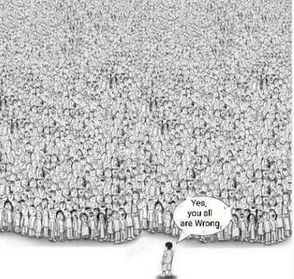

But I feel some people just can’t accept this. If you don’t like something, you must be *bad* at it, or impatient, or stupid, or you didn’t read the tutorials, or you mashed through the story. The reason you didn’t enjoy it is a *moral failing* on your part because *I* liked it and *I’m* a good person so anyone who thinks differently than me must be a *bad* person.
If this feels like a petty call-out of “gamer” culture, that’s because it is. Too often I’ve seen people disliking things be attacked for being bad, or salty, or unmanly because they can’t handle the “difficulty” of a game that can never just be criticized. I’m tired of this shit, I see it all the time, and it’s why I almost never talk to people about video games.
Because no one is ever allowed to just think something is good or bad, no one can accept that different people have different opinions. You must be too stupid to understand Pillars of Eternity, or too illiterate to appreciate Ace Attorney, or too impatient to enjoy Cult of the Lamb.
And yes this post is a subtweet, because when talking to a friend recently, I had exactly this kind of conversation. I didn’t like part of a game, and this was thrown back at me as a *moral failing* on my part. That because I didn’t play *the right way*, my complaints about not having fun were invalid, and were instead a reflection of my impatience and ignorance for not reading the correct menus or using the correct strategies.
And I hate that shit. Sometimes people just hate your favorite game, or favorite movie, or favorite book. And part of being an adult and not a child should be accepting these opinions, allowing people to complain if they want, and if you feel obligated to defend the honor of your favorite media, to at least couch your defense as how “you” feel, and how “you” played, rather that attacking the other person for their failure to enjoy it.
I just feel like too many people treat and attack on their preferred media as an attack on them. If you thought Ace Attorney was bad, I disagree. And it could be fore any reason, you can think that the murders are too contrived, or the world is unrealistic, you can think the characters like Mia and Pearls are creepy, or that Phoenix is an empty suit, you can think investigations are boring, and trials drone on and on, you can think it’s too simple or too convoluted or anything else. And I’d disagree, but I would hope I’d be willing to see that an attack on my favorite media is just you venting, and not an attack on me.
Nothing you say is an attack on me. “How was I supposed to know to press on that statement!” Fair criticism, I get people can get bored when most presses yield no new information. “I think Mia’s power is creepy,” is something I disagree with, but I can accept others think this way. “The murders are unrealistic and convoluted,” I like it because every case feels engaging and nothing is ever simple or straightforward, but you don’t have to like it yourself. Unless you go out of your way to say “only idiots/perverts/misanthropes enjoy this game,” I’m not going to hold your critiques against me.
So please give me the same treatment. If I dislike a game or movie or book, I’m not attacking you or the people who like it. I’m talking about my dislike because all people like talking about themselves. You just told me about your day, can’t I tell you about mine? So just let me say I don’t like it, say you liked it and that’s fine. But don’t attack me, because I’m not attacking you.
-
Stardew Valley: Story Spoilers
Last time I was writing about the gameplay of Stardew Valley. I consider it very much like a farming version of Factorio, but the gameplay isn’t the only thing that keeps me interested.
Stardew Valley is a very “cozy” game for lack of a better word. The art style is all cutesy, with animals making little hearts whenever you pet them. The characters are also written to be very sweet (or saccharine, depending on your taste). They each have their own life problems, but most of them will be unwaveringly kind and loyal if you give them even a modicum of respect. So most of your time will be spent walking through this colorful world with cute animals and plants, talking to people who will be your friends almost from the word go, and engaging in a story where you are single-handedly revitalizing a small town with your rustic farmstead.
So yeah, “cozy.”

Minor point, I also like some of the asymmetry in the spritework. Abigail here has her bow on the left side regardless of whether she’s facing towards or away from you. Might be a sprite error? But it feels intentional and cute. But for all the fact that I like the town, the world, and the story, I feel like the game routinely fails to stick the landing. The game is full of plot points and story elements that seem like they should be important and meaningful, but then don’t go anywhere and no one cares about them. Warning: total spoilers ahead.
The overarching story of Stardew Valley is about rebuilding the town’s community center with the help of some forest spirits named “Juminos.” The community center was once the heart of town life, but has become run down and disused ever since Jojo Mart (aka Evil Walmart) moved in next door. You’d think these stories might be connected: was the moral decay from going to Evil Walmart instead of a general store causing the townsfolk to lose their passion? Was the Evil Walmart the cause of the town’s becoming run down? Did the Evil Walmart’s strip mining operation cause the Juminos to appear and try to fight back?
No not really. The Evil Walmart is just there. The Juminos are just there. The strip mining blocks off the local mines for purely gameplay-based reasons (not overwelming the player in their first week). But none of these plot points have any relation to each other. Don’t expect any sort of final boss fight or plot twist, everyone’s too nice for that.
Before you can even talk to the Juminos, you have to find the magical wizard who teaches you their language. Wait, a magical wizard in this rural farming game, is he going to be a mentor figure? An Obi-Wan who teaches you the ways of inner strength? No he just lives there. Zoning guidelines meant he couldn’t build his magic tower inside city limits so he lives out in the forest, don’t question it.
And the town really is run-down, for example the bus driver is unemployed because her bus is broken. Did the Evil Walmart cause the town’s decay, and are they lobbying the state to prevent repair so they can swoop in and buy land on the cheap? No, things are run down so the Juminos can have stuff to fix for you. And when the state’s Governor comes to visit the town no one talks about the decay and everyone has a good time with him. Even though you can fix things, and people are grateful, it feels so disconnected from everything (and people aren’t all that broken up that the town is broken) that it’s hard to feel proud for what you’ve done.
And again, what about that strip mining operation? The mines you can visit are infested with evil monsters, but are closed off at game start because of a rockslide caused by the Evil Walmart. Did the Walmart cause the mine to become evil? Are the Juminos nice spirits to fight back against these evil spirits? Does the town mind that there’s killer monsters lurking just outside town? No, there’s an adventurer’s guild that takes care of them, no one minds.
And what about clearing the mine itself? You get a quest to reach the bottom of the mind and find what’s down there, do you find anything meaningful that might add to your understanding of the world? Maybe the secret of the Juminos power? Or evidence of the Evil Walmart’s misdeeds? No, you find a key that unlocks a new mine you can explore. This new one’s infinite, so you’ll never reach the end.
These may all sound like disjointed, meaningless complaints, but I truly feel like this game has a “journey/destination” problem. In the moment I love every minute of it, but completion just feels like checking off boxes, I never feel a sense of relief or amazement for what I’ve done, and the story is part of that.
I feel the game could be so much deeper and more meaningful if these stories were connected and expounded upon. The town is pretty run-down with some folks either unemployed or working bad jobs because of it. People should comment on this, and there should be a sense of elation from the townsfolk when you fix things. Instead they mostly just do and say what they always did, and at most they have a new daily schedule based on what got fixed.
I feel like the Evil Walmart and the Juminos should be connected in some way too. Either the Walmart caused the decay of the town or the Juminos are fighting back against the Walmart or something. But aside from a single cutscene in the beginning and one at the end, the Walmart doesn’t even figure into the story at all. It occupies a large chunk of the narrative’s setup, but with almost no intrigue or payoff.
And I feel like the Wizard and the haunted mine are too unusual to not get some story justification. You could have skipped the Wizard and just let the main character learn the Jumino’s language on their own. Of if you must have him, then give him a purpose, even just the visual gag of the local Wizard walking to town to buy groceries would be nice. But instead he spends all day in his tower not doing or saying anything of note. And the mine is just a monster dungeon that people comment on without thinking about the implication of holy shit, man-eating monsters are living not 5 minutes outside our town! Good thing the game doesn’t let them leave the mine!
During my first run of the game, I kept thinking that there would be some mystery, some deeper connection that I’d find as I played the game further. But no, the entire story is basically revealed to you within the first 10 minutes of gameplay, and there’s nothing to say or build upon after that.
So I said there’s spoiler in this post, but really the spoiler is that there are no spoilers. You can get the entire story by just playing for 2 hours before refunding it on steam. And that’s a shame.
-
Stardew Valley: Farming for Factorio players
I’ve recently been playing (or rather replaying) Stardew Valley. It’s a game about starting a farm in a rural community, and even though it seems like the furthest thing in the world from Factorio or Dyson Sphere Program, for me it scratches that same itch for “systems” based games that I’ve written about before.
The crux of Stardew Valley is that your avatar is working a menial job at “Jojo Mart” (think evil Walmart), until they’re sent a note by their grandfather inviting them to take over the farm at Stardew Valley. The farm itself is pretty run down, but the townsfolk are eager to teach the young newcomer about turning it into a profitable endeavor.
Jojo Mart is muscling into this town as well, competing with the town’s only General Store, but that’s mostly a background element. The real story progression comes when your character happens upon the “Juminos,” little forest spirits who inhabit the abandoned community center. They ask for gifts of “the forest’s bounty” and in exchange they’ll help the town and your farm however they can.
The gifts for the Juminos come from all the products you can farm in the game: seasonal veggies, animal products, fish of the sea. And they give you small rewards for completing a “bundle” of related gifts (like giving them all the Fall Veggies, or all the Summer Fish), and then a big reward when you complete all the “bundles” of a certain theme (like completing all the Veggies bundles, or all the Fish bundles). This system rewards you for learning how to run your farm well to produce all the needed items, and gives you both near and long-term goals to work towards.
Completing these goals also requires improving the farm by constructing barns, coops, and the like using stone/wood/etc. So you have to balance not only farming, but also gathering the materials and money necessary to make long-term investments.
It’s really fun, but also quite hectic. And I didn’t even mention that there’s a cave full of monsters you need to go into to mine stone, copper, and iron, plus every character in the game can be given gifts to become friends with them, and they’ll give you not only special bonuses but also cute cutscenes in return.
In Stardew Valley, a typical day for me starts the night before as I sit in my in-game room planning what I need to do next. I want to complete the “Animal Products” bundle for the Juminos, but that requires getting sheep (for their wool), which requires constructing a barn, which requires getting stone, which requires going to the mine. So I resolve to go to the mine tomorrow to get stone.
When I wake up though, I first have to water/harvest my crops and tend to my chickens, a somewhat tedious bit of micromanagement which becomes easier as you improve your farm. I try to do this as quickly as possible, but although my character wakes at 6am, it’s already 10am before I’ve finished this work. I harvested 8 pumpkins so I resolve to first buy 8 more packets of pumpkin seeds to plant in the furrows, no use leaving those empty when they could be growing things!

Stardew Valley doesn’t believe in crop rotation any more than Amy here While heading to the General Store I make sure to pick any flowers or wild produce on my way. These help my “foraging” skill and can sell for a pretty penny as well. I take note of the calendar outside the store and notice that it’s a character’s birthday, maybe they’ll like the flowers I picked? I find them in town and give them my gift because gifts give extra friendship points on a character’s birthday. Then I hustle back to the store to sell my pumpkins and buy more seeds.
It’s already afternoon by the time I’ve planted and watered the new seeds, and I’m finally ready to hike to the mines. I can only carry 24 items at a time, and since I want to bring back as much stuff as possible I put away everything in my inventory except a pickaxe and a sword (for protection).
Finally by 2pm I can start battling monsters and mining for stone, copper and iron. But I need to get back home by midnight if I want to have a good night’s sleep and have enough energy for the next day. Energy is an important resource in the game, and just about every action you take will cost some amount of it. So being mindful of the time, I leave the mine at 10pm with stone in tow.
I get back home around 11:30, put my well-gotten gains into storage bins and start planning my next day before bed. I finally have the stone I need for that barn (so I can get sheep, so I can get wool, so I can finish the Juminos bundle) but I still need wood, so tomorrow I’ll have to go into the woods and chop trees. Regardless, I’m that much closer to my in-game goals.
It should be easy to see that this kind of gameplay loop can be *really* addictive. At any one time there’s a dozen things you could be working on (getting resources, expanding your farm, buying and selling, socializing with characters) and a number of goals you’re working towards simultaneously. It can be somewhat hectic and stressful if you don’t know where to look for guidance, and unfortunately I think the online wiki is mandatory to have a good time, because there’s too much information that’s just kinda hidden away.
I only wish there were a better in-game way to find things out. I wish that if the Juminos asked you for a certain type of fish for example, they’d also tell you specifically when and under what conditions that fish can be caught. Because sometimes there’s a fish that can only be caught in Spring/Summer when it’s raining, but you spent your rainy days doing other things. Sure you might have fished really often, but if you weren’t fishing at the right time on the right days, you had no chance to catch this specific fish.
And once Fall rolls around and you finally look up how to catch the fish, you realize that you’ll have to play another half-year in-game before you can even get a chance to try.
I also wish that characters could tell you where other characters are. Sometimes you want to give someone a birthday present, or they send you a quest asking for some item. But I can’t memorize every townie’s schedule, so unless I want to waste a day running all over town (and the woods! lots of folks hang out in their!), I need to go to the wiki again. I think I should be able to ask their parent for some general information, “Oh, we told Sebastian he can’t smoke in the house so he goes to the lake instead.” Some general ideas about their schedule would be nice to have in-game.
Anyway that’s Stardew Valley. I actually have a LOT more to talk about it, maybe 2 or 3 more posts. But for now I’ll say: it’s probably in my top 10 games of all time, so if you were into Factorio or Dyson Sphere Program, give it a chance. I know building a community farm seems like the complete opposite of Factorio’s “coal mines and industry” vibe, but they really are quite similar in my opinion.
-
“I hate them, their antibodies are bull****”
I want to tell two stories today, they may mean nothing individually but I hope they’ll mean something together. Or they’ll mean nothing together, I don’t know. I’ve gotten really into personal fitness and am writing this in between sets of various exercises I can do in my own house.
The first story is from before the pandemic. I used to be a biochemist (still am, but I used to too). During that time I went to a lot of conferences and heard a lot of talks by the Latest and Greatest. One of the most fascinating talks was by a group out of Sweden who were preparing what they called a “cell atlas,” a complete map that could pinpoint the locations of every protein that would be in healthy human cells.
The science behind the cell atlas was pretty sweet. We know that the physical location of proteins in the body really matters, the proteins that transcribe DNA into RNA are only found in the nucleus because DNA itself is only found in the nucleus. Physical location is very important so that every protein in the body is doing only the job it’s assigned, and not either slacking off or accidentally doing something it isn’t supposed to. The first gives you a wasting disease and the latter may cause cancer.
So knowing the location of these proteins on a subcellular level is actually pretty important. But how can we even determine that? We can’t really zoom into a cells and walk around checking off proteins, can we?
The key was that this group was also really into making their own fluorescent antibodies. They could make antibodies for any human protein and then stick on a fluorescent tag that lights up under the right conditions. Then it was just a task of sticking the antibodies into cells and seeing which part lights up, that tells you where the protein is.
There was a bit more to it of course, I should do a post about how all this relates to Eve Online, but that was the gist of it: put antibodies in cells and see where the cell lights up. Use that to build an atlas of the subcellular locations of the human proteome.
It was some cool science and a nice talk. A few months later I was at another conference and the discussion came up of if conferences ever really have “good” talks or if scientists are incapable of anything above “serviceable.” I proffered the cell atlas talk as one I thought was actually “good,” it was good science explained well. The response I got from one professor stunned me: “oh I hate those people, their antibodies are bullshit.”
I don’t know how or why, but somehow this professor had decided that the in-house antibodies which underpinned the cell atlas project were all poorly made and inaccurate. That then undercut the validity of the entire project. I didn’t press further for this professor’s reasoning or evidence, I could tell he was a bit heated (and drunk) and left it at that. But while I never got any evidence against the cell atlas antibodies, I also never heard much in their favor. They seemed like a big project that just never got much recognition in the circles I ran in.
So was the cell atlas project a triumph of niche science, or a big scam? Well I don’t know, but it reminds me of another story.
As I said above, I’m much more into personal fitness these days. The Almighty Algorithm knows this, and so youtube serves me up a steady stream of fitness influencer content. I still stay away from anything that isn’t Mike Israetel or a few other “evidence based” youtubers, but even this small circle has served up its own helping of scientific slapfights.
In this case the slapfight is about “training to failure.” Most fitness influencers agree that you have to train hard if you want results. What exactly counts as “hard” though, that is where the controversy lies.
First of all, what is “training to failure?” Well unfortunately that too is controversial, because everyone has a different definition of what “failure” actually means. But generally, failure is when you are doing some exercise (a pushup, a pullup, a bench press) and you cannot complete the movement. Say you’ve done 5 pullups and you can’t do another, that’s “failure.”
Mike Israetel shows off example workouts of himself training hard, and he claims he’s training with “0 to 1 reps in reserve,” that’s a fancy way of saying he is training very near failure. If he does 5 pullups and claims he has 0 to 1 RIR (reps in reserve), then he is saying he could do AT MOST 1 more pullup, but he might actually fail if he even tried. He does this for almost every movement: bench presses, leg presses, squats, deadlifts, his claim of 0 to 1 RIR means he is doing the exercise until he can either no longer do it, or do it at most 1 more time before failure.
Failure itself is hard to measure, and sometimes you don’t know you’ll fail a move until you try. I once was doing pushups and just suddenly collapsed on my chest, not even knowing what happened. A quick assessment showed my shoulders gave out, and since pushups are supposed to be a chest exercise this implies I was doing them wrong, but that was a case where I clearly trained to failure since I tried to do the motion and failed.
But other fitness influencers have called Mike out on his 0 to 1 RIR claim, they think he isn’t training anywhere close to failure. The claims and counterclaims go back and forth, and unfortunately the namecalling does as well. I’ve kinda lost respect for the youtubers on all sides of this argument because of it.
But it gets back to the same point as the antibody story up above: a scientist is making a claim that they think is well-founded and backed by evidence, other scientists claim it’s all bullshit.
We think of science as very high minded and such, that science is conducted through solemn papers submitted to austere journals. I don’t think that’s ever been the case, science is conducted as much through catty bickering and backbiting as it is in the peer-reviewed literature. Scientists are still people, I’m sure a lot of us will be happy to take our cues from people we respect without spending the time to go diving into the literature. The literature is long and dense, and you may not even be the right kind of expert to evaluate it. So when someone you respect says a claim is bullshit, I’m sure a lot of people accept that and don’t pay the claim any additional mind.
So is the cell atlas actually good? Is Mike Israetel actually training to failure? I don’t know. I’m not the right kind of scientist to evaluate those claims. The catty backbiting has reduced my opinion of all the scientists involved in these controversies, although I understand that drunk scientists are only human and youtubers need to make a living through drama, so I try not to be too unkind to them.
Still, it’s a reminder that “the science” isn’t a thing that’s set in stone, and “scientists” are not all steely-eyed savants searching dispassionately for Truth. I don’t have any good recommendations from this unfortunately, the only thing I can think of is the bland “don’t believe scientists unquestioningly,” but that’s hardly novel. I guess just realize that scientists can disagree as childishly and churlishly as anyone else.
-
“I go with the athletes, not the science”
Sorry I haven’t written about finance in a while, I know science+finance (SciFi, if you will) was kinda my niche, but since I got serious about my fitness I’ve been recommended a lot of fitness content by the Almighty Algorithm, and it’s gotten me thinking.
Today’s topic requires just a tiny bit of background. As I wrote about, I’ve been following the advice of Dr Mike Israetel in part because he says all the right science-y shibboleths to make me believe he knows what he’s talking about. But I’ve also gotten recommended content from many other lifters who push back against some of his claims.
To an extent their pushbacks pass the smell test as well, they reference the same concepts that Dr Mike (and others) discuss, but they interpret those concepts differently. So the disagreement between Dr Mike’s “science-based” advice and other people’s advice seems to be a legitimate disagreement over the science, rather than a denial of science and the substitution of personal preference in its stead.
But other parts of this disagreement strike me as more… thoughtless. I watched a video critiquing some of the science-based conclusions, and it stated (paraphrased) “people say this move is terrible, but then you see world record power lifters doing it and you think hmmm, maybe it’s not so terrible after all.”
I think this appeal to authority has no place in a science-based discussion. Now yes, every scientific theory on exercise must be tested and proven *outside* the lab as well as in the lab. If a conclusion only works in a controlled lab environment then it isn’t necessarily best in the “real world.” But saying “well the best power lifters do this so the science must be wrong” is kind of absurd, because maybe they could be *better* if they actually listened to the science.
It reminds me of a story about Pliny the Elder. Pliny was a wealth Roman politician, whose wealth was derived mainly from vast agricultural estates. Not only that, he had extensive sources of the best knowledge available in the Roman world. So in his book Natural History, he draws upon his knowledge and experience to categorically state that *if you do not honor the gods, you will not be successful in agriculture*. And if you asked any of the Roman agriculturalists of his era, they’d probably give you the same answer.
Is the science on agriculture wrong? If all the best farmers honor the Gods, is that the only way to succeed?
No.
So if the best power lifters in the world are doing a certain move that science says is terrible, maybe the science is actually right and the power lifters are succeeding due to their own innate abilities combined with all their other training. I’d hazard a guess that a single move isn’t make or break to their training at all, and defending a move with this appeal to authority doesn’t really seem logical. It seems more like casting about for evidence to support an idea that you’d like to be true.
Science must be refuted with science. You have to be able to use real-world data and say “lab results say this move is bad but here’s all the evidence showing that people who eschew the move generally fail and people who use the move generally succeed.” You can’t point to a single piece of anecdote and say “well some people who use it succeed,” because then you’d be pointing to Pliny the Elder and saying “well I guess honoring the gods does improve your farm, because this guy was a really successful farmer and that’s what he did.”
Anyway, exercise science still seems to be in its infancy. I hope it gets more rigorous and comprehensive in the future, but it still seems to need some time before we can believe its claims as much as we can believe virology or chemistry.
-
Cope, or good sense?
As I wrote last time, I’ve been following Dr Mike Isratael’s youtube channel in my own quest to lose weight and (maybe) gain muscle. And as I said last time, Dr Mike says all the right words to make me think he knows what he’s talking about, but I’m afraid I only believe him because he knows the shibboleths, not because he’s actually right. What if he’s a charlatan like the rest, but his shibboleths are “basic biochemistry” instead of “pseudo-right wing culture,” and that’s why I believe him? What if what he’s saying isn’t correct, will I have the sense to know?
Well I’ve started… not disbelieving, but rather not following all the advice he gives. On the one hand, this could be proof that I’m a free-thinker, who takes all advice to heart and executes it not based on its source or shibboleths, but on its factual content. On the other hand, maybe that’s all cope and I’m not following it because I don’t want to.
The basic idea comes down to 1 thing: dieting. As I said, my primary goal is to lose weight, but I’m hitting the gym and I’d sure like to gain muscle on the way. Well Dr Mike has a video out about how that entire idea is a myth, and that the most productive way to do things is to eat a calorie surplus to gain weight (and go to the gym to make sure that’s muscle weight), while eating a calorie deficit in order to lose weight (and go to the gym to make sure that’s only fat weight). Trying to gain muscle on a calorie deficit, or lose fat on a surplus, is inefficient and possibly impossible.
Now Mike does caveat this with a few exceptions. If an exceptionally jacked individual was gravely injured and has lost muscle and gained fat while laid up in the hospital, then it’s much easier for them to gain back that fat and lose back that muscle once they get out of the hospital. It’s always easier to get *back* in shape than to get in shape *for the first time*.
Another caveat he talks about is “newbie gains,” where someone who is young and never went to the gym can start gaining muscle/losing fat together. But the caveat to the caveat is that this isn’t sustainable, eventually it will be one or the other.
So I’ve decided to believe that I’m in the “newbie gains” stage, the caveat to my own claim being that I did used to go to the gym a bit and I’m not actually that young. Regardless, I’m choosing to believe that Dr Mike is giving this advice to aspiring bodybuilders, people who are already fairly muscular and with a health amount of bodyfat, and therefore his advice doesn’t apply to me who is very unmuscular and with an unhealthy amount of bodyfat.
To reiterate, my goal is to lose weight and gain muscle. Dr Mike says that’s not usually possible and that I have to pick one and only one goal if I’m going to succeed, and I’ve decided to ignore that advice and believe that his advice is aimed at an audience that I’m not really a part of.
But maybe this is all wrong. Maybe for an obese person to become healthy, they need to lose a lot of weight, and during that time they simply won’t gain much of any muscle no matter how they try. And maybe that obese person is me.
If I were to take Dr Mike’s advice to heart, I would probably restructure my training with the understanding that I need to focus solely on the weight loss, probably by entering a more severe calorie deficit than I’m at now, in order to more quickly lose weight so I can then put on muscle. I’d probably spend a lot less time thinking about my gym technique and a lot more time working on my diet.
Am I ignoring Dr Mike’s advice because I’m a free-thinker making a rational conclusion about whether his advice is right for me? Or am I doing it because this is the first piece of advice I just don’t like?
I don’t know.
-
Subscribe
Subscribed
Already have a WordPress.com account? Log in now.
 Streams of Consciousness