-
Perception and Reality
Well it’s been one of the most tumultuous 3 and a half weeks in politics, ever since the June debate between Biden and Trump. Since that debate:
- The media perception of Biden has degraded from “frail but sharp old man” to “doesn’t always know what’s happening around him”
- The Democratic Party line has gone from “Biden is the nominee, we can’t change him or it will cause chaos” to “Harris is the nominee”
- Every Democrat in congress seemed to be calling for Biden to step down, and
- Biden has stepped down as candidate, endorsing Harris
Some Democrats have (as they have all year) said that this was nothing more than an overblown media circus, that would have never caught fire if the lyin’ press hadn’t been so desperate for clicks that they cooked up a scandal. There’s a strong current among the Stancilite wing of the party to claim that every voter is an automaton who believes nothing except what the media says. So if the media says Biden is old, that’s what they believe. But the media *should* have said Biden was sharp as a tack and steering the ship of state, because then everyone would have believed that.
The idea that “The Media” (capital T capital M) is always against the Democrats is part and parcel of liberal mythmaking. Nevermind that it’s also part and parcel of *conservative* mythmaking, I encountered this liberal mythmaking first-hand in the aftermath of the Howard Dean campaign.
The liberal myth goes something like this: Howard Dean was a threat to the Establishment with powerful grassroots organization and nationwide appeal. But one night when trying to give a triumphant yell, he instead gave a weird-sounding scream. The Media repeated the “Dean Scream” endlessly, making a mockery of him to the voters and torching his campaign. In his stead, the underwelming, flip-flopping John Kerry was sent to lose against George W Bush. If *only* we’d stuck with Dean!
The problem with the “Dean Scream” myth is that it reverses cause and effect: it says that The Media used the Dean Scream to discredit him in the eyes of the voters. Yet looking at the record, the Dean Scream happened as he was trying to gin up his supporters after a dismal showing in the Iowa caucus, in which he vastly underperformed expectations and got just 18% of the vote, less than half of front-runner John Kerry and a very distant third behind the ascendant John Edwards.
Taken in context, The Media didn’t discredit Dean, the voters had already turned their backs on him. Dean was supposed to be a front-runner going into the caucus but his very poor showing put paid to that idea hours before his historic scream.
Kerry and Edwards would go on to be presidential and vice presidential nominees for that year.
Yet the idea that the Media creates perception (and therefore reality) still has power among the twitterati. When Biden was dealing with the fallout of the debate, many liberal commentators tore into The Media, claiming that if anyone was suffering from dementia it was rambly, half-awake Donald Trump. And since Biden has now dropped out, liberal commentators are trying to will a “Trump has dementia” angle into existence.
This seems like an insane take to me because *we all saw the debate*. No matter how much Trump lied and deflected, he said real words and you could understand them, Biden sounded like he was barely awake! The line of the night was Trump’s terrifyingly accurate quip of “I don’t know what he just said, and I don’t think he does either.”
And we can all see that Trump has done rally after rally after rally while Biden really *hasn’t*, and team Biden did everything in their power to prevent even a single off-script moment from ever being seen. All the while reports are coming in from allies all across congress and *across the Atlantic* that Biden hasn’t been all there for a really long time, and is confusing people and places left and right.
Meanwhile the curious voter can tune into any one of the many rallies that Trump holds, or just watch Fox News and see a man doing twice as many rallies, interviews and the like than Biden. As well as doing infinitely many more unscipted spots since Biden didn’t seem to do any.
Saying Trump is too old will certainly resonate, half the country already thought he was while 80% of the country thought Biden was. But trying to tar Trump with the same brush Biden got will not work I think because the reality doesn’t look like what the Democrats want out of a narrative. Like the Dean Scream myth, Democrats have taken away the idea that The Media creates reality, and if they can just *will* a narrative into existence, they can say anything about their opponents that their opponents say about them. I don’t think that works any more than Republicans trying to call Democrats election deniers works, because people have eyes.
At the end of the day The Media can certainly amplify stories and let narratives run away with things, but the idea that they can create something out of nothing is a myth. And Democrats trying to say *the media needs to be saying this” ie “Trump has dementia, Trump can’t speak straight,” trying to demand The Media simply reverse the story and put all of Biden’s flaws on Trump, well that isn’t going to work. They’d do a lot better hammering on things which are real instead of trying to create something out of nothing.
That may have been part of the problem for Democrats these past 3 weeks. While they were doing damage control for Biden, the most common rejoinder I saw was “Trump is just as old and just as senile!” The first is false, but at least close to true, Trump is very old. The second is an outright lie, 50 million people saw the debate, and you can’t lie to their face like that.
If Democrats lose, I think The Debate will enter the hall of myths alongside the Dean Scream, as a moment when The Media sharpened their knives and took out the strongest Democratic candidate available because (laughably) they were in the tank for Republican. And I think myths like that will make the party far weaker than it would otherwise be.
-
Why is State Farm leaving California?
note: I had intended to publish this months ago. But I never finished it, and now I’m struggling to get a post out in time, so I’ve tried to make this one acceptable.
There was recently news that State Farm insurance is leaving California, and will no longer accept new customers. Perhaps they may even kick old customers off their plans and refuse to do any business in California at all. This caused a wave of reactions, from consternation that a company could be so mean to California, to demands that State Farm “reimburse” customers who have paid for years with no claims, to calls to nationalize the insurance companies because “clearly” they’re just stealing from the little guy.
All these reactions will be addressed in turn, but first, let’s talk about how insurance works. If you recall my post from way back about Ric Flair and his gym, insurance is just a way to reduce your downside risk in exchange for a small lose of your upside gain. You pay a little every month and in exchange if your house or business is destroyed, you get some money back.
What’s important is that insurance is structured like a bet: the insurance company is betting that nothing bad will happen to your property during the period of your insurance, if they win the bet they keep your money and you get nothing in return (except maybe peace of mind). While they only pay out if they lose the bet and your property *is* damaged. Because of this, many people see insurance as a scam. Why would I ever pay if I don’t expect my property to be damaged? Well you’re mitigating risk, maybe there’s only a 1% chance your home is destroyed, but that’s a 1% chance that you lose *everything* and are left utterly homeless unless you have insurance to cover the cost of rebuilding your home. Isn’t it worth it to pay a little to ensure you aren’t homeless from an act of God?
Now first, I want to quickly call out a very dumb line of reasoning I’ve seen floating around regarding insurance. I’m not quoting any one tweet or post, but synthesizing what I’ve seen in many places at many times:
Why isn’t there a refund check for insurance like taxes? I’ve paid so much without using the policy, and even if I make a claim, they find ways to avoid paying. Total scam!
This sentiment belies a complete failure to understand insurance on even the most *basic* level. To start with, if you want a refund because you’ve paid in without using the policy, should the insurance company be able to demand more money if you paid in and then *did* use the policy? Of course not, you’d call them insane and selfish. But realize that it’s the identical situation, in reverse.
An insurance policy is simple: you pay regularly and they pay if certain conditions are met. Of course “certain conditions” can be interpreted differently by different people. And insurance companies are profit-maximizing (like all companies) they’ll try to avoid paying when they can. But this is a necessary evil, better the company try to limit payouts than it go bankrupt overpaying it’s customers. Because then every *other* customer would suddenly lose their insurance.
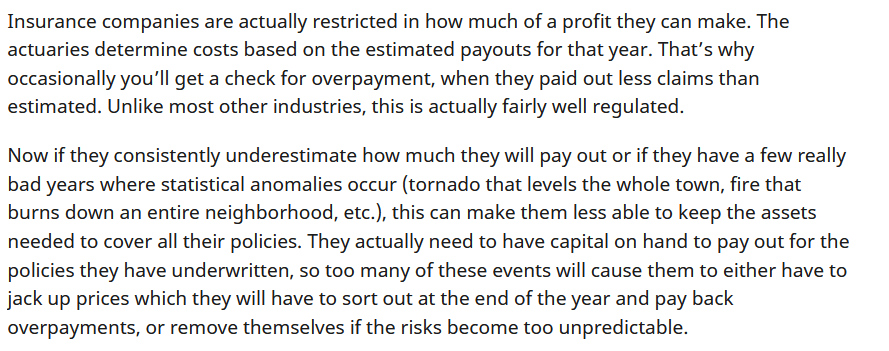
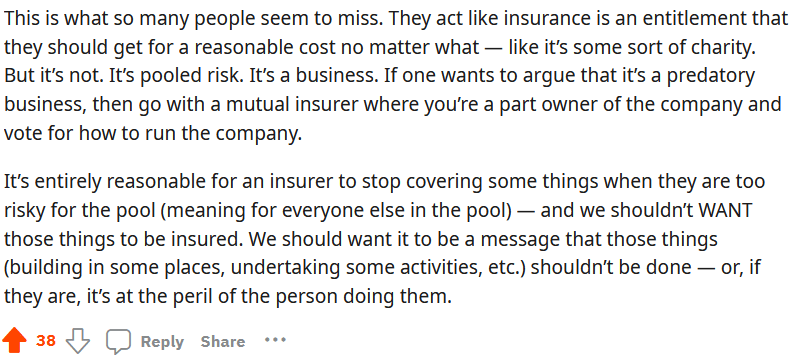
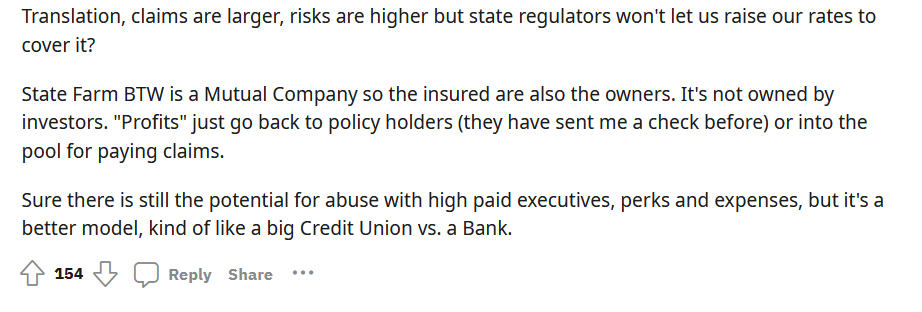
So finally, why is State Farm leaving California? Because they can’t make a profit. Most states regulate insurance incredibly heavily, to the extent that they put price caps on insurance premiums. That way the company cannot raise prices without the state’s say so. And if the state won’t let a company raise prices to cover rising costs (and costs ARE rising because of inflation and climate change), then the insurance company is not obligated to subsidize a state with coverage cheaper than costs.
As is so common, people blame the free market for a government-run system.
-
More about primes
Last time I blogged, we were dividing 1 by prime numbers using long division on a hand-written piece of paper. We saw that while 1/5 in base 10 is the simple, easy-to-remember 0.2, 1/5 in base 12 is 0.2497… with infinitely repeating digits. Why is that?
The answer I think has to do with prime factors. 10 has prime factors of 2 and 5, so in base 10 every prime number *except 2 and 5* will have infinitely repeating digits when you take its reciprocal (again, reciprocal just means “divide 1 by that number” ie the reciprocal of 5 is 1/5). When I used base 12, the reciprocal of the prime number 5 now had infinitely repeating digits, because 5 is *not* a prime factor of 12. The reciprocal of 2 in base 12 was still well-behaved, but that’s because 2 *is* a prime factor of 12.
I can generalize the above point as this: “the reciprocal of any prime number will have infinitely repeating digits, *unless* that number is a prime factor of the base you are using.”
So in base 10, the reciprocals of 2 and 5 do *not* infinitely repeat, while the reciprocal of any other prime does. In base 12, the reciprocals of 2 and *3* do not repeat, while the reciprocal of any other prime does. In base 210, the reciprocals of 2, 3, 5, and 7 do not repeat, and I can prove that because 2, 3, 5, and 7 are the prime factors of 210.
But that got me thinking, what about non-prime numbers? (For the record, mathematicians call non-primes “composite” numbers but there’s already enough jargon here so I’ll go with “non-primes”)
Do the reciprocals of non-primes repeat infinitely or do they not? Well a few examples show mixed results, 1/20 is 0.05, but 1/21 is 0.047619… with infinitely repeating 047619s. Then there are cases like 1/24, where the reciprocal starts with some non-repeating digits and then later digits repeat infinitely, 1/24 is 0.04166… with only the 6s repeating, not the 041.
It makes sense why these reciprocals all have a leading zero, when you do the long division you need to bring down more zeros before you get a number you can divide into. So the reciprocal of any number between 10 and 100 will have 1 leading zero, and between 100 and 1000 will have 2 leading zeros, etc.
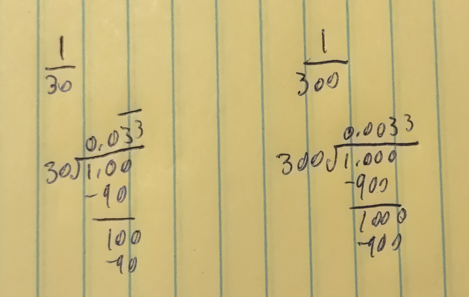
See above, the reciprocal of 30 and 300 is the same except for how many zeros you need in the front before you get to something you can divide into. (EDIT: just imaging I put the line over the 3s in 1/300, I just realized in editing that I forgot to do that, -2 points on the test for me).
But aside from leading zeros, why do some reciprocals have *only* infinitely repeating numbers and some have a set of numbers that repeat and a set of numbers that do not? I surmise again that it has to do with prime factors.
If *all* the prime factors of a non-prime number are *also* prime factors of the base you’re using (so in base 10, 2 and 5 are its factors), then the reciprocal of the non-prime number will be finite and well behaved like 1/20. On the other hand, if *all* the prime factors of a non-prime are not shared with the base (such as 21), then the reciprocal will only have repeating digits (baring leading zeros if the number is bigger than 10, 100, 1000 etc). Finally, the prime factors of a non-prime are mixed between those shared with the base and those not shared, then the reciprocal will have a bit at the beginning that does *not* repeat and will then go into repeating digits.
This should all hold true in other bases as well. In base 28, the reciprocal of 25 should be infinitely repeating (since they share no prime factors) while the reciprocal of 224 should be some non-repeating number (as 28 and 224 have the exact same prime factors, 2 and 7). I won’t show you the calculations as they’re quite messy but I think 1/224 in base 28 is 0.035 (I don’t dare do the reciprocal of 25, I’m sure to mess it up).
I’m sure mathematicians have known all this for year, but I enjoyed finding it out myself, and just wanted to share.
-
What’s so special about prime numbers?
If you’ve ever watched Numberphile, you’ve probably heard a *lot* about prime numbers. In school prime numbers are mostly just curiosities. They’re numbers that can only be (cleanly) divided by 1 and themselves, so you hate getting them in a fraction. But the further you go in higher math, the more prime numbers seem to show up *everywhere* even in places you wouldn’t expect them.
My new favorite Numberphile video is on the reciprocals of prime numbers. A “reciprocal” of a number is just 1 divided by that number. So the reciprocal of “10” is “1/10” or in decimal form 0.1 . The video shows off the work of a 19th century mathematician named William Shanks who exhaustively catalogued the reciprocals of primes.
Because you see, prime numbers are special this way. Prime numbers don’t make “clean” reciprocals like 1/10 . The reciprocal of a prime tends to be made up of infinitely repeating digits instead. 1/7 is equal to 0.142857142857142857142857142857142857142857142857142857 with the “142857” part repeating infinitely. In math class we represented this with a line over the repeating digits. But I’m having trouble getting wordpress to properly display bars over numbers, so I’ll use “…” to represent repeating digits instead. So 1/7 would be 0.142857… in my decimal notation.
Now back to primes. What Shanks did was he took the reciprocal of larger and larger prime numbers and counted how many digits it took before the the numbers start repeating. So 1/7 repeats after 6 digits while 1/11 repeats after just 2 digits (0.09…). Shanks catalogued these repeating digits all the way up to prime numbers in the 80,000 range, whose reciprocals don’t start repeating until 60,000 digits or more.
The video is well worth a watch, and it’s fascinating to wonder if there’s any pattern to the data. But what struck me was a question from the host Brady near the beginning of the video: “do the reciprocals of all primes repeat?” The mathematician Matt Parker answered “yes” and continued the math lecture, but this got me thinking.
As soon as I told this question to a friend, they immediately said what many of you are probably thinking: “what about 1/5?” 5 is a prime number itself, but 1/5 is a nice, clean, non-repeating number of 0.2 . 2 is also a prime number and makes a clear 0.5 with its reciprocal. Maybe Matt Parker just wasn’t so attentive when he answered “yes” but it seems that not all reciprocals of primes repeat.
But then why are 2 and 5 so special? Why, out of every single prime number, are they the only ones with non-repeating reciprocals? Again I think everyone knows the answer: it has to do with Base 10, but I wanted to study this phenomenon a bit more so I did some math myself.
First, a quick note: we say our counting system is “base 10” because when writing a large number, each position in the number corresponds to units of 10 raised to some power. You may remember from school writing a number like 435 and being taught that is has “4 hundreds,” “3 tens,” and “5 ones.” AKA 435 is (4*100) + (3*10) + (5*1). It’s important that all the positions in a base 10 counting system correspond to 10x for some value X. The hundreds place represents 102, the tens place represents 101, and the ones place represents 100.
Now what about a base 12 counting system instead? What does the number 435 mean in base 12? Just like before, each position corresponds to some power of 12. So 122 is 144, meaning that 4 is in the “144s” place. The 3 is in the “12s” place and the 5 is still in the “1s” place because 120 and 100 both equal 1. So a 435 in base 12 is equal to (4*144) + (3*12) + (5*1), which would be 617 in base 10.
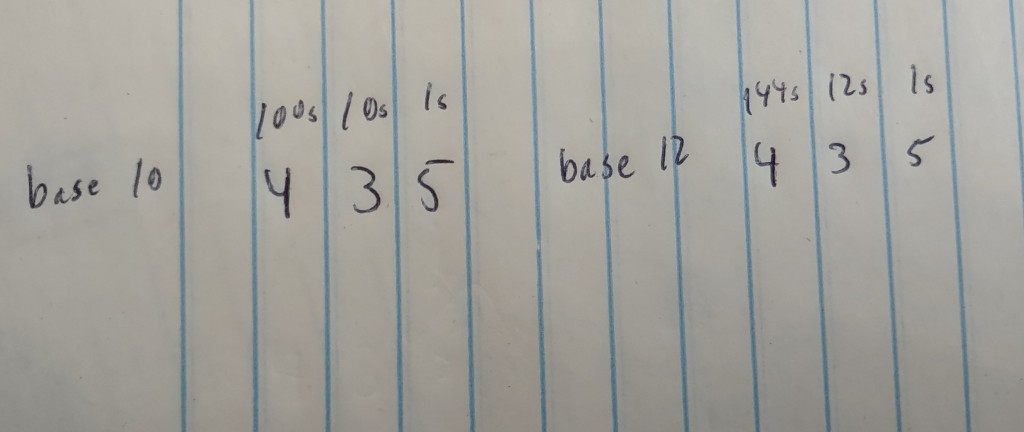
Now my question: do the reciprocals of primes still repeat the same way in a base 12 counting system as they do in base 10? We already know that 2 and 5 are special primes in base 10, their reciprocals don’t repeat. How about in base 12?
Well the reciprocal of 2 still works, it’s just equal to 0.6 instead of 0.5. But the reciprocal of 5 suddenly becomes madness
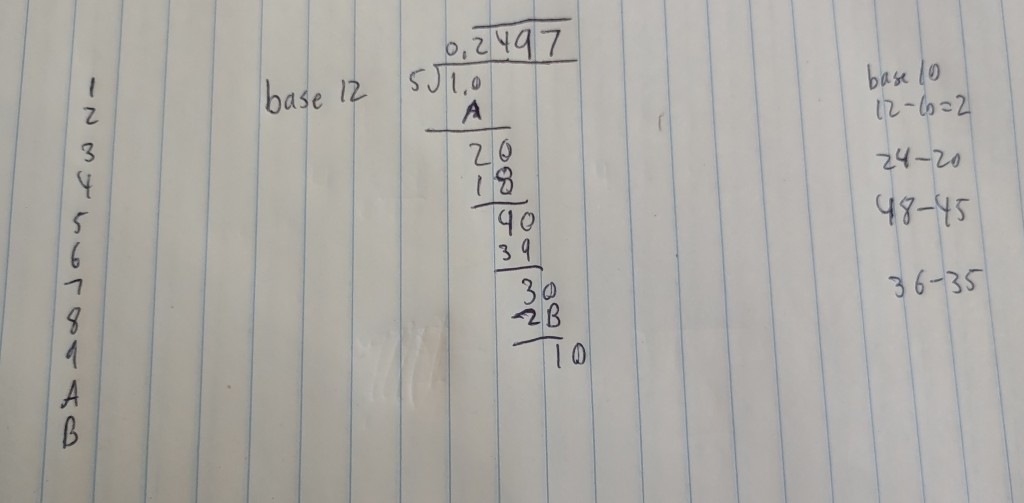
Here I did the long division for 1/5 in base 12. To keep myself on track I wrote a base-10 version of the subtractions I was doing at each step of the long division. And I don’t know how real mathematicians do it, but since I don’t have a number to represent “10” and “11” as single digits, I used “A” and “B”.
As you can see, *now* this prime’s reciprocal *does* repeat, even though it didn’t in base 10!
I think the mathematician was getting at something deeper when he said all reciprocals of primes repeat, but I’ll have to save it for another post as I had wanted to publish this one on Sunday and I’m already 3 days late.
-
The point of government isn’t just to spend money
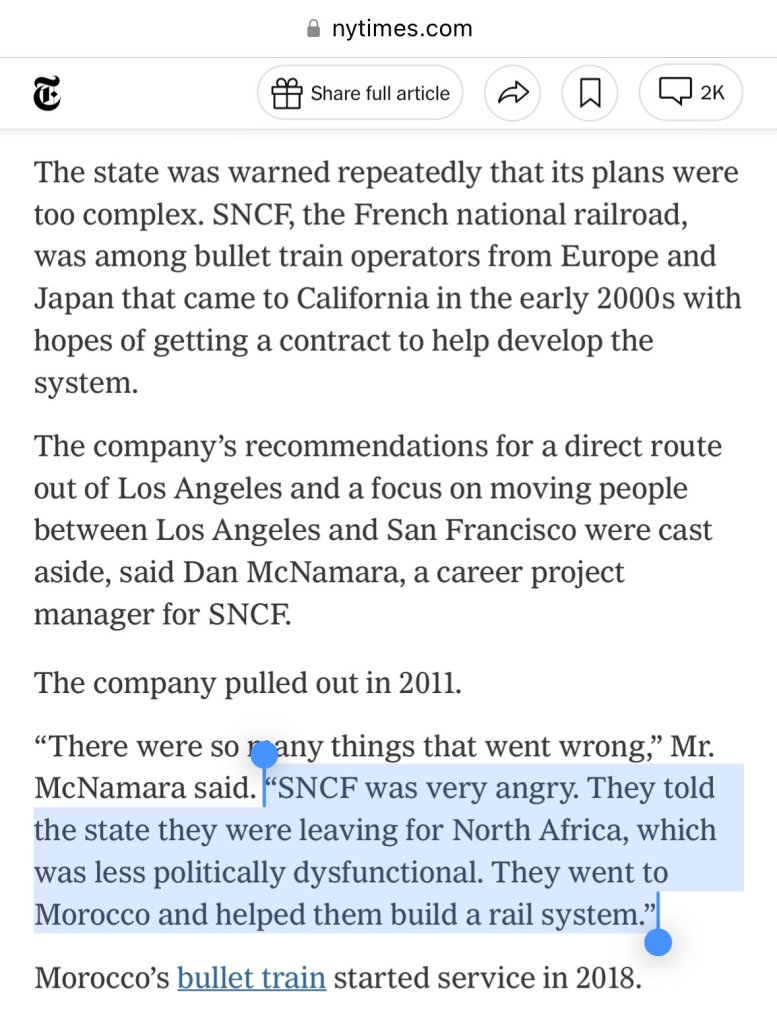
It’s election season, so I’m being inundated with election spam on every social media and traditional media I use. I know election posts probably aren’t people’s favorites, but this is the streams of my consciousness and I just wanted to vent.
To start with, some of the twitterati are pulling an absolute masterclass in doublethink. Centrists in the commentariat have been crowing for the last 4 years about how Biden has pumped more oil than any president in history. They’ve been dunking on Republicans about how despite Trump and the GOP’s rhetoric, Biden is more carbon friendly than Trump was.
Now, every words of this is true. I pointed out years ago how despite a small pandemic dip oil production has steadily increased during both Biden and Trump’s presidencies. Biden has inherited a fracking boom, and has not done anything to clamp down on it, so record-setting oil production is to be expected.
But the same commentariat that will crow about Biden’s oil boom will screech in anger and confusion when climate groups like the Sunrise Movement announce they won’t support Biden’s re-election. How can they do that? How can they refuse to support the president who has pumped more oil than any other in history? Gee, maybe because Democrats have said that Climate Change is an existential threat for years, and these folks actually believe it? Seems pretty obvious to me why the Sunrise Movement and other climate groups wouldn’t be happy with Biden’s energy policy.
As a defense, the commetariat likes to point to Biden’s massive spending bills. Billions and billions of dollars are being pumped into the green energy sector, and Democrat columnists are producting hockey-stick graphs comparing Biden’s green spending to previous presidents as proof of his climate success.
The problem with this is that the point of the government isn’t just to spend money. The point of the government is to get results. How much has that billions of dollars actually achieved?
For example, we all know that switching to electric cars is hard when there’s so few charging stations. Biden’s climate bills were supposed to build charging stations across the country to combat this. How many charging stations have Biden’s Billions actually created? As of May this year, just 8. But don’t worry, that number is growing! In March it was just 7! With a rough estimate of 1 charging station every 2 months, can anyone say these billions (trillions!) of dollars are being well spent?
This is exactly the kind of thing that If We Can Put a Man on the Moon… discussed. Politicians are incentivized to declare victory immediately for their re-election campaign. This leads to them touting metrics like “amount of money spent” instead of something actually useful like “miles of track laid” or “amount of actual EV infrastructure.” And since “money spent” is the only metric politicians are focusing on, that money gets spent extremely badly.
Years later, when the money is all spent and the infrastructure is still crumbling, a new campaign will of course arise, saying we now need to spend even *more* money to fix this thing that should have been fixed with the first tranche.
Let me be clear: I believe that climate change is a problem we need to address. But I do not think government spending is the best way to address that. In the last year, Tesla has built around 40 times more EV charging stations than Biden’s infrastructure bill, and they didn’t use taxpayer money to do it.
So why does it *have* to be government spending? I think it’s honestly because a lot of politicians don’t believe that companies can ever accomplish things. When you spend your entire life in government, every problem looks like a taxpayer-funded nail.
The government *can* solve these problems, but it doesn’t need to spend billions to do so. You really want to improve charging infrastructure? Tax gasoline. Tax oil. Tax every step of the refinement process. You will see how quickly consumers shift to electric cars, and how quickly companies spring up to service those electric cars. Hell, a network of gas stations already exists all across the country. If gas was taxed and consumers switched to electric cars, those stations would quickly be forced to switch from offering gas to offering fast electric charging.
You may say that a gas tax would hurt American consumers, but it would hurt them no more than the spending-fueled inflation that America has right now.
Here’s the funniest thing: politicians have adopted the language of the market and claimed that government spending is an investment. We are investing in green energy. But investment expects a return, and if the return on billions of dollars investment is 8 or so EV stations, that isn’t an investment, it’s a ripoff.
Biden chose to keep oil cheap and burn money on 8 EV charging stations. Is it any wonder climate activists don’t appreciate him? When success if measured in dollars spent, then failure is assured.
-
Gene drives and gingivitis bacteria

One piece of sci-fi technology that doesn’t get much talk these days is gene drives. When I was an up and coming biology student, these were the subject of every seminar, the case study of every class, and they were going to eliminate malaria worldwide.
Now though, you hardly hear a peep about them. And I don’t think, like some of my peers, that this is because anti-technology forces have cowed scientists and policy-makers into silence. I don’t see any evidence that gene drives are quietly succeeding in every test, or that they are being held back by Greenpeace or other anti-GMO groups.
I just think gene drives haven’t lived up to the hype.
Let me step back a bit: what *is* a gene drive? A gene drive is a way to manipulate the genes of an entire species. If you modify the genes of a single organism, when it reproduces only at most 50% of its progeny will have whatever modification you give it. Unless your modification confers a lot of evolutionary fitness to the organism, there is no way to make every one of the organism’s descendants have your modification.
But a gene drive can do just that. In fact, a gene drive can confer an evolutionary disadvantage to an organism, and you can still guarantee all of the organism’s decedents will have that gene. The biggest use-case for gene drives is mosquitoes. You can give mosquitoes a gene that prevents them from sucking human blood, but since this confers an evolutionary disadvantage, your gene won’t last many generations before evolution weeds it out.
But if you put your gene in a gene drive, you can in theory release a population of mosquitoes carrying this gene and ensure all of their decedents have the gene and thus won’t attack humans. In a few generations, a significant fraction of all mosquitoes will have this gene, thus preventing mosquito bites as well as a whole host of diseases mosquitoes bring.
Now this is a lot of genetic “playing God,” and I’m sure Greenpeace isn’t happy about it. But environmentalist backlash has never managed to stamp out 100% of genetic technology. CRISPR therapies and organisms are on the rise, GMO crops are still planted worldwide, environmentalists may hold back progress but they cannot stop it.
But talk about gene drives *has* slowed considerably and I think it’s because they just don’t work as advertised.
See, to be effective a gene drive requires an evolutionary contradiction: it must reduce an organism fitness but still be passed on to the progeny. Mosquitoes don’t just bite humans for fun, we are some of the most common large mammals in the world, and our blood is rich in nutrients. For mosquitoes, biting us is a necessity for life. So if you create a gene drive that knocks out this necessity, you are making the mosquitoes who carry your gene drive less evolutionarily fit.
And gene drives are not perfect. The gene they carry can mutate, and even if redundancy is built in, that only means more mutations will be necessary to overcome the gene drive. You can make it more and more improbable that mutations will occur, but you cannot prevent them forever. So when you introduce a gene drive, hoping that all the progeny will carry this gene that prevents mosquitoes biting humans, eventually one lucky mosquito will be born that is resistant to the gene drive’s effects. It will have an evolutionary advantage because it *will* bite humans, and so like antibiotic resistant bacteria, it will grow and multiply as the mosquitoes who still carry the gene drive are outcompeted and die off.
Antibiotics did not rid the world of bacteria, and gene drives cannot rid the world of mosquitoes. Evolution is not so easily overcome.
I tell this story in part to tell you another story. Social media was abuzz recently thanks to a guerilla marketing campaign for a bacteria that is supposed to cure tooth decay. The science can be read about here, but I was first alerted to this campaign by stories of an influencer who would supposedly receive the bacteria herself and then pledged to pass it on to others by kissing them. Bacteria can indeed be passed by kissing, by the way.
But like gene drives, this bacteria doesn’t seem to be workable in the context of evolution. Tooth decay happens because certain bacteria colonize our mouth and produce acidic byproducts which break down our enamel. Like mosquitoes, they do not do this just for fun. The bacteria do this because it is the most efficient way to get rid of their waste.
The genetically modified bacteria was supposed to not produce any acidic byproducts, and so if you colonized someone’s mouth with this good bacteria instead of the bad bacteria, their enamel would never be broken down by the acid. But this good bacteria cannot just live in harmony and contentment, life is a war for resources and this good bacteria will be fighting with one hand tied behind its back.
Any time you come into contact with the bad bacteria, it will likely outcompete the good bacteria because it’s more efficient to just dispose of your waste haphazardly than it is to wrap it in a nice, non-acidic bundle first. Very quickly the good bacteria will die off and once again be replaced by bad bacteria.
So I’m quite certain this little marketing campaign will quietly die once its shown the bacteria doesn’t really do anything. And since I’ve read that there aren’t even any peer reviewed studies backing up this work, I’m even more certain of its swift demise.
Biology has brought us wonders, and we have indeed removed certain disease scourges from our world. Smallpox, rinderpest, and hopefully polio very soon, it is possible to remove pests from our world. But it takes a lot more work than simply releasing some mosquitoes or kissing someone with the right bacteria. And that’s because evolution is working against you every step of the way.
-
New job, new regrets
I’m starting a new job soon. As a scientist, I feel like you go into every job hoping you’ll accomplish something. Not just keep the lights on or stay out of trouble, but to actually create or discover something that’s never been seen before.
I had a lot of hopes when I joined my current job, and few to any of them have panned out. Maybe I was unrealistic or overoptimistic, or just plain unlucky and I shouldn’t feel bad, but I do feel bad and wish I could have done more.
As I go into my final days in this office, at this job, I look at all the data I have and the people I’m training to replace me, and I feel like maybe with a little bit more time, I could accomplish what I’d planned. I could create something publishable and really add to the field. But then after a few days of that feeling, I’ll run into a new unsolvable problem and be right back where I started, feeling certain that I’ll never accomplish what I wanted at this job.
I don’t know, I don’t want to get into too many specifics because the technical details would bore my readers, but the hopes I had when entering this job didn’t match the regrets I have leaving it. I wish I could have done more, but I don’t know how. And I’m worried that the work I *did* do will be forgotten and ignored by my coworkers who are still there, since I never got my work into a publishable state.
If I were in it for the money, I wouldn’t be in science. I just wish I could get the discoveries that I *am* in it for.
-
China is getting the trade war it deserves
And the US is getting the inflation it clearly wants.
Contrary to the title, this post will only be about America, because I don’t have any real insight into the CCP that hasn’t been covered elsewhere. But I read this article running cover for Biden’s disastrous policy of protectionism, and wanted to post my thoughts.
The central premise of the article is that cutting off trade with China is good because they’re a fascist and expansionist foreign adversary. Now, that’s also a great reason to cut off trade with Saudi Arabia, but America’s trade policy isn’t actually about foreign policy, as you’ll soon find out.
Even more importantly, tariffs don’t hurt the country you’re tariffing, or at least they hurt them *less* than they hurt your *own country*. Even Biden knows that, just ask the Biden of 2019
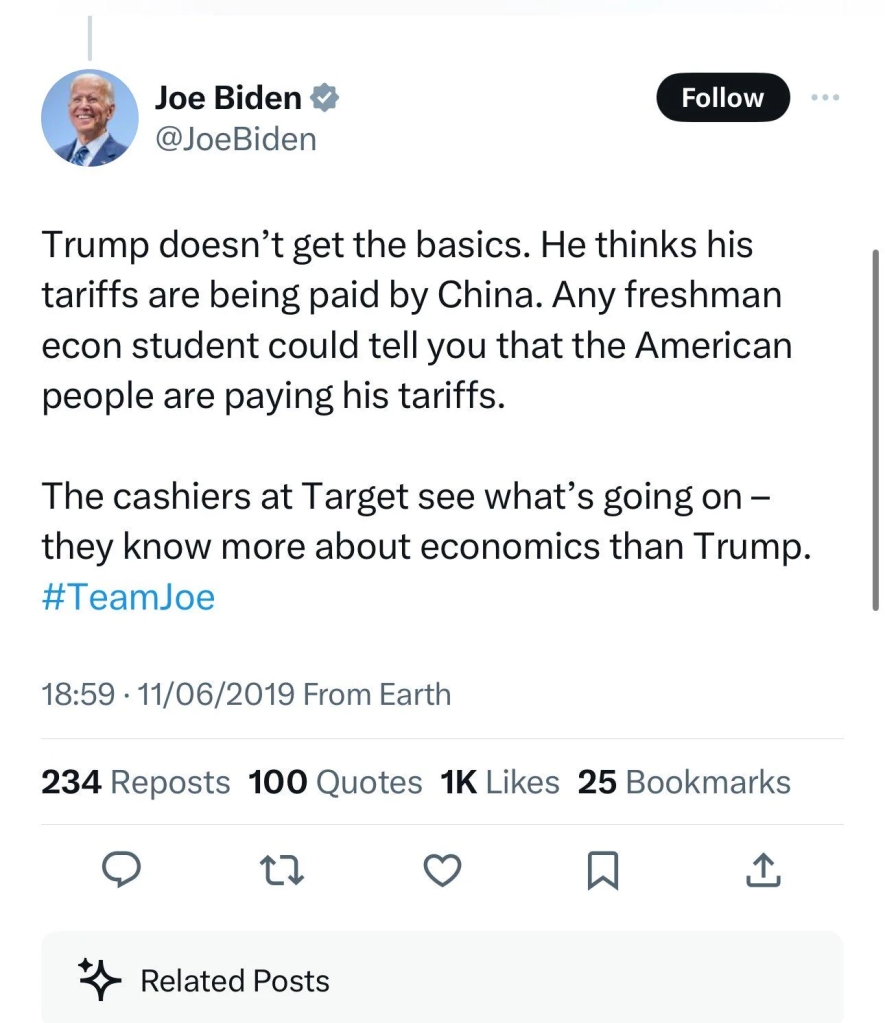
Tariffs are a great way to push up your own country’s inflation by taxing supply without reducing demand. Furthermore, even if you don’t buy Chinese products you will be paying for this inflation because of substitution effects: someone who is no longer able to buy a Chinese EV may instead purchase an American car, increasing demand for American cars and therefore driving up their price.
There’s two great ways to understand how terrible tariffs are. First, think of the oil shock in the 1970s: middle east nations cut off America’s access to oil and gas from their countries, causing spiraling prices and runaway inflation. By blocking America’s access to energy, they were able to put an economic squeeze that defined the decade.
China is being tariffed on solar power, wind power, and green industries of all kinds, and China makes up more of our imports than the middle east ever did. Spiraling prices are yet again on the menu.
Furthermore, think of Britain’s strategy against Germany during both World Wars. Britain used its powerful navy to prevent Germany from importing goods. This caused shortages and spiraling inflation, leading to riots that overthrew the government in the First World War and overwhelming shortages during the Second.
Tariffs are a way for us to do to ourselves what our enemies would do to us in war: restrict the import of needed goods.
Finally, consider Biden’s empty words about the “existential threat” posed by Climate Change. If Climate Change is dire, then why is Biden raising tariffs on solar power, wind power, and EVs, rather than Chinese oil and Chinese airplanes? Biden is essentially setting up an “anti-carbon tax,” in which polluting industries are exempt from a tax being paid by green industries.
The truth is that none of this is about national security, anymore than the Japan Scare of the 1980s was about national security. Just look at how Japan’s peaceful economic expansion was seen back then:
“The Danger from Japan.” Mr. White warned that the Japanese were seeking to create another “East Asia Co‐prosperity Sphere”-this time by their “martial” trade policies, and that they would do well to “remember the course that ran from Pearl Harbor to the deck of the USS Missouri in Tokyo Bay.
Biden is a 1980s style politician, with the (failed) economic outlook of that time. When he sees foreigners being successful it makes him scared, so he raises tariffs to “protect” American industries. But far from protecting industries, tariffs only harm them.
Industries rely on consumers to sustain them, but tariffs are a tax on consumers, sucking up consumer surplus and leaving less money for consumers to spend on domestic industries. Politicians think that domestic industries can magically appear to replace all the foreign ones, but simply put: no man is an island and nor is any country. Autarky is the failed economic policy of fascism, not an economic model for democracies.
Just look at a country like Brazil. Heavy tariffs were supposed to promote domestic industries and help consumers. Instead, consumers pay exorbitant prices for things like video games, while Brazil’s gaming industry remains anemic relative to the nation’s size and wealth. Brazilian cars, Brazilian microchips, and Brazilian steel are not the envy of the world.
And it isn’t because Brazilians are bad at industry, its because their government is doing everything it can to stop them. The high tariffs on everything from steel to cars to microchips are supposed to spur domestic industry, but who’s going to open up a factory when you have to pay those high tariffs just to import the machines and inputs needed to make your products?
Biden is a protectionist because he’s a protectionist. Not because China or Canada are scary or because he needs to fight climate change. But to be fair, Trump is just as protectionist as Biden if not more-so. It’s clear that the current crop of American politicians supports higher inflation and poorer consumers. And that bodes ill if you want to see America succeed and its enemies fail.
-
More excuses
I’ve got a lot more posts I want to make. I have a half-written post about why insurance companies are leaving California. I have ideas about whether the Federal Reserve should target 2% or 3% as the inflation rate. And I even have more thoughts about Dominions 6, which I’m sure everyone is excited to read. But I haven’t been writing.
I don’t know why, but I often have trouble in the springtime. For whatever reason, my mood often becomes languid, I no longer want to work on things, and I start avoiding social contact even when it makes me happier to socialize. I sometimes sit for hours just watching videos or reading on my phone when I should be working or would rather be socializing, because I’m scared of facing the real world.
I don’t know why I do this, and I’m trying to stop. I’ve done more work to make concrete plans on what I need to get done at work so that I can actually get to doing it instead of avoiding it. And I’ve tried to push myself to actually call or text people when I want to make plans with them, rather than avoiding that because I feel bad that I haven’t spoken to them in a while.
That in and of itself is a difficult hole to dig out of. I feel depressed, so I don’t talk to my friends. Then when I want to talk to them, I feel bad that I haven’t talked to them in a while, so I avoid doing so out of embarrassment. I need to stop doing that, because it doesn’t get me anywhere.
I don’t know, this post is rambly. But this is the streams of my consciousness. I hope I can get those other posts about finance and video games written. And I hope the summer brings me more peace of mind than what I’ve had so far this year.
-
Chickenhawks

Jingoism is a hell of a drug.
20 years ago during the end of Bush’s presidency, military intervention was anathema to most of the Democratic party. New interventions were treated with suspicion, and getting out of current wars was seen as paramount.
5 years ago, during Trump’s presidency, military intervention was again evil and bad. Trump’s assassination of an Iranian general was yet another reckless decision that would lead us to world war for little to no gain.
Yet today, the Democratic party is again making common cause with many of the foreign policy “hawks” that drove support for the wars in Iraq and Afghanistan. And somehow no one sees what’s wrong with this.
In 2023, the Houthis in Yemen began attacking ships transiting through the Red Sea on their way to the Suez Canal. The Red Sea and Suez Canal bring an enormous volume of trade to Europe, Africa and Asian. Shutting off this passage means ships have to take the long way around Africa, which greatly raises prices and increases shortages.
Then in January of 2024, Biden put the Houthis back on the Global Terrorism list (he’d removed them from the list as one of his first acts as president), and announced the USA would begin bombing Yemen to stop the Houthi attacks.
Social media lit up with stupid talking points about America’s military might, and how “the Houthis are going to learn why America doesn’t have free healthcare.” Social media is overwhelmingly populated by the young and left-leaning, so seeing the same demographic group that protested the Iraq War now beating their chests over a bombing campaign was jarring to say the least.
And what happened? After months of bombing, the Houthis are still attacking ships. Shipping companies are still avoiding the Red Sea. Transit through the Suez is still down and prices due to circumnavigating Africa are still up.
And America still doesn’t have free healthcare.
The bombing campaign has clearly failed at its goal of ensuring safe traffic through the Red Sea. So much so that Biden has now offered a ceasefire where he will again remove the Houthis from the global terror list if they will stop attacking ships. America’s military might could not silence the enemy guns or enforce America’s will, and so we are once again forced to negotiate with terrorists.
To be fair to Biden, this may be the right move. He openly stated that he was only placing them on the global terrorism list because of their attacks against ships, removing them from that list if they stop attacking ships is only natural. It is a low-cost concession to the Houthis, as removing them from the list makes it easier for them to access international markets, but doesn’t do much to harm America directly.
But it’s still obvious that this was a failed bombing campaign, and it raises the question of if we’re negotiating with terrorists now, why didn’t we *start* with negotiations *before* bombing them? The bombing does not seem to have done anything to reduce the frequency or intensity of Houthi attacks, if anything it has only given the Houthis greater credibility in Yemen as it has galvanized the populace to “rally ’round the flag.”
Hawks will complain that I’m being unfair: the bombing campaign was *not* a failure, America just wasn’t even trying to win. And it’s true, America has the capacity to conduct Dresden-level bomb campaigns and Desert Storm level ground campaigns nearly at-will. Neither of those happened, so America clearly wasn’t using its full might.
But was there any political will for carpet bombing or a ground invasion? Absolutely not, a tepid bombing campaign was all that would have been acceptable in an election year. And so if you take America as both a military and political entity, then yes this bombing campaign was about all America was capable of.
But none of the chickenhawks who beat their chest in January will ever admit that the campaign was a failure, ever admit that we are negotiating with terrorists, ever admit that there were other options or other solutions. Thousands of politicians and military aficionados went to their graves believing that the War in Vietnam could have, should have been won, and if we’d just stayed in a little longer (or nuked Hanoi), we could have won it. I have no doubt this campaign (much much smaller as it is) will also be remembered thus by many.
But the fact is that there are not always military solutions. It’s a classic slogan to say that “we don’t negotiate with terrorist,” but it’s just not true, we negotiate with terrorists all the time.

An FBI negotiator brings a suitcase full of cash to a terrorist who has hijacked a plane. There are times when terrorists have leverage over you, and the problem with leverage is that it exists whether you want it to or not. Whether that leverage is hostages, military might, or geographic position, you can’t just wish it away and pretend it doesn’t exist. Nations also have constraints: budgetary, political, logistic, which can constrain their military response significantly.
So while it’s true that in an open field with no holding back the American military would destroy the Houthi military without a single casualty, that’s not the war that Biden fought. Trying to remove terrorists from their own country that supports them without a ground invasion or naval blockade will always be a challenge. And if a nation is politically, economically, or logistically incapable of doing that, then they need to look hard at what they are *actually trying to accomplish*.
I have seen precious few cases in my adult life of military intervention leading to a lasting improvement in the situation. The best example would be the bombing campaign in Yugoslavia from nearly 3 decades ago. The second best example would be the few years of near-normality that the American military gave to Afghanistan, prior to the Taliban returning.
But one success and one partial success is a terrible track record for the number of military campaigns we’ve been engaged in. And it seems the Houthi campaign will be yet another mark in the failure column, as it has done nothing to eliminate Red Sea attacks which will almost certainly be ended only by negotiations if they are even ended at all.
So the next time social media lights up with chest-thumping about how American military might should be directed at a problem, think for more than a few seconds about whether a military solution is even possible.
-
Subscribe
Subscribed
Already have a WordPress.com account? Log in now.
 Streams of Consciousness