Why didn’t Europe run out of jet fuel this summer?

In the spring of 2026, the Iran War started. This immediately shut down the Strait of Hormuz and led to a critical shortage of oil in the world markets.

But crude oil itself isn’t really important to any of our lives, we don’t use it in our cars, planes, or plastics. It’s the refined oil products that really affect us. And this came to a head immediately in Europe.

Europe imports most of its oil from the middle east, and much of that oil is refined into jet fuel for aviation. With the Strait shut down and no more oil coming to Europe, it seemed obvious that a jet fuel crisis was about to ruin the continent’s summer plans.

This isn’t idle chit chat either, social media was ablaze with rumors, warnings and panics about a jet fuel crisis that would shut down Europe’s airports. Dire predictions were made that most of the major European powers would be completely out of jet fuel by now, unless the Iran war ended *immediately* back in the Spring.

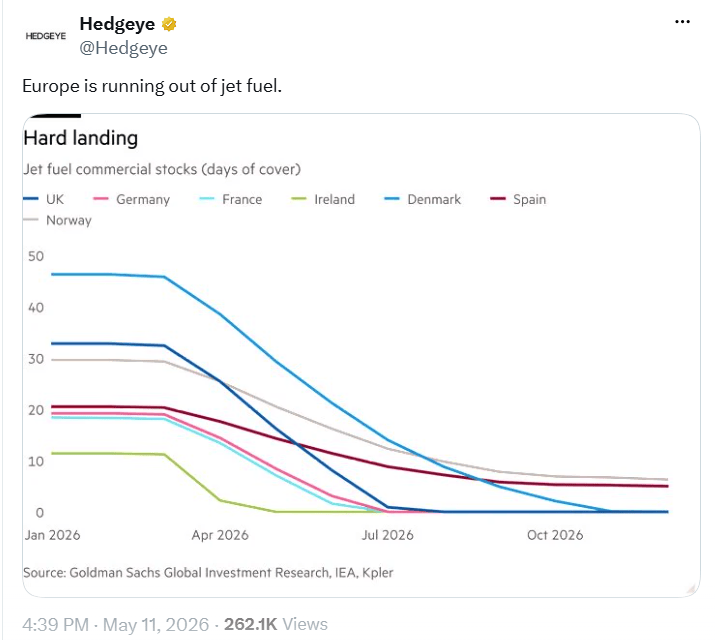
But the Iran War didn’t end. But also, Europe didn’t run out of jet fuel. Planes continue to fly Europe’s skies with the same regularity as they did in 2025. Why did yet *another* dire prediction of imminent fossil fuel doom not come true? In general it’s because those loudest about fossil fuels and economics know the least about them.

First of all, Europe’s jet fuel crisis was a highly localized event. Oil had trouble leaving the Gulf nations due to the war in Hormuz, and much of this oil was destined for Europe. But the rest of the world kept ticking, kept producing and refining oil, and kept making jet fuel. The global price of oil and oil products rose moderately as supply was constricted, but it’s important to remember that most goods are elastic. As the price rose, many people chose not to use oil and switched to other forms of power, like coal plants starting back up in China and Southeast Asia.

And likewise, jet fuel doesn’t have to be made in European refineries from Persian Gulf oil. America is a net oil exporter and a refinery powerhouse. Millions of barrels of oil and oil products were exported from America to Europe as European prices rose in conjunction with the shortage.

So a jet fuel shortage doesn’t at all mean grounded planes, it just meant that Europe had to import fuel instead of making it themselves. But some online argued that imported fuel could never make up the shortfall, as tankers are too slow and supply chains too rigid to allow this fact rerouting of jet fuel. They were wrong about that, but also tankers alone are not needed.

When a plane normally flies a route, it likes to take only as much oil as it needs to get to where it is going (plus some extra in case of an emergency). So if a plane is flying New York → Paris → Berlin, it will take only the oil it needs to get from New York to Paris, then top off in Paris so it has enough to get to Berlin. This way they don’t carry extra fuel, which means extra weight, which means less fuel efficient travel.

But what if jet fuel in Paris is very expensive, as was the case during the jet fuel shortage? Then the airline will decide instead to fill the tanks *completely* in New York, that way they’ll have enough to get to Paris and Berlin without having to fill up in Europe. The added cost of less fuel efficiency is overcome by the added benefit of buying jet fuel for cheaper. This is also a direct and immediate way to “import jet fuel” to Europe, just have planes that fly America to Europe routes top off before they leave America.

And importantly, all these things happened without the hand of the government. The EU did not have to send a missive telling airlines to top off their tanks in America, the airlines did it anyway by following the logic of supply and demand. As prices rose in Europe, they sought cheaper jet fuel in America. That’s how a modern economy works, nothing is stagnant, there’s always market participants trying to mitigate the effects of a supply shock as doing so gives them an edge over their competitors.

The final element of this tale is the most controversial: more oil got pumped than expected.

First, closing off the straight of Hormuz didn’t completely cut off oil from the Persian Gulf. Oil has been rerouted overland, and convoys have continued to pass through the straight. Some won’t like to hear it, but there’s a reason oil isn’t $200 a barrel as many twitterati predicted. There’s a lot more oil getting out than Iran would like you to believe.

Secondly, a shortage of oil has caused other oil producers to ratchet up their production. Again, many twitterati believe the oil industry is nothing but mustache twirling ne’er-do-wells. They believe that the oil companies either can’t pump more oil (because there physically isn’t enough) or won’t pump more (as they love high prices). No one is willing to admit that high prices spur more supply, as greedy companies try to produce more and more oil to take advantage of those prices.

In particular, America and Argentina have had a new oil boom in response to the war in Iran. Both nations use a lot of fracking, which has a much quicker lead time than traditional oil plays, and can be scaled up and down rapidly in response to market forces. America and Argentine won’t replace the Persian Gulf completely any time soon, but a lot more oil has been produced in response to the global oil shortage than the simplistic models assumed. The shortage was thus never as severe as people made it out to be.

Commentators online need to think more in terms of second and third order effects. Cutting off oil from Hormuz doesn’t happen in a static world, you can’t just subtract that oil from the global total and assume the price per barrel will hit $200. Oil companies pumped more oil in response. Gulf nations rerouted their supplies in response. Airline companies retooled their purchasing in response. And Europe never ran out of jet fuel.

Chickenhawks

Jingoism is a hell of a drug.

20 years ago during the end of Bush’s presidency, military intervention was anathema to most of the Democratic party. New interventions were treated with suspicion, and getting out of current wars was seen as paramount.

5 years ago, during Trump’s presidency, military intervention was again evil and bad. Trump’s assassination of an Iranian general was yet another reckless decision that would lead us to world war for little to no gain.

Yet today, the Democratic party is again making common cause with many of the foreign policy “hawks” that drove support for the wars in Iraq and Afghanistan. And somehow no one sees what’s wrong with this.

In 2023, the Houthis in Yemen began attacking ships transiting through the Red Sea on their way to the Suez Canal. The Red Sea and Suez Canal bring an enormous volume of trade to Europe, Africa and Asian. Shutting off this passage means ships have to take the long way around Africa, which greatly raises prices and increases shortages.

Then in January of 2024, Biden put the Houthis back on the Global Terrorism list (he’d removed them from the list as one of his first acts as president), and announced the USA would begin bombing Yemen to stop the Houthi attacks.

Social media lit up with stupid talking points about America’s military might, and how “the Houthis are going to learn why America doesn’t have free healthcare.” Social media is overwhelmingly populated by the young and left-leaning, so seeing the same demographic group that protested the Iraq War now beating their chests over a bombing campaign was jarring to say the least.

And what happened? After months of bombing, the Houthis are still attacking ships. Shipping companies are still avoiding the Red Sea. Transit through the Suez is still down and prices due to circumnavigating Africa are still up.

And America still doesn’t have free healthcare.

The bombing campaign has clearly failed at its goal of ensuring safe traffic through the Red Sea. So much so that Biden has now offered a ceasefire where he will again remove the Houthis from the global terror list if they will stop attacking ships. America’s military might could not silence the enemy guns or enforce America’s will, and so we are once again forced to negotiate with terrorists.

To be fair to Biden, this may be the right move. He openly stated that he was only placing them on the global terrorism list because of their attacks against ships, removing them from that list if they stop attacking ships is only natural. It is a low-cost concession to the Houthis, as removing them from the list makes it easier for them to access international markets, but doesn’t do much to harm America directly.

But it’s still obvious that this was a failed bombing campaign, and it raises the question of if we’re negotiating with terrorists now, why didn’t we *start* with negotiations *before* bombing them? The bombing does not seem to have done anything to reduce the frequency or intensity of Houthi attacks, if anything it has only given the Houthis greater credibility in Yemen as it has galvanized the populace to “rally ’round the flag.”

Hawks will complain that I’m being unfair: the bombing campaign was *not* a failure, America just wasn’t even trying to win. And it’s true, America has the capacity to conduct Dresden-level bomb campaigns and Desert Storm level ground campaigns nearly at-will. Neither of those happened, so America clearly wasn’t using its full might.

But was there any political will for carpet bombing or a ground invasion? Absolutely not, a tepid bombing campaign was all that would have been acceptable in an election year. And so if you take America as both a military and political entity, then yes this bombing campaign was about all America was capable of.

But none of the chickenhawks who beat their chest in January will ever admit that the campaign was a failure, ever admit that we are negotiating with terrorists, ever admit that there were other options or other solutions. Thousands of politicians and military aficionados went to their graves believing that the War in Vietnam could have, should have been won, and if we’d just stayed in a little longer (or nuked Hanoi), we could have won it. I have no doubt this campaign (much much smaller as it is) will also be remembered thus by many.

But the fact is that there are not always military solutions. It’s a classic slogan to say that “we don’t negotiate with terrorist,” but it’s just not true, we negotiate with terrorists all the time.

An FBI negotiator brings a suitcase full of cash to a terrorist who has hijacked a plane.

There are times when terrorists have leverage over you, and the problem with leverage is that it exists whether you want it to or not. Whether that leverage is hostages, military might, or geographic position, you can’t just wish it away and pretend it doesn’t exist. Nations also have constraints: budgetary, political, logistic, which can constrain their military response significantly.

So while it’s true that in an open field with no holding back the American military would destroy the Houthi military without a single casualty, that’s not the war that Biden fought. Trying to remove terrorists from their own country that supports them without a ground invasion or naval blockade will always be a challenge. And if a nation is politically, economically, or logistically incapable of doing that, then they need to look hard at what they are *actually trying to accomplish*.

I have seen precious few cases in my adult life of military intervention leading to a lasting improvement in the situation. The best example would be the bombing campaign in Yugoslavia from nearly 3 decades ago. The second best example would be the few years of near-normality that the American military gave to Afghanistan, prior to the Taliban returning.

But one success and one partial success is a terrible track record for the number of military campaigns we’ve been engaged in. And it seems the Houthi campaign will be yet another mark in the failure column, as it has done nothing to eliminate Red Sea attacks which will almost certainly be ended only by negotiations if they are even ended at all.

So the next time social media lights up with chest-thumping about how American military might should be directed at a problem, think for more than a few seconds about whether a military solution is even possible.