In the spring of 2026, the Iran War started. This immediately shut down the Strait of Hormuz and led to a critical shortage of oil in the world markets.
But crude oil itself isn’t really important to any of our lives, we don’t use it in our cars, planes, or plastics. It’s the refined oil products that really affect us. And this came to a head immediately in Europe.
Europe imports most of its oil from the middle east, and much of that oil is refined into jet fuel for aviation. With the Strait shut down and no more oil coming to Europe, it seemed obvious that a jet fuel crisis was about to ruin the continent’s summer plans.
This isn’t idle chit chat either, social media was ablaze with rumors, warnings and panics about a jet fuel crisis that would shut down Europe’s airports. Dire predictions were made that most of the major European powers would be completely out of jet fuel by now, unless the Iran war ended *immediately* back in the Spring.

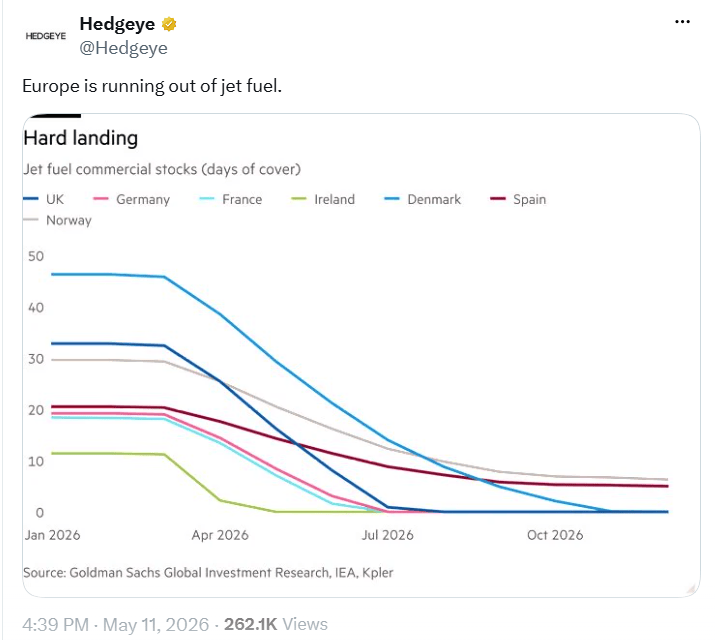
But the Iran War didn’t end. But also, Europe didn’t run out of jet fuel. Planes continue to fly Europe’s skies with the same regularity as they did in 2025. Why did yet *another* dire prediction of imminent fossil fuel doom not come true? In general it’s because those loudest about fossil fuels and economics know the least about them.
First of all, Europe’s jet fuel crisis was a highly localized event. Oil had trouble leaving the Gulf nations due to the war in Hormuz, and much of this oil was destined for Europe. But the rest of the world kept ticking, kept producing and refining oil, and kept making jet fuel. The global price of oil and oil products rose moderately as supply was constricted, but it’s important to remember that most goods are elastic. As the price rose, many people chose not to use oil and switched to other forms of power, like coal plants starting back up in China and Southeast Asia.
And likewise, jet fuel doesn’t have to be made in European refineries from Persian Gulf oil. America is a net oil exporter and a refinery powerhouse. Millions of barrels of oil and oil products were exported from America to Europe as European prices rose in conjunction with the shortage.
So a jet fuel shortage doesn’t at all mean grounded planes, it just meant that Europe had to import fuel instead of making it themselves. But some online argued that imported fuel could never make up the shortfall, as tankers are too slow and supply chains too rigid to allow this fact rerouting of jet fuel. They were wrong about that, but also tankers alone are not needed.
When a plane normally flies a route, it likes to take only as much oil as it needs to get to where it is going (plus some extra in case of an emergency). So if a plane is flying New York → Paris → Berlin, it will take only the oil it needs to get from New York to Paris, then top off in Paris so it has enough to get to Berlin. This way they don’t carry extra fuel, which means extra weight, which means less fuel efficient travel.
But what if jet fuel in Paris is very expensive, as was the case during the jet fuel shortage? Then the airline will decide instead to fill the tanks *completely* in New York, that way they’ll have enough to get to Paris and Berlin without having to fill up in Europe. The added cost of less fuel efficiency is overcome by the added benefit of buying jet fuel for cheaper. This is also a direct and immediate way to “import jet fuel” to Europe, just have planes that fly America to Europe routes top off before they leave America.
And importantly, all these things happened without the hand of the government. The EU did not have to send a missive telling airlines to top off their tanks in America, the airlines did it anyway by following the logic of supply and demand. As prices rose in Europe, they sought cheaper jet fuel in America. That’s how a modern economy works, nothing is stagnant, there’s always market participants trying to mitigate the effects of a supply shock as doing so gives them an edge over their competitors.
The final element of this tale is the most controversial: more oil got pumped than expected.
First, closing off the straight of Hormuz didn’t completely cut off oil from the Persian Gulf. Oil has been rerouted overland, and convoys have continued to pass through the straight. Some won’t like to hear it, but there’s a reason oil isn’t $200 a barrel as many twitterati predicted. There’s a lot more oil getting out than Iran would like you to believe.
Secondly, a shortage of oil has caused other oil producers to ratchet up their production. Again, many twitterati believe the oil industry is nothing but mustache twirling ne’er-do-wells. They believe that the oil companies either can’t pump more oil (because there physically isn’t enough) or won’t pump more (as they love high prices). No one is willing to admit that high prices spur more supply, as greedy companies try to produce more and more oil to take advantage of those prices.
In particular, America and Argentina have had a new oil boom in response to the war in Iran. Both nations use a lot of fracking, which has a much quicker lead time than traditional oil plays, and can be scaled up and down rapidly in response to market forces. America and Argentine won’t replace the Persian Gulf completely any time soon, but a lot more oil has been produced in response to the global oil shortage than the simplistic models assumed. The shortage was thus never as severe as people made it out to be.
Commentators online need to think more in terms of second and third order effects. Cutting off oil from Hormuz doesn’t happen in a static world, you can’t just subtract that oil from the global total and assume the price per barrel will hit $200. Oil companies pumped more oil in response. Gulf nations rerouted their supplies in response. Airline companies retooled their purchasing in response. And Europe never ran out of jet fuel.

