-
Everyone’s a reactionary in their own backyard
I’ve blogged before about Ezra Klein’s abundance agenda. To recap: Ezra Klein asks the following questions:
- Why are so many people moving out of blue states and into red states?
- Why do red states grow faster than blue states?
- Why do blue states have so many problems with homelessness?
- Why can’t blue states build train lines and green infrastructure on time and on budget?
Klein concludes that liberals being maligned as “bad on the economy,” is not entirely unfair, and that Blue State policies have in many cases reduced growth and made people’s lives materially worse off. A fixation on bureaucracy is a hamstring to business. For liberals to win, Ezra wants them to not just be “not as bad” as conservatives, but he wants them to embrace a pro-growth mindset and pro-growth policies. These policies would deliver more energy, more housing, and more jobs without ever-increasing government expenditures.
I feel I can conclusively say that Klein has lost the argument, at least in online left-leaning circles. Instead, Bernie Sanders and the anti-growth crowd are winning people over to the idea that we need to *further* restrict businesses, further increase government bureaucracy, and thereby further reduce growth.
Bernie doesn’t want to fix electricity prices by improving generation and transmission like Klein does, he wants a moratorium on building datacenters.
Bernie doesn’t want to fix housing by allowing private companies to build more of it like Klein does, he wants to prevent companies from buying houses.
Bernie doesn’t want to grow the economic pie like Klein does, he wants to shrink and reslice it.
But Bernie wouldn’t have a microphone if people weren’t willing to listen to him, and in online left-leaning circles, Bernie is listened to, not Klein.
I think it’s because fundementally, people are reactionary in their own backyards. It’s all well and good to say we should encourage economic growth. But new businesses compete with old residents for land, water, and electricity. And so old residents complain that new businesses push up prices, and demand that new businesses be stopped completely. This pattern is universal and as old as civilization itself. But the modern American left is now overwhelmingly urban, and urban areas are where new businesses want to build, so the American left is now overwhelmingly anti-business.
I just want to rattle off a few arguments I’ve seen online about building, why these arguments don’t hold water, and why I think Klein will not manage to bring his Abundance Agenda into prominence.
Bernie has recently called for a moratorium on new datacenters, to protect consumers from increased electricity prices. I’ve seen a lot of the online left that considers itself “pro-growth” defend this, on the principle that:
- “Data centers produce economic growth, but not for the people who pay the higher electricity prices.”
Because data centers are “different,” it’s Good to ban new ones, it’s not anti-growth at all it’s just anti-“bad”-growth. To which I’d say:
- “________ produce economic growth, but not for the people who pay the higher electricity prices.”
Insert factories, electric trains, mass transit, a new University campus, or literally *anything else* and this argument is the same. This isn’t an argument against data centers, it’s an argument against any economic growth whatsoever. When things change there will always be winners and losers. When economies grow, some individuals don’t get the full benefit of that growth. But the idea of the Abundance Agenda was that the losers need to suck it up for the greater good, the price of your house isn’t worth blocking new housing and increasing the homeless rate of the wider city.
When it’s “other people” blocking housing and causing problems, it’s easy to demonize them and say they’re small-minded, wrong-headed, etc. But suddenly when it’s your back yard, and its your electricity bill, then the same people who demonized NIMBYs become NIMBYs themselves.
Of course it’s different, because THOSE OTHER people didn’t have reasonable concerns, they were motivated solely by greed and stupidity. WE however are smart and reasonable, all our concerns are well-thought out. This is how everyone thinks, but a lot of online liberal spaces are incredibly insular, and so don’t realize that their “reasonable” complaints are nothing new, but are just part and parcel of the NIMBY handbook going back decades.
If you say that new homes aren’t needed, and developers are just greedy, then there’s a reasonable amount of the online left who will dogpile you for your stupidity. New homes ARE needed, homelessness proves that there aren’t enough homes for everyone. Building new homes reduces home prices and increasing housing.
But if you say data centers aren’t needed, suddenly you’re on the 60 side of a 60/40 issue. A minority of the online left has no issue with data centers. But there are enough anti-AI people, anti-Silicon Valley people, anti-everyone rich (which therefor means anti-AI because rich people own and are the face of AI companies), and just plain closeted NIMBYs that being against new data centers is a “reasonable” belief in these spaces, where being against new housing wouldn’t be.
A few years ago, Silicon Valley and techies in general were seen as a staunch bastion of liberalism, proof that LIBERALS were actually the economically smart ones and not conservatives. A single election was all it took to change that, with a few techies siding with Trump, and with others not being sufficiently *anti*-Trump, the Tech sector has lost its shine and is now placed by many liberals in the same bin as the steel sector, the automotive sector, or even the oil and gas sector. These are just “bad people” who make money by making the world worse. So if they want AI, some people will reflexively oppose them, and supporting AI comes at a social cost in these spaces, even if you strenuously state how much you oppose the techies and the wider Silicon Valley elite.
With this shift, Silicon Valley can now be railed against in liberal spaces in just the same way as Ford or US Steel. These idiots want to build a new thing? It won’t bring any real jobs, it will dirty up our town, it will raise our prices, and they’re just making money by being evil anyway.
So blocking any new silicon valley thing becomes a socially defensible position, where 4 years ago it wasn’t. This is how coalition politics shake out on a local scale, people don’t weigh up the real-world costs and benefits of a position, they weigh up the *social costs* and the *social benefits* of a position. Supporting AI carries a social cost, opposing it carries a social benefit. That decides how the coalition reacts to AI much more strongly that the real-world economics of the situation.
Because simply put, a data center moratorium is a dumb as a factory moratorium. I, personally, won’t be enriched by a new factory being built. And most modern factories are so automated that they provide vanishingly few direct jobs, they aren’t the assembly lines with workmen that people think about, they’re honestly about as automated as a data center these days.
But my area will benefit from the increased investment, prices will go down as supply of goods increases, and I think other people should be allowed to make money by investing just as I’d like to be allowed to make money by investing myself. I wouldn’t want my dream restaurant to be blocked by NIMBYs who don’t want me bringing traffic to their part of town, so I don’t think it’s right to block other people’s economic activities even though a new data center will bring more electricity demand to me.
Some try to argue that data centers don’t produce anything real, that all AI is a bubble. That still isn’t a reason to block data centers. YOU DO NOT KNOW how the AI race will shake out, nobody does. The point of capitalism is that everyone makes their bets, and we find out later who won. If you want to bet against AI, short NVIDIA, or short Microsoft, Google, and Meta. You can bet against them and make money if you’re right, but you don’t know you’re right, and if the AI boosters are right and you block them from building datacenters, you’re impoverishing us all just like when you block housing, or a new factory, or a new University campus. You’re reducing economic growth because you think you know better but won’t put your money where your mouth is by shorting the stock, instead taking the easy way of blocking the business.
But this has been a rambly post about my opinions. The point is that these are the arguments I’ve seen all over left-leaning online spaces. The arguments are overwhelmingly anti-capitalist, anti-business, and anti-growth. Any sector that is not seen as explicitly left-leaning becomes a socially acceptable target for attack and NIMBY policies. This is antithetical to Klein’s abundance agenda. This is why I thought his agenda would not win in the left-of-center mind space, and I’m even more confident of that prediction now.
Coalitions aren’t build by reasoned argument, they are build by the social costs and benefits of holding a specific position. Techies have been etched with the scarlet letter (T for Trump, natch), and so opposing anything and everything they do has a social cost in left-of-center spaces, regardless of the reasoned arguments that growth is good for the people’s prosperity. Basically all businesses are etched with the scarlet C for conservative, and so opposing business is generally in vogue as well. Klein’s agenda relies on allowing businesses to get their way, to improve all our lives by letting business do business. That isn’t going to fly in the modern left, and I doubt Klein can change it.
-
Revealed Preference, Revealed Belief
Revealed preference is a very important economic concept because quite simply: talk is cheap. You cannot poll people on what they economically most want, because humans are want to lie about ourselves so that we appear more noble, more virtuous, and so on. You cannot poll people, instead you have to look at what people *do*.
To explain revealed preference in simple terms: actions speak louder than words. People like to claim that they eat healthily, that they care about what they’re putting into their bodies. But many of those very same people fill their shopping cart with junk food at the expense of all else. So while they claim to eat healthily, they are revealed to eat junk food. Their revealed preference is that they prefer the taste of junk food over the benefits of healthy food, but you wouldn’t know it by talking to them.
At a societal level, revealed preference also shows up whenever popular causes force people to put their money where their mouth is. Reducing plastic waste polls really well, and large segments of society claim that they would happily pay more for a biodegradable option rather than pay less for a plastic option. But the data from supermarkets doesn’t bear this out, with nearly all consumers continuing to prefer a cheaper plastic option when available compared to a more expensive biodegradable option.
So when economists try to understand what drives people’s economic activity, whether it’s what they buy, where they work, or how they commute, one cannot rely on what people *say* they do, you must instead find out what they *actually* do. Because the gap between words and actions is massive and we all want to appear more noble than we truly are.
With revealed preference comes the tantalizing, but tricky prospect of studying *revealed belief*. Revealed *preference* is just showing what *actions* people take that are contrary to their statements. But revealed *belief* would be about showing *the reasoning behind those actions*.
To give an example, lets dissect the junk food vs healthy food choice. You might find people who adamantly claim that they eat healthy food *not just* for their health. They may claim that healthy food tastes better, is more convenient, and is even cheaper than junk food. But if that same person is revealed to mostly eat junk food, we can surmise that their stated beliefs about healthy food vs junk food (that it tastes better, is more convenient, and even cheaper) are also wrong.
Such a person who claims to eat healthy food but only eats junk food clearly has significant cognitive dissonance, or is just *lying* in order to seem healthier. It isn’t just that their actions belie their beliefs, rather their *revealed beliefs* are contradictory to their *stated beliefs*. They probably don’t actually believe healthy food is tastier and cheaper, they just say that to try to further the lie that they eat only healthy food. Their real belief is that junk food is tastier and cheaper, that’s why they buy it and eat it.
This *revealed beliefs* thing is tricky though because there could be several confounding factors. Say someone *only states* that they believe healthy food is tastier than junk food. If they are then revealed later to be buying junk food, is it because they actually don’t think healthy food is tastier? Or is it because the cheapness of junk food and the expensiveness of healthy food outweighs taste considerations? There can always be some other reason that people take their actions, outside of their stated reasons.
But with recent events, I do think I’ve seen a mass example of revealed beliefs. And it’s with tariffs.
When Trump was coming on the scene, first in 2016 and again in 2024, economists and political commentators from both sides of the Atlantic argued passionately against his tariffs on every conceivable level. Trump’s tariffs weren’t just a good idea taken too far, rather *any tariffs at all* would harm consumers and depress the American economy to unimaginable levels. Even tariffs against geopolitical foes like China should be avoided, as such tariffs harmed America a lot more than they harmed China, and so ultimately would be counterproductive.
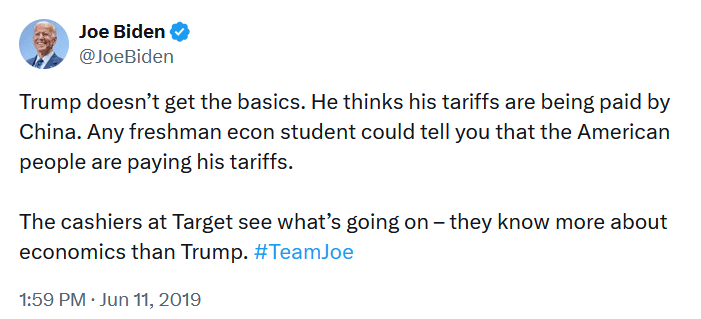
Yet today in 2026 I see *many of those exact same people*, primarily from the European and Canadian parts of the Atlantic, argue passionately that the EU and other nations *must respond in kind* to Trump’s tariffs. That Europe and Canada should raise massive counter-tariffs against Trump, equal or greater in value to whatever he is levying against them, and specifically targeted at America’s major industries. When Trump’s team met EU officials and agreed to a “deal” whereby the US would raise tariffs and the EU would not respond in kind, this was seen as a disaster, a surrender, and a damning indictment.
It seems clear that there is a revealed belief going on here. These transatlantic thinkers claim that tariffs hurt America more than they hurt the tariffed countries, but if that were the case, then counter-tariffs would hurt the EU and Canada more than they’d hurt America. The “solution” to Trump’s trade war would then be to do nothing at all. LET Trump tariff every nation to high heaven, he’s primarily hurting America after all, and don’t respond in kind under any circumstances. Don’t tariff American products, don’t go after American businesses, don’t do anything differently than you’d normally do, because any such anti-trade measure would harm your own countries more than it harms America.
But the revealed belief here is that Trump’s tariffs *do* harm other countries more than they harm America, because counter-tariffs and other trade barriers are being called upon, on the assumption that they will harm America more than they’ll harm other nations. It seems that many transatlantic thinkers are revealing that all the rhetoric around tariffs was a Noble Lie. All the claims about how tariffs are ineffective and self-destructive were lies meant to dissuade the public from supporting tariffs in the first place. But now that the tariffs are out of the bag, the Noble Lie has no more use, and the Awful Truth about tariffs, that they are harmful to one’s own nation, but are effective at countering trade imbalances, has come to the fore.
Noble Lies such as this beclown the person saying the lie. They reveal the liar to be a hypocrite and untrustworthy. If you found that the person who goes on and on about healthy food was actually eating nothing but junk food, you’d probably never again trust their recommendations to you about healthy eating. And likewise, a lot of poli/econ commentators have lost a lot of credibility in my eyes by going back on their pre-Trump claims about tariffs. By revealing that they never believed those things in the first place, they reveal (to me at least) that I should never trust them again going forward.
-
“GDP is bullshit”

Transcription: “GDP is also a bullshit metric. If I buy $100 of flouride, add water, buy some bottles, repackage it as Crest Mouthwash, and sell it for $15/bottle, I’ve generated like $1500 of GDP. That’s not really adding value, that’s enriching shareholders at the cost of people who don’t realize they’re being robbed.”
Response: my guy, that’s literally the definition of adding value.
Now to be fair, this comment was downvoted when I found it, meaning more people disagreed than agreed, but still, this sentiment about “adding value” is something I see all over the internet in anti-capitalist spaces. People will literally explain adding value, then say something adds absolutely no value.
Even a marxist would agree that the labor required to add water, buy bottles, and package something adds value to the product. And a capitalist would say that if this poster successfully created mouthwash that people would buy for $15/bottle, then they’ve added value to that $100 of fluoride. And if this poster actually did this experiment, and made money off of it, they could quickly start a company and become rich.
But they can’t do this, because it’s actually quite difficult to create good, quality fluoridated mouthwash, and they have no skills besides complaining on the Internet.
Still, they have explicitly defined a process in which a low-cost good is turned into a highly desirable product, a process which both a labor-obsessed marxist and a capital-obsessed capitalist would say has “added value” to that good, and have said that it isn’t “real” value. They extend this to say that GDP is bullshit.
“GDP-is-bullshit”ism has seemed to take hold in some spaces. I can see why, people’s personal situations don’t always track the wider economy, so the economy as a whole (measured by GDP) can go up massively while some people or some sectors are struggling. It may not matter to you than millions of people have more time, money, and leisure because you personally lost your job as say a factory worker. In this case GDP can seem like a false measurement because people have a hard time looking outside themselves.
But in another way, it is true that some politicians laser-focus on GDP to the expense of all else. It is a basic truism that when a metric becomes a target, it ceases to be a useful metric. GDP is a *metric* of economic health, but once voters realized this they started grading their politicians on the GDP measurements they saw in the news. That in turn made GDP into a *target* for politicians to point at and say “look, I’m making things better!”
In that case, GDP can go up (because it’s being targeted) while people’s actual situation is going down. This is exactly what happened during the tail end of the Trudeau administration in Canada, Trudeau focused solely on rising GDP as his target, but GDP-per-capita went down. People’s living situations in Canada were not really improved at all despite Trudeau raising the national GDP.
Still, GDP is a good measure of what it measures: productivity. And what is productivity? It is the turning of low-value things into high value things.
The above poster blithely described it as “bullshit,” but think of this: everything we as a society need and want requires someone else to use their time, money and effort to make it for us. If there isn’t enough food for all of us, our lives are measurably worse off. Increasing the production of food requires the labor of a farmer, requires the cultivation of land, requires the creation of irrigation and of transport infrastructure and warehouses for the food and inspections to ensure the food is clean. The creation of all those things is captured in GDP.
GDP directly captures when something of value is created, whether it’s food, or irrigation to make the food, or warehouses to store the food, or even Crest Mouthwash made from raw fluoride. YOU may not think the thing created has value, maybe you don’t wash your mouth. But the beauty of capitalism is that OTHER people get to decide for THEMSELVES what they think is valuable, and if they want mouthwash, they’ll happily pay for it, and thus creating new mouthwash to sell to those people raises GDP.
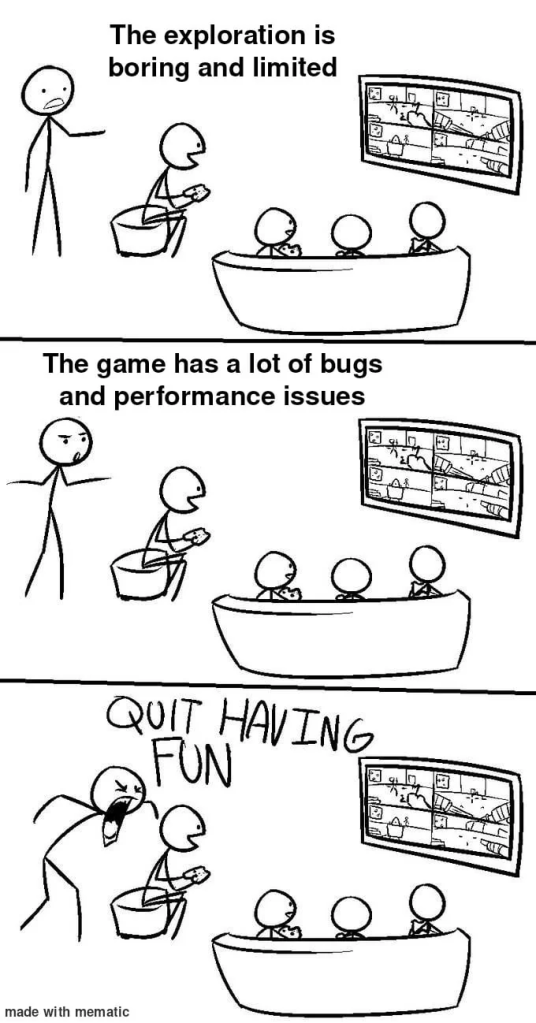
This is a small post, it’s mostly meant to dunk on a single Internet commentator, and by extension dunk on an entire subculture of “GDP-is-bullshit”ists. But I want to make clear: GDP is NOT bullshit. It is a measure of goods and services created. Those goods and services have VALUE, maybe not to you, but to SOMEONE ELSE. If they didn’t have value to someone else, they wouldn’t raise GDP. And so complaining that some people’s goods and services add value, even though you don’t think they’re useful, is like complaining that other people are having fun with a game you don’t like.
-
Yields, Hermetic Order, and Civ IV
I want to blog about Civilization VI again, and this time about yet another swing and a miss: the secret societies game mode.
Civ VI usually plays exactly how every other Civ game plays out, 6-12 randomly chosen civilizations are plopped down on a randomly generated map, and the player must “build a civilization that stands the test of time,” ie win the game with science/culture/diplomacy before the game ends in 2050. Why 2050? Well the game must end at some point, and when these games were coming out in the early 2000s, 2050 seemed to be so unimaginably far in the future as to be a good “end date.”
But Civ VI has a secret societies mode which shuffles this system around. This mode is built on the popular fiction trope of there being one or several secret societies which have guided human history from the very beggining. There are 4 societies here, and they’re each in perpetual conflict with each other all the way back to the Neolithic era:
The “Order of Blood” aka a secret society of Vampires (think of White Wolf’s Old World of Darkness)
The Hermetic Order aka a science-y magic secret society
The Voidsingers aka a Cthulhu Mythos secret society
The Owls of Minerva who seem ever so slightly Harry Potter themed, although maybe that’s just me.Anyway, the Civ VI secret societies game mode adds these guys as players to the game. They don’t actually have any cities or units of their own, mind you. But in the early neolithic while the player is exploring the map, these societies will occassionally approach the player and invite the player’s civilization to join them. In exchange, they’ll give the player’s civ powerful abilities that will only increase as the game continues.
But this game mode is very unbalanced, and worse yet it isn’t very well thought out in places.
The order of Blood gives you a vampire unit and later lets you build Vampire castles. The vampire is as strong as the strongest melee unit you have, and if killed it shows back up in your capital needing to be healed rather than actually dying like a normal human unit. That’s neat.
The Owls of Minerva give you bonuses when you send a trade route to a city-state. This would be neato, except these bonuses also inadvertantly cause the city-state to acquire more and more territory, such that if the player picks the Owls as their patron, the city-states on the map will gobble up all the tiles that the actual Civs are supposed to use to build their empires. It’s a shame city-states can’t build empires of their own.
The Voidsingers give you a statue of the Old Gods, which seems to give minor bonuses to faith generation, but then later in the game they make 20% of your faith generation get added to your gold, science and culture generation also. The cult therefore ends up being the most powerful society by far just because of how much it powers up your entire empire, even though their bonuses seem by far the most mundane, almost lame.
The Hermetic Order though is… weird. To discuss them, I first have to tell you about yields and ajacencies.
So the map in Civ VI is divided into tiles, and each tile has a “yield” on it describing how much “stuff” that tile produces. A simple grassland tile produces 2 food. A plains tile produces 1 food/1 production. Yields can be altered by resources, improvements, and technology also. If we have a wheat resource on that plains tile, it jumps to 2 food/1 production. If we farm that wheat, it becomes 3 food/1 production. If that wheat farm has 2 other farms “adjacent” to it, it becomes 4 food/1 production. That last one is more than twice as good as a simple plains tile.
Cities work these tiles and use their yields. A city needs production to produce things and food to feed its citizens. Thus the main gameplay loop is acquiring high-yield tiles and improving them further with builders, technology, and so on. This lets your cities grow large, produce stuff, and have culture, science, and gold to boot.
Next adjacencies, we saw them briefly in the wheat-farm discussion. Civ VI has a system where certain things get bonuses if they are “adjacent” to other things. Nice and vague, but here’s some examples:
A campus gets a bonus to its science generation if it’s next to a mountain.
A commercial district gets a bonus to its money generation if it’s next to a river.
A theatre square gets a bonus to its culture if it’s next to a “wonder of the world,” whether that’s a natural wonder like Mount Everest or a man-made wonder like the Hanging Gardens.So the other gameplay loop is planning where you’ll place your buildings, farms, and other things to maximize their adjacency bonuses as well.
So here’s where the Hermetic order comes in: the very first thing they give you is the ability to see “ley lines” on the map, which power up your adjacencies is you build buldings near to them. This is also where the problems begin: these ley lines might not be anywhere near where you want to build a city.
The other societies just give you a “thing” immediately, whether it’s a vampire or a statue to the Old Gods, but the Hermetic order demands you go out and not only find these ley lines, but also build your cities near them, because the ley lines are useless to you unless you actually build stuff near them for the adjacency bonus. But what if there’s no ley lines near your territory? What if on this map they’re all in the desert or tundra, far from fresh water, good land, or any kind of resources? Sucks to be you then, because now you’ve basically joined a secret society that gave you nothing in exchange.
People call it save-scumming, but whatever: when I want to join the Hermetic Order, I’ll first save the game, and then join them to reveal the ley lines. If I find out there’s no ley lines in reasonable locations from me, I’ll just reload the earlier save and join a different society instead. No other secret society is this dependent on random luck to make them useful. This is added to the fact that how you join the order is also a pain: you can’t join the Hermetic Order until you find a nature wonder, which are quite rare on the map, and again you may have absolutely none near you.
The other societies give you fairly simply joining requirements: find a tribal village, find a city-state, kill some barbarians. Villages, city-states, and barbarians virtually litter the map, but natural wonders are very very rare. So not only are the bonuses this society give you very hit or miss, but even joining them is a pain.
Later on in the game, the Hermetic Order will power up your ley lines by giving them yields based on how many Great People you’ve earned, but this is unfortunately a “win more” scenario, not an actual benefit.
What do I mean by “win more?” That’s a thing where the bonuses you receive don’t help you win, because you only get them if you’re already winning. Essentially they’re bonuses that don’t actually help make the difference between your winning and your losing, they just make you look stylish if you’re already winning.
See, getting Great People requires your nation to build a lot of buildings of the right type, and use faith and gold to entice the great people as well. This obviously means you already need lots of production, faith, and gold generation to get great people. So if you’re getting lots of great people, the Hermetic Order will rewards you by upgrading your ley lines with more… production, faith and gold.
This isn’t like Civ IV where you could focus on getting great people or focus on a non-great people economy instead. Every useful thing in Civ VI generates great people, so if you’re playing well and winning the game, you’ll get a lot of them. If you’re not playing well and struggling, you’ll get almost none. So if you’re winning, the Hermetic Order will help you win more, if you’re not winning, they won’t help you at all. Not a great system to be honest.
I think this is why this is the worst of the secret societies, even if mechanically they are by far the most interesting. The other societies all give you a very direct way to turn their bonuses into win conditions. The Voidsingers tell you to maximize your faith generation, and in return they’ll give you all the other stuff you need. The vampires tell you to maximize your military power, and that in turn powers up your vampires. The Owls of Minerva tell you to maximize your relations with city-states, and in return they’ll ensure those citystates remain utterly loyal and VERY powerful for you.
But the Order of Hermes demands that you get lucky enough to find a bunch of ley lines, and then also be winning enough to get a bunch of great people.
I’d prefer it vastly if instead of the ley lines being randomly generated, if the Order gave you a special unit that could *build* a couple of ley lines wherever you want them. Maybe give you a few more ley lines as the game progresses, like how the vampires give you extra vampires as the game progresses. Then they could actually feel like a pure benefit instead of a diceroll.
And instead of powering up ley lines based on how many great people you’ve recruited, maybe they could power up your great person recruitment for every building you build near them. Then instead of a “win more” condition, they’d actually help you come from behind and recruit great people if you haven’t already gotten some.
Anyway that’s my 2 cents. The devs have long moved on to Civ VII, but I think it’s unsurprising that game was so poorly received, when so much of Civ VI showed but flashes of brilliance with not enough thought put into them to make them truly stand the test of time.
-
The demotivation spiral
I’ve been lacking motivation recently, lacking the drive to do all the things I want to do. So I don’t do things.
That makes me depressed that I haven’t gotten anything done. So I get even more demotivated. So I don’t do more things.
This spiral is a bad place to be in. I’m trying to get out. I’m going to set goals to work out on specific days (MWF). I’m setting measurable deadlines for things to get done in both my work and my personal life. I’m going to set goals to reach out to my friends more often, because being with friends always motivates me.
And I’m going to try to get less depressed when things don’t go right. I think that’s been part of the problem, when things go poorly I take it too hard on myself.
I’m a scientist, the hallmark of science is that while we can predict what may happen, we then have to test it through experiments. If our experiments go a certain way, then our prediction was wrong and we have to find out what to do now. That’s just part of science, it’s all part of the process.
But when my experiments aren’t going as I expected them to, I take it too personally. I haven’t yet learned enough how to step back and just accept it, just find out what happened, alter the conditions, and revise the predictions. Instead I keep wondering if I myself am to blame, and if I myself and uniquely unqualified to do this job I’ve been doing my entire adult life.
What makes people successful isn’t just a single moment of brilliance, but a determination to keep being brilliant, which takes work. Whether its physical determination, mental fortitude in the case of adversity, or what have you, success if a pattern of behavior, not a lottery ticket.
And I need to remember that and act like that. It won’t help me if I just get things right once and then rest on my laurels, that won’t bring success. And likewise it won’t help me to mope about whenever I get things wrong.
This is all something that I’m sure everyone deals with, no one needs me to tell them, but it’s something I want to tell myself and I feel like writing it down is the best way to do that.
I need to keep going, keep trying, and keep acting like this matters, even in the face of failure. Letting every failure spiral me further into depression is just a recipe for more failure.
-
Wish I could talk to cats
Wanting to talk to animals has been a dreamed-of superpower since at least the days of the Greeks. But I have far more practical reasons for wanting it. I’m just never sure at all if my cat is happy with her amenities.
Do you like the new, automatic water dish? Are you drinking from it? Or are you thirsty because you don’t understand this newfangled drinking dish and only understand the old dish you had? I wish I could ask her this. I need to put you in the carrying case, but we’re not going to the vet or anywhere scary, we’re just visiting my family who you already know and you like being there. I wish I could tell her this. I’m moving my arm, but you don’t need to jump off my lap, I just need to get more comfortable. Oh and which cat bed do you prefer? Are you sleeping in the colorful cat bed because it’s more comfortable, or just because the gray cat bed is in a more open space and you don’t feel safe there?
Frustratingly I may know the answer to this last question, but only through trial and error. Switching the colorful cat bed and the gray one does indeed change which bed she sleeps in. It seems that for cat beds, what’s important is location, location, location, more than color or comfort.
It’s hard to take care of someone who can’t tell you what they want. And it can be stressful when you’re trying to give them what they want but don’t know if you’re getting it right.
I wonder if this is how parents feel?
-
Stars with a Story
I wanted to tell a short story about a star I found interesting. It’s nothing like I’ve blogged about before, but I haven’t blogged in a long time and I need to write SOMETHING.
At the heart of the Crab Nebula is a little star that I will call Crabby. Its real name is PSR B0531+21, but no one’s going to remember that name so Crabby it is. Crabby is a star that exploded in 1054 AD, and the Crab Nebula is the remnants of that explosion.
What’s so special about Crabby is that we know *exactly* when it exploded, because Chinese astronomers recorded it. For almost every other supernova remnant in the galaxy we don’t have that kind of information, it’s hard to tell whether something exploded a million years ago or a *billion* years ago because we’re viewing it from so far away. So knowing the exact *year* that Crabby exploded is like knowing someone’s time of birth down to the millisecond. It gives us incredible precision that we normally don’t get in astronomy.
And that precision has let scientists come up with some wacky theories, such as the theory that Crabby is a “strange star.”
Now what’s a strange star exactly? Isn’t it a little rude to call a star “strange” in the first place? Well it requires a little bit of quantum mechanics to explain this, but read on because I promise it’s worth the read.
See, when a star normally collapses, the force of gravity becomes so great that it compactifies the matter within to a ridiculous extent. The core of a collapsing star is usually made of heavy elements like iron, and the collapse forces those atoms as close together as physically possible. There’s a simple rule in quantum mechanics: two things can’t occupy the same exact space, and this rule leads to an absolute limit of density: the density where atoms can’t get any closer together or they’d literally overlap.
Here on earth atoms aren’t usually that close together. Liquids and gases of course let atoms slosh about, but even solids on earth usually have their atoms arranged in intricate patterns with a little bit of space in between each atom. White dwarfs crush this down into the absolute limit of density, around a ton or more per cubit centimeter.
So white dwarfs like this are ultra compact objects with ultra compact structures. But gravity can do even better than a white dwarf.
See the strength of gravity depends on mass: more mass, more gravity. So what happens in the cases of a VERY massive white dwarf? Their high mass means they want to crush things down even denser, but we’ve already reached the limits of atomic density, so where else can we go?
Well remember that atoms themselves are mostly made up of empty space, there’s a lot of emptiness between the nucleus and the electrons, for example. Atoms themselves can be crushed down into just their neutrons, with each proton absorbing an electron to become a neutron. When we crush down atoms in this way, we remove all that empty space they contain, and that lets us crush the whole star down to *even greater levels of density*.
At this level we have a “neutron star,” a star so crushingly dense that it’s the size of a city with the mass of the sun. Our friend Crabby is theorized to be a neutron star. But it might possibly be even more special.
Some have theorized that Crabby is a bit too cold for its age, and how could it have lost all that heat? The answer may bring us to the fringes of theoretical physics.
See just like atoms can be crushed down into neutrons, neutrons can be crushed down further. Neutrons are made up of 3 quarks: 2 down quarks and 1 up quark. But those quarks are much smaller than the neutron itself, and between them is mostly empty space. So once again, if the gravity of the star is strong enough, a neutron star can be “crushed down,” until its neutrons are crushed into quarks.
The whole star itself can’t be crushed like this, or else it would get so small that it would become a black hole. But the core of a massive neutron star may be so dense that its neutrons are indeed crushed into quarks, releasing all that empty space within the neutrons, and leaving a quark-rich soup that resembles the instant after the big bang. We have no firm evidence of this happening, but if it happens, then such a star would be called a quark star.
And then some massive quark stars might have a final trick up their sleeves. Remember that rule from earlier, about how 2 things can’t occupy the same space? That rule is what holds each of these type of stars from crushing down too far. White dwarfs can’t let their atoms occupy the same space, it’s only when the force of gravity is *large enough to crush atoms* that a white dwarf gets crushed down into a neutron star.
Similarly, neutron stars can’t let their neutrons occupy the same space, and that’s what keeps them from crushing down further. But when gravity is strong enough to *crush neutrons*, then parts of the neutron star might devolve into a quark star.
But in a quark star, the neutrons are crushed into 2 down quarks and 1 up quark each. Now here’s the funny thing about that quantum rule I told you about: two things can’t occupy the same space right? Well that’s only true *if they’re the same type of thing*. Two neutrons can’t occupy the same space because they’re both neutrons. Same with 2 down quarks, they can’t occupy the same space either. But a down quark and an up quark? They can occupy the same space no problem.
So the neutrons are crushed into 2 down quarks and 1 up quark right? 1 down and 1 up quark can occupy roughly the same space, they can take up 1 “unit” of space together. But that second down quark? It needs to find a *different* space for itself to occupy.
But let’s bring gravity back into the picture: we’ve already seen how it can crush atoms down to neutrons, and neutrons down to quarks, can it crush these quarks even further? Well not directly, quarks are “fundamental particles,” there’s nothing they could crush down into. But there is an *indirect* form of crushing that could happen…
Remember that 1 down and 1 up quark can share the same space but that second down quark has to find a new space. If we could change that second down quark into something else, we could free up that space so gravity could crush further, but how?
Well while all the “regular” matter of our universe, stars, planets, bloggers, is all made of just up and down quarks, there’s more quarks then just them hiding in the fringes of particle physics.
The strange quark is another type of quark, different from up and down. It’s decidedly strange indeed, since it doesn’t exist anywhere in the universe except for fractions of a second at very high energies. But that’s not important, what *is* important is that *it’s another type of quark,” and just like how up and down quarks can share the same space because they’re different from each other, a strange quark *can also share that space* because it’s different from both up and down quarks.
So at the very highest limits of density, when neutrons themselves are crushed and when their quarks are crushed further, the sheer force of gravity might force those quarks to take drastic action. Half of the down quarks from the neutrons might convert into strange quarks, so that they can take up less space with the other quarks and crush the star yet further.
If this is the case, and these strange quarks do exist at the hearts of massive neutron stars, then this may the *only* place they exist for any significant length of time. Usually strange quarks decay because they’re so unstable, but at the crushing densities here, strange quarks are forced to *exist* because it’s the only way to crush down far enough under gravity. Despite being unstable, strange quarks here *can’t* decay, because gravity is forcing them to stay strange.
Now this is all very theoretical, but it begs the question: do strange stars even exist?
Maybe
And it begs another question: is Crabby a strange star?
Maybe maybe
Like I said if the neutrons are crushed into quarks and eventually strange quarks, it will only happen at the very center of the neutron star, a place we can’t observe and can only speculate about. But there is tantalizing evidence: we know exactly how old Crabby is thanks to those Chinese astronomers who recorded its explosion, and our evidence shows it to be a fair bit colder than we’d expect for a neutron star of its age, why could that be?
It’s been suggested that when neutrons are crushed into quarks and then strange quarks, that bursts of neutrinos are created which carry away much of the star’s heat into the cosmos. It *may be* that such a thing happened to Crabby, which is why it’s so cold.
This theory wouldn’t even be possible if we didn’t know how old Crabby is, if it were just another neutron star we would always have questions about if it’s actually just an older star that has had time to cool down, rather than being a young star that is unusually cold. And we owe it all to the astronomers from the past who first saw Crabby in their night sky, nearly one thousand years ago.
-
“Why don’t they only film the hits?”
There’s a joke from “That Mitchel and Webb Look” that I want to dissect like a frog for a moment. The video is just one minute long, but if you don’t want to watch it I can summarize it here:
- “So for the sketches we’re filming, I’m thinking we’ll make them “hit, hit, miss, hit, miss, miss”
- “Do we have to film all the misses as well as the hits? Why not only film the hits and use those for the show?”
- “Well it’s a sketch comedy show, it has to be hit and miss.”
The joke doesn’t need to be explained, but I will anyway: why does a sketch comedy show have a lot of sketches that miss the mark, as well as ones that are laugh out loud funny? Isn’t it easier to just film the hits? Well obviously the writers didn’t think those misses would miss the mark, they thought those misses might be hits as well, that’s why they wrote them and filmed them. You don’t know for sure what will be a hit and what will be a miss before you release the show.
A similar pattern is discussed with venture capital investing. Venture capitalists invest in hundreds of startups on the assumption that around 90% of them will fail and make no money at all. The 10% that succeed are expected to pay for all the failures. Well then why don’t venture capitalists *only* invest in the successes and not waste money investing in the failures? Again: they don’t know for sure what will succeed or fail before investing. A huge amount of time and money goes into predicting the success or failure of startups so these VCs can try to invest wisely, but it isn’t a solved problem by any means.
And if you think this investing problem has an obvious solution, take out a personal loan and invest 50,000$ in a single startup that *you know for sure* is guaranteed to be successful. You’ll 1000x your money and be able to pay off the loan and interest easily.
But this pattern of “why not only go for the hits?” holds true in science as well. But here many people don’t seem to understand or believe it.
Governments, corporations, and charities invest billions into potentially lifesaving treatments every year. 90% of those scientific ventures will come to nothing, only a few will be successful. But you don’t know for sure which will succeed and which won’t before you try.
I think of this because I all too often see people complain about “why did we invest X number of dollars into researching such and such, when Y was invented with so much less?” A World War 2 version of this is the infamous refrain about how the project to develop a better bomb-sight for American planes costed more than the Manhattan Project which made nuclear bombs. A modern version of this complaint might be complaining that the Amyloid hypothesis in Alzheimer’s disease has received so much funding despite never curing Alzheimer’s.
In both cases though, our best foreknowledge seemed to indicate that this was the right path. Nuclear fission was completely unproven tech, the scientists themselves were pessimistic about their abilities to make a bomb out of it. When the first test of a real nuclear bomb took place, the scientists involved had a bet going for how much power the bomb would produce (with some predicting it would be a dud). *EVERY SINGLE ONE OF THEM* drastically underestimated the power of the bomb they had created, the most wildly optimistic predictions underestimated the bomb’s power by half.
By contrast air-power was a proven war winner when the USA started spending billions on bomb-sights. Germany’s blitzkrieg had used massive air power to help them overwhelm, surround, and destroy, other nations all across Europe. Air power could destroy the railroads and bridges that let troops move across modern battlefields, it could destroy the factories where the troop’s guns and tanks were made, and domination of the air allowed an army a far better picture of the battlefield then their enemies had. In this scenario, the allies looked at the success of German air power and believed that upping their own air power might similarly prove dividends. They never got the total success of the German blitzkrieg, but overwhelming air power was at least part of how the USA held on in the Korean war, so it wasn’t a complete waste.
Similarly, the evidence for Alzheimer’s disease has always seemed to point toward Amyloid Beta playing a key role. The evident failure of drugs targeting Amyloid Beta means there’s a lot more we have to learn, but just because the Amyloid Hypothesis is flawed doesn’t mean a competing hypothesis is automatically right. Putting billions towards the Tau or neurotransmitter hypotheses is not guaranteed to have brought success, in fact these hypotheses were studied even during the dominance of the Amyloid Hypothesis, and neither of them produced working drugs either.
People have a video-game understanding of research, as I’ve complained about before. They think that if we just put enough money towards the correct hypothesis, we’ll find what we’re looking for. But we don’t know what’s correct before we commit our money, and if our hypothesis fails, we don’t even know if we just haven’t thrown *enough* money at the problem, or if we’re chucking good money after bad. Which answer you lean to likely says more about your politics than about the quality of the research itself. Should we throw more and more money towards commercial nuclear fusion, even though that industry has never once succeed in even the most modest goals set for itself? Should we cut off the Amyloid Hypothesis, even though a century of research shows that Amyloid Beta does play a key role in Alzheimer’s disease? Everyone seems to think they already know the answer, but few are willing to prove it with evidence.
-
Addendum: Factorio is getting worse as a game
I posted a while ago about how I loved Factorio but didn’t like Factorio: Space Age. The crux of my argument was that Factorio rewarded players creativity and expression, letting and encouraging the players to find their own solutions to problems and play “their way.” Space Age undid all that, the devs have decided that there is only 1 right way to solve each problem, find their way and do what they want you to do. There is no more player freedom and expression, no more playing “you way,” it’s the devs’ way or the high way.
I decided that Space Age was a bad expansion pack, but at least the base Factorio game was still untouched, right? Well no, Space Age’s “my way or the high way” ideology has also infected the base game. The game has certain achievements for completing it within certain constraints, and now the devs have decided that if you play “your way,” you are no longer eligible for their achievements.
Nefrums, a Factorio youtuber, used to have an amazing series of videos where he completed 100% of Factorio’s acheivements in a single base in a single session, a speedrunning achievement in which he held the world record many times. The only realistic way to complete this gargantuan task was to change the way the game was played to make them possible. The task was still monsterous of course, it wasn’t at all easy by any means, but it was possible since Nefrums was allowed to play “his” way.
Now an update has made playing the game Nefrum’s way no longer possible. When you start a new game, you can see all the little tweaks you can make to how the game is played. There is a warning next to *every single tweak* saying that if you change this setting, you disable some achievements. Obviously it’s no longer possible to play Nefrum’s way since he would change these setting but still get 100% of the achievements in a single base. But again, the devs don’t want you playing “your way,” it’s the devs’ way or the high way.
So now even the base game has decided that if you aren’t playing “correctly,” you need to be punished for your arrogance. The devs have become so insular that they are seemingly enraged by anyone playing “wrong,” so they need to change the game to “fix” them.
Achievements don’t harm the devs in any way, they are purely a motivational factor for the players. If Nefrums wants to get 100% of the achievements by changing the settings, that doesn’t hurt the devs and it doesn’t hurt any of the other Factorio players at all. So there is no reason to change things and disable those achievements except pure spite, pure spite that someone, somewhere might be playing the game “wrong” and getting achievements in the “wrong” way.
Such a shame that the devs I once thought were pinnacles of the video game world have become so spiteful and insular. I don’t think I’ll even play another game of theirs, I’ve been burned badly with how bad Space Age was relative to the Factorio base game, and now they’ve even gone back and changed the base game to make it worse.
Such is life.
Addendum, I’m sure fans and devs might be angry at my post, and attack me by saying Space Age is making hella bank and so I’m just a hater. But I think the evidence shows the wider community agrees with me. Factorio’s base game is rated “Overwelmingly Positive” by the Steam reviewers, a mark of excellence only a very few games achieve. Factorio: Space Age is rated at a mere “Very Positive,” and the recent reviews give it a “Mostly Positive,” meaning barely a majority of the reviewers gave it a thumbs up.
“Mostly Positive” is a very low bar to clear in Steam reviews, only the worse of the worst video games will ever score below “Mostly Positive”. So in grade scales we could say that the base game got an “A,” its expansion got a “B,” and the recent players of the expansion give it a “C,” a barely passing mark.
It’s pretty clear that many many players, not just me, think Space Age is a worse game than Factorio was. If you like it, I am glad, but I don’t like it, please don’t get angry at me for not liking a game you like.
-
Opportunity Costs in Civilization 6
One of the most important concepts I learned in economics is the idea of opportunity costs. Every action we take has a cost, not just the cost of the action itself, but the cost of *now not being able to do something else* with either the time or money or both that we just spent.
A simple example: a company only has 100$ to invest in a machine. If they buy the machine that makes blue widgets, they can’t also buy the machine that makes red widgets. Thus, buying the blue widget machine doesn’t *just* cost 100$, it also has the *opportunity cost* of not buying the red widget machine.
There are also opportunity costs with time, if you decide to go to Europe for your holiday vacation, you can’t also go to South America at the same time. So the cost of going to Europe isn’t just the cost of the time and the tickets, it’s also the opportunity cost of not going to South America (or anywhere else) as well.
As an aside, this is why for some people it can make sense to NOT go to college EVEN IF college were totally free. The cost of going to college includes the *opportunity cost* of not having a full-time job (if you’re a full-time student).
A comedian once made a joke that, after graduating college he couldn’t find any work “because the dropouts already had the jobs.” A funny joke, but it demonstrates a point: You spend 4 years getting a degree, but if that degree doesn’t measurably increase your employment prospects, you could have been better off spending those 4 years getting work experience at a full-time job. You could not only get the money that a full time job gives you, but the experience itself would increase your employability and ability to get better jobs.
So the education and degree you’re seeking needs to increase your employability *more* than just doing 4 years of work. If not, then it’s a net loss *even if your education was free* because you had the *opportunity cost* of not getting those 4 years of work experience.
But I didn’t want to blog about college, I wanted to blog about Civilization again.
The non-gamers in my audience may be tired of my gaming blogging, but I’ve spent a lot of this holiday season playing Civ IV and Civ VI with friends, so I’ve been thinking about this.
I complain that in Civ VI, some of the leaders seem to have traits that are utterly worthless, they don’t feel like they improve your Civ’s abilities any more than having a vanilla Civ with *no* traits. Eleanor of Aquitaine is one of these, her ability to culture-flip cities feels very underpowered and completely useless, and doesn’t make her any more powerful than a Civ that doesn’t have any abilities at all.
My friend shoots back at this by saying that if you put a lot of resources into it, you can set up a situation in which you culture-flip whole continents in an instant. And yes, this is theoretically possible. Does that mean Eleanor is “very powerful in the right circumstances?” No. Because of *opportunity costs*.
See, the cost of putting all your resources into Eleanor’s culture-flipping ability is that *you can’t put those resources into other things*. You can’t research technologies or build military units if you are instead spending your entire GDP on culture buildings. Culture isn’t free, and it doesn’t just cost what it costs to produce it, it has the *opportunity cost* of not doing anything else with that money and production.
So in any situation where Eleanor can “culture flip a continent” by spending an absurd amount of resources on culture, any other Civ could just use those resources to win the game with military, or science, or even diplomacy.
Eleanor’s ability is useless not because you *can’t* use it to do things, but because the amount you have to spend to make her ability not-useless could instead be better used to win the game in *any other way at all*. Her ability has an *opportunity cost* in that if you try to use it to its fullest, you are by definition not using those resources on better strategies that will win you the game more easily.
And that’s what I feel about a lot of the Civ VI leaders. Some leaders have abilities so minor they don’t feel impactful. Some have abilities that completely change the nature of the game. And some like Eleanor have these abilities that are actually traps, because the opportunity cost of trying to use their ability to its fullest makes you worse off than if you’d ignored their ability and played the game normally.
People didn’t like Civ IV’s leader system because every leader drew from a limited pot of abilities. Gilgamesh is Creative/Protective, while Catherine the Great is Creative/Imperialistic. From my perspective, that’s unique, *no one but Gilgamesh has that specific combination of traits*. From other people’s perspective though “they’re both creative so they’re too similar to be cool.”
These people who say this seem to really be drawn to Civ VI because every leader has *completely unique abilities* not seen anywhere else. But from my perspective “many of those abilities are worse to use than just ignoring the ability and playing the game normally.” Leaning into your “special ability” can have an opportunity cost, and no one but me seems to recognize this.
So in the future, please think about opportunity costs, both for college and for your video games. Making a nation have a super special ability isn’t actually cool if leaning into that ability makes you worse off than if you’d ignored it and played the game normally. Opportunity costs are real, even if not everyone understands them.
-
Subscribe
Subscribed
Have a WordPress.com account? Log in now.

