If I were president of Nigeria

You may have read in the news that Nigeria is going through an economic crisis. I feel most news agencies haven’t done a lot of due diligence, they have poured plenty of ink over the human interest stories of people unable to buy petrol, of the mass protests, and of the government’s response. But they haven’t done anything to explain the economic underpinnings of the crisis.

At best they may have given you a few basic facts. The president cut fuel subsidies and currency controls; the price of everything skyrocketed; the president says some pain is necessary. But they aren’t doing anything more than blaming the president’s actions for the crisis while also blandly repeating his assertions of “no pain, no gain.”

WHY did the president do what he did? Why does he think it’s necessary? What has it achieved? What has it *not* achieved? And what could he be doing differently?

Nigerian President Tinubu came into power only last year, amid an already languid economy. He comes from the same party as his predecessor, but was not content to be “Continuity Buhari,” he wanted to shake things up. At his inauguration, he announced the end of the fuel subsidy “with immediate effect.” People of course rushed out to buy the last of the subsidized fuel before prices skyrocketed. Not long after, he began loosening currency controls. The central bank had been artificially inflating the value of the Naira, and so without these controls it’s value came crashing down.

But I don’t think Tinubu did this because he hates poor people and doesn’t want to spend money on them. I think there were dire financial circumstances that demanded these actions, but not only do they demand *more* actions that Tinubu seems unwilling to entertain, but he himself has not been a great spokesman for why he did this.

To start with, the fuel subsidy was costing Nigeria an incredible amount each day. Nigeria maintains a relatively low tax environment thanks to a state monopoly on oil which is the government’s main source of revenue. The fuel subsidy hoovered up between 15 and 25 percent of this government revenue, a huge outflow that badly constrained government finances while also inhibiting a transition to renewable, perhaps even cheaper energy like wind and solar.

Meanwhile, the currency controls also costed Nigeria greatly. There are two ways to maintain an artificially powerful currency: buying currency on the local market and restricting the movement of currency into and out of the country.

The Nigerian central bank spent loads of dollars and euros from its vault buying up naira (Nigeria’s currency) on the global market, to raise the price of naira relative to these other currencies. But this was never enough to keep the value of the naira up, the central bank’s “official” exchange rate was always around 100 to 1000 times more expensive than what the naira was *actually* worth. The black market exchange rate pegged the naira as being worth way way less than what the central bank said.

In normal circumstances, this black market rate would quickly take over, obliterating the value of the naira as people trade naira for dollars at fair market prices, rather than the bank’s artificially set price. So currency controls were implemented to prevent this.

There were (and still somewhat are) huge restrictions on bringing dollars or foreign currency into Nigeria. It’s hard to bring cash on an airplane, and if you send money digitally through a bank, the Nigerian central bank will forcibly convert your dollars into naira at their set price, turning your 100 dollars into say 10,000 naira instead of the 1,000,000 naira they’re actually worth. This loses you a lot of money. And then there are crackdowns on any unofficial money changers, all this means that it’s very restrictive to move money into and out of the country.

But what if you’re a tourist, or a business that wants to invest in Nigeria? Then the central bank’s currency scheme is a certain way to fleece you for your dollars. Nigeria (like most countries) demands all transactions be in its local currency, the naira. So if you want to buy Nigerian yams, either because you’re a tourist who wants to eat yams or because you’re an exporter wanting to export them on the global market, you need to change your dollars into naira to do so. This either means losing 90% of your dollar’s value through the official exchange rate, or risking jail time by smuggling dollars into the country and using a black market money changer.

Either way, this makes investment *and* tourism a lot more precarious, and does even more to scare foreign money *out* of the country, at a time when Nigeria desperately needs money coming *in* to save its beleaguered industries.

To get back to Tinubu, he saw that Nigeria’s government finances were not good. The government deficit ran 5% of GDP, and was growing. It was difficult, and VERY expensive for Nigeria to borrow money on the world market because of this, so continuing the deficit-spending path was merely robbing future generations to pay for the present generation.

So he wanted to cut spending and boost investment. He cut the fuel subsidy, since it costed so much of the government’s revenue, and he loosened currency controls so that it’s easier to invest in Nigeria. In this way he hope to grow the economy and raise tax revenue. In the long run, this should provide *more* money to support the people.

Loosening currency controls however, led to triple digit inflation, as the naira’s official value finally caught up to its black market value. And combined with the end of the fuel subsidy this made everyone a lot poorer and made food and basic necessities a lot more expensive.

There’s a glimmer of hope that Tinubu’s plans are working, foreign investment is surging and perhaps after so much pain, Nigeria can come out the other side with a stronger economy that can actually spend more on its people, more on education, safety, and medical welfare instead of just subsidizing petrol. But it may also be far to little to save Tinubu’s presidency, and his successor can just undo it all to appease the populace.

I think the gains would come a lot faster for Tinubu if he were willing to be a truly radical reformer, and not just cut spending on the poor.

In addition to the fuel subsidy and currency restrictions which make investing in Nigeria difficult, the country also has a highly restrictive trade policy which isn’t making things any easier. Nigeria prohibits the import of a wide variety of products, from staple crops like cassava (related to the yam or sweet potato) to cement to eggs and meat. The only justification for this is to “protect domestic industry and farmers,” but let me rebut that:

First of all, people cannot afford food! The end of the fuel subsidy, the floating of the currency, these have put the price of food out of reach of many Nigerians. There are thousands of foreign companies, in West Africa and the rest of the world who can step in to provide more food if import restrictions are lifted. More food means a drop in the cost of food, through the laws of supply and demand, and so this increase in supply would go at least some way towards alleviating the hardships brought on by Tinubu’s other reforms.

And furthermore, importing food would create just as many jobs, if not more, than it “destroyed.” Markets need workers to staff them, trucks need drivers, loaders, unloaders and ports need all the same. Importing eggs so that people can afford to eat might make it harder to a poultry farmer to compete, but it would also create a number of jobs in logistics, supply, and customer-facing roles to get those eggs into people’s hands.

Furthermore, the unemployed farmer need not remain so. The high price of eggs makes it hard not only for customers to afford eggs, but also for any industry that uses eggs to afford them. Ice cream is very popular in Nigeria, but locally made ice cream is more expensive than it should be because the price of eggs remains high. But importing eggs would lower the price of eggs by driving up supply, and would allow ice cream manufacturers to buy more eggs, make more ice cream, and thus they’d need to hire more loaders and unloaders, more line workers, more mechanics for their ice cream machines, and so on. The loss of jobs in the poultry industry would easily be replaced by the gain of jobs in every manufacturing industry which uses eggs as an input.

And new industries could also be created. The thing about the government controlling the economy (as it does when it restricts the import and export of goods) is that the government doesn’t know as well as the market what a country’s competitive advantage is. And by stifling the import of so many goods, the Nigerian government makes it difficult for the economy to *find* those competitive advantages.

The USA eats far more pineapples than it produces, but imported pineapples are often packaged and canned in the USA, and that packaging and canning industry employs far more people than pineapple-growing alone ever could. And it’s not as if the USA *couldn’t* grow pineapples. California, and Florida all grow pineapples, but they have found competitive advantages in other products (like oranges or computer software) and the pineapple-growing jobs are instead pineapple-canning jobs, which are higher paid as well.

So if Nigeria ended its import restrictions, not only would individuals be able to afford groceries, but industries would be created and expanded, growing the economy. Nigeria would be able to find its competitive advantages, the things it does better than every country on earth, and would better exploit those advantages for growth and profit.

I will throw a bone to the populists who say that the fuel subsidies and currency controls may have been lifted *too fast*. I haven’t looked into it, but perhaps the pain would have been minimized, and the disruptions smoothed out, if these reforms were phased in such a way that the economy could better adjust. But if I were advising president Tinubu, my primary advice would be that he isn’t going far enough. End the trade restrictions, help the people afford basic goods, and help the industries grow through competitive advantage. The end result will be a much better economy than when you cut all the subsidies but still try to “protect” entrenched industries.
Perception and Reality

Well it’s been one of the most tumultuous 3 and a half weeks in politics, ever since the June debate between Biden and Trump. Since that debate:

  • The media perception of Biden has degraded from “frail but sharp old man” to “doesn’t always know what’s happening around him”
  • The Democratic Party line has gone from “Biden is the nominee, we can’t change him or it will cause chaos” to “Harris is the nominee”
  • Every Democrat in congress seemed to be calling for Biden to step down, and
  • Biden has stepped down as candidate, endorsing Harris

Some Democrats have (as they have all year) said that this was nothing more than an overblown media circus, that would have never caught fire if the lyin’ press hadn’t been so desperate for clicks that they cooked up a scandal. There’s a strong current among the Stancilite wing of the party to claim that every voter is an automaton who believes nothing except what the media says. So if the media says Biden is old, that’s what they believe. But the media *should* have said Biden was sharp as a tack and steering the ship of state, because then everyone would have believed that.

The idea that “The Media” (capital T capital M) is always against the Democrats is part and parcel of liberal mythmaking. Nevermind that it’s also part and parcel of *conservative* mythmaking, I encountered this liberal mythmaking first-hand in the aftermath of the Howard Dean campaign.

The liberal myth goes something like this: Howard Dean was a threat to the Establishment with powerful grassroots organization and nationwide appeal. But one night when trying to give a triumphant yell, he instead gave a weird-sounding scream. The Media repeated the “Dean Scream” endlessly, making a mockery of him to the voters and torching his campaign. In his stead, the underwelming, flip-flopping John Kerry was sent to lose against George W Bush. If *only* we’d stuck with Dean!

The problem with the “Dean Scream” myth is that it reverses cause and effect: it says that The Media used the Dean Scream to discredit him in the eyes of the voters. Yet looking at the record, the Dean Scream happened as he was trying to gin up his supporters after a dismal showing in the Iowa caucus, in which he vastly underperformed expectations and got just 18% of the vote, less than half of front-runner John Kerry and a very distant third behind the ascendant John Edwards.

Taken in context, The Media didn’t discredit Dean, the voters had already turned their backs on him. Dean was supposed to be a front-runner going into the caucus but his very poor showing put paid to that idea hours before his historic scream.

Kerry and Edwards would go on to be presidential and vice presidential nominees for that year.

Yet the idea that the Media creates perception (and therefore reality) still has power among the twitterati. When Biden was dealing with the fallout of the debate, many liberal commentators tore into The Media, claiming that if anyone was suffering from dementia it was rambly, half-awake Donald Trump. And since Biden has now dropped out, liberal commentators are trying to will a “Trump has dementia” angle into existence.

This seems like an insane take to me because *we all saw the debate*. No matter how much Trump lied and deflected, he said real words and you could understand them, Biden sounded like he was barely awake! The line of the night was Trump’s terrifyingly accurate quip of “I don’t know what he just said, and I don’t think he does either.”

And we can all see that Trump has done rally after rally after rally while Biden really *hasn’t*, and team Biden did everything in their power to prevent even a single off-script moment from ever being seen. All the while reports are coming in from allies all across congress and *across the Atlantic* that Biden hasn’t been all there for a really long time, and is confusing people and places left and right.

Meanwhile the curious voter can tune into any one of the many rallies that Trump holds, or just watch Fox News and see a man doing twice as many rallies, interviews and the like than Biden. As well as doing infinitely many more unscipted spots since Biden didn’t seem to do any.

Saying Trump is too old will certainly resonate, half the country already thought he was while 80% of the country thought Biden was. But trying to tar Trump with the same brush Biden got will not work I think because the reality doesn’t look like what the Democrats want out of a narrative. Like the Dean Scream myth, Democrats have taken away the idea that The Media creates reality, and if they can just *will* a narrative into existence, they can say anything about their opponents that their opponents say about them. I don’t think that works any more than Republicans trying to call Democrats election deniers works, because people have eyes.

At the end of the day The Media can certainly amplify stories and let narratives run away with things, but the idea that they can create something out of nothing is a myth. And Democrats trying to say *the media needs to be saying this” ie “Trump has dementia, Trump can’t speak straight,” trying to demand The Media simply reverse the story and put all of Biden’s flaws on Trump, well that isn’t going to work. They’d do a lot better hammering on things which are real instead of trying to create something out of nothing.

That may have been part of the problem for Democrats these past 3 weeks. While they were doing damage control for Biden, the most common rejoinder I saw was “Trump is just as old and just as senile!” The first is false, but at least close to true, Trump is very old. The second is an outright lie, 50 million people saw the debate, and you can’t lie to their face like that.

If Democrats lose, I think The Debate will enter the hall of myths alongside the Dean Scream, as a moment when The Media sharpened their knives and took out the strongest Democratic candidate available because (laughably) they were in the tank for Republican. And I think myths like that will make the party far weaker than it would otherwise be.

Why is State Farm leaving California?

note: I had intended to publish this months ago. But I never finished it, and now I’m struggling to get a post out in time, so I’ve tried to make this one acceptable.

There was recently news that State Farm insurance is leaving California, and will no longer accept new customers. Perhaps they may even kick old customers off their plans and refuse to do any business in California at all. This caused a wave of reactions, from consternation that a company could be so mean to California, to demands that State Farm “reimburse” customers who have paid for years with no claims, to calls to nationalize the insurance companies because “clearly” they’re just stealing from the little guy.

All these reactions will be addressed in turn, but first, let’s talk about how insurance works. If you recall my post from way back about Ric Flair and his gym, insurance is just a way to reduce your downside risk in exchange for a small lose of your upside gain. You pay a little every month and in exchange if your house or business is destroyed, you get some money back.

What’s important is that insurance is structured like a bet: the insurance company is betting that nothing bad will happen to your property during the period of your insurance, if they win the bet they keep your money and you get nothing in return (except maybe peace of mind). While they only pay out if they lose the bet and your property *is* damaged. Because of this, many people see insurance as a scam. Why would I ever pay if I don’t expect my property to be damaged? Well you’re mitigating risk, maybe there’s only a 1% chance your home is destroyed, but that’s a 1% chance that you lose *everything* and are left utterly homeless unless you have insurance to cover the cost of rebuilding your home. Isn’t it worth it to pay a little to ensure you aren’t homeless from an act of God?

Now first, I want to quickly call out a very dumb line of reasoning I’ve seen floating around regarding insurance. I’m not quoting any one tweet or post, but synthesizing what I’ve seen in many places at many times:

Why isn’t there a refund check for insurance like taxes? I’ve paid so much without using the policy, and even if I make a claim, they find ways to avoid paying. Total scam!

This sentiment belies a complete failure to understand insurance on even the most *basic* level. To start with, if you want a refund because you’ve paid in without using the policy, should the insurance company be able to demand more money if you paid in and then *did* use the policy? Of course not, you’d call them insane and selfish. But realize that it’s the identical situation, in reverse.

An insurance policy is simple: you pay regularly and they pay if certain conditions are met. Of course “certain conditions” can be interpreted differently by different people. And insurance companies are profit-maximizing (like all companies) they’ll try to avoid paying when they can. But this is a necessary evil, better the company try to limit payouts than it go bankrupt overpaying it’s customers. Because then every *other* customer would suddenly lose their insurance.

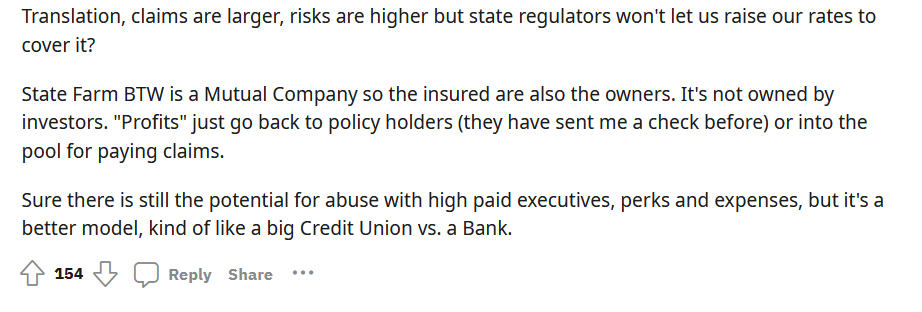
So finally, why is State Farm leaving California? Because they can’t make a profit. Most states regulate insurance incredibly heavily, to the extent that they put price caps on insurance premiums. That way the company cannot raise prices without the state’s say so. And if the state won’t let a company raise prices to cover rising costs (and costs ARE rising because of inflation and climate change), then the insurance company is not obligated to subsidize a state with coverage cheaper than costs.

As is so common, people blame the free market for a government-run system.

The point of government isn’t just to spend money

It’s election season, so I’m being inundated with election spam on every social media and traditional media I use. I know election posts probably aren’t people’s favorites, but this is the streams of my consciousness and I just wanted to vent.

To start with, some of the twitterati are pulling an absolute masterclass in doublethink. Centrists in the commentariat have been crowing for the last 4 years about how Biden has pumped more oil than any president in history. They’ve been dunking on Republicans about how despite Trump and the GOP’s rhetoric, Biden is more carbon friendly than Trump was.

Now, every words of this is true. I pointed out years ago how despite a small pandemic dip oil production has steadily increased during both Biden and Trump’s presidencies. Biden has inherited a fracking boom, and has not done anything to clamp down on it, so record-setting oil production is to be expected.

But the same commentariat that will crow about Biden’s oil boom will screech in anger and confusion when climate groups like the Sunrise Movement announce they won’t support Biden’s re-election. How can they do that? How can they refuse to support the president who has pumped more oil than any other in history? Gee, maybe because Democrats have said that Climate Change is an existential threat for years, and these folks actually believe it? Seems pretty obvious to me why the Sunrise Movement and other climate groups wouldn’t be happy with Biden’s energy policy.

As a defense, the commetariat likes to point to Biden’s massive spending bills. Billions and billions of dollars are being pumped into the green energy sector, and Democrat columnists are producting hockey-stick graphs comparing Biden’s green spending to previous presidents as proof of his climate success.

The problem with this is that the point of the government isn’t just to spend money. The point of the government is to get results. How much has that billions of dollars actually achieved?

For example, we all know that switching to electric cars is hard when there’s so few charging stations. Biden’s climate bills were supposed to build charging stations across the country to combat this. How many charging stations have Biden’s Billions actually created? As of May this year, just 8. But don’t worry, that number is growing! In March it was just 7! With a rough estimate of 1 charging station every 2 months, can anyone say these billions (trillions!) of dollars are being well spent?

This is exactly the kind of thing that If We Can Put a Man on the Moon… discussed. Politicians are incentivized to declare victory immediately for their re-election campaign. This leads to them touting metrics like “amount of money spent” instead of something actually useful like “miles of track laid” or “amount of actual EV infrastructure.” And since “money spent” is the only metric politicians are focusing on, that money gets spent extremely badly.

Years later, when the money is all spent and the infrastructure is still crumbling, a new campaign will of course arise, saying we now need to spend even *more* money to fix this thing that should have been fixed with the first tranche.

Let me be clear: I believe that climate change is a problem we need to address. But I do not think government spending is the best way to address that. In the last year, Tesla has built around 40 times more EV charging stations than Biden’s infrastructure bill, and they didn’t use taxpayer money to do it.

So why does it *have* to be government spending? I think it’s honestly because a lot of politicians don’t believe that companies can ever accomplish things. When you spend your entire life in government, every problem looks like a taxpayer-funded nail.

The government *can* solve these problems, but it doesn’t need to spend billions to do so. You really want to improve charging infrastructure? Tax gasoline. Tax oil. Tax every step of the refinement process. You will see how quickly consumers shift to electric cars, and how quickly companies spring up to service those electric cars. Hell, a network of gas stations already exists all across the country. If gas was taxed and consumers switched to electric cars, those stations would quickly be forced to switch from offering gas to offering fast electric charging.

You may say that a gas tax would hurt American consumers, but it would hurt them no more than the spending-fueled inflation that America has right now.

Here’s the funniest thing: politicians have adopted the language of the market and claimed that government spending is an investment. We are investing in green energy. But investment expects a return, and if the return on billions of dollars investment is 8 or so EV stations, that isn’t an investment, it’s a ripoff.

Biden chose to keep oil cheap and burn money on 8 EV charging stations. Is it any wonder climate activists don’t appreciate him? When success if measured in dollars spent, then failure is assured.

China is getting the trade war it deserves

And the US is getting the inflation it clearly wants.

Contrary to the title, this post will only be about America, because I don’t have any real insight into the CCP that hasn’t been covered elsewhere. But I read this article running cover for Biden’s disastrous policy of protectionism, and wanted to post my thoughts.

The central premise of the article is that cutting off trade with China is good because they’re a fascist and expansionist foreign adversary. Now, that’s also a great reason to cut off trade with Saudi Arabia, but America’s trade policy isn’t actually about foreign policy, as you’ll soon find out.

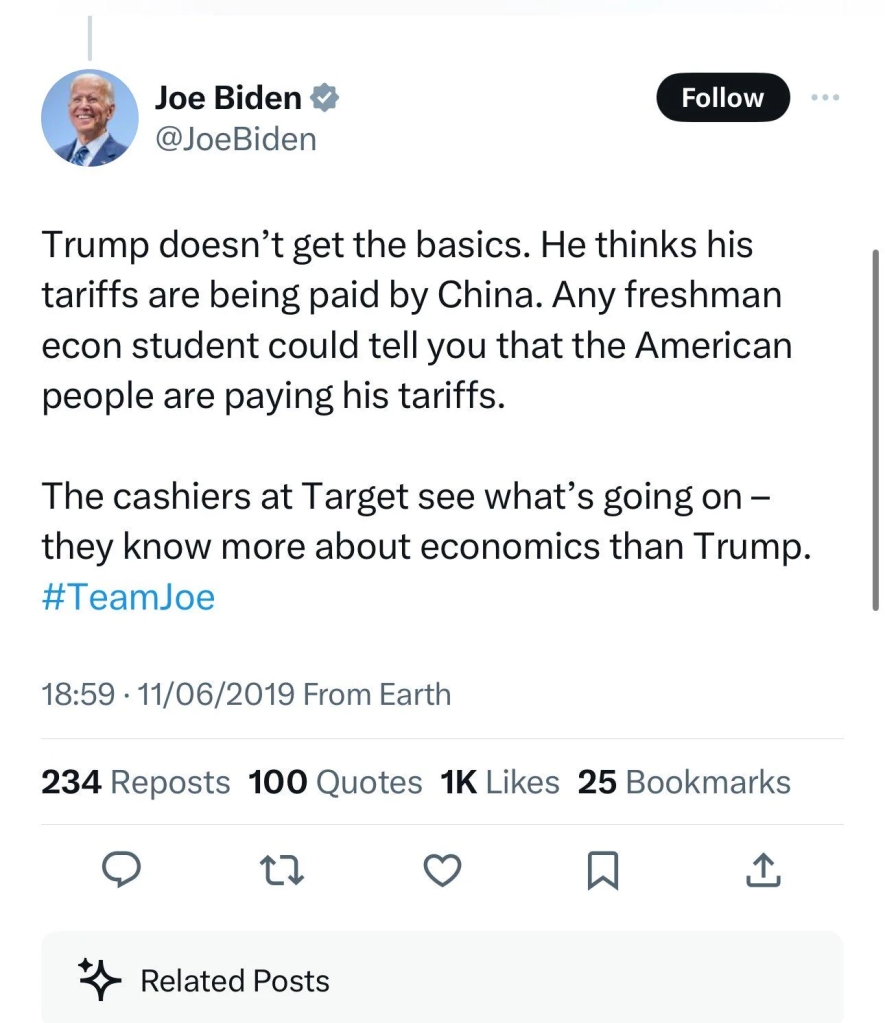
Even more importantly, tariffs don’t hurt the country you’re tariffing, or at least they hurt them *less* than they hurt your *own country*. Even Biden knows that, just ask the Biden of 2019

Tariffs are a great way to push up your own country’s inflation by taxing supply without reducing demand. Furthermore, even if you don’t buy Chinese products you will be paying for this inflation because of substitution effects: someone who is no longer able to buy a Chinese EV may instead purchase an American car, increasing demand for American cars and therefore driving up their price.

There’s two great ways to understand how terrible tariffs are. First, think of the oil shock in the 1970s: middle east nations cut off America’s access to oil and gas from their countries, causing spiraling prices and runaway inflation. By blocking America’s access to energy, they were able to put an economic squeeze that defined the decade.

China is being tariffed on solar power, wind power, and green industries of all kinds, and China makes up more of our imports than the middle east ever did. Spiraling prices are yet again on the menu.

Furthermore, think of Britain’s strategy against Germany during both World Wars. Britain used its powerful navy to prevent Germany from importing goods. This caused shortages and spiraling inflation, leading to riots that overthrew the government in the First World War and overwhelming shortages during the Second.

Tariffs are a way for us to do to ourselves what our enemies would do to us in war: restrict the import of needed goods.

Finally, consider Biden’s empty words about the “existential threat” posed by Climate Change. If Climate Change is dire, then why is Biden raising tariffs on solar power, wind power, and EVs, rather than Chinese oil and Chinese airplanes? Biden is essentially setting up an “anti-carbon tax,” in which polluting industries are exempt from a tax being paid by green industries.

The truth is that none of this is about national security, anymore than the Japan Scare of the 1980s was about national security. Just look at how Japan’s peaceful economic expansion was seen back then:

“The Danger from Japan.” Mr. White warned that the Japanese were seeking to create another “East Asia Co‐prosperity Sphere”-this time by their “martial” trade policies, and that they would do well to “remember the course that ran from Pearl Harbor to the deck of the USS Missouri in Tokyo Bay.

Biden is a 1980s style politician, with the (failed) economic outlook of that time. When he sees foreigners being successful it makes him scared, so he raises tariffs to “protect” American industries. But far from protecting industries, tariffs only harm them.

Industries rely on consumers to sustain them, but tariffs are a tax on consumers, sucking up consumer surplus and leaving less money for consumers to spend on domestic industries. Politicians think that domestic industries can magically appear to replace all the foreign ones, but simply put: no man is an island and nor is any country. Autarky is the failed economic policy of fascism, not an economic model for democracies.

Just look at a country like Brazil. Heavy tariffs were supposed to promote domestic industries and help consumers. Instead, consumers pay exorbitant prices for things like video games, while Brazil’s gaming industry remains anemic relative to the nation’s size and wealth. Brazilian cars, Brazilian microchips, and Brazilian steel are not the envy of the world.

And it isn’t because Brazilians are bad at industry, its because their government is doing everything it can to stop them. The high tariffs on everything from steel to cars to microchips are supposed to spur domestic industry, but who’s going to open up a factory when you have to pay those high tariffs just to import the machines and inputs needed to make your products?

Biden is a protectionist because he’s a protectionist. Not because China or Canada are scary or because he needs to fight climate change. But to be fair, Trump is just as protectionist as Biden if not more-so. It’s clear that the current crop of American politicians supports higher inflation and poorer consumers. And that bodes ill if you want to see America succeed and its enemies fail.

Chickenhawks

Jingoism is a hell of a drug.

20 years ago during the end of Bush’s presidency, military intervention was anathema to most of the Democratic party. New interventions were treated with suspicion, and getting out of current wars was seen as paramount.

5 years ago, during Trump’s presidency, military intervention was again evil and bad. Trump’s assassination of an Iranian general was yet another reckless decision that would lead us to world war for little to no gain.

Yet today, the Democratic party is again making common cause with many of the foreign policy “hawks” that drove support for the wars in Iraq and Afghanistan. And somehow no one sees what’s wrong with this.

In 2023, the Houthis in Yemen began attacking ships transiting through the Red Sea on their way to the Suez Canal. The Red Sea and Suez Canal bring an enormous volume of trade to Europe, Africa and Asian. Shutting off this passage means ships have to take the long way around Africa, which greatly raises prices and increases shortages.

Then in January of 2024, Biden put the Houthis back on the Global Terrorism list (he’d removed them from the list as one of his first acts as president), and announced the USA would begin bombing Yemen to stop the Houthi attacks.

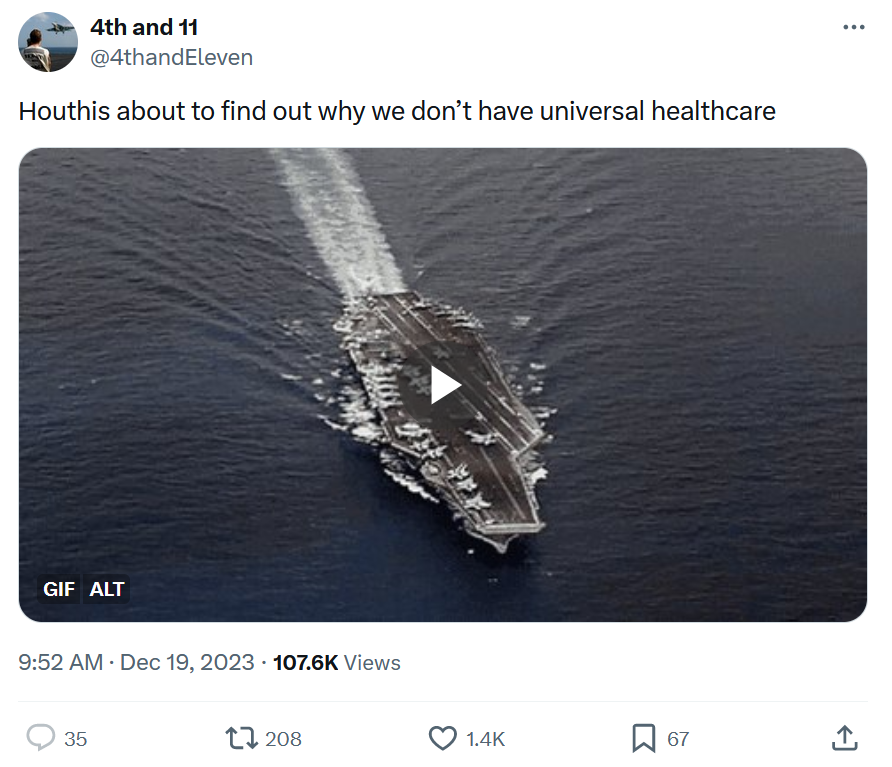
Social media lit up with stupid talking points about America’s military might, and how “the Houthis are going to learn why America doesn’t have free healthcare.” Social media is overwhelmingly populated by the young and left-leaning, so seeing the same demographic group that protested the Iraq War now beating their chests over a bombing campaign was jarring to say the least.

And what happened? After months of bombing, the Houthis are still attacking ships. Shipping companies are still avoiding the Red Sea. Transit through the Suez is still down and prices due to circumnavigating Africa are still up.

And America still doesn’t have free healthcare.

The bombing campaign has clearly failed at its goal of ensuring safe traffic through the Red Sea. So much so that Biden has now offered a ceasefire where he will again remove the Houthis from the global terror list if they will stop attacking ships. America’s military might could not silence the enemy guns or enforce America’s will, and so we are once again forced to negotiate with terrorists.

To be fair to Biden, this may be the right move. He openly stated that he was only placing them on the global terrorism list because of their attacks against ships, removing them from that list if they stop attacking ships is only natural. It is a low-cost concession to the Houthis, as removing them from the list makes it easier for them to access international markets, but doesn’t do much to harm America directly.

But it’s still obvious that this was a failed bombing campaign, and it raises the question of if we’re negotiating with terrorists now, why didn’t we *start* with negotiations *before* bombing them? The bombing does not seem to have done anything to reduce the frequency or intensity of Houthi attacks, if anything it has only given the Houthis greater credibility in Yemen as it has galvanized the populace to “rally ’round the flag.”

Hawks will complain that I’m being unfair: the bombing campaign was *not* a failure, America just wasn’t even trying to win. And it’s true, America has the capacity to conduct Dresden-level bomb campaigns and Desert Storm level ground campaigns nearly at-will. Neither of those happened, so America clearly wasn’t using its full might.

But was there any political will for carpet bombing or a ground invasion? Absolutely not, a tepid bombing campaign was all that would have been acceptable in an election year. And so if you take America as both a military and political entity, then yes this bombing campaign was about all America was capable of.

But none of the chickenhawks who beat their chest in January will ever admit that the campaign was a failure, ever admit that we are negotiating with terrorists, ever admit that there were other options or other solutions. Thousands of politicians and military aficionados went to their graves believing that the War in Vietnam could have, should have been won, and if we’d just stayed in a little longer (or nuked Hanoi), we could have won it. I have no doubt this campaign (much much smaller as it is) will also be remembered thus by many.

But the fact is that there are not always military solutions. It’s a classic slogan to say that “we don’t negotiate with terrorist,” but it’s just not true, we negotiate with terrorists all the time.

An FBI negotiator brings a suitcase full of cash to a terrorist who has hijacked a plane.

There are times when terrorists have leverage over you, and the problem with leverage is that it exists whether you want it to or not. Whether that leverage is hostages, military might, or geographic position, you can’t just wish it away and pretend it doesn’t exist. Nations also have constraints: budgetary, political, logistic, which can constrain their military response significantly.

So while it’s true that in an open field with no holding back the American military would destroy the Houthi military without a single casualty, that’s not the war that Biden fought. Trying to remove terrorists from their own country that supports them without a ground invasion or naval blockade will always be a challenge. And if a nation is politically, economically, or logistically incapable of doing that, then they need to look hard at what they are *actually trying to accomplish*.

I have seen precious few cases in my adult life of military intervention leading to a lasting improvement in the situation. The best example would be the bombing campaign in Yugoslavia from nearly 3 decades ago. The second best example would be the few years of near-normality that the American military gave to Afghanistan, prior to the Taliban returning.

But one success and one partial success is a terrible track record for the number of military campaigns we’ve been engaged in. And it seems the Houthi campaign will be yet another mark in the failure column, as it has done nothing to eliminate Red Sea attacks which will almost certainly be ended only by negotiations if they are even ended at all.

So the next time social media lights up with chest-thumping about how American military might should be directed at a problem, think for more than a few seconds about whether a military solution is even possible.

Vibes and the economy

I don’t want to get too political, but it’s an election year (in several countries) and The Discourse is inevitable. But I want to quickly push back on something I’ve seen all too often on social media recently.

In America, the numbers for the economy look “good.” Unemployment is low, *really* low. Inflation is high, but wage growth is higher. And the stock market is up. So why are Americans’ perceptions of the economy so poor? Why is consumer confidence lower than it *should* be?

Some partisans and twitterati have decided that Trump Was Right and the problem is fake news. Legacy media and social media are both driving relentlessly negative press and this is brainwashing people into believing that the “good” economy is “bad.”

But instead I’d like to take take a step back and see if polls are telling us something that “the numbers” just aren’t. And I think I have good evidence that they are.

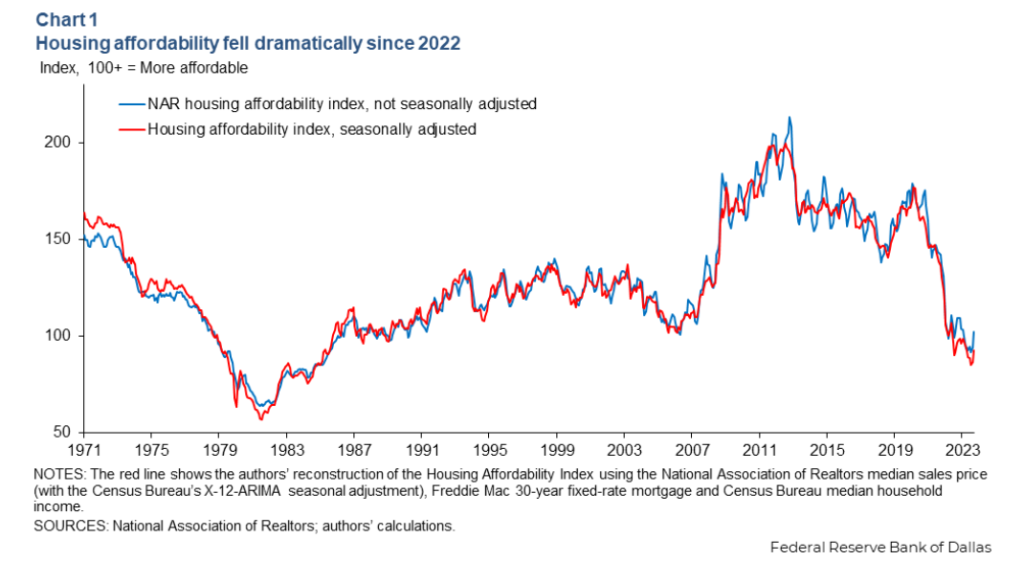
First, here’s a graph from the Federal Reserve Bank of Dallas. It shows that housing affordability is lower than at any time since the 80, lower even than during the housing bubble that precipitated the Great Recession. If you’re a millennial or a zoomer, *never in your life has housing been less affordable than it is today*.

And housing isn’t just a “nice-to-have,” it sits at the bottom of Mazlo’s Hierarchy of Needs for a reason. A stable housing situation is (for most people) a necessary ingredient before they feel confident starting a family, putting down roots, or just feeling like they “belong” to where they live.

Now, you *can* have a stable housing situation in an apartment, but it’s much harder. Rent increases can drive you out, and rent-controlled apartments are hard to come by. Apartments also aren’t always conducive to the types of living that people want in their life.

So the price of housing is driving a *real crisis* in millennial and zoomer living, as people with otherwise high earnings are unable to obtain what lower-earnings folks could get in the past, namely a house to live in.

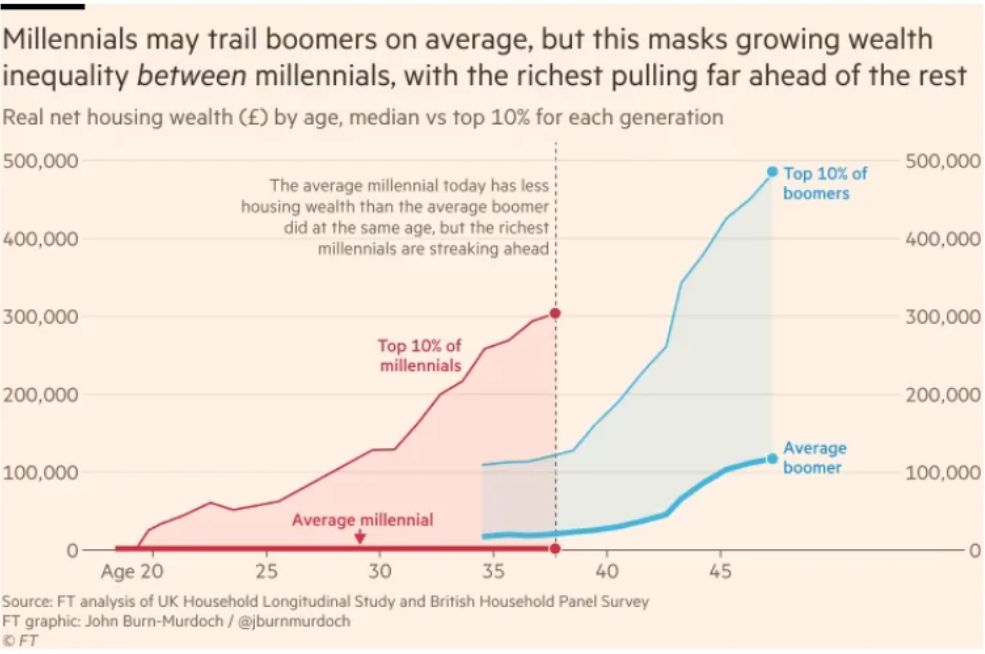
Then there’s the fact that datapoints about “all” millennials are missing key differences *between* millennials. See the next graph

The *median* millennial is doing worse than the median boomer was at this point in their life, in terms of net wealth, net assets, and housing. But the top 10% of millennials are doing way better than the boomers ever could, so taken together it seems like millennials are doing well overall. It’s like looking at a city where 1 person is a billionaire and 99 are destitute and saying that overall the city is very wealthy.

These kinds of mean/median differences are well-known to people in liberal circles, because they signal high inequality. But because a liberal is currently president, these differences are ignored by much of the twitterati.

I could say more about this topic, and I wish I had the energy to, but I’ve been so tired lately with my new medicine. Nevertheless, next time you see someone like Will Stancil screech that the kids are all morons and that everyone is rich, note that he is a member of that top 10%, not the median.

When people’s answers in polling are different than what “the fundamentals” suggest, it may be that the people are just stupid. But it’s far more likely that polling is capturing something that your data is ignoring. And right now that’s housing costs and growing inequality.

Social Media is a click-farm, it shows you only what you are most likely to click

Yet again the topic is raised that social media is harming our youth. Just as Seneca of Rome once complained that reading too many books was corrupting the youth, so too do we moderns complain about our own technology. But now it comes with a twist: social media has been anthropomorphized into a sentient being, force-feeding out children propaganda to turn their brains to mush and their muscles to puddy.

Let’s get one thing straight: social media gets money through clicks. Without clicks, advertisers won’t advertise, because they know that users aren’t engaged enough to read the ads. And the social media can’t force you to click, the user has to do that themselves.

So what do users click on? Overwhelmingly it’s exactly what they claim to hate and avoid. This is a classic case of revealed preferences, people like to claim that they are moral and high-minded, that they spend their time on science and philosophy. Overwhelmingly they prefer to spend their time on video games, celebrities, and politics. So if social media is feeding you mindless garbage, it is because you have revealed through your click habits that you prefer to eat trash.

When you first log in to any social media website, it has no idea what you like. By default, it will start sending you a very random and scattershot selection of everything it has on offer. But very quickly, you will start clicking on the things that interest you, and ignoring the things that don’t. And so social media has learned that the vast majority of us won’t click on a science post if our life depended on it, we’d rather read about Taylor Swift instead.

Next time a politician complains that their social media feed is nothing but trash, and that they have legislation to regulate social media more, tell them about revealed preferences. That politician is advertising to the world that they themselves are a trash human being.

Surge Pricing and Dirty Deals

I’m sorry I haven’t been posting weekly like I promised to. February has not been kind to me. But I wanted to quickly fire off a post relating to two topics I’ve recently seen in the news.

The first has to do with the infamous Wendy’s “surge pricing” announcement which the company has already walked back on. As I know not all my readers are American, I’ll explain both Wendy’s and surge pricing.

Wendy’s is a fast food burger chain just like any other American chain. Surge pricing meanwhile is what Uber and Lyft do when there is a very high demand all of a sudden, prices shoot up during that time, leaving customers to balk at paying 50$ for a ride home from a baseball game, when getting into downtown may have costed just 30$. Many Wendy’s customers likewise were furious at the price of a burger going up and down during the day, possibly meaning they’d pay for their food than someone who’d walked in just a few minutes earlier.

The story got so much traction that Senator Elizabeth Warren even tweeted about it, trying to play up her corporate greed narrative. Little does Warren know that we’re now living in the era of Corporate Generosity.

Nevertheless I’m always surprised that someone with the credentials of Warren is so economically illiterate. Surge pricing has been going on for decades, perhaps centuries even. The earliest examples I can think of are matinees, theatre productions (or movies) that are shown during the daytime for a cheaper cost than the evening. It costs exactly the same to run the shown at either time, so why is the daytime show cheaper? And if you’ve ever seen a bar with a “happy hour” or a restaurant with an “early bird special,” or Halloween candy sold half-off in November, you’ve also seen surge pricing in action.

What’s going in here is simple supply and demand. The price of a good or service is *not* based on the cost to make it, the price comes from the interplay of supply and demand. The price fluctuates even if the cost does not because sellers are trying to clear the market. Lower demand? Lower price.

But a restaurant also has service and shifts. Any server serving one customer must necessarily be not serving another. Yet at the same time, servers paid for 8 hour shifts, and few people would work a job where they’re only paid minimum wage for 2 hours. The cost of transport alone would eat into your wage. What this means is that if everyone only comes to eat during dinner (let’s say a 2 hour period from 4-6pm), then the servers are sitting around for 6 hours doing nothing, then madly scrambling for 2 hours. During those 2 hours, many customers might come in only to find the line is too long, or they might be able to eat but find the service poor due to overworked servers.

Thus, for decades restaurants have lowered prices during the “slow” parts of the day to entice people to eat at those times instead of during the rush. This is exactly the same mechanism as Wendy’s “surge pricing,” only it’s framed differently. But it’s still the case that they’re charging more at dinnertime even though their costs are the same.

Surge pricing like this is actually a very good thing. It evens out demand in service industries, allowing more people to be served during a day while still letting the wait staff work full 8-hour jobs. And certain customers can take advantage of this, getting a lower price at the cost of not eating during a “normal” time. Warren (and other outraged twitterati) are simply jumping on a poorly framed policy to score very stupid political points. In fact, Burger King decided to dunk on Wendy’s poorly framed surge pricing policy by highlighting their own better-framed surge pricing policy. Every restaurant is like this, and it’s actually A Good Thing.

Speaking of restaurants but not about Good Things, Gavin Newsom is quite nakedly corrupt. I had only heard mild criticisms of Gavin before, but there were some Democrats I know claiming he was basically the candidate-in-waiting should Biden not run. He is Governor of America’s largest and wealthiest state, and would surely win election because the only thing Republicans could ever say against him were tired tropes about “Commiefornia.” But actually it turns out here’s corrupt.

I know this because he handed a political kickback to his buddy who owns at least two dozen Panera Bread restaurants. California is set to raise the minimum wage to 20$/hr, except at restaurants that serve freshly bread baked. No, bagels and pastries do not count as “bread.” Panera is one of the very few restaurants that does this, and so they will still be allowed to pay their employees just 16$/hr.

You might think this would cause many restaurants to start opening up bakeries, but it gets even more corrupt: the restaurant must have been serving freshly baked bread in September 2023 to qualify. So only Panera is grandfathered in. Essentially, Gavin Newsom decided to directly use a government law to enrich his friend and confidant, and no one seems to really care.

Now of course he wasn’t handing his friend state money. But he was writing legislation that imposes costs on every single one of his friend’s rival businesses, while shielding his friend. That will allow his friend (whose name I just looked up is “Greg Flynn”) to profit much more than anyone else from fast food, since he can keep the same prices while paying his staff 80% less than the competition.

Some of the twitterati have tried to defend Gavin indirectly, saying that it’s obviously corrupt but that this carve-out won’t actually do anything. They say that since every other restaurant will have to abide by the 20$/hr minimum wage, it means no one will ever work for Panera for less than 20$/hr either. But that ignores that people take jobs based on more than just the wage. Maybe the Panera is closer to you than the Taco Bell, maybe you hate the smell of fried foods and are loathe to work at McDonald’s, maybe you don’t own a car and the Panera is the only restaurant in walking distance. Or maybe you have classes and Panera can offer you hours that better fit your schedule.

And Greg Flynn knows this. He knows that he will likely be able to find at least some workers willing to work for just 16$/hr, that’s why he asked Gavin to put that in the bill. But corruption and friend-dealing has never been punished too strongly in America, no matter how much partisans rage about how “the other side” is corrupt. Still, the naked corruption on display may have hurt Gavin in a national election, so Democrats are probably happier he didn’t decide to challenge Biden.

Are analysts’ opinions anti-correlated with the market?

This time 2 years ago, we were still riding high on the post-pandemic surge, and analysts were expecting the S&P could break 5,000. This time last year, we were still in what felt like the 2022 doldrums and analysts were predicting a recession. This time 3 months ago, people were declaring inflation was whipped. And then a few days ago, CPI and PPI came in hot.

I’ve written before about how the Efficient Market Hypothesis may imply that there is *no* correlation between analyst opinion and the stock market. Analysts are just as likely to be wrong as right, but people only remember the examples which agree with their biases. On the other hand, I read an article recently (I’m sorry I cannot find it to link) arguing that analyst opinion is in fact *anti*-correlated. That is, the Short Cramer ETF is correct, and analysts are so stupid you should do the opposite of what they say.

Speaking of, the Short Cramer ETF “SJIM” is down about 20% from when it began. But no matter, should you do the opposite of what analysts say or is that as irrational as following their advice?

One argument is that analysts are inherently *backward-looking*, they generally assume trends will continue forever. Some are perma-bulls or perma-bears, but on average when the market is down analysts predict a down year, and when it’s up they predict an up year. In this case, if the market is a random walk then it’s very unlikely to simply continue it’s current trend, thus an analyst is more likely to be wrong than right.

On the other hand, shouldn’t wisdom of the crowds have an affect? On the aggregate, many gamblers who bet on real world events (either sports of politics) are betting on what they *want* to happen, and many have no real knowledge whatsoever. Yet Nate Silver and others have argued that betting markets are often more accurate than not, whether it’s politics, sports or what have you. Some how, a million idiots adds up to something better than our smartest mind.

If that’s the case why don’t all the analysts of the market add up to something smart?

It just reminds me to be humble, because all too often I’ve seen people caught out badly by a trend. The late 2023 “inflation is beaten, start thanking Joe Biden” narrative won’t seem as smart if inflation stays persistently hot, any more than the “recession around the corner” narrative of 2023. Overconfidence when you really know nothing is the hallmark of an analyst, and maybe that’s why they’re so often wrong.