Social Media is a click-farm, it shows you only what you are most likely to click

Yet again the topic is raised that social media is harming our youth. Just as Seneca of Rome once complained that reading too many books was corrupting the youth, so too do we moderns complain about our own technology. But now it comes with a twist: social media has been anthropomorphized into a sentient being, force-feeding out children propaganda to turn their brains to mush and their muscles to puddy.

Let’s get one thing straight: social media gets money through clicks. Without clicks, advertisers won’t advertise, because they know that users aren’t engaged enough to read the ads. And the social media can’t force you to click, the user has to do that themselves.

So what do users click on? Overwhelmingly it’s exactly what they claim to hate and avoid. This is a classic case of revealed preferences, people like to claim that they are moral and high-minded, that they spend their time on science and philosophy. Overwhelmingly they prefer to spend their time on video games, celebrities, and politics. So if social media is feeding you mindless garbage, it is because you have revealed through your click habits that you prefer to eat trash.

When you first log in to any social media website, it has no idea what you like. By default, it will start sending you a very random and scattershot selection of everything it has on offer. But very quickly, you will start clicking on the things that interest you, and ignoring the things that don’t. And so social media has learned that the vast majority of us won’t click on a science post if our life depended on it, we’d rather read about Taylor Swift instead.

Next time a politician complains that their social media feed is nothing but trash, and that they have legislation to regulate social media more, tell them about revealed preferences. That politician is advertising to the world that they themselves are a trash human being.

Surge Pricing and Dirty Deals

I’m sorry I haven’t been posting weekly like I promised to. February has not been kind to me. But I wanted to quickly fire off a post relating to two topics I’ve recently seen in the news.

The first has to do with the infamous Wendy’s “surge pricing” announcement which the company has already walked back on. As I know not all my readers are American, I’ll explain both Wendy’s and surge pricing.

Wendy’s is a fast food burger chain just like any other American chain. Surge pricing meanwhile is what Uber and Lyft do when there is a very high demand all of a sudden, prices shoot up during that time, leaving customers to balk at paying 50$ for a ride home from a baseball game, when getting into downtown may have costed just 30$. Many Wendy’s customers likewise were furious at the price of a burger going up and down during the day, possibly meaning they’d pay for their food than someone who’d walked in just a few minutes earlier.

The story got so much traction that Senator Elizabeth Warren even tweeted about it, trying to play up her corporate greed narrative. Little does Warren know that we’re now living in the era of Corporate Generosity.

Nevertheless I’m always surprised that someone with the credentials of Warren is so economically illiterate. Surge pricing has been going on for decades, perhaps centuries even. The earliest examples I can think of are matinees, theatre productions (or movies) that are shown during the daytime for a cheaper cost than the evening. It costs exactly the same to run the shown at either time, so why is the daytime show cheaper? And if you’ve ever seen a bar with a “happy hour” or a restaurant with an “early bird special,” or Halloween candy sold half-off in November, you’ve also seen surge pricing in action.

What’s going in here is simple supply and demand. The price of a good or service is *not* based on the cost to make it, the price comes from the interplay of supply and demand. The price fluctuates even if the cost does not because sellers are trying to clear the market. Lower demand? Lower price.

But a restaurant also has service and shifts. Any server serving one customer must necessarily be not serving another. Yet at the same time, servers paid for 8 hour shifts, and few people would work a job where they’re only paid minimum wage for 2 hours. The cost of transport alone would eat into your wage. What this means is that if everyone only comes to eat during dinner (let’s say a 2 hour period from 4-6pm), then the servers are sitting around for 6 hours doing nothing, then madly scrambling for 2 hours. During those 2 hours, many customers might come in only to find the line is too long, or they might be able to eat but find the service poor due to overworked servers.

Thus, for decades restaurants have lowered prices during the “slow” parts of the day to entice people to eat at those times instead of during the rush. This is exactly the same mechanism as Wendy’s “surge pricing,” only it’s framed differently. But it’s still the case that they’re charging more at dinnertime even though their costs are the same.

Surge pricing like this is actually a very good thing. It evens out demand in service industries, allowing more people to be served during a day while still letting the wait staff work full 8-hour jobs. And certain customers can take advantage of this, getting a lower price at the cost of not eating during a “normal” time. Warren (and other outraged twitterati) are simply jumping on a poorly framed policy to score very stupid political points. In fact, Burger King decided to dunk on Wendy’s poorly framed surge pricing policy by highlighting their own better-framed surge pricing policy. Every restaurant is like this, and it’s actually A Good Thing.

Speaking of restaurants but not about Good Things, Gavin Newsom is quite nakedly corrupt. I had only heard mild criticisms of Gavin before, but there were some Democrats I know claiming he was basically the candidate-in-waiting should Biden not run. He is Governor of America’s largest and wealthiest state, and would surely win election because the only thing Republicans could ever say against him were tired tropes about “Commiefornia.” But actually it turns out here’s corrupt.

I know this because he handed a political kickback to his buddy who owns at least two dozen Panera Bread restaurants. California is set to raise the minimum wage to 20$/hr, except at restaurants that serve freshly bread baked. No, bagels and pastries do not count as “bread.” Panera is one of the very few restaurants that does this, and so they will still be allowed to pay their employees just 16$/hr.

You might think this would cause many restaurants to start opening up bakeries, but it gets even more corrupt: the restaurant must have been serving freshly baked bread in September 2023 to qualify. So only Panera is grandfathered in. Essentially, Gavin Newsom decided to directly use a government law to enrich his friend and confidant, and no one seems to really care.

Now of course he wasn’t handing his friend state money. But he was writing legislation that imposes costs on every single one of his friend’s rival businesses, while shielding his friend. That will allow his friend (whose name I just looked up is “Greg Flynn”) to profit much more than anyone else from fast food, since he can keep the same prices while paying his staff 80% less than the competition.

Some of the twitterati have tried to defend Gavin indirectly, saying that it’s obviously corrupt but that this carve-out won’t actually do anything. They say that since every other restaurant will have to abide by the 20$/hr minimum wage, it means no one will ever work for Panera for less than 20$/hr either. But that ignores that people take jobs based on more than just the wage. Maybe the Panera is closer to you than the Taco Bell, maybe you hate the smell of fried foods and are loathe to work at McDonald’s, maybe you don’t own a car and the Panera is the only restaurant in walking distance. Or maybe you have classes and Panera can offer you hours that better fit your schedule.

And Greg Flynn knows this. He knows that he will likely be able to find at least some workers willing to work for just 16$/hr, that’s why he asked Gavin to put that in the bill. But corruption and friend-dealing has never been punished too strongly in America, no matter how much partisans rage about how “the other side” is corrupt. Still, the naked corruption on display may have hurt Gavin in a national election, so Democrats are probably happier he didn’t decide to challenge Biden.

Are analysts’ opinions anti-correlated with the market?

This time 2 years ago, we were still riding high on the post-pandemic surge, and analysts were expecting the S&P could break 5,000. This time last year, we were still in what felt like the 2022 doldrums and analysts were predicting a recession. This time 3 months ago, people were declaring inflation was whipped. And then a few days ago, CPI and PPI came in hot.

I’ve written before about how the Efficient Market Hypothesis may imply that there is *no* correlation between analyst opinion and the stock market. Analysts are just as likely to be wrong as right, but people only remember the examples which agree with their biases. On the other hand, I read an article recently (I’m sorry I cannot find it to link) arguing that analyst opinion is in fact *anti*-correlated. That is, the Short Cramer ETF is correct, and analysts are so stupid you should do the opposite of what they say.

Speaking of, the Short Cramer ETF “SJIM” is down about 20% from when it began. But no matter, should you do the opposite of what analysts say or is that as irrational as following their advice?

One argument is that analysts are inherently *backward-looking*, they generally assume trends will continue forever. Some are perma-bulls or perma-bears, but on average when the market is down analysts predict a down year, and when it’s up they predict an up year. In this case, if the market is a random walk then it’s very unlikely to simply continue it’s current trend, thus an analyst is more likely to be wrong than right.

On the other hand, shouldn’t wisdom of the crowds have an affect? On the aggregate, many gamblers who bet on real world events (either sports of politics) are betting on what they *want* to happen, and many have no real knowledge whatsoever. Yet Nate Silver and others have argued that betting markets are often more accurate than not, whether it’s politics, sports or what have you. Some how, a million idiots adds up to something better than our smartest mind.

If that’s the case why don’t all the analysts of the market add up to something smart?

It just reminds me to be humble, because all too often I’ve seen people caught out badly by a trend. The late 2023 “inflation is beaten, start thanking Joe Biden” narrative won’t seem as smart if inflation stays persistently hot, any more than the “recession around the corner” narrative of 2023. Overconfidence when you really know nothing is the hallmark of an analyst, and maybe that’s why they’re so often wrong.

Is it culture? Or is it incentives?

The Internet in general is US-centric. So even on the European parts of the Internet it’s common for countries (or the entire continent) to compare themselves to America. There are thousands of things you could compare, but the most contentious is probably the economic comparisons. America has recently grown much more strongly than Europe, and it doesn’t take an economist to realize that nearly all of the world’s top companies and startups are located in America. San Fransisco alone has more billion-dollar startups than entire countries, and before you say “that’s just silicon valley,” New York and Boston aren’t far behind.

There are a million ways to explain this discrepancy and plenty of reasons why Europeans may even think it’s good. We could talk all day about whether worker’s rights are fundamentally incompatible with cut-throat capitalism, and if Europe has therefore chosen the better path. But the most flawed reason I see bandied about is that Europe just has the wrong culture for this kind of stuff.

Europe is more laid back, less aggressive. Their investors prefer same, consistent gains. The European mindset isn’t focused on innovation, and culturally Europeans aren’t focused on business the way Americans are.

I think these explanations are wrong and dumb, and I’d use more expletive words if I hadn’t made a New Year’s Resolution not to do so in my writing. I don’t think Europeans are culturally less attuned to startups and Big Business, I think the legal framework prevents it.

Not long ago, Europe was seen as the beating heart of innovation and technology. Industrial progress, scientific progress, just go to any chemistry or physics class and see how many formulas are named for Germans. But now America dominates the industries, and I think it’s because of government, not culture.

The American business framework provides significant bankruptcy protection. People mocked Trump for his many bankruptcies, but most investors know that 90% of good ideas fail and the last 10% have to cover those loses. Bankruptcy is a way for investors to mitigate their downside, and thus allows for bigger risks to be taken.

The American financial system also gives significant benefits to investors, giving them greater flexibility in buying and selling their company to whomever they wish. Until Biden and Trump brought protectionism back to the fore, it was not uncommon to see American companies sold to foreign investors with little fanfare. Nativists and racists may complain about *gasp* Chinese people owning an American company, but from the investor’s perspective selling the company is a good way to cash out his winnings from the investment. Foreign buyers compete with American buyers, and this increase in demand means prices go up. This means the sale price of companies goes up, and that increases the returns on an investor’s investment.

But long before Trump, Europe was made famous in the tech world for blocking foreign buyers from its companies. Again, nativists wrongly think that this strengthens the European tech industry by “keeping it in European hands.” But when an investor sells out, they get cash in return. What do you think they do with that cash? They don’t hoard it like Smaug the Dragon, they reinvest it. Because they’re investors. By blocking foreign buyers, you reduce buying pressure, you reduce how much money investors can get out of their investment, and you therefore reduce their upside potential. Is it any wonder then they’d prefer a safer investment, when Europe is happy to cap the gains on any risky tech investment they make?

And Europe prides itself on fining big tech companies for any reason whatsoever. But surely it’s obvious that a government hostile to profitable tech companies would scare off anyone wanting to make a profitable tech company near them. Better to start in America or get out of Europe ASAP. Microsoft and Apple can afford billion dollar fines, but such sanctions could be lethal to a smaller European tech company. So again investors are scared off, entrepreneurs are scared off, and Europe wonders why it doesn’t have a tech sector.

“But what about ASML and Spotify!” And what about them? For every single, solitary European company that manages to rise above the hostile governing environment, there are 10 American companies that rose under easier circumstances. Spotify started in 2006, and since then Massachusetts alone has started Draft Kings, Moderna and Intellia Therapeutics, all of comparable value to Spotify. And Massachusetts has half the population of Sweden.

People respond to incentives, and the incentives for risky tech investment are very poor in Europe. Bankruptcy is easier in America, returns are (or were before Biden and Trump) less likely to be capped by protectionist policies, and (before Biden) the government generally has taken a more lax approach to dealing with corporations. You can debate if these things are good or bad, but I find them far more likely reasons for America’s tech dominance than “culture” or “attitude.”

Doing the Possible: When is it Impossible?

I recently wrote about “If We Can Put a Man on the Moon,” the book that wants to teach people how to do government well. Some of their message is simple: success in government requires a good plan executed well. But while they want their message to be non-partisan and universalist, I’m not sure it can ever work that way.

The big question I have is this: when is failure because of a good plan done poorly, and when is it because of an impossible plan that would never succeed? For instance, the book lays plenty of criticism at Nixon’s price controls and Ford’s purposeless “WIN” buttons, and it does so by saying that price controls and government nudging cannot control inflation. The book agrees with Milton Friedman than inflation is a monetary phenomenon, solved by Volcker when he hiked interest rates.

On the other hand, the book criticized many plans for their implementation rather than their ideas. Boston’s failed bussing experiment of the 70s is excoriated for how it was done with no real plan or input from the community. But is bussing ever a good policy for implementing desegregation? Many have looked back and said that no, bussing was never going to work. It was unpopular amongst both white and black communities. Just look at this blast from the past:

A majority of Americans continue to favor public school integration, but few people—black or white—think that busing is the best way to achieve that goal, the Gallup Poll reported yesterday.

Five per cent of the people in a recent survey by the organization—9 per cent of the blacks and 4 per cent of the whites—chose busing children from one, district to another rather than several other alternatives.

New York Times

Most of those interviewed preferred either changing school boundaries or providing low-income housing in middle-income neighborhoods as preferable plans for school integration. 

In the same vein, the book knocks the Iraqi occupation for having no plan for creating a stable, post-Saddam Iraq. But was that kind of “nation building” even possible for the US military to achieve? Especially in a country with such vast cultural and ideological differences to ours? 

I remember going to school with a guy who served in Iraq. He talked about how he was tasked with keeping Iraqis safe by removing weapons and disarming citizen. He once came to the tent of a Bedouin he thought had a gun and ammo. And when the Bedouin refused to let him search the tent, he simply ordered his troops to cut open all the Bedouin’s bags of rice, ruining his food but finding a hidden AK-47.

The soldier then said that he told this Bedouin “look, you should have just made this easy for us,” but all I could think of was “wow, this is why they fucking hate us.” This soldier just proudly violated the rights that we in America would call the 2nd and 4th amendment, and if he’d done that in America it would be a national scandal. Iraq may not have our constitution, but they still probably feel entitled to basic human rights of dignity and property. Even if we amended our constitution to remove the 2nd and 4th amendments, how would any American feel about armed military personnel breaking into their house, upturning all their belongings, and then stealing their stuff? 

So was “nation-building” even possible? Or was it, like bussing, an idea doomed from the start?

This is the difficulty in analyzing good governance, by focusing on the process you implicitly assume the idea is workable. Now, the authors do mention some ideas that they find impossible. They chide Nixon’s price caps because price caps can’t fix inflation, which is a monetary phenomenon. I happen to agree with them, but that’s because both I and the authors ascribe to an orthodox economic framework. A socialist would disagree with us, saying price caps are perfectly valid but that Nixon just used them poorly.

So a socialist might see Nixon’s price caps as a failure of implementation and not a failure of ideology. And while the authors see bussing and nation-building as failures of implementation and not ideology, a school choice advocate and a non-interventionist would disagree and say that for those ideas, a successful outcome was never possible. So how do you judge policies by their process, when people can’t agree on their possibility?

Ultimately, I think “a bad plan” vs “a good plan, poorly executed” is a political question for which there is no agreed upon answer. And to that, while the tenants of the book may be accepted broadly, it won’t do much to change the tenor of governance even if everyone in America agreed with it. All of politics is about the disagreement over “which plan is good,” and “how do we execute a plan well.” So telling people to “have good plans” and “execute them well” is sort of like telling a sprinter to “just run faster.” It’s advice that does nothing.

I think the book is good, I think it’s well worth a read by anyone interested in politics. I just think it’s impact will not be too great even in the minds of its readers.

Doing the Possible: Musings on good governance

I’ve been reading “If We Can Put a Man on the Moon,” which is a book that attempts to explain why some government policy succeeds and some fails. The book outlines how public policy requires a clear objective, a clear plan to reach that objective, and the ability to follow through with it. It all seems rather obvious when you write it out like that, but the book offers some definite insights.

A clear objective seems obvious, but is surprisingly easy to overlook. Gerald Ford promised to “whip inflation now,” but how exactly did he expect to do that? Supposedly the government would politely encourage citizens to do things like grow more food and use less fuel, to increase supply and decrease demand. It’s a nice idea, but polite encouragement doesn’t move the economy, and Fords “WIN” policy went nowhere.

A clear plan is also something that seems obvious, but often gets overlooked. When California reformed its electric grid in the 90s, no one had really thought through how the new system would work. They set mandates to ensure that prices were capped for consumers, but did nothing to ensure adequate supply. It was legal, for example, to buy power at a low price in California and export it for the uncapped price in other states. Then, if California didn’t have enough power, the utility was obligated to import power from other states no matter the cost, but was not allowed to pass this cost on to customers. This lead to companies easily gaming the system by exporting power for cheap, then re-importing it at a higher price. 

People like to blame greedy companies for the failed California power experiment, but companies are always greedy in all cases. The government should create a system in which corporate greed leads to societal good, such as how tech companies have given us ever better computers at lower and lower cost. Failure to plan leads to a system that is designed to fail.

The ability to follow through is a common complaint, but it too has unexpected pitfalls. The political class has different incentives than both the bureaucrats and the people, but they all work together for a plan to succeed. Politicians have an incentive to pass a bill and say they “fixed” something, that’s why most celebration happens on when a bill is pass instead of 5 years later when its effects are being evaluated. Bureaucrats are just career workers like anyone, and have an incentive to do their job and get paid. They aren’t incentivized to go above and beyond for the benefit of a politician who might not be there in four years. 

This is why it’s so common for politicians to take office promising “big changes” but still not accomplish much. Once the bill is passed and the photo-op is finished, it’s out of their hands and they don’t has a reason to keep caring. And when someone comes in saying they’ll “upend the stuffy bureaucracy,” well if they don’t meet the career employees halfway they’ll engender resentment in a group that can drag its feet and wait for the political will to die down.

All told, the book does have a lot of prescriptions for good governance:

  • Have an idea for how to fix a problem, and don’t make a plan of action without a strong idea. Likewise, seek out good ideas from everywhere, and be willing to challenge your own ideas to see if they’re actually appropriate.
  • Make a rational design for how the problem will be fixed. Focus on the design, not just on getting buy-in from the right pressure groups. Stress-test the design and hire people to poke holes in it. Then fix those design holes before passing a new law.
  • Ensure oversight and continued evaluation even after a law is passed. The job doesn’t end after the vote and the signature.
  • Understand that government is different than any other sector, and that you have to meet people halfway. You can’t treat public employees or the public at large as workers in your company or as cogs in a machine. 
  • Don’t assume the success of a plan. And don’t assume that just because it hasn’t failed yet that it won’t in the future. Look for any signs that cracks are forming, and fix them before they get too big. The space shuttle Colombia flew 27 missions, many of which showed problem signs, before the fateful 28th mission that ended in disaster.
  • Keep re-evaluating. If a program is no longer fit for purpose, fix it, replace it, or kill it. Be willing to see that something isn’t working and be willing to change it. And don’t keep trying the same program over and over without change, be willing to go back to the beginning and look for new ideas and new designs.

That, in a nutshell is what the book is about (or at least my reading of it). It’s certainly more uplifting that what you expect from a book about governance, but without ignoring the data and the details. I’ll have more to say on it later, but I think anyone who likes this sort of thing should check it out.

Nationalization

Nationalization (or rather Nationalisation) was a big part of Jeremy Corbyn’s manifesto during the 2017 and 2019 General Elections. If Labour won, it promised that anything and everything would be nationalized, usually at below market price.

I’ve always been skeptical of claims that nationalization leads to any kind of savings. The claim is that since a Government company doesn’t have to worry about profits for shareholders, it can be more efficient than a private company. All the profits that are paid out as dividends are instead re-invested into the company to provide better service at a lower cost.

But there truly isn’t any law saying a company ever has to provide dividends and profits. If Corbyn, McDonnell and co truly thought that companies could run better and more efficiently without profit, they could always just do that themselves without need of the government. Private citizens can always set up a non-profit corporation, they can take money from people (God know’s Corbyn was a fundraising machine) and set up a company that doesn’t pay dividends to shareholders, but instead re-invests everything to provide better service at a lower cost.

If such a non-profit did truly provide better service at a lower cost, then customers would flock to it over the for-profit companies that already exist. And again since this non-profit doesn’t hand out dividends, then Corbyn Co could easily be the fastest growing company in the world as it takes on more and more customers and reinvests into being better and better.

So why did they need nationalization? Why couldn’t they give the British people good services as a low price by just setting up a non-profit company and out-competing the for-profit ones? Why do socialists only ever think they can succeed by taking from someone else?

I think they simply didn’t have enough economic literacy to realize how their whole idea was such a shambles. Non-profit companies haven’t taken over the world because for-profit companies are actually way more efficient. They’re more efficient than non-profits and more efficient than Government companies, but socialists prefer to deny the lessons of history and keep acting like it’s the 1970s.

Not only are nationalized companies less efficient, but the act of nationalization creates inefficiencies. The idea that the government can force a sale of a profitable enterprise creates a chilling effect as investors become less likely to invest knowing it can all be taken from them at any moment. People don’t want to be forced to sell to the government, even at a “fair” price. Most eminent domain projects throughout history were done at a “fair” price, with people being paid the market value for their homes and then kicked out to make way for freeways and whatnot. But “fair” price or not, no one likes a forced sale.

And Corbyn Co wanted to take things a step further by paying below market value for the companies they wanted to nationalize. So not only was the government forcing a sale, but they were also committing theft at the same time.

I write all this because nationalization became a big word again during the recent bout of inflation, and I’ve seen way to many people jump on the bandwagon saying we need to nationalize energy companies, housing companies, and everything else to keep prices down. But prices don’t rise because companies are greedy, they rise because of fundamental shortages and inefficiencies. A nationalized company would have just as much trouble with inflation as a for-profit one, only a nationalized company could push its losses onto the taxpayers rather than be forced to raise prices and cut costs.

High prices are a signal that there is a shortage and that alternative avenues should be sought. When the price of gas rose, I decided I couldn’t justify driving to work every day so I tried to bike whenever possible. But would a nationalized American Gas company instead pass that cost onto the taxpayer? Wouldn’t they keep prices low so that I kept using as much gas as I always did? In that case every taxpayer who tries to be a good world citizen and use less carbon would be subsidizing me personally as a drove a distance that I could easily bike instead.

As inflation tapers off, it seems clear that nationalization was not the answer, and we are entering the Era of Corporate Generosity. But I doubt we’ve silenced forever the calls of nationalization, no matter how many times it leads to omnishambles. Still, I hope no serious nationalization proposal is put forward for a long time yet.

“The Crime of ’73”

Boy, these posts aren’t quite coming out weekly now are they?

I might have posted on this topic before, but I wanted to write something down and this was on my mind. It’s interesting how the controversies of yesteryear always fade away, even though in their day they dominated the news and the mind-space of politically conscious voters.

Take the Silver vs Gold movement. When America was founded, it had a bi-metallic standard, meaning that both silver and gold were legal tender. Congress set down in writing how much weight of silver made a dollar and how much gold made a dollar, and so both could be used to buy and sell. But of course, as commodities the price of silver and gold in the market would fluctuate, but congress didn’t understand or act quickly enough to fix things.

For example, silver mines in Mexico continued to run and depressed the price of silver relative to gold. This created an arbitrage opportunity because the price of gold was higher than that of silver:

  • Take 10 silver dollars and exchange them for 10 gold dollars, as they are equivalent
  • Take the gold dollars to Mexico and melt them down.
  • Take that gold and exchange it for raw silver
  • Bring that silver back to the Mint in America and demand to have it struck into silver dollars. Because of the price difference between silver and gold, the silver you brought back will make more than 10 dollars worth, so you can pocket the extra as your profit.
  • Start back from the beginning, trading 10 silver dollars for 10 gold dollars

This happened because congress set a fixed value for a commodity who’s value changed on the market, and as that value changed there was arbitrage created. Gold flowed out of the country and was replaced with silver. When the California gold rush happened, the price of gold suddenly decreased and the whole process reversed. Congress didn’t understand what was happening, and so simply decided to remove the bimetallic standard to stop this from happening.

But now we get to “The Crime of 1873.” When congress removed the silver standard in 1873, silver miners could no longer have their pure silver struck into coins that could be used as tender. The mint was by far the largest purchaser of silver and so removing silver from the standard removed most of the demand and so killed the price. Congress therefore upended the livelihoods of thousands of miners and mining towns by changing the laws on coinage. And those people never forgave them.

For years this “Crime” was the hottest topic in certain political sections. It was the litmus test for candidates and parties. And it was the entire foundation of the presidential candidacy of William Jennings Bryan. For years, certain voters would never vote for a candidate or party who had supported the “Crime,” and they may not have even kept polite company with voters who supported those candidates. In its time, the “Crime” was seen as the greatest betrayal possible, and plenty of people pointed to it as the reason for national or local economic problems. They blamed the “Crime” and hoped that overturning it would fix things.

Of course, America never regained the silver standard. For a time, the Federal government compromised and declared it would still buy silver from the miners directly, but in time even this subsidy was removed. The people affected by the “Crime” probably never forgave the Republicans (who passed the bill) for what they did. Indeed the “Crime’s” authors had a hard time defending their actions in the face of angry voters. Some authors claimed that the bill didn’t do what critics claimed, and that the US had technically been non-silver since 1853. Others claimed that ending the silver standard was an unintended biproduct. But this had the perverse effect of amplifying conspiracy theorists who believed the bill was passed with malicious intend, and giving ammo to those who wanted to overturn it.

In the 1880s and 1890s, the “Crime of 73” was as much a controversial topic as any political topic today. Friendships could be ended by it. But it too did pass. I think most of the controversies of our day shall also pass, these days even American History students will barely remember the “Crime.”

Choosing your facts based on your beliefs; everyone believes they are the rational one

It’s very common and very well-known that people will, to an extent, choose their facts to fit their beliefs. But for many the facts they choose aren’t necessarily even well-founded.

If you are a conservative, you probably prefer generally lower taxes, and you can find well-heeled economists who generally prefer lower taxes and lower spending over higher taxes and higher spending. Likewise a liberal or leftist can find economists who support higher taxes and higher spending. The issue is not “settled” and as with anything in economics (besides rent control, which is universally known to be bad) there are voices on either side.

But there are some things that are uncontroversially accepted as true by all the experts in their field, and for some reason there are people that argue against it for no reason whatsoever.

When I was in school, I remember a debate about teaching evolution. To cut to the chase, many Christians (not all by a long shot) have thought that evolution undermines their religion, and no matter how much evidence there is for it, these Christians will choose facts to fit their beliefs. That includes denying evolution, but also denying the fossil record (which supports evolution) and the age of the Earth (which supports evolution). This sometimes means denying modern microbiology and cancer biology (which are evolution in action). It’s fairly well-known by anyone who isn’t a Christian that this is a Dumb Thing To Do, and that picking your facts based on your beliefs just leaves you looking stupid.

But then I found that while the Christians do it, the anti-Christians do it too.

Let’s be clear: some atheists are just people who don’t believe in God. That’s fine, everyone has their beliefs. But some atheists are better termed anti-theists, they are people who oppose religion and its existence entirely. And it is these atheists that have constructed their own theories of “Intelligent Design” to support their ideas. Often these theories try to prove that Christianity is not only false, but that is is a complete con from start to finish and that no one truly believes in it anyway.

The Atheist version of Intelligent Design is the “Jesus Myth Theory.” This is the idea that not only was Jesus just a mortal man (not the son of God), but that there was never even a person called Jesus at all, and that this is proof that Christianity was an invented scam. To be blunt, this idea has no more credence than Intelligent Design, but so-called rational atheists who turn up their nose at the stupid Christians with their stupid Intelligent Design will still believe this idea because they have chosen their facts based on their beliefs. I may write a post later about the evidence for Jesus’ existence, but the point I’m trying to make is that even communities which are adamant in their own rationality can wind up being suckered into myths just because those myths agree with what they want to believe.

Let’s get one thing straight: EVERYONE believes that they’re rational. Everyone believes that their opinions are backed by evidence, backed by science, fundamentally true, and that only the dumb and misled would ever believe something different. That’s what makes the self-professed “Rationalist” community so misguided: claiming you’re the only community focused on rational beliefs is just admitting that you’ve never spoken to a community different than your own.

EVERY community believes they are the rational ones, believes they are driven by facts and not emotions, believes that the others are ignoring facts to suit their opinions. And the Rationalist community has it’s own Intelligent Design theories just as the Atheist and the Christian communities do. A good Rationalist, Atheist, or Christian should of course never believe something just because their compatriots believe it, or just because it would support some of their ideology, but a good Rationalist, Atheist, or Christian must also recognize that they probably have biases themselves and that their own community probably harbors an “Intelligent Design” theory all its own.

In the hallowed halls of Twitter and social media it’s widely believed that only the Left of the political spectrum knows and respects science, all right-wing beliefs are obviously false and dis-proven by data. The the exact inverse is believed on the right. I know both communities are havens of their own misinformation. I have seen too many on the Left tell me that supply and demand don’t exist, that building more housing doesn’t lower rent and cost and that inflation is driven only by corporate greed and not supply or demand. I have likewise seen the misinformation on the right over gun deaths, drug crime, vaccines and the like. I’m sure some of my own beliefs are misinformation, but we are all the heroes in our own stories and so self-reflection is very hard.

But I just wrote this post because even if I’m only screaming into the void I wanted to remind people that everyone thinks they are rational. Your political enemies who you consider irrational and emotional idiots are human just like you, and they arrived at their beliefs through the exact same human mechanisms you did. Are you sure anything and everything you believe is true? Are you sure there could never be any evidence that supports your opponents? Don’t dismiss people are idiots just because they believe something else, most humans are just as rational as you.

Tariffs are taxes, I’m tired of pretending otherwise

Every politician says they’re lowering taxes. Or if they raise taxes, it’s only on the rich, poor people definitely deserve lower taxes. So do middle class people (where “middle class” equals “everyone less than rich” and “rich” equals “everyone richer than my current audience and me”). Taxes are unpopular and taxes shouldn’t be raised.

But tariffs are fine apparently. In a new wave of protectionism, Biden and Trump have jacked up tariffs on everything from solar panels to lumbar. And despite claims of “national security” and “containing China” these tariffs have most strongly hit America’s allies such as Canada and Germany. The national security claims are bunk, these tariffs hit allies far more than they hit enemies.

But still Biden doesn’t get pushback for raising taxes because “tariffs” aren’t seen as taxes. Wrongly, most people don’t realize that slapping a tax on imported goods raises the price of all of those goods, even the locally made ones. Think of it like this: if Biden slapped a tax on Pepsi such that every Pepsi now costed 5$, would Coca-Cola sit back and keep their prices? Of course not, as a greedy company Coca-Cola knows that customers will flock to its lower-priced products, and this will give it the ammunition to raise prices to juuuuuuuust under what Pepsi has. So now 4$ Cokes will become the norm.

So too does it happen with tariffs. When you raise the price of Canadian lumbar, American lumbar companies also raise their prices because they know the consumer has no choice but to take it. When you raise the price of German steel, American steel raises its prices. These taxes on foreign goods have raised the price on all goods. They then raise the price of what those goods are used for, for example lumbar tariffs are raising house prices. And what do you call it when the price of goods rises over time? Inflation.

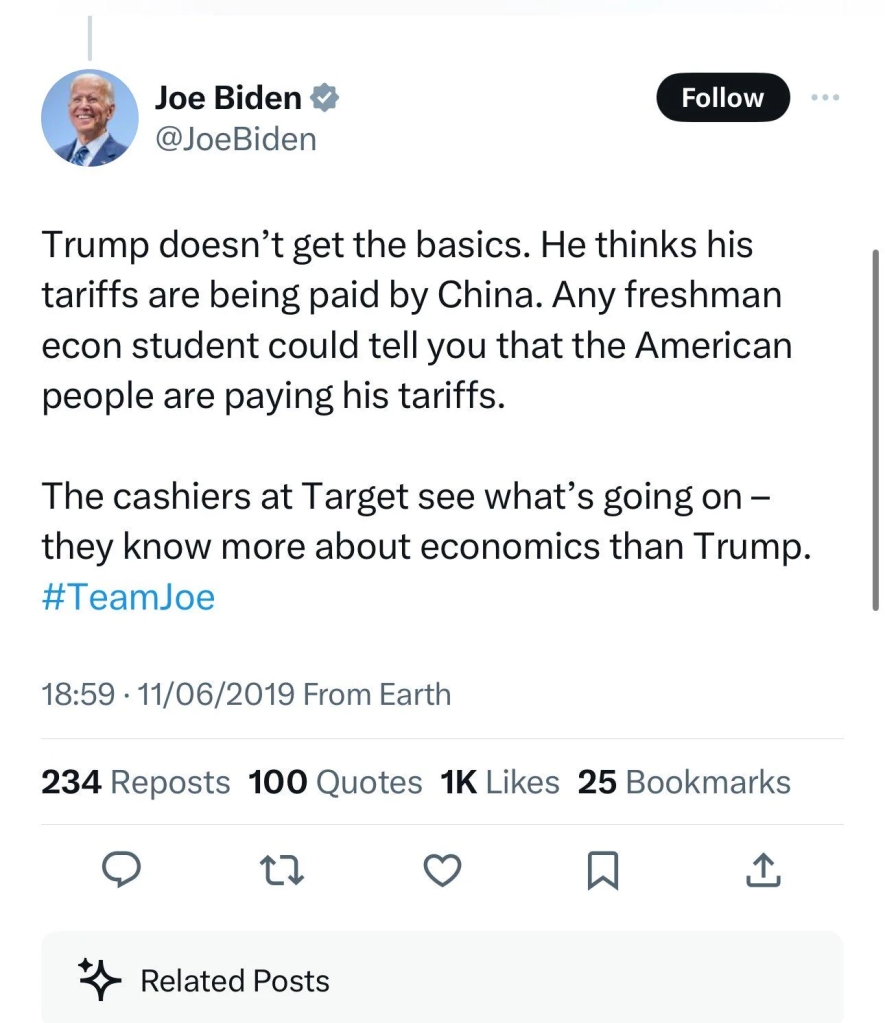
Biden’s tariffs are adding to inflation. Trump’s tariffs are adding to inflation. Tariffs are nothing more than a tax on goods, a tax that the poor and middle class pay most as they are the ones most damaged by inflation. I’m tired of house prices soaring in part because of these new taxes. I’m tired of solar panel prices soaring as well. It’s all very two-faced of the Biden admin to claim global warming is an existential threat and then do everything in their power to kill the solar industry with new tariffs. Taxing it into the ground only makes global warming worse.

So I’m tired of these tariffs, they’re nothing more than a tax. And I’m not going to pretend otherwise.